

Quick Answer: The best shower filter for hard water can't remove calcium or magnesium. No shower cartridge can. What a good one does is remove chlorine and some metals, which is a big part of why showers leave skin tight and hair dull. For proof that it works, get the Weddell Duo, which appears on NSF's current NSF/ANSI 177 listing. For renters on a budget, the AquaBliss SF100 screws on in two minutes. For the longest cartridge life, the Sprite HO2 is rated for 12 months.
Disclosure: As an Amazon Associate, Grains & Gallons earns from qualifying purchases.
Most product pages skip this part. Hard water means dissolved calcium and magnesium, and the only things that remove them at shower flow rates are ion exchange (a softener) or reverse osmosis. A 4-inch cartridge with 2.5 gallons a minute rushing through it has a few seconds of contact time. That's enough to knock out chlorine, but not enough to remove meaningful hardness. If a box says "softens water" or "removes calcium," treat it as marketing.
So why buy one at all? Because the shower complaints people blame on hard water usually have two causes: mineral film from the hardness, and chlorine drying out skin and hair. A filter fixes the second one. If you rent, or you're not ready for a softener, fixing half the problem with five minutes of work is a good deal. We explain why boiling and pitchers don't change hardness either in does boiling or filtering soften water.
In this guide
- Can a shower filter remove calcium and magnesium?
- What the evidence says about hard water, skin and hair
- KDF, vitamin C or calcium sulfite: matching media to your water
- Inline filter or filtered showerhead?
- Whose certification can you actually check?
- The best shower filter for hard water, ranked
- What each filter costs you per year
- When a softener is the better buy
- Living with hard water while you wait
- FAQ
- Filter the chlorine, soften the hardness
Can a shower filter remove calcium and magnesium?
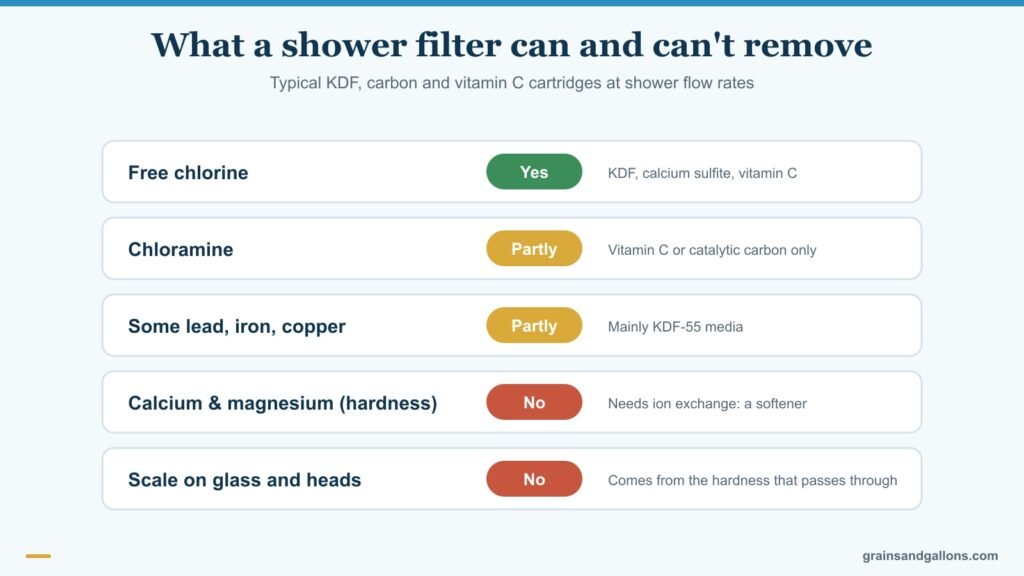
No, and this is where competing reviews split. The honest ones say calcium and magnesium pass straight through carbon and KDF media. The others print "removes calcium" with nothing to back it up. Penn State Extension describes ion exchange softening as the household method that removes the calcium and magnesium causing hardness (Penn State Extension, Water Softening). A shower cartridge isn't an ion exchange bed, and the few shower units that do contain softening resin use it up within days on hard water.
What you can expect from a good filter:
- Chlorine: large reduction, and you'll notice it in the smell straight away.
- Some metals (iron, copper, lead): partial reduction with KDF-55 media.
- Scale on the glass and showerhead: barely changes. The white crust is calcium carbonate, and it keeps forming.
- How your skin and hair feel: often better, mainly because chlorine is gone.
What the evidence says about hard water, skin and hair
This matters because "fixes eczema" is the most common claim on filter boxes, and anyone shopping for a shower filter for eczema or a hard water shower filter for hair should know what the studies found. The research points to hardness, not chlorine, as the main skin irritant. A 2018 study in the Journal of Investigative Dermatology found that hard water left more surfactant (soap) residue on skin and damaged the skin barrier, especially in people with atopic dermatitis. Removing calcium and magnesium reduced that effect, while chlorine had little effect on residue (Danby et al., 2018).

Even full softening isn't a cure. The SWET randomized trial gave families of children with eczema whole-house ion exchange softeners and found no additional benefit over usual care (Thomas et al., PLOS Medicine 2011). Our take: a shower filter is a comfort upgrade for chlorine-sensitive skin and hair. It isn't a treatment. If eczema is the main reason you're shopping, read hard water and eczema and talk to a dermatologist before spending $150 on a showerhead.
KDF, vitamin C or calcium sulfite: matching media to your water
Every brand mixes the same few media, whether it sells a KDF shower filter, a vitamin C shower filter, or a 15-stage blend. Knowing which is which tells you more than the "15-stage" count on the box.
| Media | Good at | Won't do |
|---|---|---|
| KDF-55 (copper-zinc) | Converts chlorine, reduces some lead and iron, slows bacteria in the cartridge | Remove calcium or magnesium |
| Calcium sulfite | Very fast chlorine removal, works in hot water | Handle chloramine well, or last as long as KDF |
| Activated carbon | Odors, some chemicals, chlorine at cooler temperatures | Work well at hot shower temperatures |
| Vitamin C | Neutralizes chlorine and chloramine almost instantly | Last long; cartridges are used up fast |
| Ceramic beads, tourmaline, "mineral balls" | Marketing copy | Anything we could find evidence for |
Check your utility first. If your city disinfects with chloramine rather than free chlorine (the annual water quality report will say), KDF and calcium sulfite do much less. You'll want vitamin C media or catalytic carbon. Our shower filters for chloramine guide covers that case.
Inline filter or filtered showerhead?
The inline shower filter vs filtered shower head choice comes down to your current fixture. Inline filters screw onto the shower arm and you keep your existing head. Filtered showerheads replace the head, with the cartridge built into the handle or body.
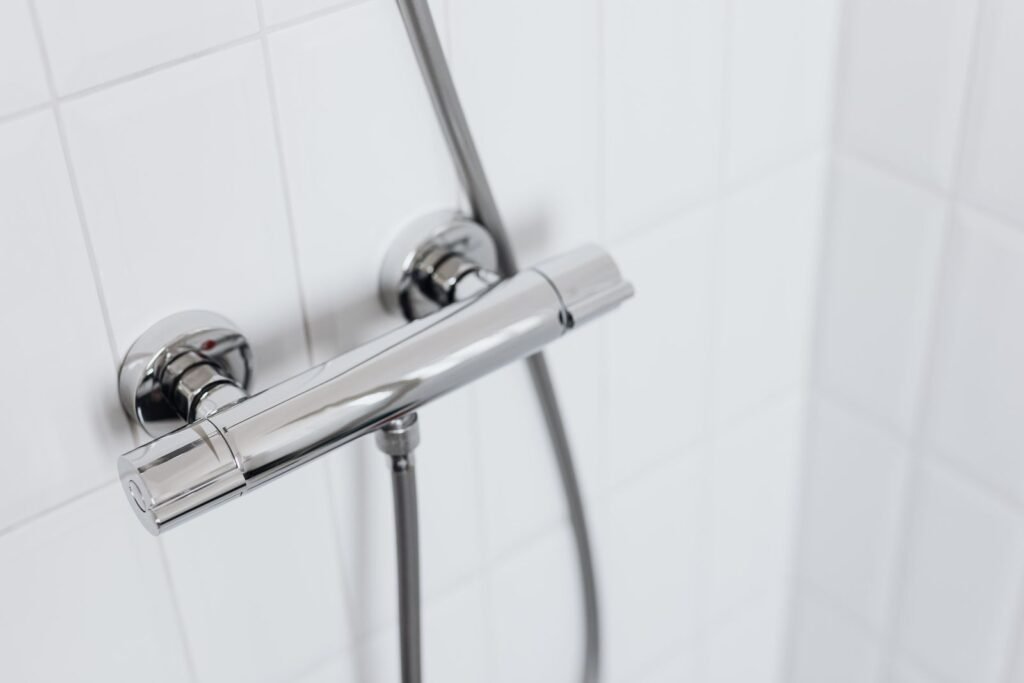
- Choose inline if you like your current head, have a rain head or handheld, or want the cheapest cartridges. Inline units add 3–4 inches at the arm, so check your clearance.
- Choose a filtered head if your current head is already scaled up and needs replacing anyway, or if looks matter. Expect to pay more per cartridge.
Both install without tools on a standard 1/2-inch NPT arm. Neither needs landlord approval, and both come with you when you move.
Whose certification can you actually check?
To qualify as an NSF 177 certified shower filter, a product has to pass NSF/ANSI 177, the standard written specifically for shower filters, and it only covers free available chlorine reduction. It says nothing about hardness. When we checked NSF's live shower filter listing in October 2026, it named only a handful of products: Weddell Duo (WD-100), MOSAIC, Purifull, Coolang and Moolmang Vitamax.

That matters because several popular filters advertise certification that doesn't appear on that list. Sprite's Amazon listing says "certified to NSF/ANSI 177." Culligan's says "tested according to NSF/ANSI 177," which isn't the same as certified. Neither brand appeared on NSF's listing when we checked. It may be an old certification, a lab test the brand paid for, or a listing under another name, but you can't confirm it yourself. In our picks, we only treat a filter as certified if it appears on the NSF listing.
The best shower filter for hard water, ranked
| Pick | Format | Main media | Cartridge life | Certification we could verify |
|---|---|---|---|---|
| Weddell Duo | Inline, dual cartridge | Dual-stage proprietary | 10,000 gal (NSF listing) | NSF/ANSI 177 ✔ |
| AquaBliss SF100 | Inline | Calcium sulfite, carbon, vitamin C | 3–6 months | None listed |
| Sprite HO2 | Inline + 3-setting head | Chlorgon | 12 mo / 25,000 gal | Claimed, not on NSF listing |
| Culligan HSH-C135 | Handheld head | KDF (WHR-140) | 6 mo / 10,000 gal | "Tested to" 177, not listed |
| Jolie | Fixed head | KDF-55, calcium sulfite | 90 days | Third-party lab claims |
| Hello Klean | Handheld head | KDF-55, calcium sulfite, carbon | 3–4 months | None listed |
Weddell Duo: the certification you can look up
The Weddell Duo is an inline filter with two clear cartridges, so you can watch them discolor and change them when they need it instead of guessing from a calendar. It's on NSF's NSF/ANSI 177 listing for chlorine reduction, with a 10,000-gallon cartridge rating and a 2.0 gpm flow listed. It installs without tools between your arm and any standard head, including rain and handheld styles.
Who it's for: People who want independent proof that the filter does what it says, and households on city water with a strong chlorine smell.
The downside: At around $90 it's the priciest inline option here, and genuine replacement cartridge sets cost $30–$50. The 2.0 gpm listed flow is a little below the 2.5 gpm federal maximum, so you may notice a slightly softer spray. Like every pick here, it does nothing for calcium.
AquaBliss SF100: the $37 renter's fix
The AquaBliss SF100 is the one to buy if you want the chlorine smell gone this weekend and don't want to think about it again for a few months. You unscrew your showerhead, thread this onto the arm with the included tape, and put your head back on. It works with fixed, rain, handheld and combo heads.
Inside is a multi-stage cartridge built around calcium sulfite and carbon, with vitamin C that AquaBliss says also reduces low levels of chloramine for a short time. Cartridges (SFC100) last 3–6 months and swap in about two minutes.
The downside: There's no third-party certification. Owners on very hard water report the threads crusting and becoming hard to unscrew at cartridge-change time. Fresh plumber's tape on each change mostly solves it.
Sprite HO2: one cartridge a year
Sprite has made shower filters for decades, and the HO2 is still the model it's known for. Its Chlorgon media converts free chlorine to chloride and is designed to hold up in hot water. The HOC cartridge is rated for 12 months or 25,000 gallons, the longest in this list, and the unit adds only about 4 inches to the arm. A basic 3-setting head is included if you want to replace yours.
Who it's for: Anyone who wants the lowest running cost and the fewest cartridge changes.
The downside: It looks utilitarian. Sprite claims NSF/ANSI 177 certification, but we couldn't find it on NSF's listing (see above). It targets chlorine only, so it's the wrong choice if your city uses chloramine.
Culligan HSH-C135: handheld, filter built in
If you want a shower head filter for hard water in one piece, the Culligan HSH-C135 replaces your showerhead with a handheld unit on a 5-foot metal hose, with the filter in the body. It takes the same WHR-140 cartridge as Culligan's old wall-mount WSH-C125, which is no longer reliably in stock. That cartridge is rated for 10,000 gallons or 6 months, and cheap third-party WHR-140s are easy to find.
The specs are good for hard water: 2.5 gpm, 5 spray settings, and rubber anti-clog nozzles you can rub scale off with a thumb. It also has a 5-year warranty, the longest here. Culligan says it reduces chlorine, sulfur odor and scale.
Who it's for: People with a scaled-up head that needed replacing anyway, and anyone who wants a handheld for rinsing kids, pets or the tub. If your current head is clogged, read why hard water clogs a showerhead before you decide to replace it.
The downside: Take the "scale" claim lightly. It's still a KDF filter. And "tested according to NSF/ANSI 177" isn't the same as appearing on NSF's certified listing.
Jolie: the one you've seen on social media
The Jolie is a well-made fixed head in several finishes. It uses a KDF-55 and calcium sulfite blend, which is a sensible mix for chlorine and metals. Jolie cites its own clinical study on reduced hair shedding and third-party lab tests. Filters change every 90 days in under 20 seconds.
Who it's for: Someone who wants a filtered head that looks like a designer fixture and doesn't mind a quarterly filter subscription.
The downside: At about $169 plus a filter every 90 days, it's the most expensive pick to run, and the media inside isn't meaningfully different from much cheaper KDF/calcium sulfite heads. It isn't on NSF's 177 listing. You're mostly paying for design. We go deeper in our Jolie shower head review.
Hello Klean: more media for metals
The Hello Klean head packs KDF-55, calcium sulfite and coconut-shell carbon into its filter, and the brand claims 98.6% chlorine reduction and over 90% reduction of heavy metals. The 108-nozzle head uses about 25% less water than a standard head while keeping the spray strong. Filters last 3–4 months.
Who it's for: Older buildings with iron or copper in the water, which shows up as orange or blue-green stains around the drain. It's also worth a look if you color your hair, since copper is one reason color goes brassy.
The downside: No third-party certification is listed, it's $140, and the 3–4 month filter cycle adds up. It's still a filter, not a softener, so white scale on the glass will keep coming back.
What each filter costs you per year
Sticker price misleads in this category. The cartridge schedule is the real cost.

| Pick | Upfront | Cartridges per year | Rough yearly refill cost |
|---|---|---|---|
| Sprite HO2 | ~$28 | 1 | ~$20–$30 |
| AquaBliss SF100 | ~$37 | 2–4 | ~$30–$60 |
| Culligan HSH-C135 | ~$65 | 2 | ~$20–$35 (third-party WHR-140) |
| Weddell Duo | ~$90 | 2–3 | ~$60–$90 |
| Hello Klean | ~$140 | 3–4 | ~$100–$160 |
| Jolie | ~$169 | 4 | ~$120–$160 |
Prices are what Amazon showed in October 2026 and will move. Over three years, the Sprite costs about a quarter of what the Jolie does, and both do the same core job.
When a softener is the better buy
Some people should skip all six of these:
- If the shower glass, faucets and kettle all crust up white, your problem is mostly hardness, not chlorine. Test first: how to test water hardness at home takes five minutes. Anything above about 7–10 gpg is going to leave film no matter what's screwed onto the arm.
- If you own the place and hardness is above 7 gpg, put the money toward a softener. A shower filter treats one fixture. A softener protects the water heater, dishwasher and every faucet. We compare the two in water softener vs shower filter.
- If you rent but want real softening, small portable options exist. Our guide to a water softener for a condo or apartment covers what landlords usually allow.
- If you're on a private well, there's probably no chlorine to remove. A chlorine filter is solving the wrong problem, and iron and sulfur need different media.
Living with hard water while you wait
A filter won't stop scale, but a few habits make hard-water showers far less annoying:
- Soak the showerhead monthly. A bag of white vinegar tied around the head overnight dissolves calcium on the nozzles. Rubber nozzles (Culligan, most rain heads) can also be rubbed clean.
- Use a chelating or clarifying shampoo once a week. Ingredients like EDTA or citric acid lift mineral film from hair that a filter leaves behind.
- Squeegee the glass after each shower. Spots form as water evaporates. Removing the water stops most of them.
- Install with care. Wrap every thread two or three times with plumber's tape and hand-tighten plus a quarter turn. Expect a small pressure drop. A big one usually means a clogged screen or two flow restrictors in series. Low pressure after installing a shower filter walks through the fixes.
FAQ
Do shower filters work for hard water?
They work on chlorine and some metals, not on hardness. Calcium and magnesium pass through KDF, carbon and vitamin C media, so scale and spots continue. Many people still notice softer-feeling hair and skin because the chlorine is gone.
Can a shower filter soften water?
Not meaningfully. Softening needs ion exchange resin, and a shower-sized cartridge either has none or runs out within days on hard water. A whole-house softener is the only real fix for hardness at the shower.
How often should you change a shower filter?
Follow the gallon or month rating, whichever comes first: about 12 months for the Sprite HO2, 6 months for Culligan WHR-140 cartridges, 3–4 months for Hello Klean, and every 90 days for Jolie. Change it sooner if the chlorine smell comes back.
Do shower filters help with eczema or dry skin?
They can ease chlorine-related dryness. Research points to hardness as the bigger irritant, though, and even whole-house softeners showed no added benefit for childhood eczema in a randomized trial. Treat a filter as a comfort upgrade, not a treatment.
Does a shower filter reduce water pressure?
Slightly. Any cartridge adds some resistance. A noticeable drop usually means the filter's restrictor and your head's restrictor are stacked, or a sediment screen is clogged. Both are quick fixes.
Is NSF/ANSI 177 certification worth paying for?
It's the only independent proof that a shower filter reduces chlorine. It doesn't cover hardness. Check the brand on NSF's own listing rather than trusting the box, because several popular filters claim certification but don't appear on that list.
Filter the chlorine, soften the hardness
The best shower filter for hard water is the one that removes chlorine, because that is the only job a shower cartridge can do well. Buy the Weddell Duo if you want certification you can verify, the AquaBliss SF100 if you rent and want the cheapest fix, or the Sprite HO2 if you'd rather change a cartridge once a year. If the white crust on your glass is what bothers you, no filter will fix it. Test your hardness, and if you own your home, put the money toward a softener.
Related guides