


Quick Answer: A water softener for condo or apartment living is often possible if four things line up: you have written permission from the HOA or landlord, your unit has its own water line with a shutoff you can reach, there's room for a compact softener beside that line, and a drain and outlet are within reach. If any one fails, skip the whole-unit softener and treat the problem spots instead, usually with a shower filter plus fixes for the kettle, dishwasher and laundry.
You've got the spots on the shower door, the crunchy towels and the white rim on the kettle. In a house, you'd put a softener where the main comes in. In a condo or apartment, the plumbing, the walls and sometimes the rules belong to someone else.
Before anything else, confirm you actually need one. The Minnesota Department of Health suggests a softener may be worth it above about 7 grains per gallon (120 mg/L) and points out that some utilities already soften the water they deliver. Your water utility's annual quality report or a test strip will tell you.
In this guide
Four checks before a water softener for condo or apartment living

Work through these in order, because each one can end the project:
- Permission. HOA board or landlord, in writing.
- Your own water line. A shutoff that feeds only your unit.
- Room. Floor space, access to add salt, and a floor that can take the weight.
- Drain and outlet. A standpipe or laundry tub within reach, plus power for most models.
HOA approval, leases and the paperwork
Condo owners: in most associations you own your unit's interior plumbing, but the rules may still require board approval for plumbing changes, a licensed plumber or a permit. Some buildings restrict anything that ties into shared drains or adds water weight to a floor. Read the CC&Rs and ask the board in writing.
Renters: you need the landlord's written approval to cut into plumbing. Many will say no. Some say yes if a licensed plumber does the work and you restore it when you leave, and a few landlords install softeners themselves as an amenity. Our guide to water softeners in rental properties covers who pays, who maintains and what to put in writing.
Whichever you are, keep the approval, permit, model and installation date together. Buyers and inspectors ask about added equipment in condos, and renters should agree up front whether the softener stays and who restores the plumbing at move-out.
Your unit's own line, a closet and a drain
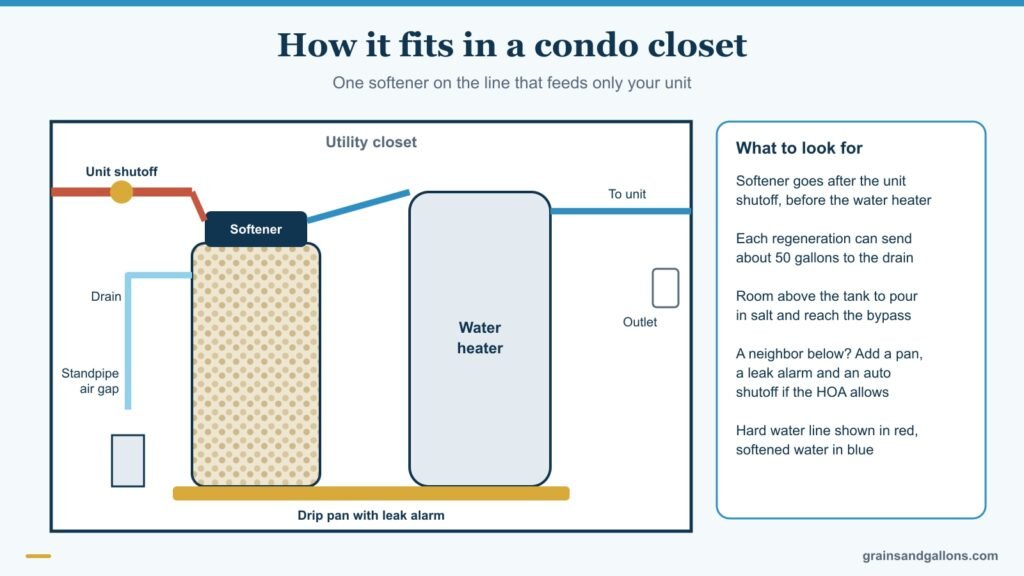
The water line. A softener has to sit on the line that feeds your whole unit, after the point where your water splits off from the building's supply. Look for an individual shutoff, often in a utility closet, under the kitchen sink or behind an access panel near the water heater. If you have your own water heater, the cold line feeding it is usually close by. If your unit is fed from a shared riser with no single entry point, there's nowhere to put a whole-unit softener. Some buildings soften centrally instead; see one water softener for multiple units for how that works and how to raise it with the board.
Room and weight. A compact cabinet softener takes roughly the footprint of a large trash can, plus clearance above to pour in salt and in front to reach the bypass. Our guide on how much space a water softener needs gives dimensions. A softener full of water and salt is heavy, and in an older building a closet floor over a neighbor's ceiling deserves a second thought. A drip pan with a leak alarm is cheap insurance.
Drain and power. During regeneration a softener sends salty rinse water to a drain; Penn State Extension puts it at about 50 gallons per regeneration for a typical unit. In an apartment that usually means a washer standpipe or laundry tub, with an air gap at the end of the line. A balcony drain, storm drain or toilet isn't an option. See where a water softener can drain. You'll also need an outlet within reach of the power cord unless you choose a non-electric model.
Size it small and check local salt rules

Most condos don't need much capacity. Penn State's sizing method multiplies people by about 75 gallons a day by your hardness in grains per gallon. Two people on 10 gpg water use about 1,500 grains of hardness a day, so even a small softener goes several days between regenerations. Our guide on how to size a water softener walks through the math, and our picks for the best water softeners for small homes focus on that size range.
Two more things before you buy:
- Brine rules. A few US sewer districts limit or ban new salt-based softeners because chloride passes straight through treatment. Check water softener brine restrictions and call your sewer district.
- Which taps to soften. Penn State notes you don't need softened water at toilets or outside spigots, and the Minnesota health department recommends keeping an unsoftened tap for drinking and cooking. In a condo the kitchen cold tap is often the easiest one to leave on hard water.
Have a licensed plumber install it, especially if the HOA requires one, and make sure the bypass is easy to reach for the next owner or tenant.
Options when a whole-unit softener won't work

This is the more common outcome, and it's not a dead end. Most of what people dislike about hard water happens in a few places:
| Where hard water bothers you | What to do instead |
|---|---|
| Dry skin, dull hair, shower glass spots | A shower filter that installs without tools. It won't soften, but it can reduce chlorine. Our list of renter-friendly shower filters covers models you can take with you |
| Kettle and coffee maker scale | Use filtered water or descale on a schedule |
| Dishwasher film | Rinse aid and a detergent made for hard water |
| Laundry | A softening additive and the right detergent dose |
| Faucet and fixture spots | Wipe dry; descale aerators occasionally |
To see how much of the problem a filter can handle, read our comparison of a whole-house softener vs a shower filter.
Portable softeners, the kind sold for RVs, are another option for one fixture or a laundry hookup. They regenerate by hand with salt and need somewhere to drain the brine, so they suit occasional use better than full-time apartment life. See installing a water softener in an RV for how they work.
Salt-free conditioners need no drain or power, but they still go on the main line, so they need the same permission and plumbing access. They also don't remove hardness; read does a salt-free system actually soften water? before you buy one expecting soft water.
FAQ
Can I put a water softener under the kitchen sink?
Only a small point-of-use unit, and it only treats that faucet. A whole-unit softener needs to be on the line that feeds every fixture, which is rarely under a sink. Most people who want softer water at one tap are better served by a filter or a portable unit.
Do I need my HOA's permission to install a water softener?
Usually, yes. Even when you own the interior plumbing, most associations require approval for plumbing changes and may require a licensed plumber or permit. Get it in writing before you buy.
Can a renter install a water softener?
Only with the landlord's written approval, since it means cutting into the plumbing. If the answer is no, a shower filter and point-of-use fixes are the realistic options, and they come with you when you move.
Where does a condo water softener drain?
To a drain inside your unit, usually a washer standpipe or laundry tub, with an air gap at the end of the line. Balcony drains, storm drains and toilets aren't acceptable drain points.
Get permission first, then go compact
A water softener for condo or apartment living works when the paperwork and the plumbing both cooperate: written approval, a line that feeds only your unit, room in a closet and a drain nearby. If all four line up, choose a small softener and have a licensed plumber fit it with a drip pan. If any one is missing, spend the money on a shower filter and spot fixes instead.