


Quick Answer: A sulfur smell after water softener installation is hydrogen sulfide gas, and the softener rarely makes it from scratch. Smell the cold tap, then the hot tap. Hot only means the water heater's magnesium anode rod is feeding sulfate-reducing bacteria; swap it for an aluminum-zinc or powered anode. Hot and cold, but a tap that bypasses the softener is fine, means bacteria are growing in the softener; sanitize it. If even the bypassed tap smells, the sulfur is in your water and needs its own filter ahead of the softener.
A sulfur smell after water softener installation usually shows up within days: the shower smells like a carton of eggs left in the sun, and the new equipment gets the blame. The softener is usually making an existing problem louder, or it sat idle long enough to grow something. The smell is hydrogen sulfide gas, and your job is to find where it's being made. One test narrows it down in about two minutes.
In this guide
- Run the hot-and-cold tap test first
- Hot water only: the anode rod is making the gas
- Why a sulfur smell after water softener installation is so common
- Cold water smells too: sanitize the softener
- The bypassed tap smells: sulfur is coming from the well
- One bathroom only? Check the drain trap
- FAQ
- Match the fix to where the smell starts
Run the hot-and-cold tap test first

Pick a tap you use often, like the kitchen sink.
- Run cold water for 30 seconds and smell the stream.
- Switch to hot and run it until it's actually hot. Smell again.
- If you have a tap that skips the softener (often an outdoor spigot), or you can put the softener in bypass, smell that cold water too.
Now read the result:
| What smells | Most likely source | What to do |
|---|---|---|
| Hot only | Water heater (anode rod + bacteria) | Swap or treat the anode |
| Hot and cold, but not the bypassed tap | Bacteria inside the softener or brine tank | Sanitize the softener |
| Hot, cold and the bypassed tap | The water itself, before the softener | Test and filter the supply |
| Only right after regeneration, then fades | Brine tank or drain | Clean the brine tank |
Most people can smell hydrogen sulfide well below 0.5 mg/L, according to Penn State Extension, so your nose is a good first instrument.
Hot water only: the anode rod is making the gas

Most tank water heaters have a magnesium anode rod inside. Its job is to corrode instead of your tank. Many wells and some city supplies carry sulfate and harmless sulfate-reducing bacteria. In the warm, still water inside the heater, those bacteria use what the corroding anode gives off and turn sulfate into hydrogen sulfide.
The fixes, in order:
- Swap the anode. Penn State Extension recommends replacing the magnesium rod with an aluminum rod, which usually stops the odor while still protecting the tank. A powered (electric) anode is the other common choice. Removing the anode entirely shortens the heater's life and can void the warranty, so don't do that.
- Disinfect the heater. A hydrogen peroxide or chlorine treatment of the tank kills the bacteria for a while. Follow your heater manufacturer's procedure if it gives one.
- Raise the temperature temporarily, only if your heater's manual allows it and everyone in the house knows. Water hot enough to kill the bacteria is also hot enough to scald.
If you're not comfortable draining a tank, call a plumber. Our guide to a rotten egg smell only in hot water walks through the anode swap step by step.
Why a sulfur smell after water softener installation is so common
Three things tend to line up right after a softener goes in:
- The softener sat before it was plumbed in, or the house was empty for weeks. Standing water in a dark, damp resin bed lets bacteria multiply. Penn State Extension notes that, in rare cases, adding a softener can itself create conditions that favor sulfur-reducing bacteria.
- The water heater chemistry changes. Softened water swaps calcium and magnesium for sodium, and many plumbers report that magnesium anodes corrode faster in it. More anode activity can mean more food for the bacteria already in the heater.
- The smell was there all along. A new system makes people pay attention, and installs often include a heater flush that stirs things up.
Cold water smells too: sanitize the softener
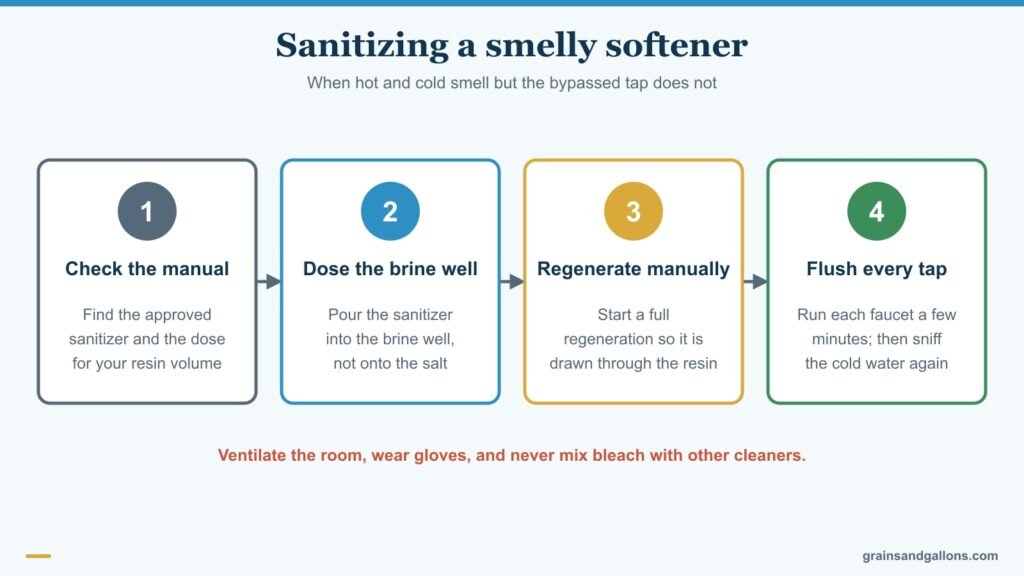
When hot and cold both smell but the bypassed tap doesn't, something is growing inside the softener. Typical triggers: a long gap without regenerating (out of salt, unplugged, vacation mode) or a brine tank with sludge or stale water.
- Sanitize the softener. Most manufacturers give a method using unscented household bleach or a softener-specific sanitizer added to the brine well, then a manual regeneration. Doses depend on resin volume and some units need a specific product, so use your manual's dose. Our step-by-step on how to sanitize a water softener explains the process.
- Clean the brine tank if it has sludge or smells on its own. See brine tank smells bad.
- Flush the house lines by running each tap for a few minutes after the sanitizing cycle.
If the smell returns within a few weeks, the water feeding the softener probably carries enough bacteria to keep reseeding it. That points to the source water, or to iron bacteria if you also see rusty slime; our guide to iron bacteria in well water covers that overlap.
The bypassed tap smells: sulfur is coming from the well

If cold water that never touches the softener smells too, the hydrogen sulfide is coming from your well or, less often, the city supply. A softener isn't built to remove a dissolved gas. The EPA's private well guidance lists hydrogen sulfide among common well water issues, and the National Ground Water Association recommends testing before choosing treatment.
On a well:
- Test for hydrogen sulfide, iron and manganese together; they often travel as a group.
- Shock chlorinate the well if bacteria might be involved, then see if the smell returns. Bypass the softener first, as explained in shock chlorination and your water softener.
- Match the treatment to the level. Penn State's working ranges: a large activated carbon unit below about 1 mg/L, oxidizing filters such as manganese greensand up to about 2–3 mg/L, and chlorine or potassium permanganate feed with filtration for heavy cases, most often above 6 mg/L. Catalytic carbon handles more than plain carbon but needs enough dissolved oxygen in the water.
For lighter sulfur, our picks for whole house catalytic carbon filters are the simplest option. For sulfur that comes with iron, the air-injection approach in our SoftPro Iron Master review is one example of the type. Either filter goes before the softener so it doesn't foul the resin; our well water treatment train order shows where each piece sits.
On city water: A sudden rotten-egg smell from every tap is worth a call to the utility; it's usually a local main issue, not something to filter at home.
One bathroom only? Check the drain trap

A smell in one room usually isn't the water. Fill a glass at that sink and smell it in another room. If the glass is clean, the drain is the source: a dry trap, a cracked vent or slime in the pipe can give off sulfur smells that seem to come from the faucet. Pour water into seldom-used drains to refill the trap, and clean the drain if it's slimy.
FAQ
Can a water softener cause a rotten egg smell?
Rarely on its own. A softener can grow sulfur-producing bacteria if it sits idle or runs out of salt, and Penn State Extension notes that in rare cases a softener creates conditions that favor them. More often, the smell comes from the water heater's anode rod or from sulfur already in the well.
Will a water softener remove sulfur smell?
No. Ion exchange resin swaps calcium and magnesium for sodium, and hydrogen sulfide is a dissolved gas, not a hardness mineral. You need carbon, an oxidizing filter, or chlorine or peroxide treatment installed ahead of the softener.
Is it safe to drink water that smells like sulfur?
At the low levels found in most household water, hydrogen sulfide is mainly a taste and odor problem, and there is no federal drinking water standard for it. Because the smell can also come from bacteria, have a well tested for coliform bacteria too.
Why does my hot water smell like sulfur but not my cold?
The hydrogen sulfide is being made inside the water heater, where sulfate-reducing bacteria react with the magnesium anode rod. Swapping to an aluminum-zinc or powered anode is the usual fix.
Match the fix to where the smell starts
A sulfur smell after water softener installation almost never means the softener is broken. The tap test sorts it out: hot only is the anode rod, hot and cold is bacteria in the softener, and every tap is the water itself. Fix that one source, and the eggs go away.