


Quick Answer: A rotten egg smell only in hot water means the water heater is making hydrogen sulfide gas. Sulfate-reducing bacteria in the warm tank turn sulfate into the gas, and the heater's magnesium anode rod speeds the reaction. Swap the magnesium rod for an aluminum or aluminum-zinc anode, such as the Eau 44" flexible aluminum-zinc anode rod, and chlorinate the tank to kill the bacteria. Don't just pull the anode out.
Disclosure: As an Amazon Associate, Grains & Gallons earns from qualifying purchases.
Cold water is fine. Turn on the hot tap for a shower or the dishes, and the bathroom smells like bad eggs. A rotten egg smell only in hot water is one of the clearest clues in home water troubleshooting, because it points straight at the water heater instead of your well or city supply. That's good news: the fix is a part and an afternoon, not a whole-house treatment system.
In this guide
- Smell the cold tap first, then each hot tap
- Why a rotten egg smell only in hot water starts at the anode rod
- Swap the magnesium rod for aluminum-zinc
- Chlorinate the tank so the bacteria don't return
- Powered anode when the smell keeps coming back
- Mistakes that shorten the heater's life
- It is a heater fix, not a water problem
- FAQ
Smell the cold tap first, then each hot tap
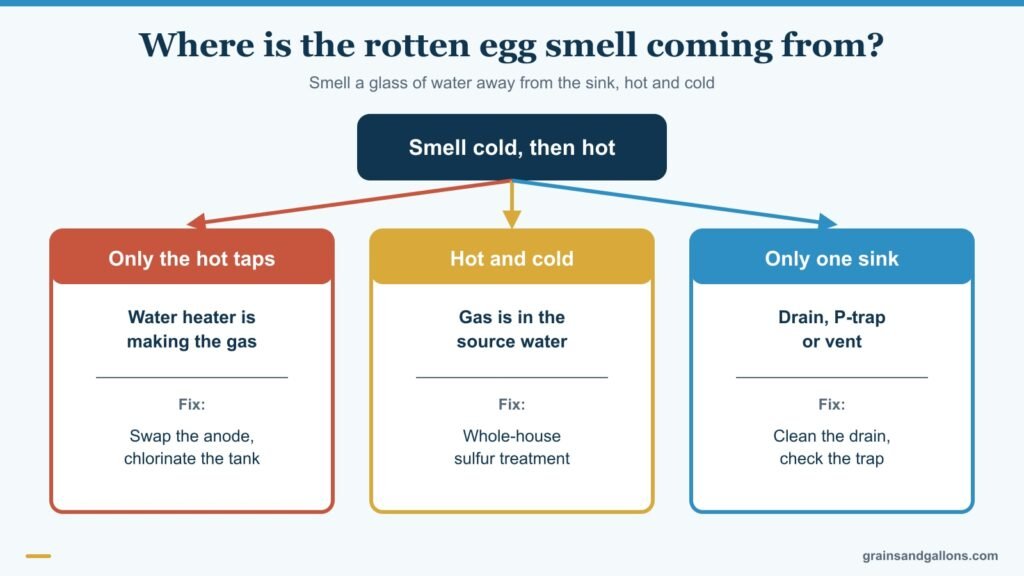
Before you buy anything, confirm where the smell lives. The Minnesota Department of Health's guide to hydrogen sulfide in well water suggests checking after you've been away for a few hours, when water has sat in the pipes and heater.
- Run cold water into a glass, carry it to another room, and smell it. Then do the same with hot. Smelling at the sink fools you, because drain odor rises from the basin.
- Check two or three hot taps. If every hot tap smells, it's the heater. If only one sink smells, the drain or P-trap is the likely source. Our guide to water that smells like sewage covers drain and vent smells.
- Note your heater type. Tankless heaters have no anode rod and hold little water, so the anode diagnosis below doesn't fit them.
If the cold water smells too, even faintly, the hydrogen sulfide is in your source water and the heater is just making it more noticeable. That calls for point-of-entry treatment. Catalytic carbon handles light sulfur odor; heavier levels usually need an oxidizing filter. Our picks for whole-house catalytic carbon filters are a good start for low levels.
Why a rotten egg smell only in hot water starts at the anode rod

Most tank water heaters ship with a magnesium anode rod, a sacrificial metal rod that corrodes so the steel tank doesn't. Two other ingredients complete the problem: sulfate in the water, and sulfate-reducing bacteria that thrive in a warm, low-oxygen tank. The bacteria convert sulfate to hydrogen sulfide, and the magnesium rod feeds the reaction.
Penn State Extension's page on hydrogen sulfide in water wells says the magnesium rod "often provides a chemical catalyst for producing hydrogen sulfide from naturally occurring sulfates," and that replacing it with an aluminum rod "should eliminate the rotten egg odor." Penn State also notes that most people can smell hydrogen sulfide at levels well below 0.5 mg/L, which is why a small amount of gas fills a bathroom.
What usually sets it off
- A new water softener. Owners often report the smell within weeks of installing a softener. Our article on sulfur smell after a water softener covers that case.
- A new water heater with a fresh, highly active magnesium rod.
- A vacation or a low thermostat setting, when warm water sat still in the tank.
- A change in the well, such as drought, heavy rain or a new pump that shifts sulfate and bacteria levels. See why well water chemistry changes.
Swap the magnesium rod for aluminum-zinc

This is the lasting fix in most homes. North Dakota State University's water quality team gives the same short answer for rotten egg odor only from the hot water tap: replace the anode with an aluminum one, and base any further treatment on a water test.
Before you buy:
- Read your heater's manual or warranty. Some manufacturers specify the anode type or sell their own odor-control anode, and using a different one can affect the warranty.
- Measure what you have. Most residential heaters use a 3/4" NPT hex-head anode, but lengths vary. A flexible or segmented rod lets you fit a full-length rod where ceiling height is tight.
- Check for a combination anode. On some heaters the anode is built into the hot outlet nipple. That's a different part.
The swap: turn off the power (or set gas to pilot or vacation), shut the cold supply, open a hot tap to relieve pressure, and drain a few gallons. Break the old anode loose with a 1-1/16" socket and a breaker bar; this is usually the hard part. Wrap the new rod's threads with PTFE tape, install it, refill with a hot tap open until water runs steady, then restore power. If the old rod won't budge, or the heater sits in a cramped closet, hand this one to a plumber.
Chlorinate the tank so the bacteria don't return
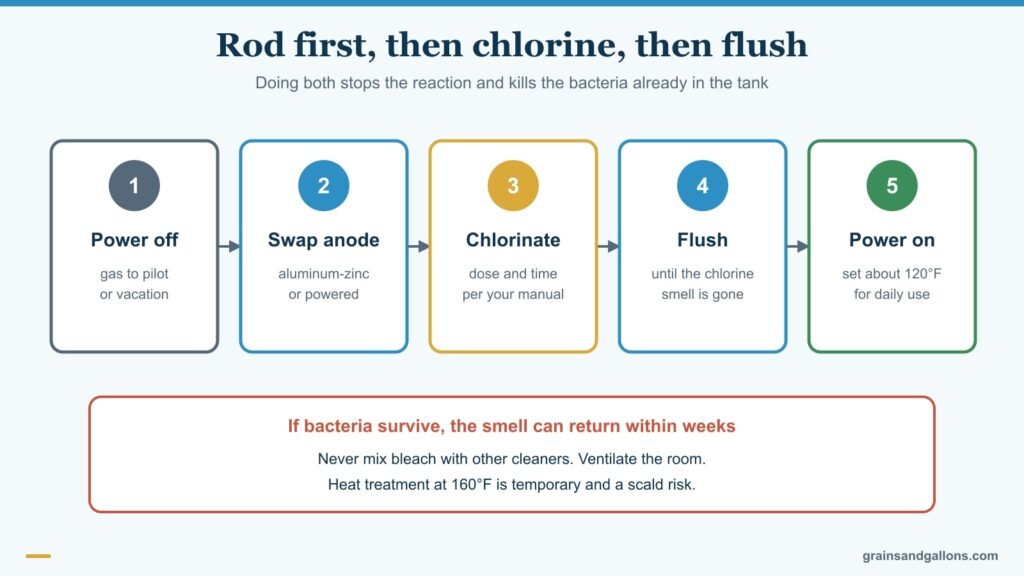
A new rod stops feeding the reaction. Disinfecting kills the bacteria already living in the tank. Doing both is the most reliable route, and the Minnesota Department of Health recommends disinfecting and flushing the heater with a chlorine bleach solution. It also warns that if chlorination doesn't kill all the bacteria, the problem may return within a few weeks.
Dose and contact time vary by tank size, and some manufacturers publish their own procedure, so follow your heater's instructions rather than an internet recipe. Turn off the power first, ventilate the room, and never mix bleach with other cleaners.
Heat treatment: a short-term reset
MDH also lists raising the heater to 160°F for several hours to kill the bacteria. It's a temporary fix, and a risky one: water that hot scalds in seconds. Only do it if your manual allows it, put a warning on every faucet, keep children away, and turn the thermostat back down afterward. Around 120°F is the common everyday setting for scald safety.
Powered anode when the smell keeps coming back
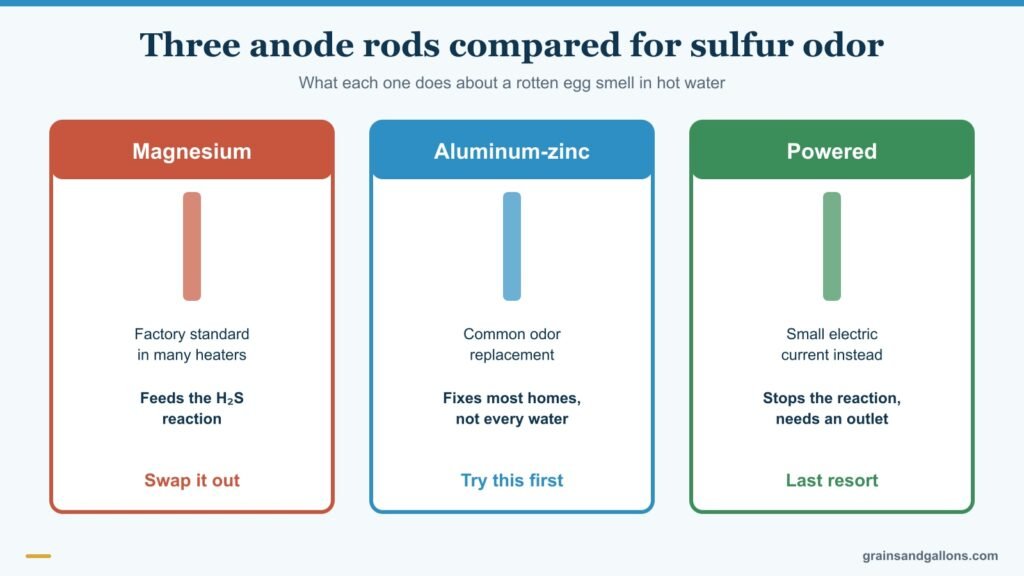
A powered (impressed-current) anode protects the tank with a small electrical current instead of a sacrificial metal. With no magnesium in the tank, the reaction that feeds the odor stops, and the rod doesn't wear away the same way. It costs more than an aluminum-zinc rod and needs an outlet near the heater, but it's the usual last resort when the smell comes back even after an aluminum swap and a chlorine treatment.
Mistakes that shorten the heater's life
Pulling the anode and leaving it out. It stops the smell, which is why people do it. Penn State warns that removal "could cause increased corrosion and reduced life of the hot water heater" and will likely void the warranty. MDH says the same: removing the anode may significantly decrease the heater's life.
Treating the whole house for a heater problem. If the cold water is odor-free, a whole-house sulfur filter won't fix the hot side. Fix the heater first.
Confusing it with a gas leak. A rotten egg smell near a gas water heater, furnace or range that's in the air rather than in the water can be natural gas, which has an added odorant. If the smell is there with no water running, leave the house and call your gas utility.
Assuming the water is unsafe. MDH says that in most cases the rotten egg smell does not relate to the sanitary quality of the water. If you're on a well, though, a new odor is a good prompt to test for coliform bacteria and nitrate, which MDH recommends. A well water test kit or a certified lab will tell you where you stand.
If the hot water is also brown or black, the anode or tank lining may be breaking down, or sediment is building up. See brown water only from the hot tap before you decide between repair and replacement.
It is a heater fix, not a water problem
With a rotten egg smell only in hot water and a clean cold side, the smell is being made inside the tank, and the cure lives there too. Confirm it at several taps, swap the magnesium anode for aluminum-zinc, and chlorinate the tank so the bacteria don't rebuild. Keep a powered anode in your back pocket if the odor returns. Leave whole-house sulfur treatment for the day the cold water smells too.
FAQ
Why does only my hot water smell like rotten eggs?
Sulfate-reducing bacteria in the warm water heater turn sulfate into hydrogen sulfide gas, and the magnesium anode rod speeds up the reaction. Cold water skips the heater, so it doesn't smell.
Is it safe to shower in water that smells like rotten eggs?
At the levels that cause a hot-water odor, hydrogen sulfide is mainly a nuisance; people can smell it long before it's a health concern. Ventilate the bathroom, and if you're on a well, test for coliform bacteria and nitrate to rule out other problems.
Will flushing the water heater get rid of the smell?
Usually only for a short while. Flushing removes some sediment and smelly water, but the bacteria and the magnesium rod stay. An anode swap plus chlorination lasts much longer.
Can I remove the anode rod to stop the smell?
You can, but you shouldn't. Without an anode the steel tank corrodes faster, and Penn State Extension notes it will likely void the manufacturer's warranty. Replace it with an aluminum-zinc or powered anode instead.
Do tankless water heaters get a rotten egg smell?
Rarely from the heater itself. Tankless units have no anode rod and don't store warm water, so a sulfur smell from a tankless system usually comes from the source water or a drain.