


Quick Answer: When tap water smells like sewage, fill a glass, carry it into another room and sniff it. If the glass smells fine, the odor is gas or biofilm in the sink drain, and cleaning the overflow, stopper and P-trap fixes it. If the glass itself stinks, check whether it's hot water only (water heater), softened water only (softener), or every tap. On a private well, a true sewage smell at every tap means stop drinking it and get a lab test for coliform bacteria and E. coli.
When your water smells like sewage, the worry is obvious. In most homes the water itself is fine and the smell is coming from the drain a few inches below the faucet. On a private well, though, it can really be contamination. Five quick checks tell those apart.
In this guide
- Stop drinking it if any of these are true
- Is it the water or the drain? Use the glass test
- Clean the drain that's faking a water problem
- Which taps smell tells you the cause
- Sewage or rotten eggs? How to tell hydrogen sulfide apart
- When well water smells like sewage, find the way in
- Test the glass first, then fix the source
- FAQ
Stop drinking it if any of these are true
Switch to bottled water for drinking, cooking, brushing teeth and mixing formula when:
- You're on a well, and the water in a glass smells like sewage or manure.
- The smell started after flooding, heavy rain or septic trouble nearby.
- The water is also cloudy or discolored, or someone in the house has a stomach illness.
- Your utility has issued a boil water notice or contamination warning.
On a well, the first test is total coliform and E. coli at a state-certified lab. The EPA's private well guidance says to test right away after flooding, well repairs, or any noticeable change in odor, color or taste, not just at the yearly check. Our guide to testing well water for coliform bacteria shows how to collect a sample the lab will accept. A home well water test kit is fine for screening, but use a lab when you suspect sewage. On city water, call the utility first. They need to know, and they can test at your tap.
Is it the water or the drain? Use the glass test
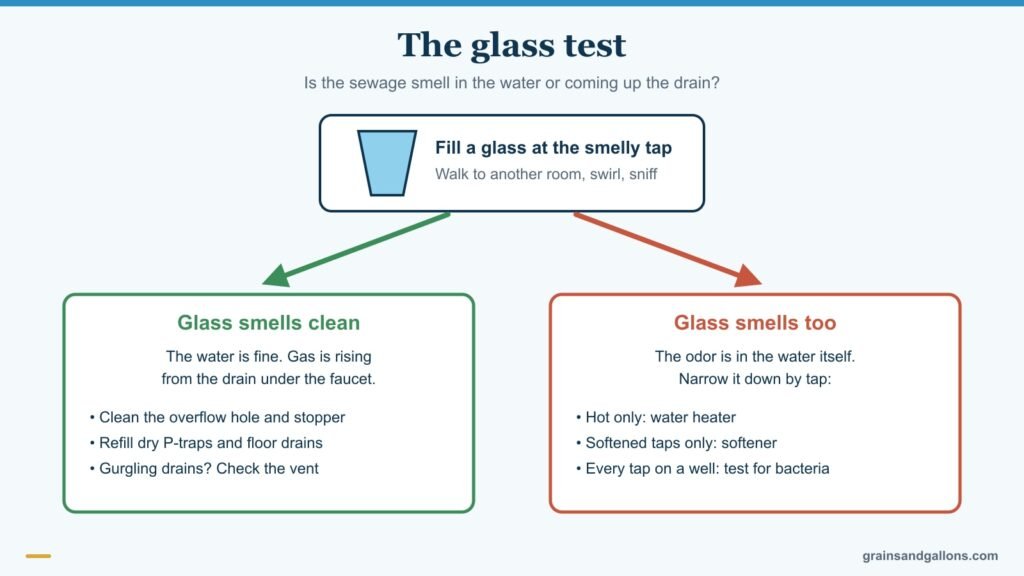
Fill a clean glass at the smelly tap, walk into another room, swirl and sniff. Try cold, then hot.
- Glass is clean. The water's fine. Running water pushes air out of the drain right under your nose, so drain gas seems to come "from the faucet."
- Glass smells. The odor is in the water. Move on to the tap pattern below.
Repeat at a second sink in another part of the house. One smelly bathroom sink points to that sink's drain. Every tap smelling points to the water.
Clean the drain that's faking a water problem

Food, soap and hair coat the inside of a drain and feed bacteria that give off sulfur gas. Work through these in order:
- Overflow hole. The small hole near the top of a bathroom sink collects soap scum and is almost never cleaned. Pour hot water with a little dish soap through it and scrub inside with a bottle brush.
- Pop-up stopper. Pull it out. The slime on it is often the whole smell.
- Drain walls. Pour ¼ cup of baking soda, then ¼ cup of white vinegar, wait 10 minutes and flush with very hot water.
- Dry P-trap. Guest baths, basement sinks and floor drains lose the water seal in the trap when they sit unused, and sewer gas comes straight up. Run water for 30 seconds or pour a bucket into the floor drain.
- Garbage disposal. Scrub under the rubber splash guard.
- Vent problems. If drains gurgle and the smell comes back days after cleaning, the plumbing vent may be blocked. That's a job for a plumber.
Which taps smell tells you the cause

| Smells when… | Most likely cause | What to do |
|---|---|---|
| Hot water only | Water heater anode reacting with sulfate, or bacteria in a tank kept too cool | See rotten egg smell only in hot water |
| Softened water only (fine in bypass) | Bacteria in the softener's brine tank or resin | Clean and sanitize. See brine tank smells bad |
| Hot and cold, city water | Utility issue or a cross-connection in your building | Call the utility; don't drink it until they've checked |
| Hot and cold, well water, sharp "rotten egg" | Hydrogen sulfide from sulfur bacteria or the aquifer | Test, then treat with oxidation or carbon |
| Hot and cold, well water, fecal or manure smell | Possible septic, runoff or wellhead contamination | Stop drinking, lab test for bacteria, inspect the well |
When the water heater smells like sewage
A water heater that sits unused, or runs at a low temperature to save energy, can grow bacteria. Its magnesium anode rod can also turn sulfate in the water into hydrogen sulfide. Penn State Extension notes that swapping the magnesium rod for an aluminum one often stops a hot-only smell, while pulling the rod out entirely shortens the heater's life and may void the warranty. Raising the thermostat for several hours and then flushing every hot tap can also kill bacteria in the tank. Turn it back down afterward, because water that hot scalds.
The softener bypass test
On a home with a water softener, put the softener in bypass and run a cold tap for a few minutes. If the smell disappears, the brine tank or resin bed is growing bacteria, usually after the tank ran low on salt or the unit stopped regenerating. Clean the brine tank, sanitize the resin with the product your manufacturer names, and keep salt in it. If the smell is more rotten egg than sewage, see sulfur smell after a water softener.
Sewage or rotten eggs? How to tell hydrogen sulfide apart
Many people call hydrogen sulfide "sewage." It's a sharp, rotten-egg smell, and you can notice it at very low levels: Penn State Extension's hydrogen sulfide fact sheet says most people detect it well below 0.5 mg/L. It's mainly a nuisance. It has no drinking water standard because the smell makes water unpleasant long before it becomes harmful, though it does corrode plumbing and can leave black stains.
A true sewage odor is more fecal, earthy and rotten than sulfurous, and on a well it can mean wastewater is getting in. You don't need to be sure which one you're smelling. A coliform and E. coli test settles the safety question, and a hydrogen sulfide test tells you which treatment you need. Penn State lists activated carbon as effective below about 1 mg/L and oxidizing filters up to about 2 to 3 mg/L, with chlorination or potassium permanganate for higher levels.
When well water smells like sewage, find the way in
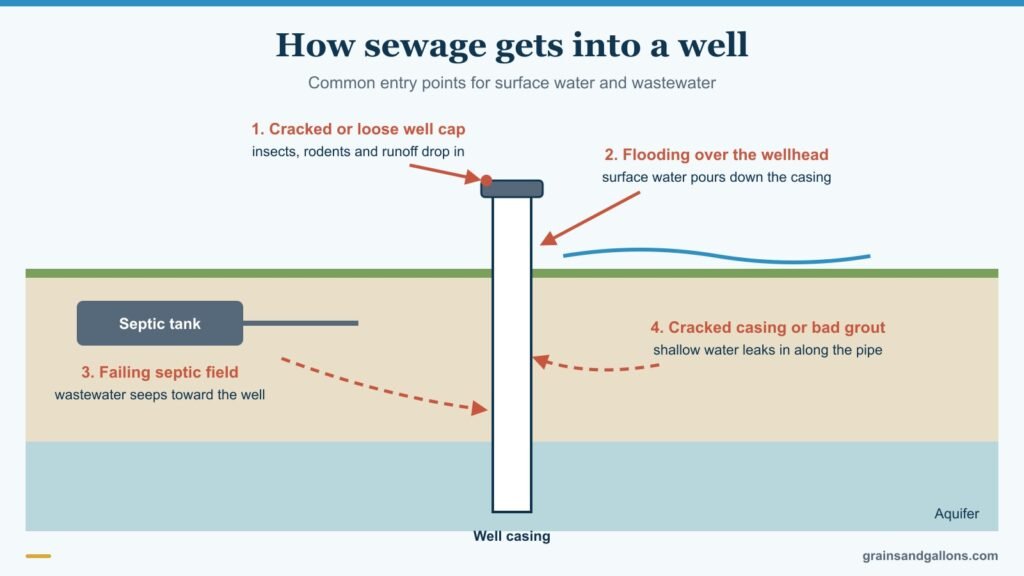
Sewage odor in well water usually means surface water or wastewater is reaching the well. Walk out to the wellhead and look for:
- A cracked, loose or missing well cap. The EPA recommends a well cap or sanitary seal and checking it periodically.
- Flooding that covered the wellhead, or a casing that ends at or below ground level.
- A failing septic system or drain field uphill from the well.
- A shallow or older well near livestock, a ditch, or a cracked casing that lets shallow water run down the outside of the pipe.
After a positive bacteria test, the usual sequence is: fix the entry point, shock-chlorinate the well and plumbing, flush, and retest. A softener needs attention during that shock treatment. See shock chlorination and your water softener for when to bypass it and how to sanitize it afterward. If bacteria keep coming back, continuous treatment such as UV with good pre-filtration is the usual answer, and our guide to well water systems for bacteria and coliform compares the options. If sewage is reaching a well, bring in a licensed well contractor and your local health department.
Afterward, flush every tap, replace any filter cartridges that were in service, and retest once the chlorine is gone. If the smell returns after heavy rain, the well is still letting surface water in.
Test the glass first, then fix the source
Most of the time, when water smells like sewage, the glass test clears the water and a dirty drain or a dry trap is the real culprit. If the glass smells too, the tap pattern points to the water heater, the softener, the utility or the well. The one case you shouldn't wait on is a sewage smell from every tap on a private well: drink bottled water and get a lab test for coliform bacteria before you do anything else.
FAQ
Is it safe to drink water that smells like sewage?
Not until you know the cause. If a glass smells clean in another room, the drain is the source. If the water itself smells, especially on a well, use bottled water until a lab test for coliform and E. coli comes back clean.
Why does my sink smell like sewage only when the water runs?
Running water pushes air out of the drain, carrying gas from biofilm in the overflow, stopper or trap right up to your nose. Clean the overflow hole and stopper and the smell usually goes away.
Why does only my hot water smell like sewage?
The water heater is the source. Bacteria grow in tanks kept at low temperatures or left unused, and the magnesium anode rod can turn sulfate into hydrogen sulfide. Flushing the tank and switching to an aluminum anode often fixes it.
Can a water softener make water smell like sewage?
Yes. Bacteria can grow in a brine tank that ran low on salt or a unit that stopped regenerating. If the smell disappears when the softener is in bypass, clean the brine tank and sanitize the resin.
How do I get rid of a sewage smell in well water?
Test for coliform bacteria first, then find how contamination is getting in: the cap, flooding, a septic system or a cracked casing. Fix that, shock-chlorinate the well, flush and retest. If bacteria return, add continuous treatment such as UV.