

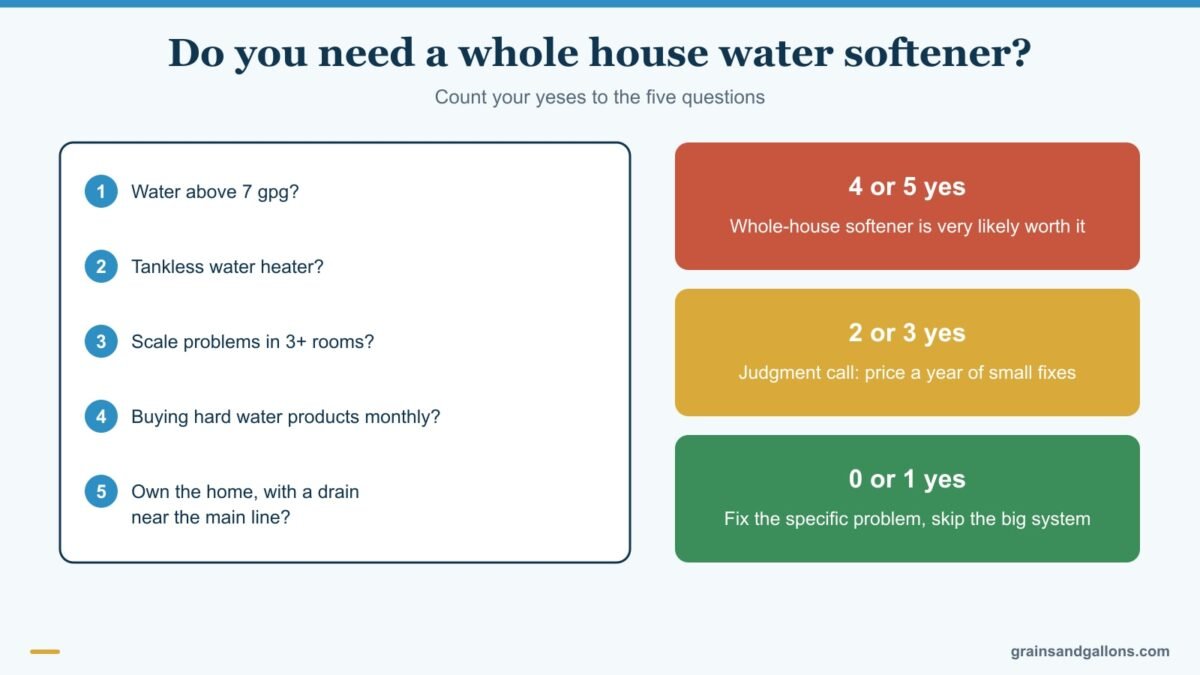
Quick Answer: Do you need a whole house water softener? You do when hardness causes problems in several places at once, especially anything that heats water: the water heater, a tankless unit, the dishwasher. If only one thing bugs you (spotty glasses, a crusty kettle), a targeted point-of-use fix is cheaper. Rough rule: above about 7 grains per gallon with problems in three or more rooms, go whole-house.
Maybe it's one thing, like a crusted kettle. Or maybe it's everything: faucets, glassware, laundry, a water heater that pops. Do you need a whole house water softener in both cases? No, and the right fix depends on which situation you're in.
In this guide
- Match the problem to the smallest fix that works
- Where hard water actually costs money
- Do you need a whole house water softener yet? Five signs
- Cost and upkeep, side by side
- When whole-house isn't the right call
- If you go whole-house, decide size and which taps it feeds
- FAQ
- Small problems get small fixes; scale everywhere gets a softener
Match the problem to the smallest fix that works
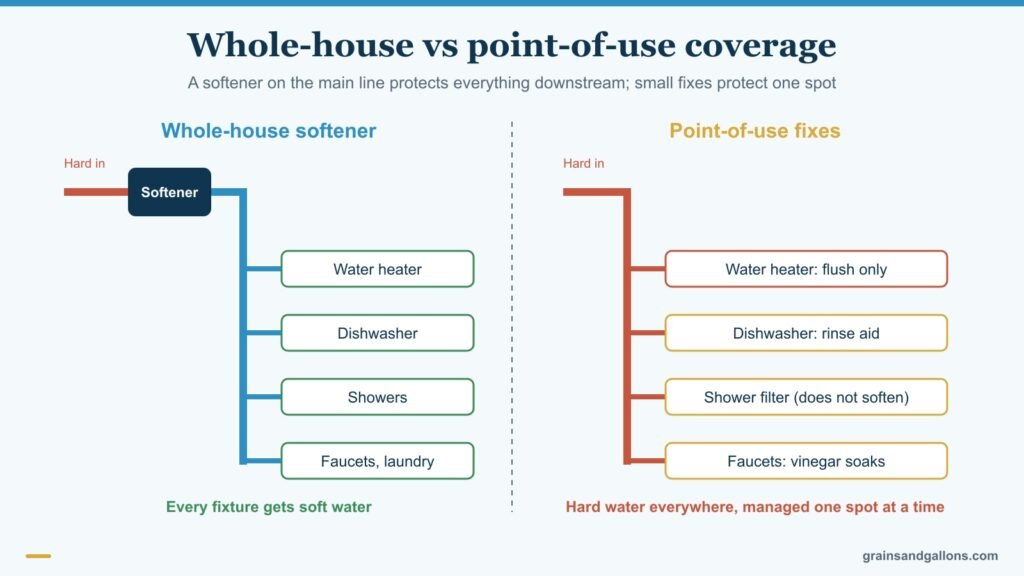
A whole-house (point-of-entry) softener sits on the main line, so every fixture downstream gets soft water. Point-of-use fixes treat one spot. For each thing bothering you, here's the least you can do and how well it holds up:
| What's bothering you | Smallest fix | Holds up in very hard water? |
|---|---|---|
| Spots and film on glasses | Rinse aid plus a hardness-rated detergent | Partly; struggles above about 15 gpg |
| Kettle, coffee maker scale | Descale monthly; use filtered water | Yes, with routine descaling |
| Filmy feel in the shower | Shower filter (doesn't truly soften) | No; most target chlorine |
| White crust on faucets | Regular vinegar soaks | Works, but it's a chore forever |
| Water heater scale, noise | Annual flushing | Slows buildup, doesn't stop it |
| Tankless heater scale | Descaling on the maker's schedule | Depends on the maker's hardness limit |
One or two rows? Start with those fixes. Four or more, and you're paying for many small fixes while still living with hard water. The shower is the most common mix-up: most shower filters reduce chlorine, not hardness. See whole-house softener vs shower filter.
Where hard water actually costs money
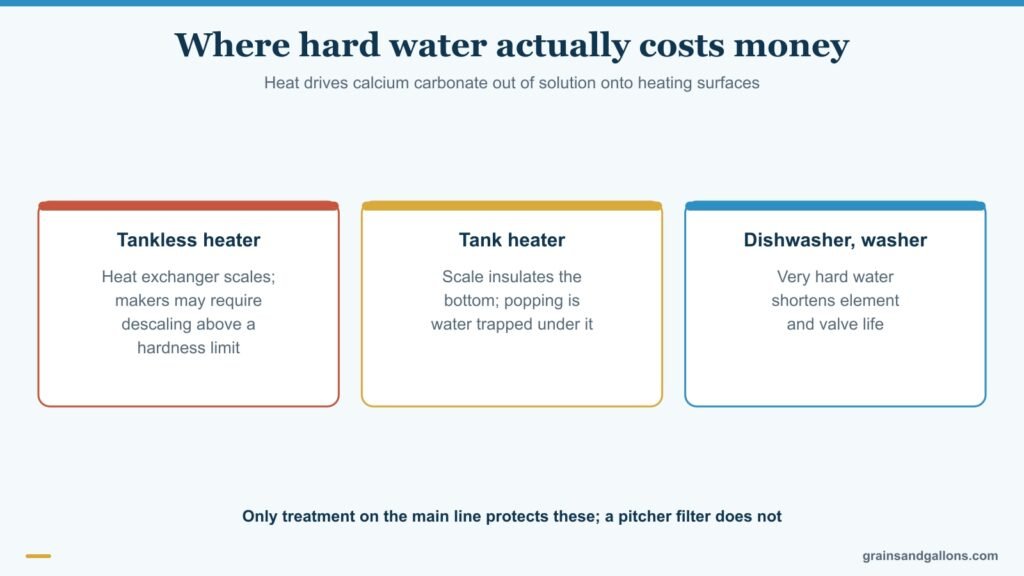
Scale on heated surfaces costs money, and the Water Quality Association lists scale deposits and higher energy costs among the core signs of hard water. Heat drives calcium carbonate out of solution, so scale forms fastest in water heaters and dishwasher elements; why hot water causes more scale explains the chemistry.
- Tankless water heaters are the most sensitive. Check the manual for a maximum hardness; above it, the maker may require scheduled descaling or treatment ahead of the unit.
- Tank water heaters lose efficiency as scale insulates the bottom, and the popping you hear is often water trapped under it.
- Dishwashers and washing machines last years in moderately hard water, but very hard water shortens element and valve life.
No point-of-use fix helps here. A pitcher filter doesn't protect your water heater; only treatment on the main line does.
Do you need a whole house water softener yet? Five signs

- You're descaling something weekly.
- Your water tests over about 10 gpg and you have a tankless heater.
- You've replaced a heater element, dishwasher part or showerhead early because of scale.
- You buy three or four hard water products every month.
- New fixtures look crusty within months.
Any two usually means a whole-house softener pays off.
Cost and upkeep, side by side
Softener sellers commonly quote whole-house systems at roughly $1,500 to $4,000 installed and point-of-use units at a few hundred dollars. The ongoing costs differ too: a whole-house softener needs salt refills and occasional service, while point-of-use filters need cartridge changes every few months to a year and still leave the rest of the house hard. When a year of small fixes approaches the yearly cost of a softener, the bigger system wins.
When whole-house isn't the right call
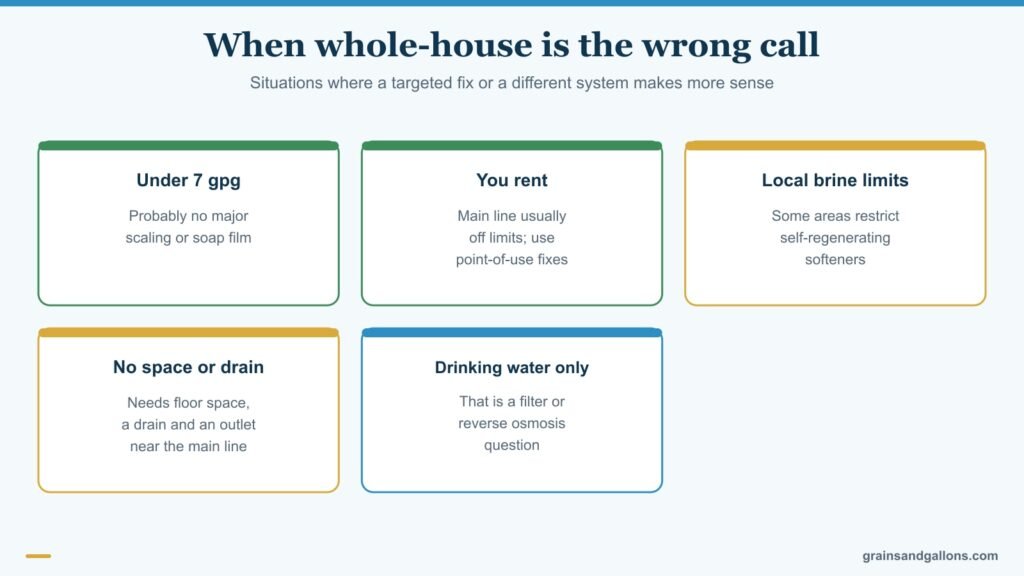
- Water under about 7 gpg and nothing heats up enough to matter. Penn State Extension notes that hardness below 7 gpg probably won't cause major scaling.
- You rent. You usually can't modify the main line; point-of-use fixes are realistic.
- Your town restricts softener discharge, as some parts of California do.
- There's no spot for it. A softener needs floor space, a drain and usually an outlet near the main line.
- You only care about drinking water. That's a filter or reverse osmosis question.
For salt-free and tankless options, see water softener alternatives; most reduce scale differently and won't change your hardness test result.
If you go whole-house, decide size and which taps it feeds

Size depends on hardness and household water use, not bathroom count. Oversized wastes salt; undersized regenerates constantly. Our softener sizing guide walks through the math, and the best water softener for a family of 4 and best water softeners for small homes narrow the choices.
Which taps it feeds matters too. Outdoor hose bibs are usually left hard, and some people keep one kitchen tap unsoftened; see should a kitchen tap bypass the softener.
FAQ
Is a whole house water softener worth it?
It is when hardness is above about 7 gpg and causing scale in several places, especially water heaters. For mildly hard water with one or two annoyances, targeted fixes cost less.
Can I soften only the hot water?
You can, and it protects the water heater, but every cold tap still spots and showers still feel hard because they mix in cold water. Most households get better results treating the whole supply.
Do point-of-use softeners exist?
Yes, for a single appliance or sink, but they protect only that spot. Shower filters sold for "hard water" usually don't soften at all.
What's the downside of a whole house softener?
Upfront cost, salt and occasional service, floor space near the main line, a drain connection, and a small amount of added sodium in the water.
Small problems get small fixes; scale everywhere gets a softener
Do you need a whole house water softener? If hardness is above about 7 gpg and scale is showing up in three or more rooms or inside a water heater, yes. If it's one annoyance in one room, fix that spot and keep your money.