

Quick Answer: Can you reuse water softener discharge? Not for anything that grows. The brine and rinse stages carry most of the salt you put in the brine tank (sodium chloride, or potassium chloride if you use it) plus the hardness and iron the softener removed, and that salt builds up in soil and damages lawns and gardens. It also isn't clean greywater in most places. The workable reuses are small: bucket-flushing a toilet, or keeping only the low-salt backwash. Cutting the discharge at the source does far more.
You watch the drain hose run during regeneration and think: that's a lot of water. Could it go in a rain barrel, on the lawn, into the garden? So can you reuse water softener discharge, or is it waste? The instinct to save it is good. The water mostly isn't, and the reason is which part of the cycle you'd be catching.
In this guide
- What each regeneration stage sends down the drain
- Why salty discharge and plants don't mix
- Can you reuse water softener discharge anywhere at home?
- Softeners that recycle their own brine
- Where softener discharge has to go instead
- Shrink the discharge rather than catching it
- FAQ
- Keep brine out of the garden and make less of it
What each regeneration stage sends down the drain
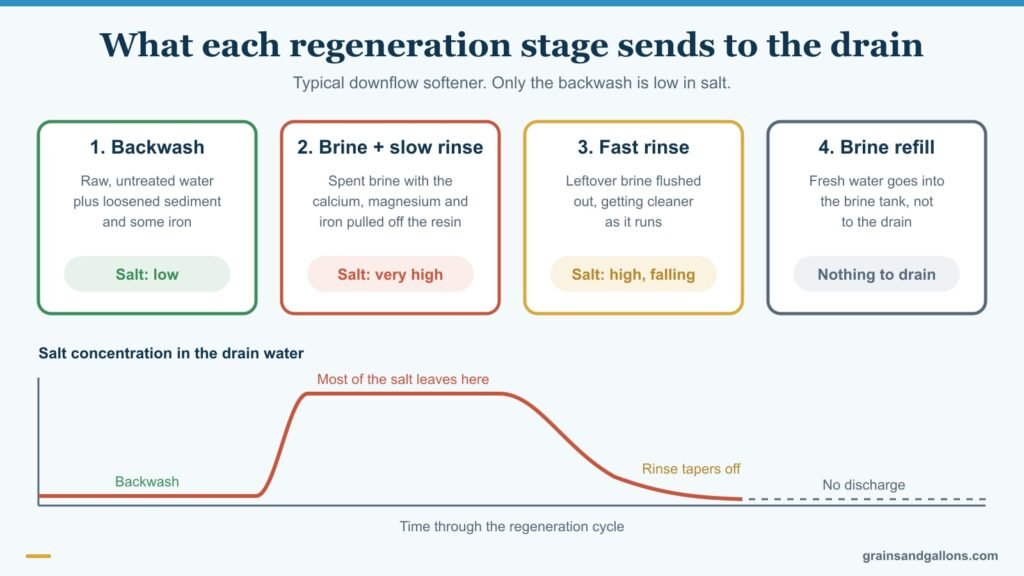
A regeneration isn't one flush. It's a sequence, and each stage sends something different to the drain. Exact steps vary by valve, but a typical downflow softener runs like this:
| Stage | What goes to the drain | Salt content |
|---|---|---|
| Backwash | Raw water that loosened the bed, plus sediment and some iron | Low (it's your untreated water) |
| Brine draw and slow rinse | Spent brine, plus the calcium, magnesium and iron pulled off the resin | Very high |
| Fast rinse | Leftover brine being flushed out, getting cleaner as it goes | Starts high, falls quickly |
| Brine refill | Nothing; water goes into the brine tank | n/a |
The middle stages are the problem. Only the hardness sites on the resin take up sodium, so the rest of the sodium and all of the chloride go to drain. In water treatment specialist Larry Zinser's elution-curve testing for Water Conditioning & Purification, the brine reaching the drain ran about 8 to 10 percent salt and stayed there through most of the brine and rinse cycle. Fresh water poured on a lawn has none.
How much water in total depends on the softener's size and valve. Our guide on how much water regeneration uses breaks it down by tank size.
Why salty discharge and plants don't mix

Salt hurts plants in two ways. Dissolved salt in the soil makes it harder for roots to pull in water, so plants look drought-stressed even when the ground is wet. And chloride itself is toxic to many plants at brine-level concentrations, which shows up as browned leaf edges and dead patches of grass.
Sodium adds a slower problem. It breaks down soil structure, so clay soils seal up, drain poorly and grow less over the seasons. Rain doesn't fully flush it out, which is why "just once in a while" still adds up.
What about potassium chloride?
Potassium is a plant nutrient, and potassium chloride is gentler than sodium chloride on soil structure. But the chloride half is identical, and regeneration discharge carries far more of it than any plant needs. Some gardeners use diluted potassium discharge on salt-tolerant areas, but that's an experiment on your own soil. Switch to potassium chloride for sodium-intake reasons if you like; don't count on it to make the discharge garden-safe.
Can you reuse water softener discharge anywhere at home?
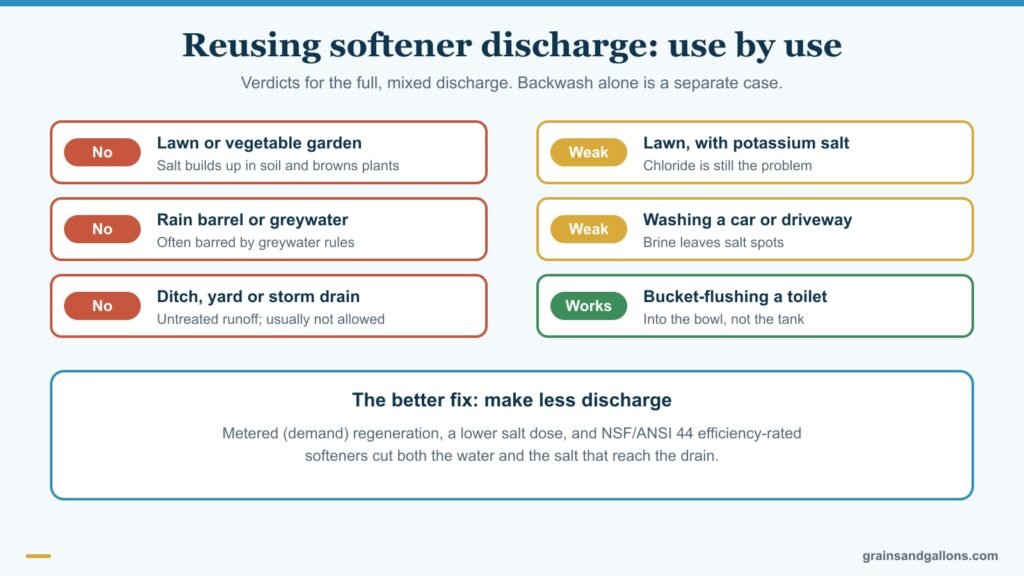
Rain barrels and greywater systems: generally no
Greywater systems are designed for lightly used water such as laundry or shower water. Softener brine isn't that. Many local greywater rules exclude softener discharge, and it can damage the plants, soil and drip lines those systems feed. Check your local code before connecting anything.
Ditches, yards and storm drains: no
Storm drains carry water to streams and lakes without treatment, so sending salty water there is usually not allowed. Some communities, including several in California, restrict softener discharge because chloride passes through wastewater treatment and ends up in rivers and recycled water. Our guide on water softener brine restrictions explains how those rules work.
Flushing a toilet: technically possible
Salty water does no harm in a toilet bowl, and some people catch the rinse water in a bucket and pour it in to flush. It works, but most softeners regenerate around 2 a.m., the buckets are heavy, and backwash can be dirty. Pour it into the bowl, not the tank, since brine is hard on the tank's metal parts. Most people try it once and stop.
Washing a car or driveway: not worth it
Backwash water is just raw water plus sediment, and the brine stages leave salt spots on paint and concrete. The hose is better.
Keeping only the backwash
The backwash is the one stage that's mostly your own untreated water. Maryland's HB 539 (2019), for example, lets homeowners reuse backwash from an on-site water treatment system for gardening, composting or lawn watering, provided it contains nothing harmful to public health or the environment. In practice, separating backwash from brine means switching containers at the right minute in the middle of the night, or adding a valve. And if your raw water is high in iron, the backwash carries that too.
Softeners that recycle their own brine
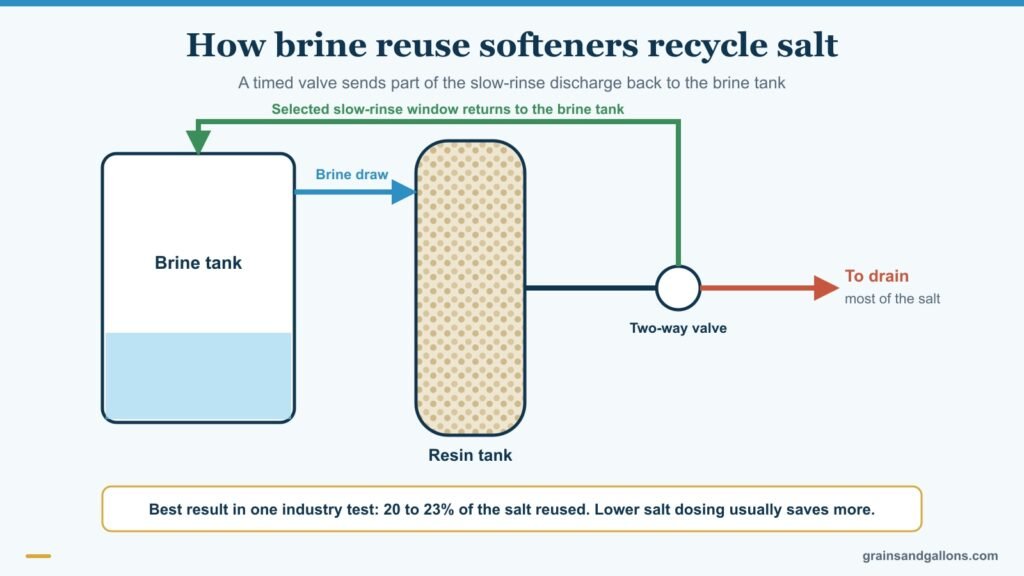
There is one form of discharge reuse that works: the softener doing it itself. Some manufacturers fit a two-way valve on the drain port. During a timed window in the slow rinse, after the brine tank's check valve has closed, the valve sends drain water back to the brine tank, where it dissolves more salt for the next regeneration.
The gains are modest. In Zinser's year of testing, the best result was reusing 20 to 23 percent of the salt sent to drain. Some makers claim up to 35 percent on commercial units. Brine reuse also needs a fairly high salt dose to have enough salt to recover, so a well-tuned softener running a low dose usually saves more salt than a brine-reuse unit. It makes most sense where high doses are unavoidable, such as water with a lot of iron. A standard for brine reuse systems, ASSE 1088, is in development.
Where softener discharge has to go instead
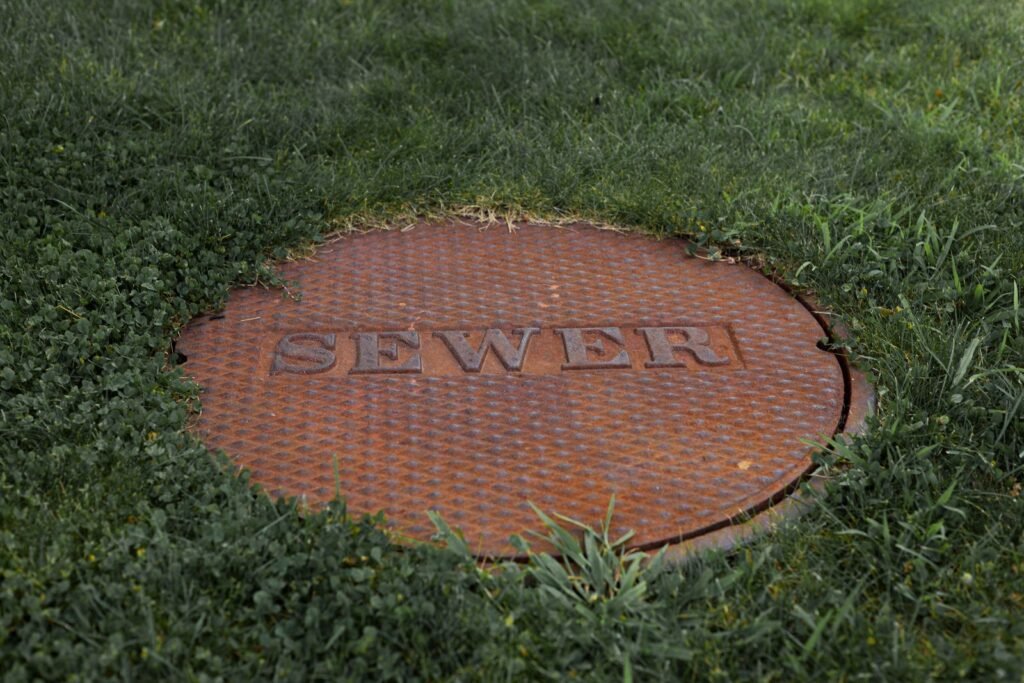
Since reuse is limited, most discharge has one of a few legal destinations:
- Sanitary sewer through a floor drain, standpipe or laundry drain with an air gap. This is the default in most towns.
- Septic system. Opinions differ on how much brine matters to a healthy system, and some states have specific rules. See water softener with a septic system before rerouting anything.
- Dry well or drain field, where local rules allow it, usually only away from wells and above the water table.
Our guide on where a water softener can drain covers each option and the code requirements.
Shrink the discharge rather than catching it
If what bothers you is the water and salt going down the drain, changing how the softener runs does far more than reusing what comes out. The EPA's WaterSense technical sheet on water softeners points out that better salt efficiency cuts the sodium and chloride in a home's wastewater, which matters for septic systems and for communities trying to meet discharge limits.
- Metered (demand-initiated) regeneration. Timer softeners regenerate on a schedule whether or not the capacity was used. A metered valve regenerates only when needed, which EPA notes is more efficient.
- An efficiency rating. NSF/ANSI 44 includes a voluntary efficiency rating that requires 5.0 gallons of water or less per 1,000 grains of hardness removed.
- A lower salt dose. Many softeners ship set high. Turning the dose down within the manufacturer's range cuts salt per regeneration; our guide to setting the salt dose shows how.
- Upflow brining. Softeners that brine upward through the resin tend to use less salt and rinse water. See upflow water softeners for low salt use.
- Soften only what needs it. EPA suggests that outdoor taps may not need softened water, so leaving them on hard water reduces regenerations.
Our list of high-efficiency water softeners that save salt compares units built around lower salt and water use.
FAQ
Can I use water softener backwash water on my garden?
Not the full discharge. The brine and rinse stages are very salty and will damage plants and soil over time. Only the first backwash stage is low in salt, and catching it separately is rarely practical.
Is water softener discharge safe for grass?
No. Grass is somewhat salt-tolerant, but repeated brine discharge browns it and builds sodium and chloride in the soil. Potassium chloride salt reduces the sodium problem but not the chloride.
Can softener discharge go into a rain barrel?
It's a poor fit. Whatever you store will be salty and unsuitable for watering, and many greywater rules don't allow softener discharge at all.
Does using potassium chloride make softener discharge safe to reuse?
Not really. It avoids adding sodium to the soil, but the discharge still carries a lot of chloride, which harms many plants at those concentrations.
Can I drain my water softener onto my lawn or into a ditch?
Usually not. Many jurisdictions prohibit discharge to storm drains, ditches and surface water, and some limit discharge onto the ground near wells. Check local rules before running a drain line outside.
Keep brine out of the garden and make less of it
So can you reuse water softener discharge? Only in small ways: a bucket for the toilet, or the low-salt backwash where local rules allow it. The brine and rinse water belong in the sewer or an approved septic or dry-well system, not on plants or in a rain barrel. If the waste bothers you, demand regeneration, a lower salt dose and an efficiency-rated softener cut the discharge itself.