

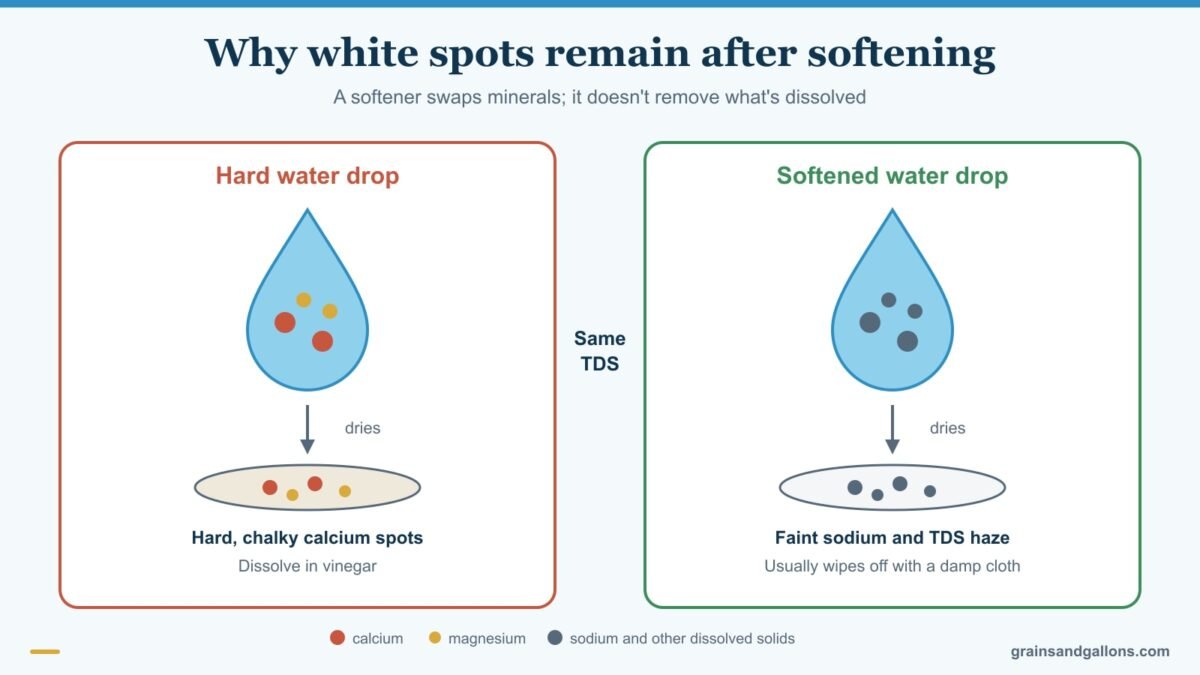
Quick Answer: When white spots remain after softening, test the hardness of the softened water at a cold tap. If it reads above about 1 grain per gallon (gpg), hard water is getting through: check the bypass valve, the salt, the hardness setting and the regeneration schedule. If it reads close to zero, the softener is working and the spots come from other dissolved solids, silica or soap residue that a softener doesn't remove. A drop-count kit like the Hach Total Hardness Test Kit, Model 5-EP gives a clearer answer than strips at low levels.
Disclosure: As an Amazon Associate, Grains & Gallons earns from qualifying purchases.
You put in a softener so you'd stop squeegeeing the shower every day. Two months later the glass still dries with a haze and the dishwasher still leaves spots. When white spots remain after softening, it can mean two completely different things, and you won't fix it until you know which one you have.
In this guide
Test the softened water at the tap that spots
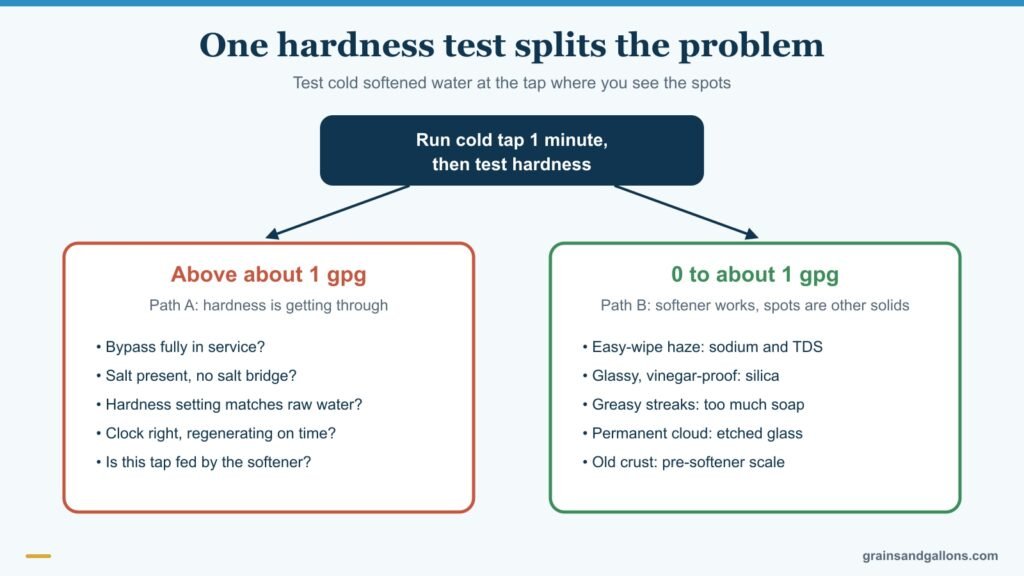
Everything depends on one number. Run a cold tap that's after the softener for a minute, ideally the one where you see the spots, then test.
- Above about 1 gpg: hardness is getting past the softener. Go to Path A.
- 0 to about 1 gpg: the softener is doing its job. Go to Path B.
Test strips are hard to read near zero. A titration kit, where you count drops until the color changes, gives a definite answer; our list of the best water hardness test kits covers both types. Test the raw water too, at an outdoor spigot or another tap before the softener, so you know what you're starting with. Minnesota's health department notes that regular testing and maintenance are necessary to make sure a softener is working properly.
Path A: hard water is still slipping through
Work through these in order. The first ones take seconds.
- Is the bypass valve in the service position? If someone bypassed the softener for a repair and forgot, it isn't treating anything. Partly open is just as bad.
- Is there salt, and is it dissolving? An empty brine tank is obvious. A hard crust with an empty space below it, a salt bridge, is less obvious but just as common. Poke it gently with a broom handle.
- Is the hardness setting right? If the valve is set for 10 gpg and your water is 22, it runs out of capacity days before it regenerates. Set it to your raw-water result, plus an allowance for iron if you have it.
- Is the clock right, and is it regenerating? A wrong time of day or a dead motor can skip regenerations. Check the display for the last regeneration.
- Is this tap actually on the softener? Some homes have a kitchen cold line, wet bar or outdoor spigot plumbed before the softener. Test the tap where you see spots, not just any tap.
- Is a little hardness slipping through all the time? That's bleed-through. Low salt doses, worn resin or very hard raw water can let some hardness leak past even right after regeneration. Our guide to hardness bleed-through explains the causes, and how to check if a water softener is working has the full checklist.
When the softener needs a pro
If you've worked through all six and still measure hardness, the resin may be fouled or worn, or the valve may need service. A water treatment dealer or plumber can check the internals. On a well, if the spots changed suddenly, retest the raw water first; well chemistry can shift with the seasons or after pump work.
Path B: zero hardness, but spots anyway
A softener swaps calcium and magnesium for sodium. It doesn't lower the total amount of dissolved material in the water. Penn State Extension notes that softening adds 7.5 milligrams of sodium per quart for each gpg of hardness removed. When water evaporates, everything dissolved is left behind, including that sodium, so soft water can still spot. The EPA lists deposits and staining among the noticeable effects of total dissolved solids above 500 mg/L. The difference is usually how the spots look and how easily they come off.
| What you see | Likely cause | What helps |
|---|---|---|
| Faint haze that wipes off easily with a damp cloth | Total dissolved solids (sodium and other salts) | Squeegee or towel dry, rinse aid in the dishwasher |
| Hard, glassy spots that vinegar won't dissolve | Silica | Prompt drying; RO for drinking and rinse water |
| Greasy film or streaks, especially on glass | Too much soap or detergent | Use less. Soft water needs less product. |
| Cloudy glassware that never comes clean | Etching (permanent surface damage) | Prevention only: less detergent, lower heat |
| Hard, chalky spots that dissolve in vinegar | Hardness. Go back to Path A. | Fix the softener |
Measure the dissolved solids
A TDS meter reads total dissolved solids in parts per million. It doesn't tell you what the solids are, and softening barely changes the reading because sodium replaces calcium and magnesium. But a high reading on softened water explains why it still spots. Our guide on how to use a TDS meter shows how to read one, and the best TDS meters roundup covers what to buy. Silica only shows up on a lab test, so check a well water report if you have one.
Haze that never comes off
If glassware stays cloudy after a vinegar soak, it may be etched rather than spotted, and that damage is permanent. Our guide to cloudy glasses: etching or hard water shows how to tell.
Soap residue is the spot nobody suspects
Soft water lathers far more, and most people keep using the same amount of soap and detergent they used with hard water. In the shower that leaves a film on the glass. In the dishwasher it leaves a cloudy residue that looks like hard water spots but smears when you rub it with a finger. Cut dish and laundry detergent by about a third and see whether the spots change before you blame the water.
Habits and filters that stop soft-water spots
- Dry surfaces after use. A squeegee on shower glass and a towel on faucets beat any treatment.
- Use rinse aid in the dishwasher, even with soft water. It helps water sheet off instead of beading and drying.
- Add reverse osmosis where spots matter most. RO reduces most dissolved solids, including sodium and silica, which is why car washes use it for a "spot-free rinse." It's practical for drinking and cooking water, not usually for a whole house. See reverse osmosis and a water softener together.
- Clean old scale once. Layered crust from before the softener won't vanish on its own. Remove it once and new spots should be lighter; our guide to white spots on faucets covers cleaning by finish.
FAQ
Does a water softener stop water spots?
It stops hard, chalky calcium spots, but not all spots. Softened water still contains sodium and other dissolved solids that leave a faint haze when water dries. That haze usually wipes off easily, unlike scale.
What hardness reading means my softener is working?
Close to zero, and generally under about 1 gpg at a softened cold tap. A higher reading means hardness is getting through, so check the bypass, salt, settings and regeneration.
Why does my shower glass still spot with soft water?
Usually dissolved solids left as the water evaporates, or soap film, because soft water needs less soap. Squeegee after each shower and use less body wash and shampoo. If the spots are hard and dissolve in vinegar, test your hardness.
Can a softener add white residue of its own?
Indirectly. The sodium it adds stays in the water and dries as a light film. A hardness setting far above your real hardness wastes salt but doesn't make water harder; brine left in the lines after a faulty rinse cycle can taste salty and leave residue.
Will reverse osmosis remove soft-water spots?
Yes, for the water it treats. RO removes most dissolved solids, so RO water dries nearly spot-free. Most homes use it for drinking, ice and a final rinse rather than the whole house.
If white spots remain after softening, let the test decide
A hardness reading above about 1 gpg means the softener needs attention: bypass, salt, settings or regeneration. A reading near zero means white spots remain after softening because of dissolved solids, silica or soap, and the fix is drying, rinse aid, less detergent or RO, not more salt.