


Quick Answer: A water softener rinse cycle problem usually shows up as salty water the morning after regeneration, a drain that keeps running, or cloudy water. Salty water most often means the brine draw ran slow (a dirty injector, a plugged drain flow control or low pressure), so brine was still in the tank when the rinse ended. A drain that never stops points to a valve stuck mid-cycle or worn seals. Cloudy water that clears from the bottom of the glass up is just air.
If you suspect a water softener rinse cycle problem, the good news is that the rinse step rarely fails on its own. It's short, it runs while you're asleep, and it depends on the steps before it. You notice it when something goes wrong: a salty first glass, a drain that trickles all day, or a cloudy splash in the sink. This guide matches each symptom to its cause and walks you through a manual regeneration so you can watch the rinse yourself.
In this guide
- What the rapid rinse actually does
- Is it a water softener rinse cycle problem or a brine draw problem?
- Salty water the morning after regeneration
- Watch a manual regeneration from start to finish
- When the drain keeps running after the rinse
- Cloudy, gritty or hard water right after the rinse
- Fix the brine draw first, then question the rinse
- FAQ
What the rapid rinse actually does

A softener regenerates in a fixed order. Backwash lifts and cleans the resin bed. Brine draw pulls salt solution from the brine tank through the resin, followed by a slow rinse that pushes most of that brine along. Then comes the fast rinse, also called the rapid rinse: water flows down through the bed at full flow and out the drain. Last, the valve refills the brine tank and returns to service.
The rapid rinse does two jobs:
- Flushes out the last of the brine, so the first water you draw isn't salty.
- Packs the resin back into a firm, even bed, so service water can't channel through gaps and slip past unsoftened.
On many electronic valves, each step has its own time setting. On a Fleck 5600SXT it's labeled RR (rapid rinse), and the Fleck 5600SXT service manual says each cycle step can be set from 0 to 199 minutes. A step set to 0 is skipped entirely. The right value for your tank comes from the seller or the manufacturer's setup sheet, not a forum post. If you've fitted a new head, for example one from our best replacement control valves roundup, confirm the rinse time was set for your tank instead of left at a default.
Is it a water softener rinse cycle problem or a brine draw problem?
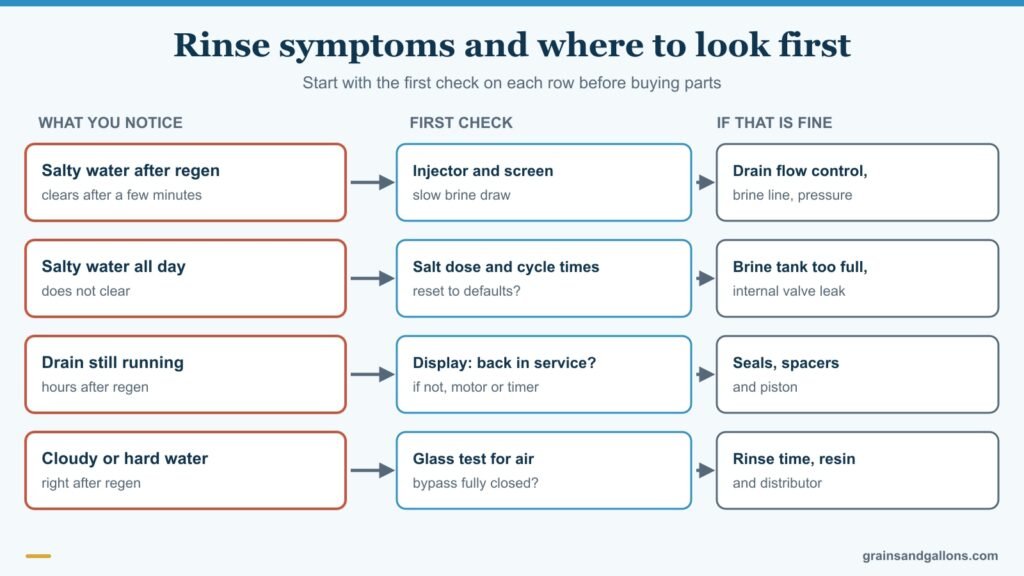
Most of the time the rinse is doing exactly what it's told. It just can't finish the job because an earlier step ran slow, or because the valve isn't sealing between cycles. Use this table to decide where to start.
| What you notice | Most likely cause | What to do first |
|---|---|---|
| Salty water first thing in the morning, clears after a few minutes | Slow brine draw, so brine was still in the bed when the rinse ended | Clean the injector and screen; check the brine line for air leaks |
| Salty water all day | Salt dose too high, rinse time too short or reset to a default, or brine reaching the tank in service | Check the salt setting and cycle times, then the brine valve |
| Drain runs or trickles long after regeneration | Valve stuck mid-cycle, or worn seals, spacers or piston | Check the display, then rebuild or replace the seals and piston |
| Cloudy or milky water right after regeneration | Air trapped in the tank or pipes | Run cold water a few minutes; it should clear |
| Resin beads in the drain or in fixtures | Missing drain flow control, or a broken distributor or upper basket | Inspect the drain fitting and distributor |
| Hard water right after regeneration, then soft | Bed not packed, bypass slightly open, or fouled resin | Check rinse time, the bypass handle and resin condition |
| Rinse step doesn't happen at all | Rinse time set to 0, or a motor or position fault | Check settings, then the motor and switch |
Salty water the morning after regeneration

This is the most common rinse complaint, and the cause usually sits upstream of the rinse itself.
Brine draw has a fixed time. If the injector is partly blocked or the brine line sucks air, the valve pulls brine slowly. When the timer moves on, a lot of brine is still sitting in the resin tank, and a few minutes of rapid rinse can't push all of it out. The first water you use tastes salty, then clears as fresh water flushes the rest.
The Fleck manual's troubleshooting table lists the usual reasons a softener fails to draw brine, and they line up with what we see in the field. Work through them in this order:
- Injector and injector screen. Scale, sediment and salt fines clog the tiny nozzle and throat. Clean them with a soft brush or toothpick, never a drill bit. Our injector cleaning guide shows where it sits on common valves.
- Drain line flow control. A plugged flow control washer slows drain flow during every step, including brine draw and rinse. See how to clear a clogged drain line flow control.
- Brine line. Watch the tubing during brine draw. Bubbles or a loose fitting mean the injector is sucking air instead of brine. Our guide to a brine line air leak covers the fix.
- Water pressure. The Fleck manual's fix for low line pressure is to increase it to 20 psi. Below that, the injector struggles.
- Salt dose and rinse time. A salt setting far above what the tank needs leaves more brine to rinse out. A master reset or a new valve can also put cycle times back to defaults that don't suit your tank.
A slight salty taste can also come from normal softening. The University of Nebraska's guide to water softening notes that softening adds about 8 mg/L of sodium for each grain per gallon of hardness removed, so very hard water produces noticeably more sodium even when every cycle works. Our article on why softened water tastes salty covers that and the other non-rinse causes.
Watch a manual regeneration from start to finish
Reading settings only gets you so far. The fastest way to see what's wrong is to start a regeneration and stand next to the softener with a bucket and a timer. Our guide on how to manually regenerate a water softener covers more brands.
- Start the cycle. On a Fleck 5600SXT, the manual says to hold the Extra Cycle button for 5 seconds. On a Clack control, the Clack reference guide says to press and hold REGEN until the motor starts, typically about 3 seconds. If you've just added salt to an empty tank, Clack says to wait at least 2 hours first so brine can form.
- During backwash, put the drain end in a bucket and confirm steady flow.
- During brine draw, watch the water level in the brine tank. It should drop noticeably. If it doesn't, the injector, screen, brine line or pressure is the problem, not the rinse.
- During rapid rinse, you should see strong, steady flow to the drain. Fleck's start-up procedure has you run this step for five minutes or until the water runs clear. Collect a little drain water near the end and taste it: it should be close to fresh.
- At the end, the valve should refill the brine tank and return to service, and the drain should stop.
On a Fleck SXT, pressing Extra Cycle while the valve is in a regeneration step advances it to the next one, so you can step through quickly once you've seen what you need.
When the drain keeps running after the rinse
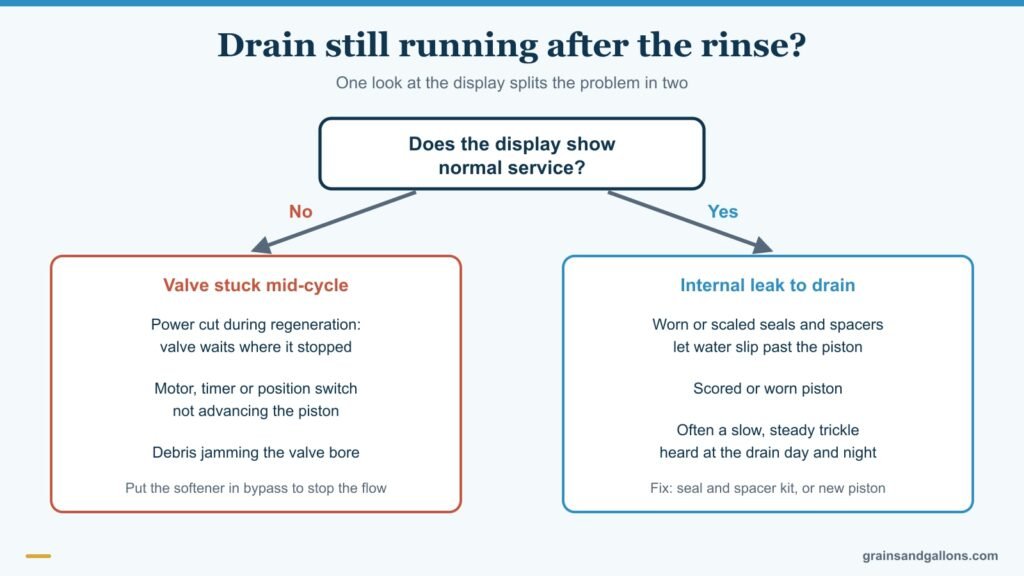
When regeneration ends, the drain should go quiet. If you hear water running or see a trickle hours later, look at the display first.
The display isn't back in service. The valve is stuck mid-cycle. The Fleck manual notes that if power fails during regeneration, the valve stays where it stopped until power returns, then resumes. A failed motor, timer or position switch, or debris in the valve bore, can also leave it parked in a drain position. Put the softener in bypass to stop wasting water, then check power and the motor.
The display says service, but water still trickles. Water is slipping past the piston. In piston valves like Fleck and Clack, a stack of seals and spacers keeps service water out of the drain port. When they wear or get coated with scale, water leaks through even in service. The brine tank level may also creep up, or brine may run constantly to the drain; see salt water coming out of the softener drain for that version.
The fix is a seal and spacer kit, and sometimes a new piston. Before you start, put the unit in bypass, unplug it, and run a cold tap downstream to relieve pressure. Our guide to servicing a control valve walks through the job.
Cloudy, gritty or hard water right after the rinse

Cloudy water that clears from the bottom up is air, not a contaminant. A little air gets trapped in the resin tank and pipes during regeneration, especially after the system has been opened. Run a cold tap for a few minutes and it goes away.
Cloudy water that settles as grit is different. Fill a clear glass and let it sit. Tan or amber beads point to resin escaping, which usually means a missing drain flow control or a broken distributor or upper basket; see resin beads in the softener drain line. Fine silt or rust-colored grit suggests sediment or iron.
Hard water right after regeneration, soft later in the day suggests the bed isn't packing or water is channeling through it. A rinse that's too short or too weak is one cause. Others are a bypass handle that's slightly open, hardness leaking through an old or fouled resin bed, or a mixing valve set too high. Confirm the rinse runs for the time your manufacturer specifies and that drain flow isn't restricted. If the resin is old, cracked or fouled, rinsing harder won't save it. A resin swap, using one of the options in our best replacement water softener resin roundup, may be the real fix.
Fix the brine draw first, then question the rinse
Nearly every water softener rinse cycle problem traces back to something the rinse depends on: a slow brine draw, a restricted drain, low pressure, a setting that got reset, or a valve that no longer seals. Clean the injector and drain flow control, watch one manual regeneration, and you'll know which it is.
If rinse trouble shows up alongside other valve faults on an older head, such as drain leaks, slow motors, stuck pistons or missed cycles, replacing the control valve is often cheaper than chasing each one. Before you order, match your tank thread, distributor tube size and the drain flow control rating for your tank diameter.
FAQ
How long should the rapid rinse on a water softener last?
It depends on the valve and tank size, so use the setting from your manufacturer or installer. As a reference point, Fleck's start-up procedure for the 5600SXT runs the rapid rinse for five minutes or until the drain water runs clear. If the rinse is set to 0, the control skips it.
Why does my softened water taste salty only after regeneration?
Brine was still in the resin tank when the rinse ended, usually because brine draw ran slow. A dirty injector or screen, a plugged drain flow control, an air leak in the brine line or low water pressure are the usual causes. Clean those first before lengthening the rinse.
Is it safe to drink salty water after the softener regenerates?
A brief salty taste isn't dangerous for most people, but it's unpleasant and it means the softener isn't working as designed. Run the cold tap until it tastes normal. If you're on a sodium-restricted diet, talk to your doctor and consider a separate unsoftened or reverse osmosis tap for drinking.
Can a power outage cause rinse problems?
Yes. If power fails during regeneration, many valves stay in their current position until power returns. The drain may keep running, or the cycle may finish later than usual. Fleck's SXT resumes the cycle from where it stopped; on a Clack, the time of day flashes after a long outage and needs resetting.
Why is water still running to the drain after my softener finished?
Either the valve hasn't returned to service, or worn seals and spacers are letting water leak past the piston. If the display shows a regeneration step, check power and the motor. If it shows service and water still trickles, the valve needs a seal kit or new piston.