

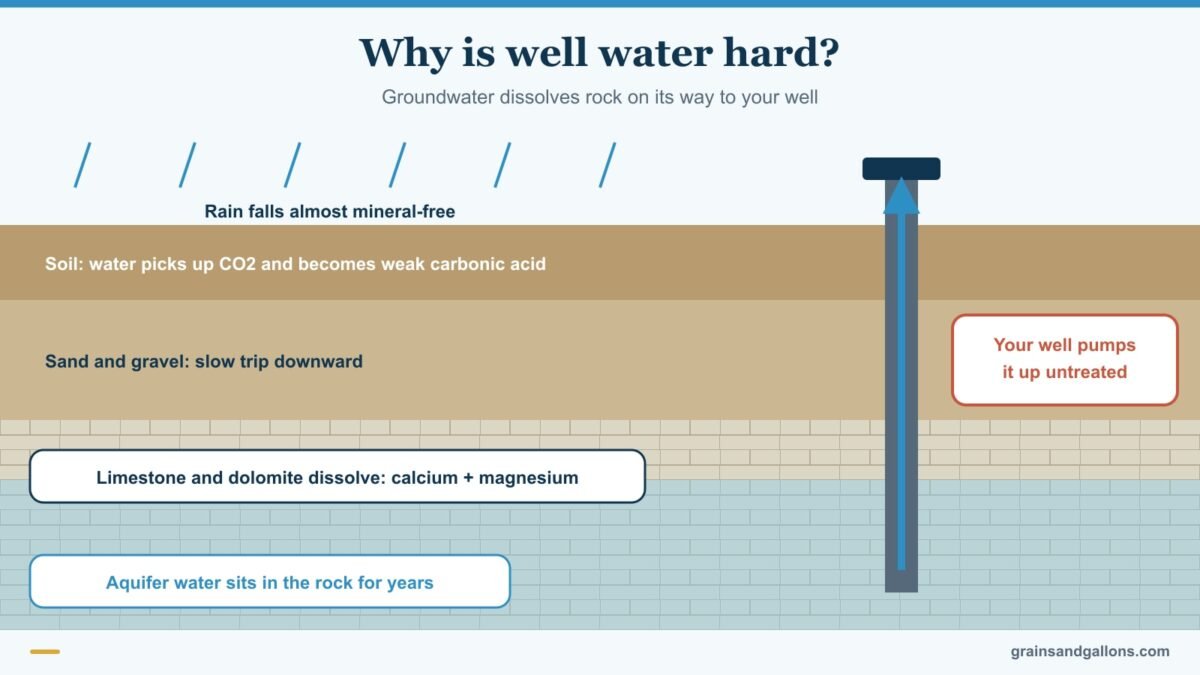
Quick Answer: Why is well water hard? Because it has spent a long time in contact with rock. Rain starts out nearly free of minerals, picks up carbon dioxide as it soaks through soil, and becomes a weak carbonic acid. That slightly acidic water then sits in contact with rock for months to centuries, dissolving calcium and magnesium from limestone, dolomite and other minerals. Wells draw straight from that groundwater, with no utility blending or treating it first, so they often run harder than city water in the same area.
You moved from a city to a house on a well, and within a month the shower glass is cloudy and the kettle sounds like gravel. If you're asking why is well water hard when the town water never was, the short answer is that nothing is wrong with the well. You're tasting the local geology.
In this guide
- Follow a raindrop down to your well
- The same chemistry that carves caves
- Why your neighbor's well may be different from yours
- Is well water always harder than city water?
- Is hard well water safe to drink?
- Hard is rarely the only thing a well brings up
- Test before you buy anything
- FAQ
- Your rock sets the hardness; your test sets the plan
Follow a raindrop down to your well
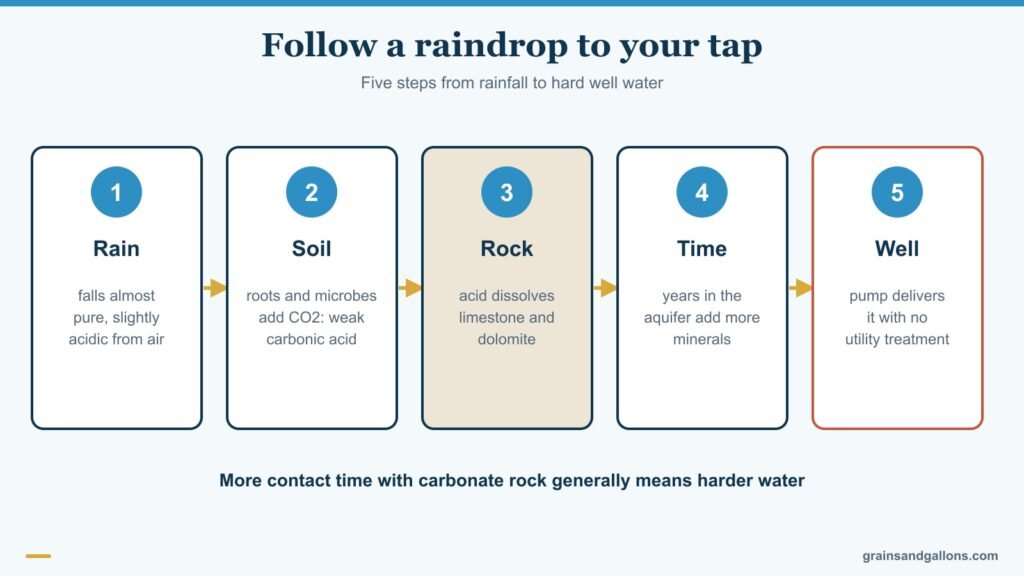
1. It falls almost pure. Rain has very few dissolved minerals. It does absorb a bit of carbon dioxide from the air, which makes it very slightly acidic.
2. It picks up much more CO₂ in the soil. Soil air holds far more carbon dioxide than the atmosphere, because plant roots and soil microbes are constantly breathing it out. Water soaking downward dissolves that CO₂ and becomes carbonic acid. It's weak, but it's enough to work on rock.
3. It meets carbonate rock. Limestone is mostly calcium carbonate. Dolomite is calcium magnesium carbonate. Carbonic acid dissolves both, releasing calcium, magnesium and bicarbonate into the water.
4. It waits. Groundwater moves slowly. Depending on the aquifer, the water in your well may have been underground for years or much longer. More time in contact with rock generally means more dissolved minerals.
5. Your pump brings it up untouched. A municipal system might blend sources, soften at the plant, or draw from a river or reservoir that's had little rock contact. A private well gives you exactly what's in the aquifer.
The same chemistry that carves caves
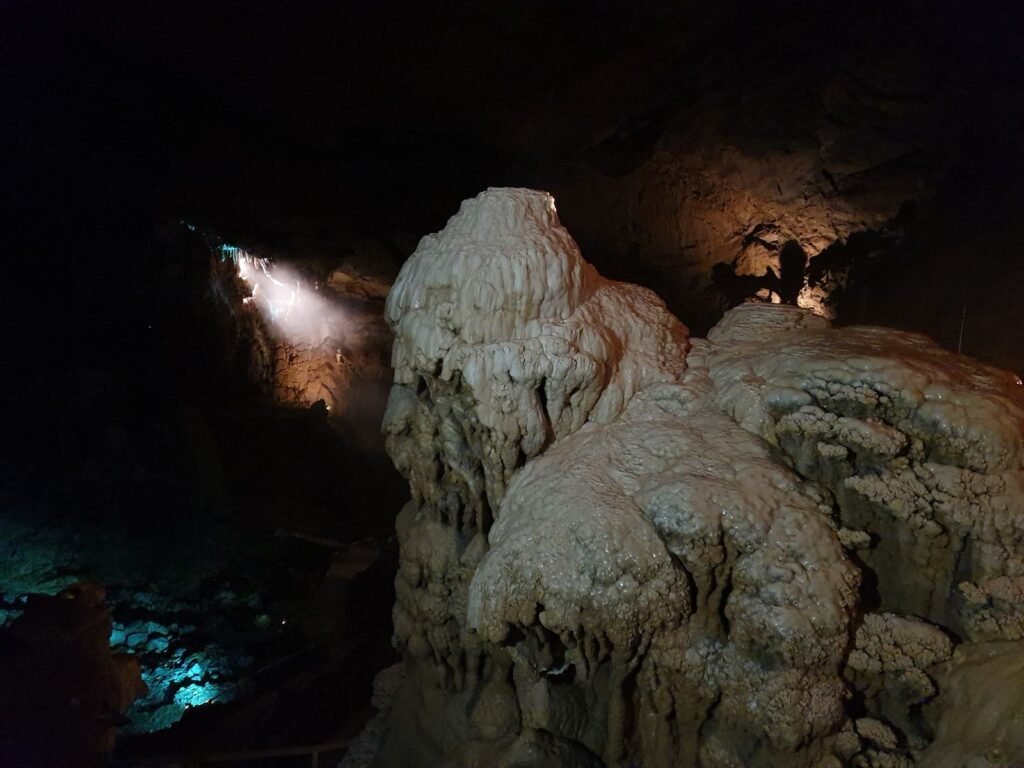
If the idea of acid dissolving solid rock sounds far-fetched, look at a cave. The National Park Service explains that solution caves form when carbon dioxide from the air and soil dissolves in water to make carbonic acid, which slowly eats away at limestone, dolomite and similar rock over long periods.
Your aquifer is running a slow, spread-out version of the same process. Every gallon that passes through carbonate rock carries a little of that rock away as dissolved calcium and magnesium. In a cave the rock disappears in big, visible chunks; in your well it shows up as scale in the kettle and spots on the glass.
Why your neighbor's well may be different from yours

Hardness tracks rock type, and rock type changes across a region and with depth. A few patterns explain most of the variation:
| What's underground | Typical effect on hardness |
|---|---|
| Limestone or dolomite bedrock | Often hard to very hard; this is the classic source |
| Sand and gravel with carbonate fragments (common in glaciated areas) | Often moderately hard to hard |
| Gypsum or other sulfate-bearing layers | Adds hardness that comes with sulfate, not bicarbonate, plus possible taste issues |
| Granite and other crystalline rock | Often soft, though these wells can carry iron, manganese, radon or low pH instead |
| Sandstone, depending on what cements it | Varies widely |
Depth matters too. A shallow well and a deep well on the same property can tap different layers with different chemistry. So the only reliable answer for your house is a test of your water.
Is well water always harder than city water?
No, but often. Hard water is generally more common in much of the Midwest, the Great Plains, Texas and the Southwest, and softer water more common in New England, the Southeast and the Pacific Northwest. City water drawn from the same aquifer as your well can be just as hard. City water from a lake or river is often softer. And plenty of private wells in granite country are soft but aggressive (low pH), which is a different problem.
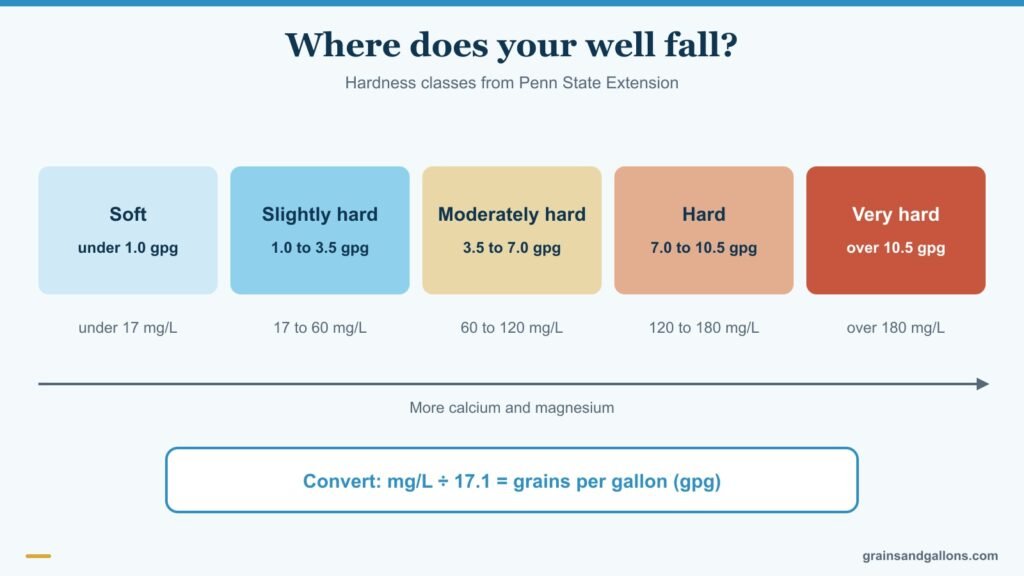
To see where your own number falls, Penn State Extension's water softening guide classifies hardness like this:
- Under 1.0 grain per gallon (under 17 mg/L): soft
- 1.0 to 3.5 gpg (17 to 60 mg/L): slightly hard
- 3.5 to 7.0 gpg (60 to 120 mg/L): moderately hard
- 7.0 to 10.5 gpg (120 to 180 mg/L): hard
- Over 10.5 gpg (over 180 mg/L): very hard
Lab reports usually give hardness in mg/L as calcium carbonate. To convert to the grains per gallon your softener uses, divide by 17.1. A well at 340 mg/L is about 20 gpg.
Is hard well water safe to drink?
For most people, yes. Calcium and magnesium are the minerals that make water hard, and Penn State notes that from a health standpoint they have no adverse effects and are in fact essential nutrients. The trouble with hard water is practical: scale in water heaters and fixtures, soap that won't lather, spotty dishes and dull laundry. Our guide on whether hard water is bad for you covers the skin and hair questions in more detail.
The bigger safety point is about the well, not the hardness. The EPA states that private well water isn't regulated by the federal government, and that private well owners are responsible for making sure their water is safe. Hardness is only one line on the report you should be getting.
Hard is rarely the only thing a well brings up
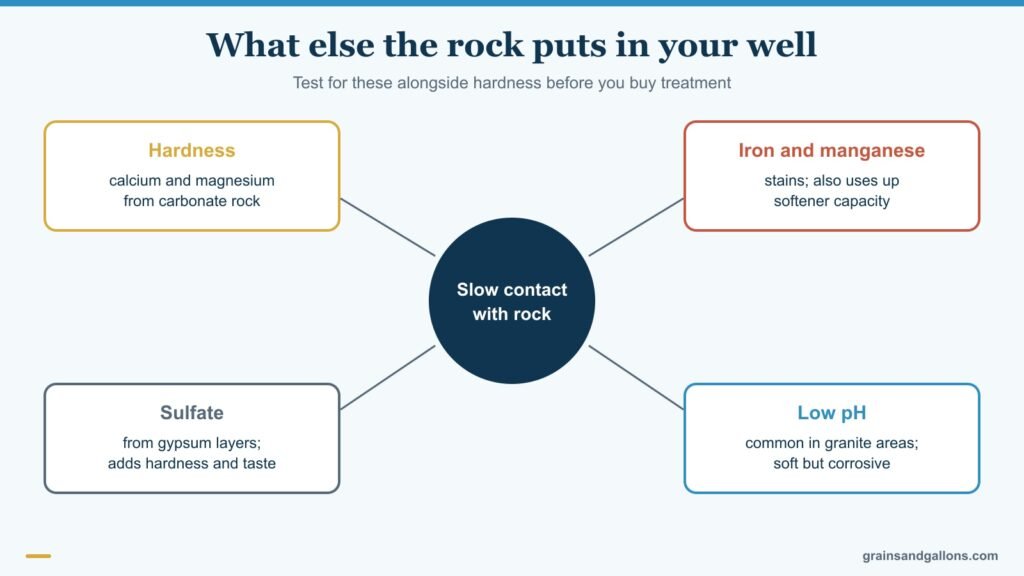
The same slow contact with rock that dissolves calcium can also dissolve iron and manganese, especially in water that's low in oxygen. That matters for treatment in two ways:
- Iron counts against your softener's capacity. A softener sized only for hardness can run out early when iron is present. Our article on how iron changes water softener sizing shows the math.
- Order of equipment matters. Sediment, iron, acid neutralizer, softener and disinfection each have a sensible place in line. See our guide to well water treatment train order.
It also helps to know whether your hardness is the bicarbonate type or the sulfate type, since that affects scaling and taste. Types of water hardness explained breaks that down.
Test before you buy anything
Don't size equipment from a regional map or a neighbor's number. Test your own well for total hardness, iron, manganese, pH and TDS at minimum, plus total coliform bacteria and nitrate for safety. A good lab panel gives all of that at once; our picks for the best well water test kits include both mail-in lab options and at-home kits. Penn State also suggests using an independent lab rather than relying only on a free test from a company selling softeners.
Then expect the numbers to drift a little. Wells can shift with seasons, drought and pumping, which we explain in why well water chemistry changes. Our guide on how often to test well water sets out a schedule; retesting once a year keeps your softener settings honest.
If your results come back above roughly 20 gpg, or you have hardness plus iron, a standard small softener may struggle. Our guide to the best water softeners for very hard water focuses on systems with the capacity and valve settings for that.
FAQ
Why is well water hard in some places and soft in others?
It comes down to the rock. Wells drilled into limestone, dolomite or carbonate-rich glacial deposits are usually hard, but wells in granite and other crystalline rock are often soft. Even neighboring wells can differ if they tap different layers or depths.
Why is my well water harder than my old city water?
Many cities draw from rivers or lakes that have had little contact with rock, blend several sources, or soften water at the plant. Your well delivers groundwater exactly as it comes out of the aquifer, after years of dissolving minerals.
Can well water hardness change over time?
Yes, somewhat. Seasons, drought, heavy pumping and changes in the water table can shift which water your well draws, and with it the mineral content. Testing once a year catches those shifts before they throw off your softener settings.
How do I fix hard well water?
Test first, then treat. A salt-based ion-exchange softener is the standard fix for hardness, but iron, manganese, low pH or sediment may need their own equipment ahead of it. The test results decide the order and the sizing.
Does hard well water need to be treated for health reasons?
Hardness itself isn't considered a health hazard, so treating it is about protecting plumbing, appliances and comfort. Bacteria, nitrate, arsenic and other contaminants are the health concerns, which is why a full lab test matters more than a hardness strip.
Your rock sets the hardness; your test sets the plan
So why is well water hard? Because rainwater turns into a weak acid in the soil and spends years dissolving calcium and magnesium from the rock around your well, and no utility treats it before it reaches your tap. You can't change the geology, but a lab test tells you exactly how hard your water is and what else came with it, and that's what should decide your treatment.