


Quick Answer: A water softener skipping cycles is often doing exactly what it should: a metered unit only regenerates when it has treated enough gallons, so it can go quiet for days. If it truly misses a regeneration it needed, check power and a flashing clock, the bypass valve, vacation mode and the control settings, then the meter and motor. If it regenerates but the salt never goes down, the brine step is being skipped, usually because of a salt bridge, a clogged injector or brine line, or a step time set to zero.
"Skipping cycles" means two very different things depending on who's saying it. Some people mean the water softener didn't regenerate on a night they expected. Others mean it regenerates, but one step, usually the brine draw, never seems to happen. Sort out which one you have first, because the fixes barely overlap.
In this guide
- Missed night or missed step? Sort it out first
- A skipped night is normal on a metered softener
- Power outages and the flashing clock
- Bypass, vacation mode and settings that stop regeneration
- When the valve runs but the brine step gets skipped
- Watch a manual regeneration to find the skipped step
- FAQ
- Fix the cause before you replace the head
Missed night or missed step? Sort it out first
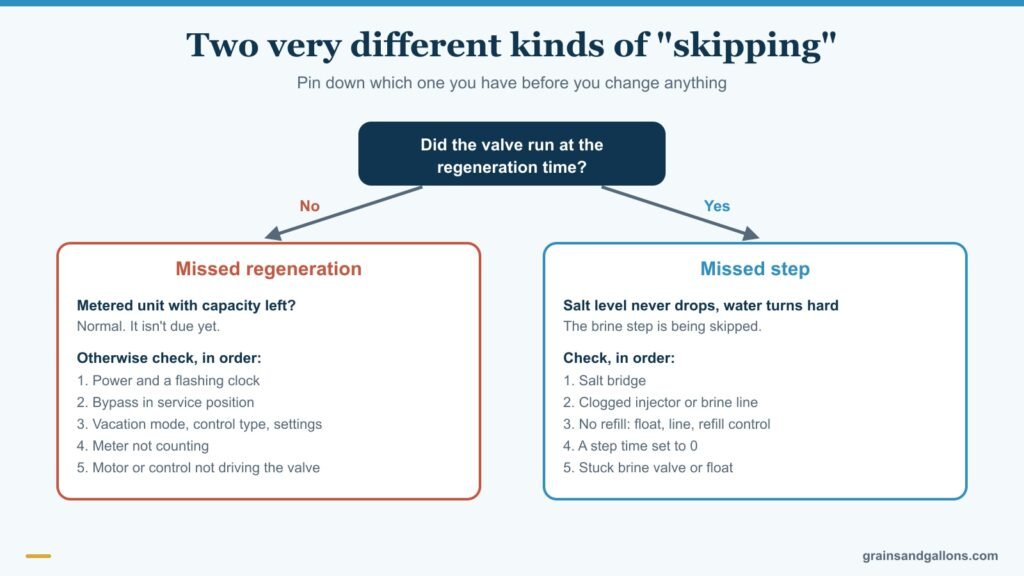
The quickest test is to be there at the regeneration time, or start a manual regeneration and listen. If the valve motor never runs, you have a missed regeneration. If it runs through its steps but the salt level never drops and soft water turns hard, a step is being skipped. Our guide on how to manually regenerate a water softener covers the button or knob for common valves.
A skipped night is normal on a metered softener
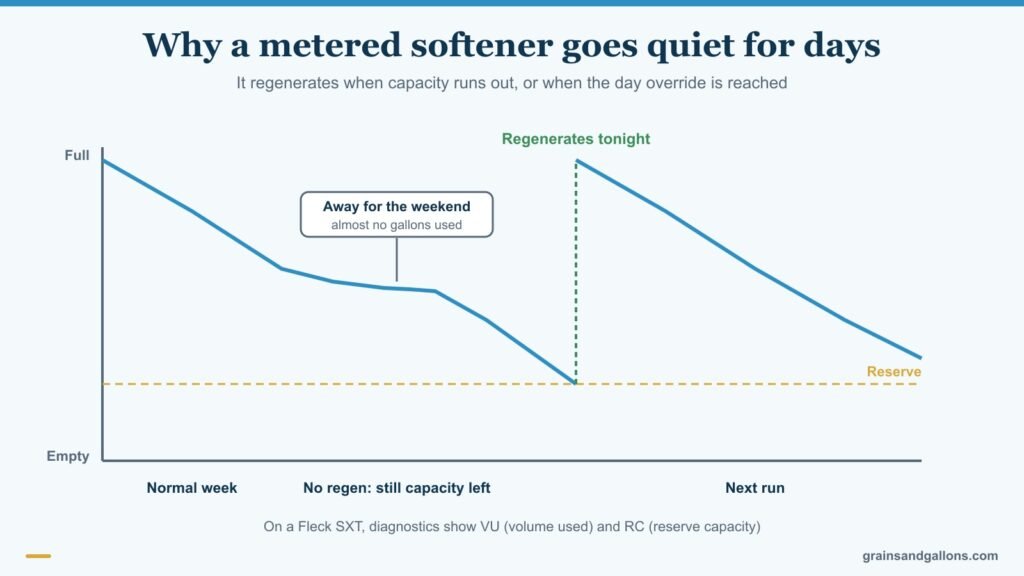
Timer softeners regenerate on a calendar: every few days or on set weekdays. Metered (demand) softeners regenerate based on gallons used. Pentair's Fleck SXT service manual describes it plainly: a meter-delayed control measures water use and regenerates at the programmed time after the calculated capacity is used up. If the house was empty for a long weekend, a week without regeneration is exactly right.
Metered controls also have a day override, a backstop that forces a regeneration after a set number of days even if the capacity hasn't run out. So a metered softener on a quiet week should still regenerate eventually.
You can usually check where it stands. On a Fleck SXT, the diagnostic screens show VU (volume used since the last regeneration) and RC (reserve capacity). Other controls show gallons remaining or flash an indicator when a regeneration is scheduled for tonight. If plenty of capacity is left, the softener isn't skipping; it just isn't due.
Power outages and the flashing clock

During an outage, nothing regenerates. The Fleck SXT manual says the control won't start a new regeneration without line power. If it misses one because of an outage, it queues a regeneration and runs it the next time the clock reaches the programmed regeneration time, which usually means one day late. That explains one skipped night after a storm.
The SXT keeps time for at least 48 hours on its backup, but it stops monitoring water use while the power is out, and the time of day flashes afterward. Longer outages are where clocks drift. GE's softener manual notes that after a long outage the softener keeps working, but regenerations may happen at the wrong time of day until you reset the clock. A clock that's 12 hours off can make the softener regenerate mid-afternoon, which looks like skipping if you only listen at 2 a.m.
What to do: reset the time, confirm the regeneration time, and check the outlet or breaker if the display is dark. If outages are frequent, the Fleck manual suggests setting enough reserve capacity to cover a delayed regeneration.
Bypass, vacation mode and settings that stop regeneration

1. The bypass. If the softener is in bypass, water never passes the meter, so a metered control never counts down. Make sure the bypass is fully in the service position after any plumbing work.
2. Vacation or holiday mode. Some controls have a setting that pauses or changes regeneration while you're away. If it's left on, regeneration stops or changes. See regeneration problems after vacation mode.
3. The wrong control type. On a Fleck SXT, the control type decides what triggers regeneration: Fd (meter delayed), FI (meter immediate), tc (time clock) or dAY (day of week). A mix-up after a reset can make a metered unit behave like a weekly timer, or the reverse.
4. Hardness too low or capacity too high. The control divides capacity by hardness to work out gallons between regenerations. Enter a hardness that's too low, or a capacity that's too high, and the gallons between regenerations balloon.
5. A meter that isn't counting. If the meter doesn't register flow, the gallons never run down and the softener only regenerates when the day override kicks in. Our guide to a flow meter not counting gallons explains how to test it.
6. The motor or control. If a regeneration is due and nothing happens at the set time, the motor may not be turning or the control may not be signaling it. Start a manual regeneration and watch. If manual works but automatic doesn't, suspect the settings or clock; if neither works, suspect the motor, power supply or board.
When the valve runs but the brine step gets skipped
You hear the valve run at night, but the salt never goes down, the brine tank level never drops and the water turns hard. The softener is going through the motions without brine.
- Salt bridge. A hard crust forms above the water with a hollow underneath, so the valve draws weak or plain water. GE's manual describes checking for one by carefully pushing a broom handle down through the salt. Our salt bridge guide shows how to break it safely.
- Clogged injector or brine line. Without suction, the brine stays in the tank. See how to clean a water softener injector and brine line clogged.
- No refill. If the brine tank is nearly dry after a regeneration, the refill step isn't putting water back, so the next cycle has no brine. Check the float, the brine line and the refill flow control; no water in the brine tank walks through it.
- A step set to zero. On the Fleck SXT, each cycle step can be set from 0 to 199 minutes, and the manual states that setting a step time to 0 makes the control skip that step during regeneration. After a master reset or a programming slip, a brine or refill step can end up at zero. Compare the step times with your installer's setup card.
Watch a manual regeneration to find the skipped step
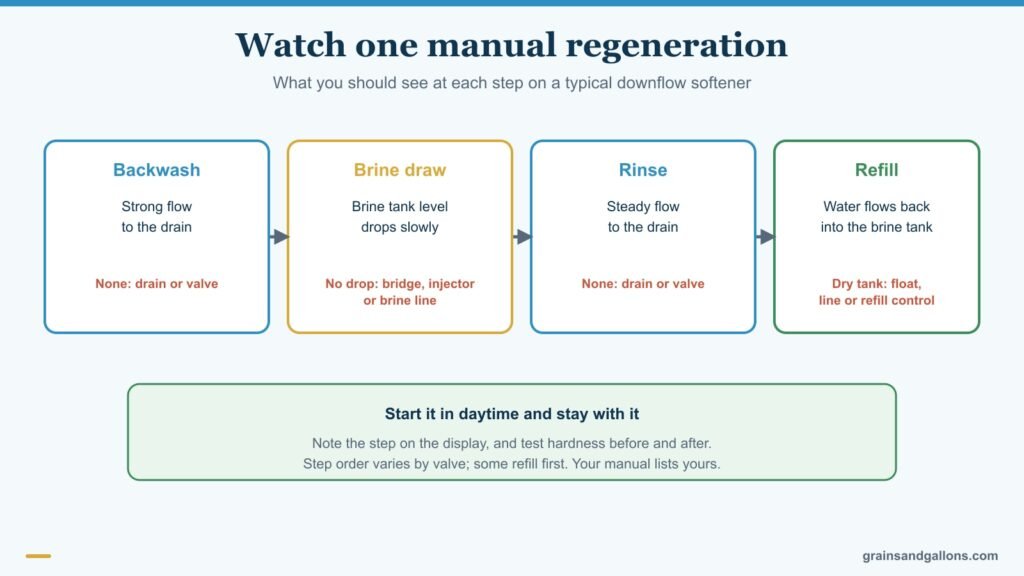
Start a manual regeneration during the day and stay close:
- Note the display as it moves through each step.
- During backwash, water should run strongly to the drain.
- During brine draw, the brine tank level should drop slowly.
- During rinse, the drain should run steadily.
- During refill, water should flow back into the brine tank.
Step order varies by valve, and some valves refill first, so follow the sequence your manual lists. Whichever step looks wrong or doesn't happen is where to focus. Our guide on how to check if a water softener is working adds hardness tests before and after.
FAQ
Is a water softener skipping cycles ever normal?
Yes, on a metered softener. It regenerates only when the gallons used reach its calculated capacity, or when the day override is reached, so low water use means fewer regenerations.
Why didn't my water softener regenerate last night?
The most common reasons are that it wasn't due yet, a power outage, a wrong clock, the bypass left on, or a setting change. A Fleck SXT that misses a regeneration during an outage queues it for the next scheduled regeneration time.
How do I know if my softener skipped the brine cycle?
The salt level stays the same for weeks, the brine tank water level doesn't drop during regeneration, and hard water returns. Watch a manual regeneration to confirm.
Can a power outage reset my water softener?
Most electronic controls keep their settings in memory, but the clock may be wrong or flashing afterward. Reset the time so regeneration happens when you expect it.
Should I replace the control valve if it keeps skipping?
Only after ruling out settings, power, bypass, salt bridges and the injector. If the motor only works some of the time or the board keeps resetting, a new head from our list of the best replacement control valves may be the cleaner fix.
Fix the cause before you replace the head
A water softener skipping cycles is usually telling you something simple: it isn't due yet, the clock drifted after an outage, a setting changed, or the brine step can't draw. Watch one manual regeneration and the cause usually shows itself. If you're on an old timer-only unit and want regeneration based on actual use, our list of the best metered on-demand water softeners is the place to start.