

Quick Answer: A water softener loop is a pair of pipe stubs where the main cold line comes out of the wall, runs through a short jumper, and goes back in to feed the house. Later you remove the jumper and connect a softener. In new construction it's cheap to add, but it only pays off if it sits on the right part of the line (after the outdoor faucets branch off, before the water heater), with shutoffs, a drain and an always-on outlet beside it. Settle those details before drywall goes up.
The plumber's walkthrough is coming up, drywall is scheduled for next week, and the options sheet says "water softener loop: yes/no." Say yes. Then make sure it's done in a way you can actually use, because a badly placed loop can cost more to fix later than having none at all.
In this guide
What a water softener loop actually is
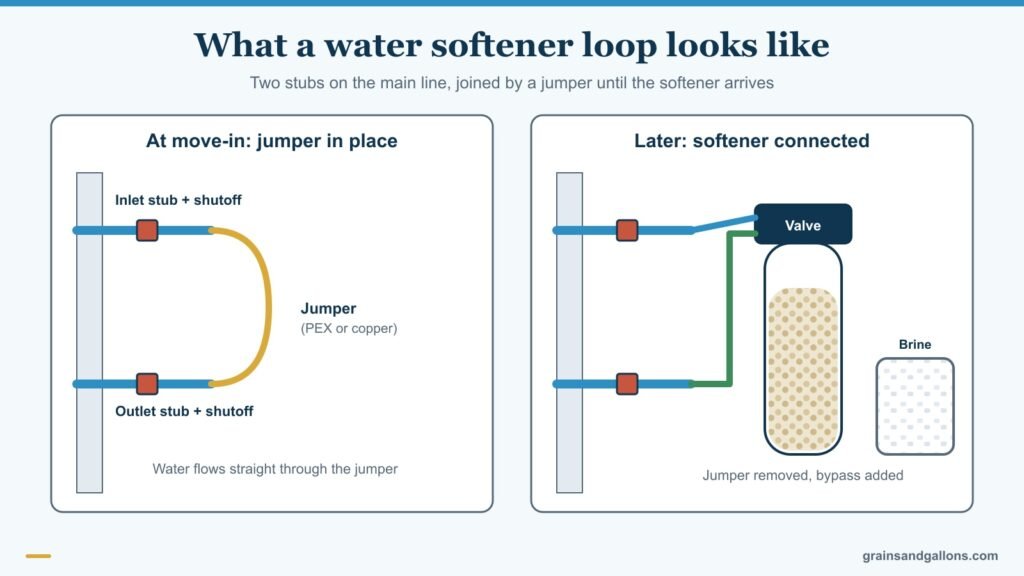
Picture the main cold line coming into the house. Instead of running straight to the fixtures, it comes out through the wall, makes a U-turn through a short jumper of PEX or copper, and goes back in. The two stub-outs are the softener's future inlet and outlet. Until a softener is installed, water just flows through the jumper.
Some builders put the stubs in a recessed wall box with a drain and outlet built in. Others leave two pipes sticking out of the garage wall with a loop of PEX between them. Either works if it's on the right line. The stubs should match the main line, which in most homes is 3/4" or 1" pipe. Necking the loop down to a smaller size than the main just builds in a pressure loss.
A loop isn't strictly required, since a plumber can cut a softener into an existing main later. But in a finished house that can mean opening walls, and it's harder to keep the outdoor lines separate after the fact.
Which lines should the loop feed?
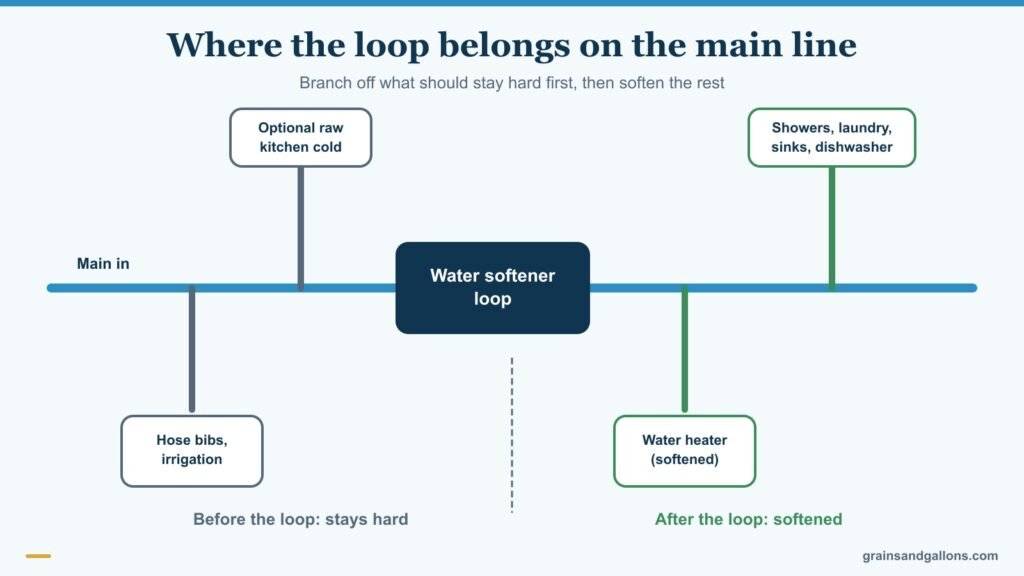
The loop's position on the main decides which water gets softened. Penn State Extension notes that toilets, outside spigots and basement sinks can be bypassed, and that some homeowners choose to soften hot water only. The usual layout:
- Hose bibs and irrigation: before the loop. There's no point softening lawn water, and it burns salt. Our guide on whether outdoor faucets should bypass a softener covers the trade-offs, including the one hose bib some people want softened for washing cars.
- Water heater: after the loop. Protecting the heater from scale is one of the main reasons to soften.
- Showers, laundry, sinks and dishwasher: after the loop.
- Kitchen cold tap: your call. A softener adds sodium; Penn State puts it at 7.5 mg per quart for each grain per gallon of hardness removed. If you want an unsoftened drinking tap, ask for that line to branch off before the loop now. See should a kitchen tap bypass the softener.
- Fire sprinklers: if the house has a residential sprinkler system, follow the sprinkler designer's guidance on where it connects.
The most common mistake is a loop placed after the hose bibs have already been teed into the softened side, or one that misses a wing of the house. Ask the plumber to show you on the plan exactly which fixtures are downstream of the loop.
Rough in water, drain, power and space together

A loop with no drain or outlet nearby is half a job. Using the Pentair Fleck 5600SXT manual as a typical example of what a softener needs:
| Item | What to ask for |
|---|---|
| Shutoffs | A valve on each stub, so the loop can be isolated for install and service |
| Drain | A standpipe, laundry drain or floor drain nearby. Fleck wants the softener no more than 20 feet from the drain, 3/4-inch line beyond 20 feet, and an air gap of two pipe diameters or 1 inch, whichever is larger |
| Power | A constant electrical supply. Avoid an outlet on a wall switch |
| Temperature | Fleck lists ambient temperatures above 34°F and below 120°F. Garage loops in cold climates need a heated or insulated space |
| Floor | A level floor with room for the resin tank, brine tank and lifting the salt lid |
Each regeneration also sends water to drain; Penn State estimates about 50 gallons per cycle. If the house is on a septic system, read our guide to a water softener with a septic system before choosing where the drain goes. Our drain line requirements guide covers code basics, and how much space a water softener needs lists real dimensions.
Garage, basement or utility room?
Builders in warm-climate areas often put the loop in the garage, close to where the main enters and near the water heater. That's usually fine. In colder areas, a basement or utility room is safer because a softener must not freeze. Our guide on where to install a water softener compares the options.
Questions to ask before the walls close
- Which fixtures are downstream of the loop, and are the outdoor faucets upstream?
- Is there a separate unsoftened kitchen cold line, if I want one?
- Where will the softener drain, and how far is it from the loop?
- Is there an always-on outlet within reach?
- Are there shutoffs on both stubs, and what size is the pipe?
- Is the loop area protected from freezing?
- Does the loop get inspected now, and will a softener install need a permit later?
Take photos of the plumbing before drywall goes up. When you install the softener months later, you'll want to know exactly where the lines run.
When you're ready to install
If the loop is right, installation is straightforward: shut both stub valves, remove the jumper, add the bypass and connectors, then hook up the drain and power. Plenty of homeowners do it themselves. Most new homes are plumbed with PEX, so our guide to installing a water softener with PEX is the one to read first, and a water softener installation kit covers the fittings.
For choosing the unit, our list of the best water softeners for new construction focuses on models that match a typical loop setup. Test your water first; new subdivisions sometimes draw from a different source than older parts of town.
FAQ
How do I know if my house already has a water softener loop?
Look near where the main enters, usually in the garage, basement or a utility closet, for two capped or jumpered pipe stubs coming out of the wall a short distance apart, often in a recessed box. If you're not sure, ask the builder for the plumbing plan or trace which fixtures lose water when you shut a stub valve.
Is a softener loop necessary?
No. A plumber can cut a softener into the main later. A loop just makes it cheaper and cleaner, and it lets the outdoor lines stay unsoftened without rerouting pipes in finished walls.
Should the loop go before or after the water heater?
Before. The water heater should be downstream of the loop so it gets softened water and stays free of scale.
Can a water softener loop be in the garage?
Yes, and in warm climates it's common. In cold climates the garage needs to stay above freezing, or the loop should go in a basement or utility room instead.
What size pipe should a softener loop use?
Match the main line, which is usually 3/4" or 1". A loop smaller than the main restricts flow to the whole house.
Get the loop on the right line, with a drain and outlet beside it
A water softener loop costs little during framing and a lot to add later, but its value depends on the details: outdoor faucets before it, the water heater after it, shutoffs on both stubs, a drain and an always-on outlet within reach, and a spot that won't freeze. Walk the plan with your plumber, confirm each item, and photograph it before drywall.
Sources: Penn State Extension, Water Softening; Pentair Fleck 5600SXT installation and operation manual.