

Quick Answer: For most new 3–4 bedroom homes, the best water softener is a 48,000-grain metered system on a Fleck valve, such as the Fleck 5600SXT 48k complete system. Builders, plumbers and future service techs all know it. Bigger builds with more bathrooms should step up to a Fleck 9100SXT twin, or have a dealer quote a larger-port valve for a 1-1/4" main. A new home on a new well should look at the Iron Pro 64K combo once the water has been tested. Whatever you choose, get the softener loop on the plans before drywall goes up.
Disclosure: As an Amazon Associate, Grains & Gallons earns from qualifying purchases.
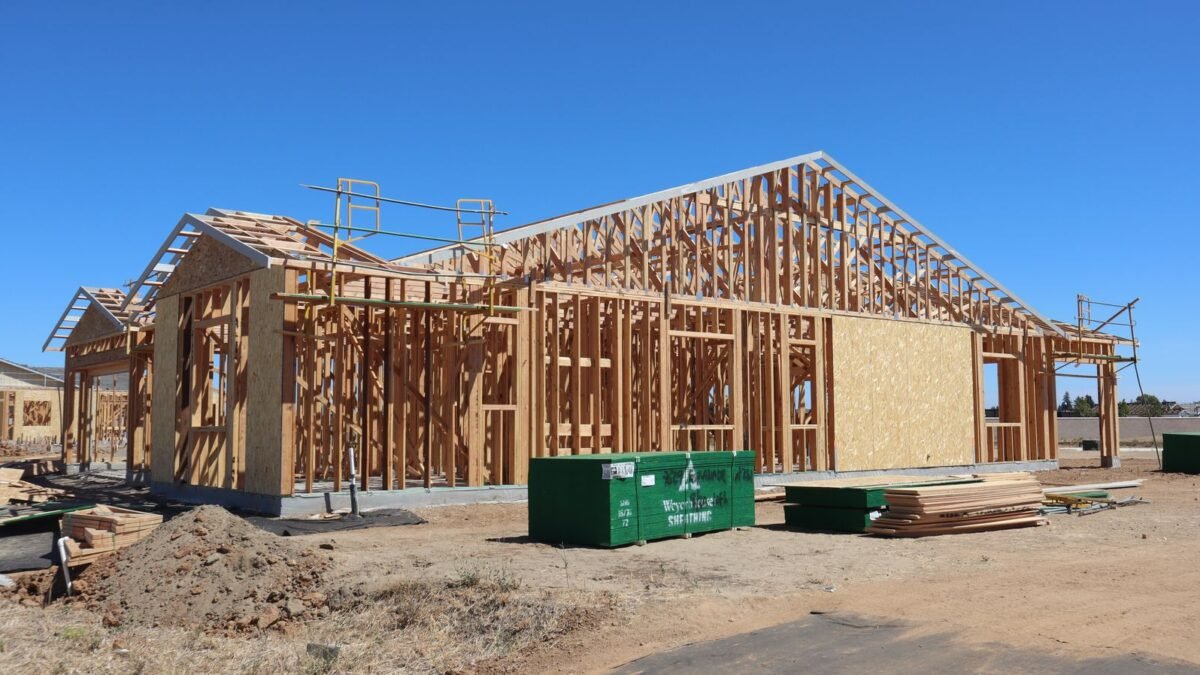
You get one cheap chance to put a softener in the right place, and it's before the drywall goes up. While the walls are open, a softener loop, a drain and an outlet next to the main cost a few hours of the plumber's and electrician's time. After you move in, the same work means cutting into finished walls, or settling for a softener in the garage with a hose running across the floor.
So this guide works backwards from your build schedule. The model matters, but less than where it goes and what's waiting for it there.
In this guide
Get these into the plans first
Ask your builder or plumber for these five things, in writing, before rough-in:
- A softener loop at the main entry. That's an inlet and outlet stubbed out side by side, usually capped or joined with a temporary jumper until the softener arrives. Ask for 1" lines if your main is 1". What a softener loop is and how it should be plumbed has a diagram to show your plumber.
- A drain within reach. That means a floor drain, a laundry standpipe, or a dedicated standpipe with an air gap. The rules are covered in water softener drain line requirements.
- A standard outlet next to the loop. Most control valves use a plug-in transformer. An extension cord across a garage floor isn't a plan.
- Floor space and headroom. Two-tank systems need room for the mineral tank and brine tank side by side, plus headroom to lift the valve off the tank for service. Check how much space a softener needs against your mechanical room drawings.
- Decide what bypasses the softener. Hose bibs and irrigation almost always should. Many people also want an unsoftened cold line at the kitchen sink. This is the one decision that's very hard to change later. See should a kitchen tap bypass the softener?
Where the loop goes (basement, garage, utility room) depends on climate and layout. Where to install a water softener runs through the options. Short version: keep it somewhere that doesn't freeze, near the main, and before the water heater.
Sizing a house nobody lives in yet
You don't know your real water use yet, so use a builder's rule of thumb: bedrooms + 1 = people, and about 75 gallons per person per day.
Example: 4-bedroom home, 12 gpg city water
- 5 people × 75 gal = 375 gallons/day
- 375 × 12 gpg = 4,500 grains/day
- About a week between regenerations: 4,500 × 7 ≈ 31,500 grains
A 48,000-grain system covers that at a salt-efficient setting with room for guests. If your hardness is 20+ gpg or you're on a well with iron, go bigger. Also go bigger, or twin, if the home has 4+ bathrooms. In that case flow, not grains, becomes the limit.
Four picks, matched to the build
Typical 3–4 bedroom, 2–3 bath, 3/4" or 1" plumbing → Fleck 5600SXT 48k complete system
This complete package includes a brine tank and 1" bypass, with resin already loaded in the mineral tank. The 5600SXT valve is the most common residential softener valve in America, which matters more for a new home than any feature. Fifteen years from now, any water-treatment tech will still carry its seals and pistons. Pentair's spec sheet lists metered and time-clock regeneration modes and memory retention through power outages.
Not for: big homes where three showers, a soaking tub and irrigation fill can run at once. The 5600 valve is the bottleneck there. If the house has a 1-1/4" main, ask a local dealer about a higher-flow valve such as the Fleck 7000; we couldn't find a complete 7000SXT system in stock on Amazon.
Large household, odd hours, or very hard water → Fleck 9100SXT twin (40k per tank)
Two tanks on one valve: one in service, one standing by. When the first tank is spent, the valve switches right away, so the house never gets hard water during regeneration, at any hour. Pentair rates the 9100 at 20 gpm continuous and says it regenerates with soft water. For a new build with five-plus people, a home office, or a tankless heater, it's the "set it and forget it" choice.
Plan for it: two tanks plus a brine tank take more floor space. Size the mechanical room before framing, not after.
New home on a new well → Iron Pro 64K combination
Rural new builds often come with a freshly drilled well, and that water can change for a while after the well goes into service. Don't buy treatment the day the driller leaves. Run the well for a few weeks, send a sample to a certified lab, and then choose.
If the test shows hardness plus light iron, the Iron Pro 64K is a good fit. It's a combination softener and iron filter on a Fleck 2510SXT metered valve, which Pentair rates for 19 gpm continuous. If the test shows heavy iron, iron bacteria or sulfur, you'll need dedicated treatment in front of any softener. Leave room on the wall for it.
New build on chlorinated city water → AFWFilters Fleck 5600SXT 48k with upflow carbon
If your city disinfects with chlorine, a carbon stage takes out chlorine taste and smell at the same time you install the softener. This package pairs a 48,000-grain 5600SXT softener with an upflow carbon filter tank. Doing it at construction means one loop and one install day instead of two.
Caution: if your utility uses chloramine instead of chlorine, standard carbon struggles with it. Check your water report before you count on this.
The four, side by side
| Pick | Valve flow (Pentair rating) | Single or twin | Best build |
|---|---|---|---|
| Fleck 5600SXT 48k complete | About 19 gpm continuous (4.4 m³/h) | Single | Typical 3–4 bed, 2–3 bath |
| Fleck 9100SXT twin 40k/tank | 20 gpm continuous | Twin | Big families, odd hours |
| Iron Pro 64K combo | 19 gpm continuous (2510SXT) | Single | New wells with light iron |
| AFW 5600SXT 48k + carbon | About 19 gpm continuous (5600) | Softener + carbon tank | City water with chlorine |
Flow figures are for the control valve. The finished system's real-world flow also depends on tank and media.
Getting a hardness number before you have a faucet
You can't test tap water in a house that doesn't have taps yet. Options:
- City water: your utility's annual water quality report usually lists hardness, sometimes as "total hardness as CaCO3" in mg/L. Divide by 17.1 to get grains per gallon.
- Ask the neighbors. Anyone in the same subdivision on the same supply can give you a test-strip reading.
- New well: wait until the well has run for a few weeks, then send a lab sample. Driller "quick tests" right after drilling can be misleading.
Until you have that number, don't let anyone sell you a specific size. "We always put in a 48k" is a builder habit, not sizing.
Walkthrough checks before the walls close
Take your phone and check these at the rough-in inspection:
- Loop is at the main, before the water heater tee
- Loop pipe size matches the main (don't let it neck down to 3/4" on a 1" main)
- Hose bibs and irrigation tee off before the loop
- If you asked for an unsoftened kitchen cold line, it's actually run
- Drain or standpipe is within easy reach and higher than the floor
- There's an outlet near the loop, not on the other side of the room
Photograph the open walls. Ten years from now, whoever services the softener will thank you.
Timeline: who does what, when
| Build stage | What to do |
|---|---|
| Plans / pre-construction | Get the loop, drain, outlet and bypass decisions written into the plumbing scope. Get the water hardness from your utility or a well test. |
| Rough-in plumbing | Verify the loop is stubbed at the main, the right size, and before the water heater. Confirm hose bibs are on the unsoftened side. |
| Rough-in electrical | Outlet next to the loop location |
| Drywall | Too late for cheap changes. Walk the mechanical room once more first. |
| Finish / move-in | Install the softener, program it, run startup, test a tap |
The builder-grade trap
Some builders will "include a softener." Ask what it is. Often it's an entry-level cabinet unit picked for price, sized for a generic house, and set to factory defaults. Sometimes it's a rented dealer unit with a monthly fee. Neither is a disaster, but you're paying for it inside the mortgage. A better plan is to ask the builder to leave a capped loop, drain and outlet, take the softener out of the contract, and install one sized for your actual water once you have a hardness number.
Also ask who handles startup. A brand-new softener that's never been programmed won't soften anything. A common move-in surprise is spotty glasses in a "softened" house where the valve still has factory defaults.