

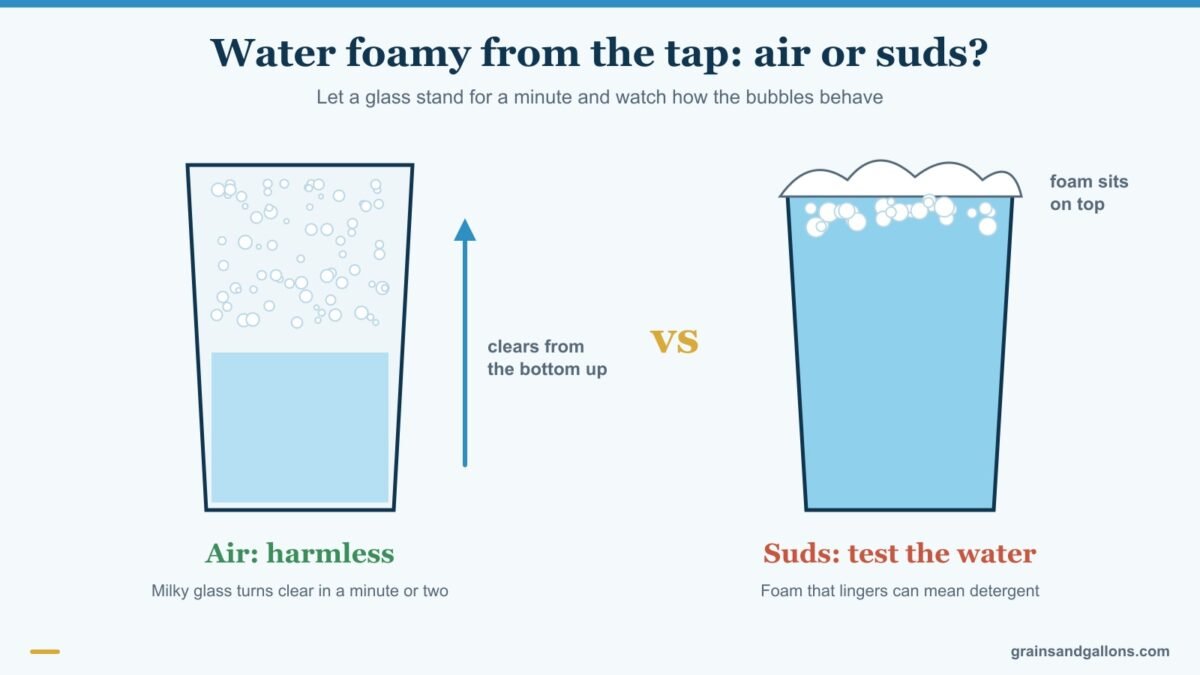
Quick Answer: Water foamy from tap after tap is almost always dissolved air. Fill a clear glass and let it stand: if the milky look clears from the bottom up within a minute or two, it's harmless air, common in cold weather or after plumbing work. If suds form a layer on top and stay, especially on a well near a septic system, stop drinking it and test for bacteria and nitrate, because detergent may be getting into the supply.
Water foamy from tap after tap looks alarming, but bubbly water and truly foamy water are very different problems. One is air, which is almost always harmless. The other is soap or detergent in the supply, which is rare but usually means wastewater is getting in. You can tell them apart with a glass and a minute of your time.
In this guide
Run the 60-second glass test
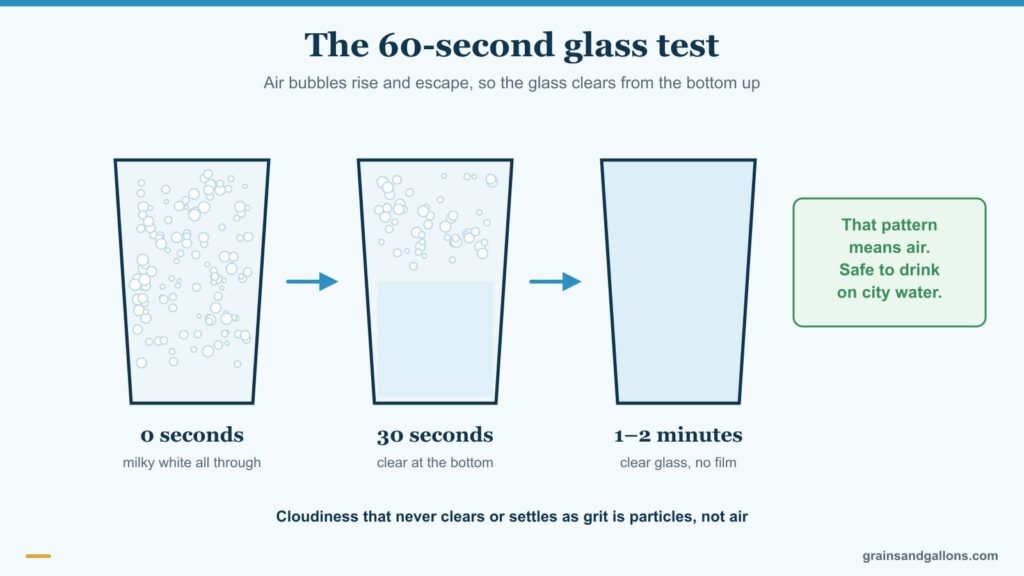
Fill a tall, clear glass from the cold tap, set it on the counter and watch.
What air looks like: The water starts out milky white. Within 30 seconds to a couple of minutes it clears, and it clears from the bottom up, because the bubbles rise and escape at the surface. You end up with an ordinary clear glass of water, with no film and no ring of foam.
What detergent looks like: Bubbles that gather into a layer of foam on top and stay there. For a second check, half-fill a clean jar, close it and shake it hard for about 30 seconds. Air bubbles vanish quickly. Foam that's still there a few minutes later points to surface-active agents, the soap-like compounds in detergents. You may also notice a soapy taste or a musty, sewage-like smell.
What neither looks like: Cloudiness that never clears, or that settles as grit at the bottom, is particles rather than air. White flakes are usually scale; see white flakes or particles in tap water.
Why pressurized water comes out milky
Water in the mains and in your pipes is under pressure, and pressurized water holds more dissolved gas, mostly nitrogen and oxygen, than it can at the faucet. When the pressure drops as it leaves the tap, the excess gas comes out as millions of tiny bubbles. That's the milky look.
A few things make it worse:
- Cold weather. Cold water holds more dissolved air than warm water. When winter water warms up in your pipes or your glass, the air comes out. That's why milky water shows up more often in winter.
- Recent work on the main or in your house. Repairs trap pockets of air in the lines. Run the cold taps for several minutes, starting nearest the meter and working outward, until the stream runs steady.
- High pressure. Higher pressure pushes more air into solution. If you also have pipes banging or pressure that surges, see water pressure surging or fluctuating.
Air in city water is safe to drink. If the look bothers you, fill a pitcher and let it stand for a minute or two before pouring.
What about chlorine or a water softener?
Some filter brands blame foam on chlorine. Chlorine changes taste and smell (see water that smells like bleach), but it doesn't make suds. A water softener doesn't add detergent either. What softened water does is make soap lather much more easily, so suds in a sink full of soapy water are normal. Plain cold water straight from the tap should still clear in the glass test, softener or not. If air sputters from the taps right after a softener is installed or put back in service, that's trapped air in the lines and it bleeds out in a few minutes of running water.
Water foamy from tap after tap, or just one faucet?
Where you see it tells you a lot.
- One faucet only. Unscrew the aerator. Aerators mix air into the stream on purpose, and a worn or clogged one can make the stream look white. If the water looks normal without it, clean or replace the aerator.
- Hot water only. Heating drives dissolved gas out of water, so bubbly hot water with clear cold water usually comes from the water heater. Flushing the tank clears sediment that gives bubbles places to form.
- Every tap, hot and cold. The cause is upstream: the city supply (cold weather, main work) or, on a private well, the well system itself.
Well systems that pull air into the lines
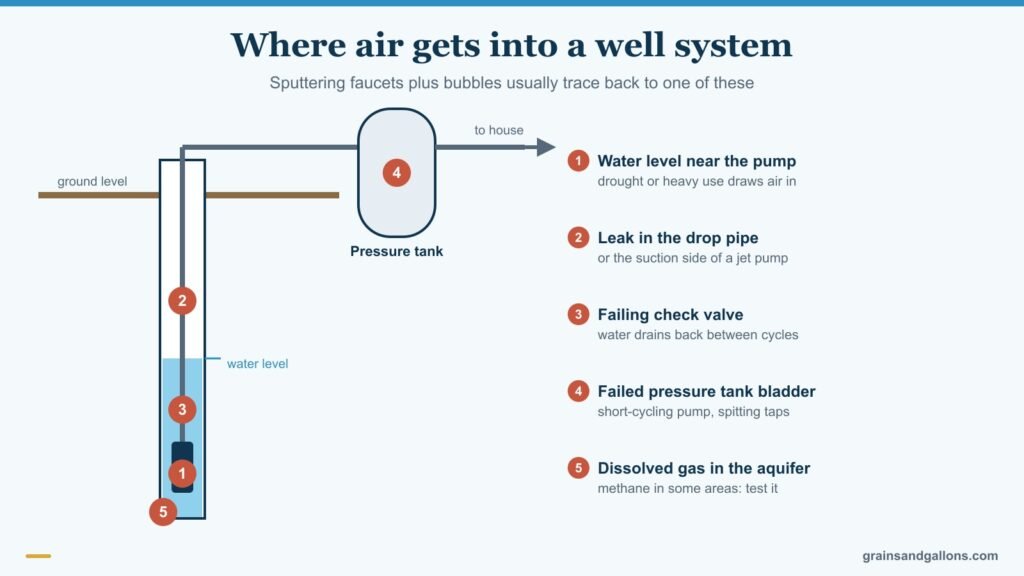
On a well, bubbles plus sputtering faucets usually mean air is getting in somewhere, and that's worth fixing:
- Water level dropping in the well. In a dry spell, or when you use a lot of water at once, the level can fall close to the pump intake and the pump sucks in air. Cut back on use for a while and ask a well contractor about the pump depth.
- A leak in the drop pipe or suction side. A cracked pipe or loose fitting below the water line, or on the suction side of a jet pump, lets air in.
- A bad check valve. If water drains back down the well between pump cycles, air gets into the line each time.
- A failed pressure tank bladder. Air can escape into the household lines. Signs include a pump that turns on and off rapidly and faucets that spit.
- Natural gas in the water. Some groundwater carries dissolved gases, including methane in certain areas. If the water fizzes heavily and you live near gas drilling or known methane, ask your health department about testing. Methane can collect in enclosed spaces such as well pits, so ventilate them.
Constant sputtering, a short-cycling pump or air hammer in the pipes are jobs for a licensed well contractor.
Lasting suds point to wastewater, not air

Real, persistent foam is a different matter. The EPA lists foaming agents among its secondary drinking water standards at 0.5 mg/L, noting that above that level water can look frothy and cloudy, with a bitter taste and odor. The detergent itself is a nuisance; the bigger worry is what usually comes with it. In a well, detergent most often comes from septic effluent, graywater or surface runoff, which can also carry bacteria and nitrate.
What to do:
- Stop drinking the water and cooking with it. Use bottled water, including for pets.
- Test for total coliform, E. coli and nitrate. How to test water for bacteria explains how to collect a clean sample, and a broader kit from our list of the best well water test kits covers nitrate and other indicators at the same time. The EPA's advice to protect your home's water is to test a private well every year for total coliform, nitrates, TDS and pH anyway.
- Look at the well and the septic system. A cracked well cap, a casing at or below ground level, standing water around the well, or a soggy, smelly drain field are common culprits. If the water also smells, our guide to water that smells like sewage walks through the sources, and running a water softener with a septic system covers how the two share a property safely. Your county health department can tell you the required distance between well and drain field.
- Call your health department. They can help trace the source and tell you how to disinfect the well once it's fixed.
Don't rely on a filter here. The problem is wastewater getting in, so the fix is stopping it.
Suds on city water mean a cross-connection
On a municipal supply, real suds at the tap are very unusual. If you see them, look for a cross-connection where soapy water could flow backward into your plumbing: a washing machine, a hose left in a utility sink or bucket, a hose-end sprayer, or a dishwasher without a proper air gap. If only one area of the house is affected, have a plumber check the backflow protection, and tell your water utility if neighbors notice it too.
FAQ
Is bubbly tap water safe to drink?
Yes, when the bubbles are air. Water that turns milky and then clears from the bottom up in a minute or two is safe. Foam that stays, or water with an unusual color, smell or taste, should be tested before you drink it.
Why does my tap water look milky only in winter?
Cold water holds more dissolved air. When very cold water warms up in your pipes and glass, the extra air comes out as tiny bubbles. It's seasonal and harmless.
Why does my water foam when I shake it in a bottle?
All water bubbles briefly when shaken, but the bubbles should pop within seconds. Foam that lasts several minutes suggests detergents or other surface-active agents, and it's worth testing.
Can a water softener make tap water foamy?
No. A softener exchanges hardness minerals for sodium or potassium and doesn't add detergent. It makes soap lather more easily, which is why soapy dishwater may foam more, but plain tap water should still clear in a glass.
Should I filter foamy water?
Not for air, which needs nothing. For real suds, no filter fixes the cause: find and stop the source first. For better taste at the sink once the water is confirmed safe, a faucet filter from our faucet-mount filter picks handles chlorine taste.
Air clears in a glass; suds call for a test
If you find the water foamy from tap after tap but it clears in a glass within a minute or two, it's dissolved air: harmless, seasonal and often gone once the lines settle. Bubbles from one faucet point to the aerator, bubbles only in hot water point to the water heater, and sputtering on a well points to the pump, check valve or pressure tank. Foam that sits on top and won't go away is the one result that needs action: stop drinking the water, test it for bacteria and nitrate, and find out how detergent is getting in.