

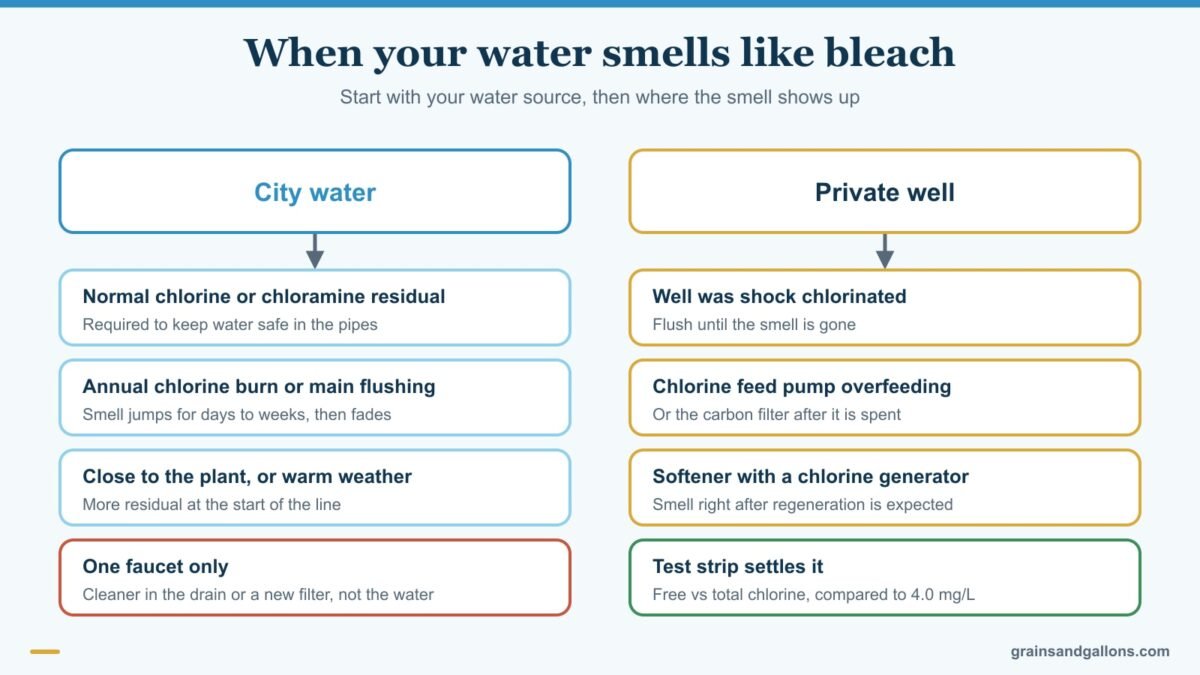
Quick Answer: On city water, when your water smells like bleach it is almost always the chlorine or chloramine your utility adds to keep the water safe in the pipes. The smell gets stronger during a utility "chlorine burn," after main flushing, in warm weather, or if you live close to the treatment plant. It's safe as long as the level stays under the EPA limit of 4.0 mg/L. Call the utility first, and if you want a number, test with WaterWorks Free and Total Chlorine Test Strips. On a private well, a bleach smell means someone shock chlorinated the well or a treatment system is overfeeding.
Disclosure: As an Amazon Associate, Grains & Gallons earns from qualifying purchases.
You fill a glass, take a sip, and it smells like a swimming pool. Maybe it showed up overnight, or maybe it has been building for a week. When your water smells like bleach, the source is rarely a mystery once you answer two questions: are you on city water or a well, and is the smell coming from every tap or just one?
In this guide
- Why city water smells like bleach on purpose
- Every tap, one faucet, or only the shower?
- Free vs total chlorine: test before you guess
- If you're on a well, a bleach smell has a specific cause
- Is chlorinated tap water safe to drink?
- Ways to get rid of the chlorine smell
- Bleach smell plus other changes: call right away
- FAQ
- Call the utility first, then test the water
Why city water smells like bleach on purpose
US water utilities have to keep a disinfectant in the water all the way from the plant to your faucet. That "residual" stops bacteria from regrowing in miles of pipe. Most use either free chlorine or chloramine (chlorine combined with ammonia). Free chlorine has the sharper bleach smell. Chloramine is milder and lasts longer in the pipes.
The EPA caps both at a maximum residual disinfectant level of 4.0 mg/L in its national primary drinking water regulations. Most systems run well below that. An odor alone doesn't mean anything is out of compliance.
These are the usual reasons the smell suddenly jumps:
- A temporary chlorine burn. Systems that normally use chloramine often switch to free chlorine for a few weeks, commonly once a year, to clean out the distribution pipes. The water smells much more like bleach during that stretch, then goes back to normal.
- Hydrant flushing or a main repair. Crews may boost chlorine in a section of pipe after work. It fades in a day or two.
- You're near the plant or a booster station. Homes at the start of the line get water with the most chlorine in it.
- Warm weather. Utilities sometimes dose more in summer because bacteria grow faster, and warm water releases its smell more readily.
Your utility's annual Consumer Confidence Report lists which disinfectant it uses and the range it measured.
Every tap, one faucet, or only the shower?
This one question narrows things down fast.
| Where you smell it | What it points to | What to do |
|---|---|---|
| Every tap, hot and cold, came on suddenly | Utility dosing change or chlorine burn | Call the utility; ask if they've changed disinfection |
| Every tap, always been there | Normal residual, you're sensitive to it | Carbon filtration for drinking water, or whole-house |
| Mostly in the shower | Hot water releases chlorine into the air in a small room | Normal; a shower filter or whole-house carbon helps |
| Only one faucet | Something at that fixture: a new filter, a just-cleaned aerator, cleaner in the drain | Smell the water in a clean glass away from the sink |
| Only after the softener regenerates | A softener with a built-in chlorinator | Check the softener model and manual |
| Private well | Shock chlorination, or a chlorine feed pump overdosing | See the well section below |
If only one tap seems to smell, fill a clean glass and smell it in another room. Cleaner in the drain fools a lot of people.
Free vs total chlorine: test before you guess
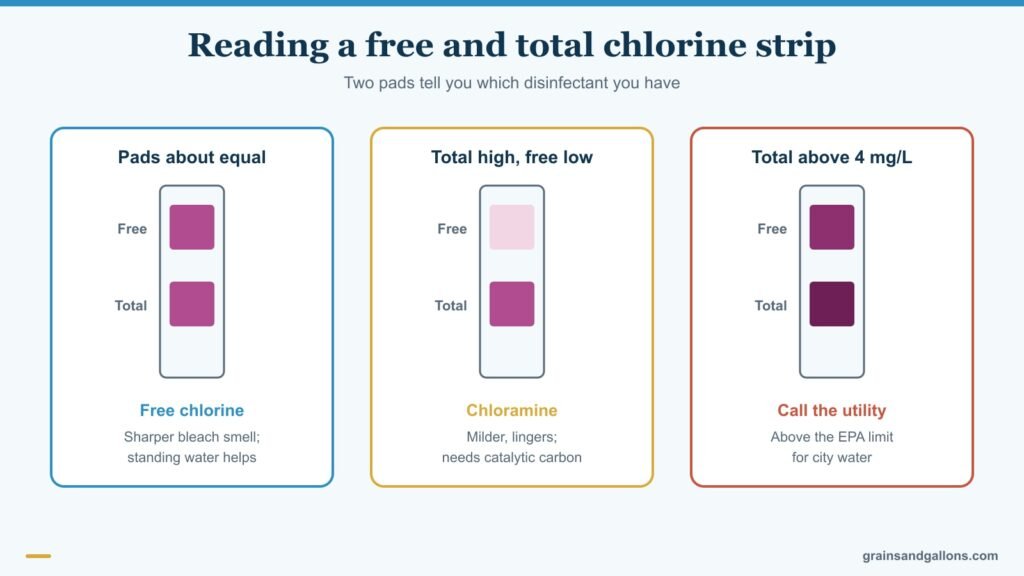
A smell can't tell you the level or whether you have chloramine. A free and total chlorine strip can. Dip it, wait the time on the label, and compare both pads to the chart:
- Free and total readings are about the same: your water has free chlorine.
- Total is high, free is low or zero: your water has chloramine.
- Total above 4 mg/L on city water: call the utility and report it. That's above the EPA limit and they'll want to know.
Our guide to testing for chlorine versus chloramine covers reading the strips and why the difference matters for picking a filter.
If you're on a well, a bleach smell has a specific cause
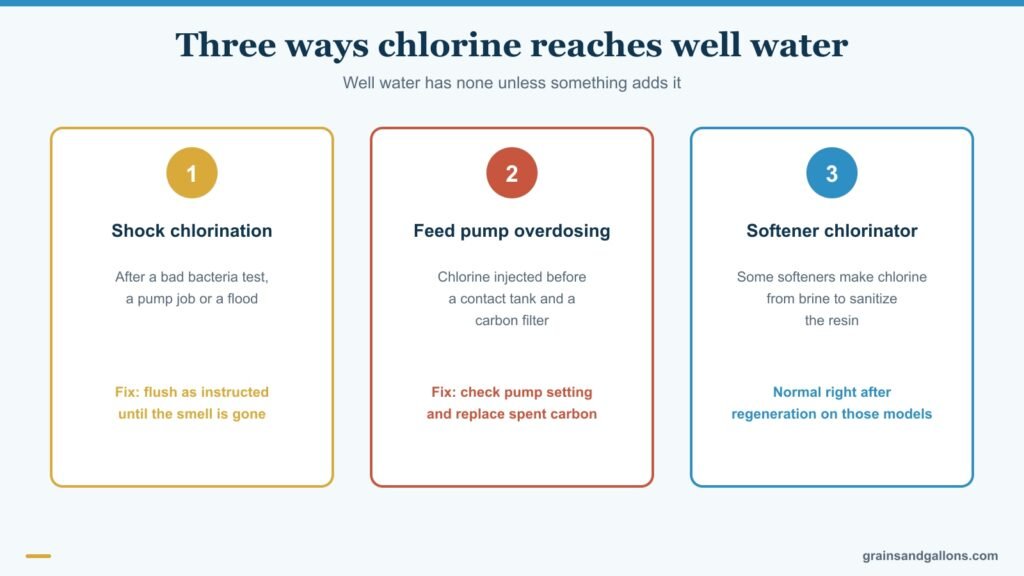
Well water doesn't come with chlorine, so if your well water smells like bleach, someone or something put it there:
- The well was shock chlorinated. This is common after a positive bacteria test, a pump replacement, or a flood. The smell should fade after the system is flushed per the instructions you were given. If your softener was in line during the shock, read what shock chlorination does to a softener.
- A chlorine injection system is overfeeding. Some wells with iron bacteria or sulfur problems have a feed pump that adds chlorine before a contact tank and a carbon filter. If the carbon is exhausted or the pump setting drifted, chlorine reaches the tap. Check the pump setting and when the carbon was last replaced.
- The softener has a chlorine generator. Some softeners make a small dose of chlorine from the brine during regeneration to sanitize the resin. A smell right after a regeneration cycle is expected on those models. See our guide to a softener chlorine smell during regeneration.
Don't drink water that smells strongly of bleach right after a shock treatment. Flush the system first and follow the instructions from whoever did the treatment.
Is chlorinated tap water safe to drink?
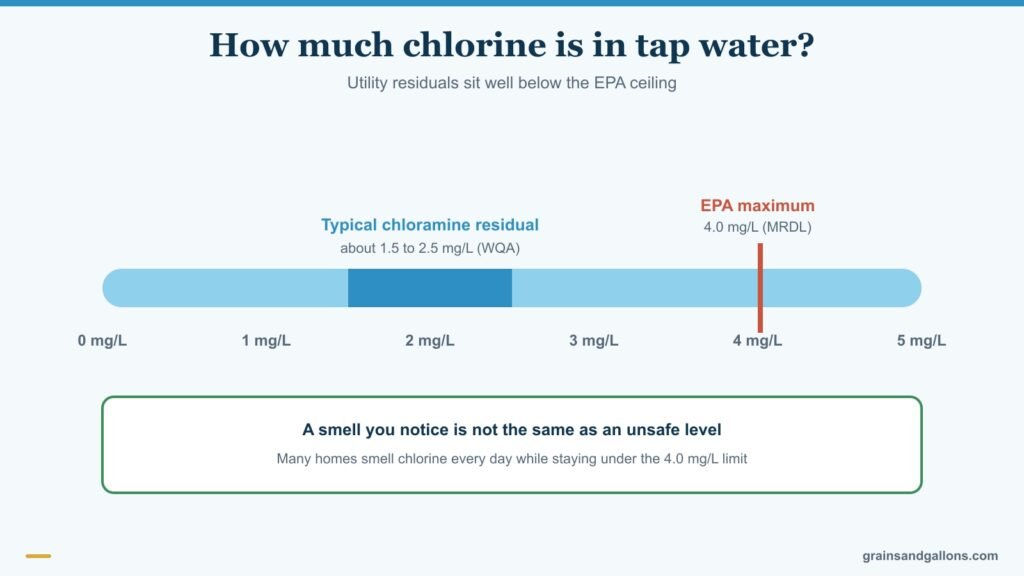
Utility water within the EPA limit is considered safe to drink, and the chlorine is there to protect you. The EPA lists eye and nose irritation and stomach discomfort as possible effects of going over the limit, not of normal levels. The Water Quality Association's chloramine fact sheet puts the average municipal monochloramine residual around 2 mg/L, in a range of about 1.5 to 2.5 mg/L.
Dialysis water and aquarium water need chlorine and chloramine removed no matter the level.
Ways to get rid of the chlorine smell

Pick the fix that matches how much water you need it gone from:
- For drinking water only: an activated carbon pitcher or faucet filter handles free chlorine taste and smell well. Our list of the best water filter pitchers for hard water includes options rated for chlorine reduction.
- For the whole house: a whole-house carbon system treats the shower, laundry and every tap. Chloramine is harder: WQA notes that ordinary activated carbon can need 10 minutes or more of contact time, so look for catalytic carbon. See our best whole-house water filters for city water.
- The free option: fill an open pitcher and leave it in the fridge overnight. Free chlorine gasses off fairly well. Chloramine doesn't, so this trick works much less well on chloramine water.
- Wait it out: if it's a scheduled chlorine burn, the smell goes away when the utility switches back.
Bleach smell plus other changes: call right away
A bleach smell by itself is rarely an emergency. Call the utility right away if it shows up with discolored water, a sharp drop in pressure, or a chemical smell that isn't quite chlorine, like fuel or solvent. If the taste shifted at the same time in ways that don't fit chlorine, our guide to water taste changing suddenly walks through the other possibilities.
FAQ
Why does my water smell like bleach in the morning?
Water that sits in your pipes overnight can smell stronger when you first run it, and the first draw also carries whatever was sitting in the faucet. Run the cold tap for a minute or two. If the smell fades, it was standing water. If every tap smells strong all day, call the utility.
Does boiling water remove the bleach smell?
Boiling drives off free chlorine, and so does leaving an open pitcher in the fridge overnight. Neither works well on chloramine, which is much more stable. For chloramine, use a carbon filter rated for chloramine reduction.
Is it safe to shower when the water smells like chlorine?
Yes, if the level is within the EPA limit. Hot water releases more chlorine into the air, so the smell is often strongest in a closed bathroom. People with sensitive skin or airways may prefer a shower filter or whole-house carbon.
How do I know if there's too much chlorine in my water?
Test it. A free and total chlorine strip gives you a number in a minute. A total reading above 4.0 mg/L on city water is above the EPA limit and should be reported to the utility. A strong smell alone doesn't tell you the level.
Call the utility first, then test the water
When your water smells like bleach on city water, it's almost always the disinfectant doing its job, turned up for a chlorine burn, a flush or a hot spell. Call the utility, then confirm with a free and total chlorine strip. Anything under 4.0 mg/L is within the EPA limit, and carbon filtration takes care of the smell if it bothers you. On a well, track down what added the chlorine and flush or fix that source.