

Quick Answer: When your water taste changed suddenly, first check whether it's every tap or just one. Every tap on city water usually means the utility switched sources, adjusted disinfection or is dealing with algae or drought, so call them. One tap points to a filter, faucet, softener or RO system. On a well, a change after heavy rain or flooding means stop drinking it and test for bacteria.
If your water taste changed suddenly, take it seriously: taste is one of the few signals you get without a lab. Most causes are ordinary, but a few aren't, so start with the safety list.
In this guide
Switch to bottled water if any of these apply
Stop drinking the tap water and use bottled until you know more if:
- It smells or tastes like fuel, solvent or paint thinner.
- It smells like sewage or septic.
- People in the house got stomach symptoms around the same time.
- You're on a well and the change followed flooding, heavy rain or well work.
- Your utility has issued a boil-water or "do not drink" notice.
- The water is also cloudy, colored or full of particles.
Then call your utility (city water) or county health department (well) and test before drinking again.
Taste every tap to find where the change starts
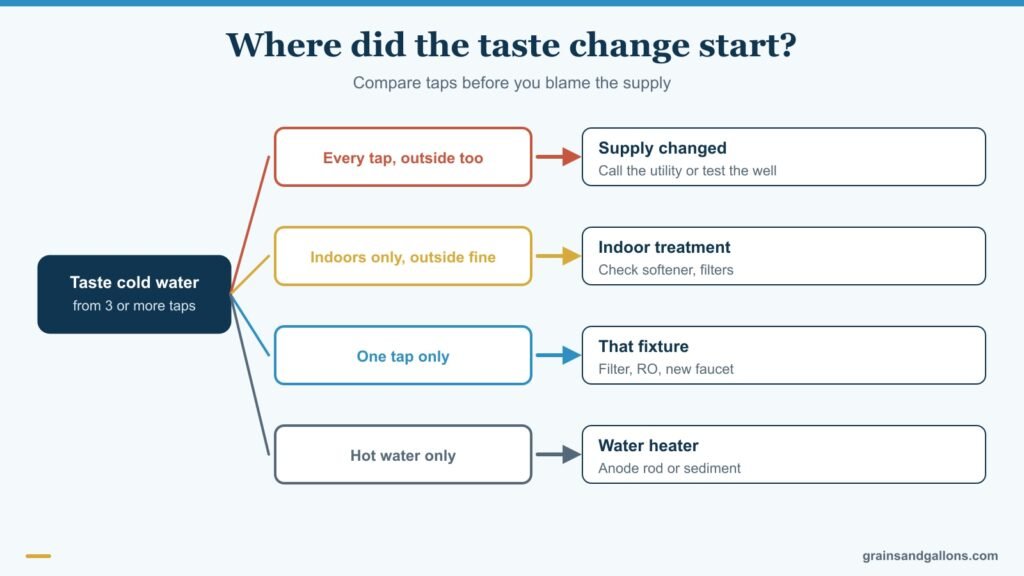
Taste cold water in a clean glass from the kitchen, a bathroom and an outdoor spigot, away from cooking smells.
- Every tap, outside included: the change is in the water entering the house.
- Indoors only, outside fine: look at indoor treatment, because outdoor taps are often plumbed before the softener.
- One tap only: check what feeds it, such as a fridge or faucet filter, an RO system or a new faucet.
- Hot water only: that's the water heater. A sulfur taste in hot water alone usually comes from the anode rod; see rotten-egg smell only in hot water.
Why city water taste changed suddenly this week
A utility can change the taste of your water without anything being unsafe:
- Source switches. Many cities blend reservoirs, rivers and wells, and a seasonal switch changes the mineral taste overnight.
- Disinfection changes. A temporary switch from chloramine to free chlorine tastes more like a pool. See water that smells like bleach.
- Algae. Warm weather lets algae grow in lakes and reservoirs. They release geosmin (earthy) and MIB (musty), which people can taste at tiny amounts but which aren't harmful. More in earthy water in summer.
- Drought. Less rain and more evaporation concentrate minerals, which can make water taste salty, chalky, bitter or metallic.
- Main breaks and flushing. Stirred-up sediment can leave a metallic or stale taste for a day or so.
Call the utility; they usually know. Meanwhile, chilled water tastes milder and a carbon filter removes most chlorine and earthy tastes. For the whole house, see our whole-house filters for city water.
Match the new taste to its cause
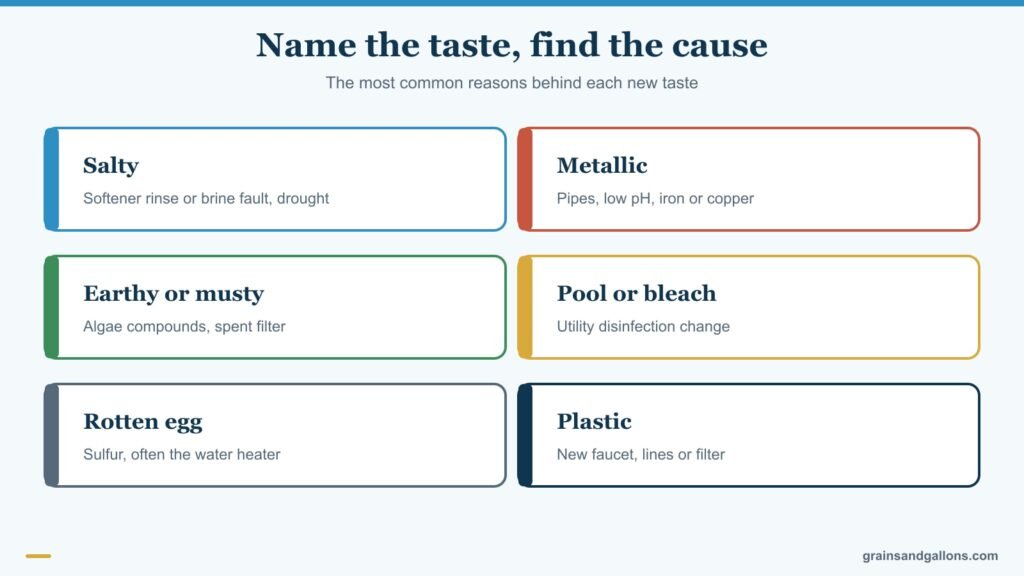
Most "sudden" changes actually start inside the house:
| New taste | Likely cause | What to do |
|---|---|---|
| Salty | Softener rinse or brine fault | Run the water a few minutes; see why softened water tastes salty |
| Plastic or rubbery | New faucet, PEX, filter or fridge | Usually fades within days to weeks |
| Musty or stale | Old filter, or water sat in the lines | Replace the cartridge and flush the line |
| Flat, sour or bitter, RO tap only | New RO, spent remineralizer, old post-filter | See RO water tastes bad |
Check the date on every filter, since spent carbon stops removing taste, and flush every tap after a trip.
A metallic taste needs a lead test, not a guess

EPA lists copper, iron, manganese and zinc, plus low pH, as causes of metallic or bitter taste. If it's strongest first thing in the morning and fades after you run the tap, metal is likely leaching from pipes or fixtures overnight.
That pattern also matters for lead, which you can't see, taste or smell. EPA says lead pipes are more common in homes built before 1986 and that testing is the only sure way to know. Running the cold tap before drinking is a stopgap, not a fix. Our guide on how to test water for lead at home covers sampling.
Test well water after any sudden change
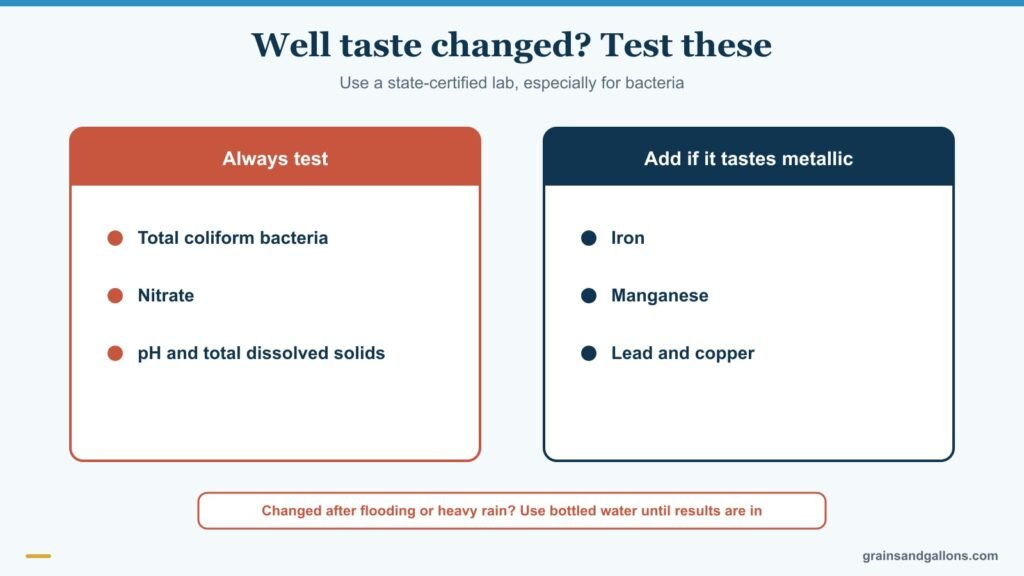
Wells have no utility watching them. Rain, drought, a new pump or nearby construction can all shift what comes out, and an earthy or swampy taste after rain may mean surface water is getting in. EPA advises testing right away when taste, odor or color changes, using a certified lab. Its routine list is coliform bacteria, nitrate, total dissolved solids and pH; add iron, manganese, lead and copper if the taste is metallic. Our well water test kits guide covers home kits, but use a certified lab for bacteria.
FAQ
Is it safe to drink water that suddenly tastes different?
Usually, but not always. Earthy, chlorine and mild mineral tastes are mostly harmless. Stop drinking it if it smells like fuel or sewage, if people are getting sick, or if a well changed after flooding.
Why does my water taste like dirt all of a sudden?
Most often algae compounds called geosmin and MIB in the utility's lake or reservoir, especially in warm weather. They aren't harmful. A carbon filter or chilling the water helps until the season changes.
Why does my water suddenly taste salty?
On softened water, a brine or rinse problem in the softener is the usual cause. On city water, drought or a source switch can raise chloride and sulfate, which EPA lists as causes of salty taste.
Track the pattern for a week, then test
If your water taste changed suddenly and it comes and goes, note when you notice it for a week. A salty taste the morning after the softener regenerates points to the softener, an earthy taste only in late summer points to the source, and metal after overnight standing points to pipes. That log, plus one phone call or one lab test, usually settles it.