


Quick Answer: If you think your mineral tank cracked, put the softener in bypass, unplug it and bleed off the pressure. Then dry everything and watch where water reappears. Leaks at the valve, the tank collar or a fitting are cheap fixes. Water seeping through the tank wall or bottom, a bulge or a visible split means the tank has failed. A pressurized tank can't be safely patched, so replace the tank, reuse the valve (and often the resin), and fix whatever cracked it.
A mineral tank cracked open is the scariest-looking softener leak, because the tall resin tank sits at full house pressure all day. Take a breath, though. Most "cracked tank" leaks turn out to be something higher up dripping down the side. And if the tank really did fail, it's a known repair: the tank is a standard part, and the valve on top usually moves straight over to a new one.
In this guide
- Mineral tank cracked? Take the pressure off first
- Is it really the tank, or a leak running down it?
- How a residential mineral tank is built
- Why mineral tanks crack
- Don't patch a pressure vessel; swap the tank and keep the valve
- When a whole new softener is the better buy
- FAQ
- A mineral tank cracked is a tank swap, not a new softener
Mineral tank cracked? Take the pressure off first

Before you investigate, do these in order:
- Bypass the softener. Turn the bypass knob or handles so house water goes around it. If there's no bypass, close the main shutoff.
- Unplug it so it can't start a regeneration.
- Open a softened cold tap downstream to bleed pressure out of the tank.
- Keep water away from power. If water is near an outlet or panel, shut off that circuit at the breaker before you step in it.
- Take photos of the leak and any damage before you clean up. Our guide to homeowners insurance and softener leaks explains what adjusters usually ask for.
Culligan's guide to a softener leaking from the bottom gives the same first move: bypass the unit to limit further leaking while you work out the source.
Is it really the tank, or a leak running down it?

Dry the tank and floor completely. Tuck paper towels around the base and wrap one around the collar just under the valve. Then turn the bypass back to service (pressure only, unit still unplugged) and watch for 10 to 20 minutes. Water at the valve or running down from it is a seal or fitting. Water at the neck is the tank O-ring or a cracked neck. A wet line on the side wall, water only at the base, or any bulge means the shell itself has failed.
If the water starts above the tank, read softener leaking from the bottom, which covers the drips that pool at the base and fool almost everyone. A seal at the tank neck is covered in water softener O-ring leak. And make sure you're looking at the right tank: a crack in the salt tank is a much simpler job, covered in brine tank cracked.
How a residential mineral tank is built
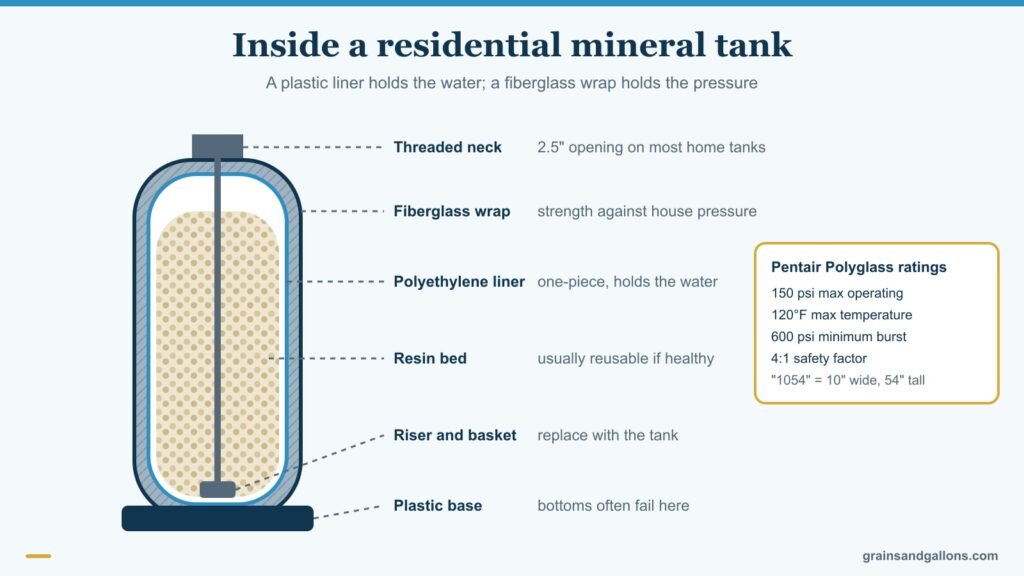
Most home softener tanks are composites: a one-piece plastic liner wrapped in fiberglass, usually standing in a plastic base. The liner holds the water and the wrap holds the pressure. Pentair's Structural Polyglass spec sheet describes its residential tanks this way: a seamless high-density polyethylene liner, a maximum operating pressure of 150 psi, a maximum temperature of 120°F, a 4:1 safety factor, and a minimum burst pressure of 600 psi.
That spec sheet also decodes the size label you'll need later. A "1054" tank is 10 inches in diameter and about 54 inches tall, and most residential tanks have a 2.5-inch threaded opening. Those three numbers are what you match when you buy a replacement.
A tank built to that standard doesn't crack from normal use. When one fails, something pushed it past its limits.
Why mineral tanks crack
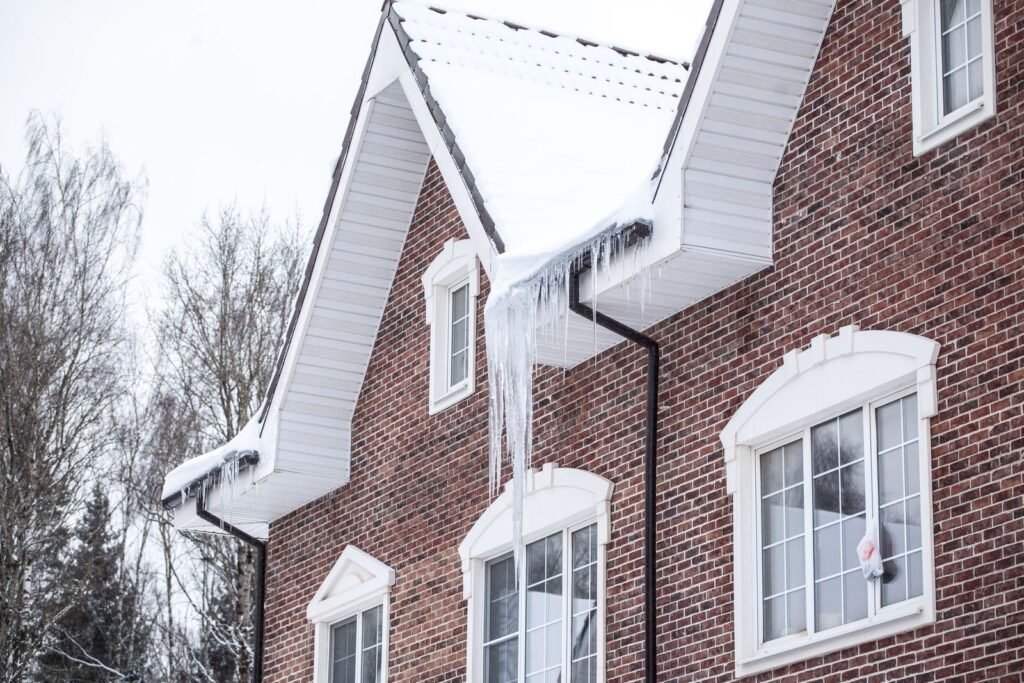
Freezing. Water expands as it freezes. A softener in a garage, crawlspace or outdoor enclosure that drops below freezing can split the tank, crack the neck or break the valve. Pentair's Fleck 5600SXT service manual says plainly that the unit cannot be subjected to freezing conditions. If yours froze, see frozen water softener for the other parts to check.
Pressure that's too high or spikes. The Fleck manual caps water pressure at 125 psi, and Clack's WS1 manual lists 20 to 125 psi as the operating range. Repeated spikes from water hammer, a failed pressure reducing valve or thermal expansion when the water heater fires can fatigue a tank over years. If your pressure is high or the gauge jumps, fix that before the new tank goes in. Our list of the best pressure reducing valves is a good start, and an expansion tank tames thermal spikes.
Hot water. Back-fed hot water from the water heater or a plumbing mistake softens the plastic liner. The Fleck valve is limited to 110°F, and the Pentair tank to 120°F.
Age. A tank that has held pressure for 15 to 25 years can simply give out, often at the bottom where the liner meets the base.
Impact. A tank that was dropped, tipped during a move, bumped by a car in the garage, or had its valve overtightened can crack at the neck or wall.
Don't patch a pressure vessel; swap the tank and keep the valve

Epoxy and fiberglass repair kits are tempting, but the tank holds household pressure around the clock. A patched tank can let go suddenly and dump its contents, resin included, across the floor. Installers replace failed tanks; they don't patch them. A new tank is often less than the price of a new softener.
What to buy: a tank with the same diameter, height and thread size as the old one (read its label), a new riser tube and bottom basket, and a new tank O-ring.
What you can usually reuse:
- The control valve, if it works and the area around its neck isn't cracked.
- The resin, if it isn't mushy, fouled or mixed with debris from the leak. Fresh resin is worth it when the system is old anyway.
- The gravel underbed, if your system has one, after a rinse.
The steps match a resin rebed: valve off, empty the old tank, set the riser and basket in the new tank, add gravel and resin, cut the riser to the length your valve's manual specifies, and reinstall the valve. Clack warns to use only silicone-based lubricant on O-rings; petroleum jelly and other hydrocarbons damage the plastic and seals. Then follow the Fleck startup routine: ease the bypass slowly back to service, let the tank fill, and run a nearby cold tap until the air is purged.
A full mineral tank is heavy. Drain it before you try to move it.
When a whole new softener is the better buy
Replacing just the tank makes sense when the valve is reliable and parts are easy to find, as they are for most Fleck and Clack systems. It's harder to justify when:
- The softener is a cabinet (all-in-one) model with a proprietary tank.
- The valve is also leaking, glitchy or obsolete.
- The resin needs replacing too and the unit is over 15 years old.
- Your household or hardness has changed and the old unit was undersized anyway.
Repair or replace an old water softener works through that decision. If you land on replacement, the best 48,000-grain water softeners are a common starting point for a three- or four-person home, but size it to your actual hardness and use.
Call a plumber if the leak is near electrical equipment, if you can't isolate the softener, if water is spreading faster than you can manage, or if moving a full tank isn't safe for you. Local code may also require specific drain and backflow arrangements when the softener goes back in.
FAQ
How do I know if my water softener tank is cracked?
Bypass and depressurize, dry the tank, then pressurize it again and watch. Water that seeps from the side wall or bottom, or a tank that bulges, means the shell has failed. Water that starts at the valve or neck is a seal or fitting leak instead.
Can a cracked mineral tank be repaired?
Not safely. The tank is a pressure vessel holding full house pressure all the time, and a patch can fail suddenly. Replace the tank and reuse the valve if it's in good shape.
Can I reuse the resin from a cracked tank?
Often, yes. If the beads are firm, not mushy or broken into fines, and free of debris from the leak, they can go into the new tank. On an old system, new resin is usually worth the cost.
What causes a water softener tank to crack?
Freezing is the most common cause, followed by high or spiking water pressure, hot water back-feeding into the softener, old age, and physical impact during a move or in a busy garage.
Do I need a new softener if the mineral tank is cracked?
Usually not. Mineral tanks are standard sizes such as 10×54 with a 2.5-inch thread, so a matching tank can carry the existing valve. A whole new softener makes sense if the valve is also failing or the unit is proprietary or very old.
A mineral tank cracked is a tank swap, not a new softener
When a mineral tank cracked for real, the fix is a matching new tank, a new riser and O-ring, and your old valve on top. Confirm the leak isn't a seal first, then fix the freezing, pressure or hot-water problem that split it, or the new tank will go the same way.