


Quick Answer: Instant hot water dispenser scale shows up as white flakes in your cup or a spout that gurgles and spits, because the small tank holds water near boiling all day and every refill brings in new minerals. Unplug the unit, let it cool and drain it following your manual's drain procedure. Check the manual before putting any acid in the tank, since some makers say acidic cleaners void the warranty. Long term, the water feeding the tank needs to be softer.
You pour hot water for tea and pale chips swirl up from the bottom of the mug. Or the spout hisses and spurts before you've touched the lever. Both are classic signs of instant hot water dispenser scale, and in a hard water house they often show up within a year or two. The flakes themselves are harmless; the bigger concern is a small tank whose element sits right in the water and runs louder and less reliably as scale builds.
In this guide
Why instant hot water dispenser scale builds so fast

Calcium carbonate gets less soluble as water heats. A regular tank water heater often sits around 120°F. An instant hot dispenser runs far hotter: InSinkErator's manual for its H3300 and GN-series systems recommends a tank setting two steps below maximum, about 205°F, and notes the dispenser delivers near-boiling water (InSinkErator manual). At that temperature much of the dissolved hardness can't stay dissolved, so it drops out on the element and tank walls.
Then there's the refill pattern. Every cup pulls in fresh cold water with a fresh load of minerals, the tank reheats it, and more scale drops out, dozens of times a week. If the water boils (more likely at altitude, which the same manual points out), some leaves as steam and the minerals stay behind. Scale also costs energy: one dispenser maker says a scaled element can use up to 10% more electricity than a clean one (Borg & Overström).
We go deeper in why hot water causes more scale. How fast it happens depends on your hardness, and one of the best water hardness test kits tells you whether you're fighting 5 grains per gallon or 25.
Flakes, spitting or crackling: what each symptom means

| What happens | Most likely reason | What to do first |
|---|---|---|
| White or tan flakes in the cup | Scale breaking off the element and tank walls | Drain and refill the tank per the manual |
| Spitting or steam from the spout | Water boiling in the tank | Turn the temperature down until the spitting stops |
| Crackling or popping while it heats | Water flashing to steam under scale on the element | Drain; if it persists, plan for replacement |
| Slow trickle | Scale in the outlet tubing or a clogged filter | Check the filter first, then the tubing |
| Rusty or discolored water | Corrosion inside the unit, not just scale | Drain; if it returns, stop using it and call service |
That last row matters. InSinkErator says the sudden appearance of rusty water may mean the unit needs service or replacement, and recommends checking dispensed water every three months. If discoloration remains after draining and refilling, stop using it and contact an authorized service agent. Don't try to descale your way out of rust.
Drain the tank the way the manual describes

The procedure InSinkErator actually documents is the seasonal drain: unplug the unit, push the lever until the water runs cool, shut off the cold supply valve, disconnect the tubes, unhook the tank, hold it upside down and drain it into the sink, then reinstall, reconnect, open the valve and hold the lever until water flows before plugging it back in. Fittings and mounting differ by model, so follow your own manual.
Draining helps more than you'd think with loose flakes; a gentle shake while it drains brings out a surprising amount of debris. It won't remove scale bonded hard to the element. A few cautions:
- Let it cool. The tank holds near-boiling water; running it until cool isn't optional.
- Never run the heater empty. Don't plug it back in until water flows from the spout.
- Expect some dripping after refilling. The manual's troubleshooting section suggests working the lever 7 to 10 times to flush the dispenser and lines.
Should you descale it with vinegar or citric acid?
Be careful here. The InSinkErator manual doesn't describe a descaling procedure, and under "Cleaning the dispenser and tank" it says cleaners with acids, abrasives, alkalines or organic solvents deteriorate the plastic components and void the warranty. Other brands differ: some countertop dispensers have a built-in descale cycle that uses citric acid. So:
- Under warranty? Call the manufacturer before putting any acid in it and ask which product, if any, they approve.
- Different brand? Read its manual; some give a descaling routine, others forbid it.
- Old and out of warranty? Some owners run a diluted food-grade descaler through the drained tank and flush it several times. That's at your own risk, and it won't save a failing element.
A dispenser that keeps spitting after a drain, crackles loudly every heat cycle or shows rust is near the end of its life, and InSinkErator notes that these tanks, like any water heater, eventually fail.
Keep scale from coming back
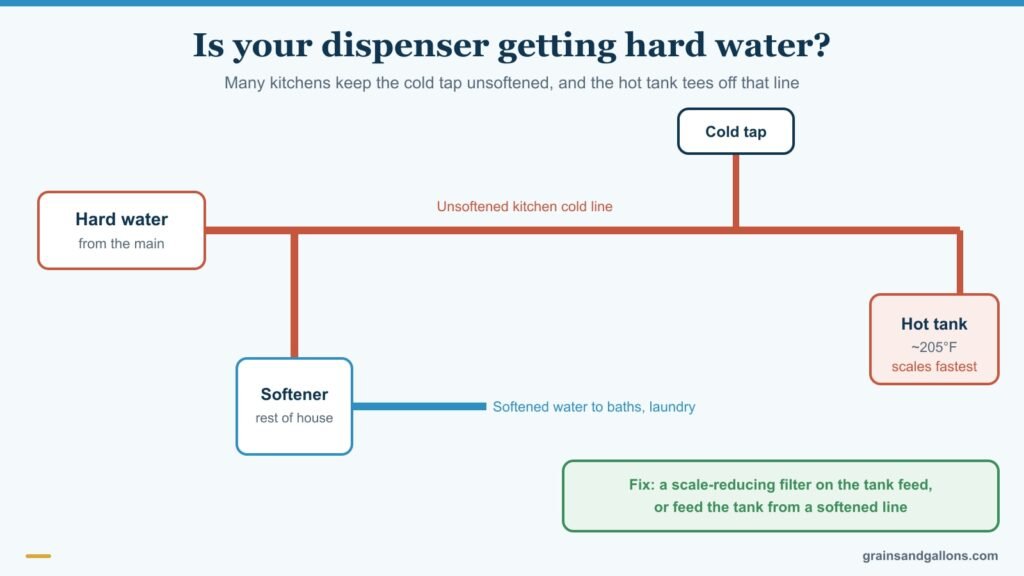
Treating the tank is a short-term fix; the water going in decides how fast scale returns.
Check whether the kitchen cold line is softened. Many installers leave the kitchen cold tap on unsoftened water for drinking, and the hot dispenser usually tees off that line, so it may get fully hard water even if the rest of the house is soft. See whether a kitchen tap should bypass the softener.
Add a filter that targets scale. Plain carbon improves taste but does little for hardness. Look for a scale-reducing cartridge; we compare options in our picks for under-sink filters for hard water. InSinkErator says a filter shouldn't drop supply pressure below 15 psi on these models.
Turn the temperature down a notch. You lose a few degrees at the cup, but less boiling means less scale.
FAQ
Are the white flakes from a hot water dispenser harmful?
They're mostly calcium carbonate, the same scale found in kettles. They're unpleasant but not considered a health hazard. Rusty or discolored water is different and needs service.
Why does my instant hot water dispenser spit and hiss?
The water in the tank is boiling. InSinkErator advises turning the temperature down until the spitting stops; scale on the element can make it worse.
What if I see white flakes in cold tap water too?
Then the dispenser may not be the source. A failing water heater dip tube or debris in the lines can cause similar flakes; see white particles in tap water. For scale in other appliances, see limescale in kettles, coffee makers and irons.
Soften the feed water, or plan to replace the tank
Instant hot water dispenser scale comes from running hard water near boiling all day. Draining clears loose flakes, acid descaling may void your warranty, and rust means it's time for service. The lasting fix is softer or scale-filtered water feeding the tank and a slightly lower temperature setting.