


Quick Answer: How long does a water softener last? A well-maintained salt-based softener commonly lasts 10–15 years, and quality valve-and-tank systems often reach 20 or more with a rebuild or two along the way. The tanks usually outlive everything. The resin and the valve's seals are what wear out, and how fast depends mostly on chlorine, iron, sediment and how hard your water is. Replacing those parts usually costs far less than a new system.
There's a reason two neighbors with the same softener can get very different lifespans out of it. One is on clean well water with almost no iron. The other is on chlorinated city water, never cleans the brine tank and runs the unit past its capacity every week. So when people ask how long does a water softener last, the honest answer is that a softener isn't one thing that wears out on a schedule. It's five or six parts that each age at their own pace.
The more useful question is: which part of yours is likely to give out, and when? This guide answers that, then shows how to tell a fixable problem from a finished softener.
In this guide
- Water softener lifespan, part by part
- How long does a water softener last on city water vs. well water?
- What shortens a softener's life
- Signs your softener is near the end
- Fix the part or replace the softener?
- Seven habits that add years to a softener
- FAQ
- Most softeners outlast their parts, so replace parts first
Water softener lifespan, part by part
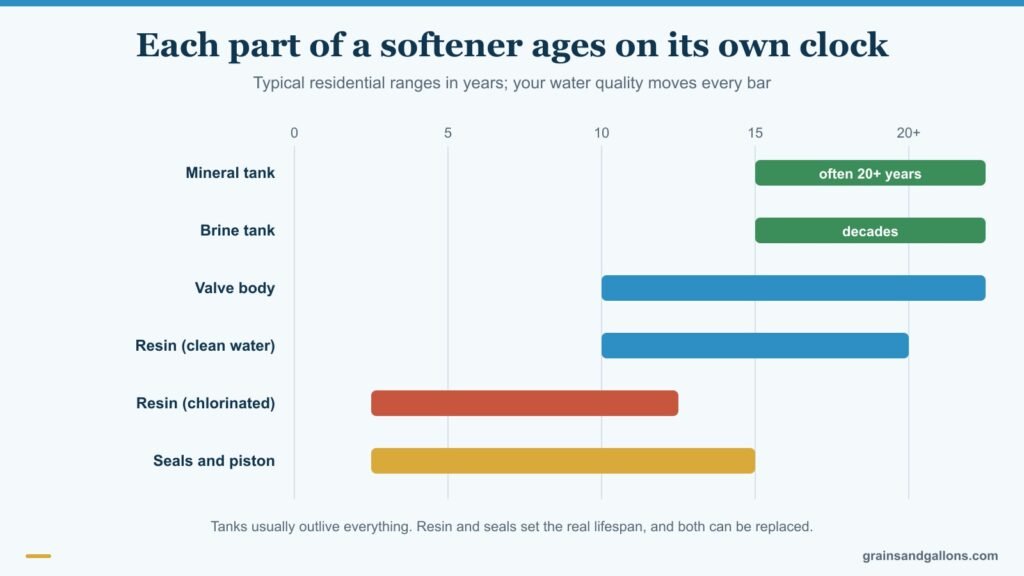
These are typical ranges for residential systems, not guarantees. Your water quality and the specific model matter more than any average.
| Part | Typical life | What ends it |
|---|---|---|
| Mineral (resin) tank | Often 20+ years | Cracks from freezing, impact or excess pressure |
| Brine tank | Decades | Physical damage; occasionally cracking |
| Resin | Roughly 10–20 years on non-chlorinated water; noticeably shorter on chlorinated city water | Chlorine oxidation, iron fouling, physical breakdown |
| Control valve body | 10–20+ years | Rare body cracks; mostly lasts if serviced |
| Piston, seals and spacers | Several years to 10+ | Wear from sediment, iron and hard use |
| Motor, circuit board, transformer | Variable | Electrical failure, power surges, moisture |
| Injector, flow controls, small screens | Clog anytime; easy to clean | Sediment, iron, resin fines |
Notice what's at the bottom of that list: the parts that fail most often are cheap and replaceable. A softener that "stopped working" at year eight frequently needs a seal kit or a cleaned injector, not a new system. Published estimates for whole units vary widely, from about 10–15 years at the conservative end to 15–25 for well-built, well-kept systems, and most of that spread comes down to the resin and the valve.
How long does a water softener last on city water vs. well water?

Your water source decides which part dies first.
On chlorinated city water, the resin sets the clock. Chlorine slowly breaks the crosslinks that hold each resin bead together, so beads swell, soften and lose capacity. A review in Water Conditioning & Purification on crosslinking in ion exchange resins gives a rough rule for standard 8% resin: expected years of service is about 10 divided by the chlorine level in ppm. That's roughly 10 years at 1 ppm and 5 years at 2 ppm. The same author suggests replacing residential resin after about 10 years, but not replacing resin that still performs well just because of its age. The details are in how chlorine damages softener resin.
On well water, iron, manganese and sediment set the clock. Iron and manganese foul the resin and gum up the injector, while sand and grit score piston seals. Penn State Extension notes that oxidized iron and manganese will foul softener resin, and that softeners only handle iron well under specific conditions, including dissolved iron below 5 mg/L and no contact with air or chlorine first (iron and manganese in private water systems). A softener working outside those limits wears out years early.
Clean water with moderate hardness is the best case. With no chlorine, little iron and a correctly sized unit, resin can last 20 years and the valve may need nothing more than an occasional seal kit.
What shortens a softener's life

Chlorine and chloramine. The biggest single factor for resin life on city water. A carbon filter ahead of the softener protects it.
Iron and manganese. They foul resin, clog injectors and wear valve seals. On iron-bearing well water, regular resin cleaning makes a big difference.
Sediment. Sand and grit score piston seals and clog screens. A sediment pre-filter is cheap insurance on wells.
Very hard water and undersizing. A softener that regenerates every day or two cycles its valve, seals and motor far more often than one that regenerates weekly. Over 15 years, that's thousands of extra cycles. Each regeneration also uses water; Penn State Extension's water softening fact sheet puts it at about 50 gallons per cycle for its example system.
Running out of salt or letting it bridge. Regenerating without brine doesn't damage the resin directly, but the household runs on hard water and the bed can foul faster. A crust of salt that never dissolves is a salt bridge and needs breaking up.
Heat, freezing and sunlight. A softener in a hot garage, an unheated crawlspace or outdoors without a cover ages faster. Freezing can crack tanks and valves outright; if it has already happened, see brine tank water frozen.
Neglect. A dirty brine tank and years of skipped checks rarely kill a softener on their own, but they let small problems become big ones. A simple maintenance schedule covers what to check and how often.
Signs your softener is near the end

None of these alone means replacement; most mean "something needs fixing." Together, on an older unit, they point toward a decision.
- Hard water returns sooner each cycle even though settings haven't changed
- Water pressure through the softener has been dropping for years
- Resin beads show up in faucets or the drain line (see resin beads in the softener drain line)
- It leaks from the valve or tank, or water runs to the drain constantly
- The salt level never goes down, or it drops far faster than it used to
- The controller is erratic, or parts for your model are discontinued
- You've already replaced the seals and resin once and it's failing again
Start with the cheap checks: confirm the hardness setting, clean the injector and screen, and look for a salt bridge. Only after those come back clean is it worth talking about resin or a new valve.
Fix the part or replace the softener?

Rough guidance:
- Valve problems on a common head (Fleck or Clack, for example): a seal and piston kit or a replacement valve is usually the move. The tanks are probably fine. Our guide to the best replacement control valves covers compatible heads.
- Capacity loss with a sound valve and tank: replace the resin. Choose 10% crosslink resin if you're on chlorinated water, and see our picks for the best replacement water softener resin. Our guide to resin life and replacement covers timing.
- Proprietary, discontinued valve, plus tired resin, plus a cracked tank: that's a replacement. If you're shopping for a typical household, we keep a list of the best water softeners for a family of 4.
A useful test: add up the parts you'd need this year. If a seal kit and a resin rebed together cost a fraction of a new system and the valve is a common model, repair wins. If the valve is proprietary and parts are scarce, every future repair will be a hunt, and replacing the whole unit starts to make sense. For a fuller walkthrough of the costs, see repair or replace an old water softener.
What the warranty tells you about expected life
Warranties are a decent hint at what manufacturers expect. Tanks often carry long coverage, sometimes ten years or more, while valves and electronics usually get shorter terms. That pattern matches the chart above: tanks last, moving parts don't. Read the fine print, though. Many warranties exclude iron damage, chlorine damage, freezing or improper installation, which are the very things that shorten life. Our guide to reading a water softener warranty explains the usual exclusions.
Seven habits that add years to a softener
- Put carbon ahead of the softener on chlorinated water. It's the single biggest gain in resin life on city water.
- Use a sediment pre-filter on well water, and an iron filter if iron is above what the softener is rated for.
- Program hardness correctly, including iron, so the unit isn't overworked or regenerating far more often than it needs to.
- Keep salt above the water line and clean the brine tank every year or two.
- Clean the injector and check seals when performance slips, instead of waiting for a full failure.
- Protect it from freezing and direct sun. Insulate or relocate units in unheated spaces.
- Write the install date on the unit, so you (or the next owner) know how old it is when problems start.
FAQ
What is the average lifespan of a water softener?
Most sources put it at about 10–15 years, with well-built, well-maintained systems reaching 20 years or more. The tanks often last longer than that; the resin and valve seals usually need replacing first.
How long does water softener resin last?
On clean, unchlorinated water, resin can last 10–20 years. On chlorinated city water without a carbon filter it's shorter, roughly 10 years at 1 ppm chlorine and 5 years at 2 ppm for standard 8% resin. Iron fouling also shortens it.
Is it worth repairing a 15-year-old water softener?
Often, yes, if it has a common valve like a Fleck or Clack and the tanks are sound. A seal kit or a resin rebed costs far less than a new system. If the valve is proprietary and parts are discontinued, replacement usually makes more sense.
Do salt-free conditioners last longer than softeners?
Not necessarily. The tank can last many years, but the media in a salt-free conditioner is typically replaced every few years, and any pre-filter more often. The two technologies also do different jobs, so lifespan shouldn't be the deciding factor.
How do I know how old my water softener is?
Look for a date code or install sticker on the valve or tank, or check the serial number with the manufacturer. If there's nothing, a plumber or dealer can often estimate the age from the valve model.
Does a water softener lose efficiency as it ages?
Yes, gradually. Resin loses capacity as beads swell, crack or foul, so the softener runs out sooner and uses more salt and water per gallon of soft water. A quick hardness test of the softened water a day or two before regeneration shows whether yours is keeping up. If hardness is creeping through, clean the resin and check the settings before assuming the whole unit is worn out.
Most softeners outlast their parts, so replace parts first
So how long does a water softener last? Long enough that, for most homes, the realistic plan is a resin rebed somewhere around year 10 on city water (later on clean well water) and a valve rebuild or two along the way, with the tanks carrying on for 20 years or more. Protect the resin from chlorine and iron, keep the valve clean, and you'll usually replace parts long before you need to replace the whole softener.