


Quick Answer: A chlorine taste after water softener installation usually isn't the softener's fault: a standard softener doesn't remove chlorine, so city chlorine passes straight through. Put the softener in bypass, run a cold tap for a minute, and taste again. If the chlorine is still there, it's in your incoming water and the fix is carbon. If it goes away in bypass, the softener is adding it, usually from a bleach sanitizing that wasn't rinsed out or a built-in chlorinator.
You just poured a glass at the kitchen sink and it tastes like a pool. The softener went in recently, so it's the obvious suspect for the chlorine taste after water softener installation. Sometimes it is to blame. More often the softener is innocent and simply isn't the tool that would have fixed it. One two-minute test tells you which.
In this guide
Start with the bypass test (two minutes, no tools)

- Find the bypass valve on the back of the softener head (or the three-valve loop on older installs).
- Switch it to bypass. Water now goes around the softener.
- Run the kitchen cold tap for 60 seconds to clear the line.
- Fill a clean glass and taste or smell it. Then switch back to service, run another minute, and compare.
Chlorine in both glasses: it's in the water reaching the softener, or a carbon stage has worn out. Read reasons 1, 2 and 5. Chlorine only through the softener: the softener is adding it. Read reasons 3 and 4.
Is the chlorine taste after water softener install from city water?
1. The softener was never going to remove chlorine
This is the most common answer. Ion exchange resin trades sodium for calcium and magnesium. Chlorine isn't a hardness mineral, so it passes through at the same level it arrived. Many people expect a softener to make water taste better overall, and when it doesn't, it feels like the softener made things worse.
There's also a perception shift. Hard water carries a mineral flavor many people are used to. Once the hardness is gone, the chlorine note can stand out more even though the chlorine level didn't change.
Fix: add carbon. A whole-house catalytic carbon tank in front of the softener removes chlorine for every tap and protects the resin at the same time; see running a carbon filter and water softener together. Our guide to the best whole house catalytic carbon filters covers tanks for chlorine and chloramine. Shopping from scratch? A softener-plus-carbon package is often simpler; see the best softener systems for hard water with chlorine odor. If only drinking water bothers you, a carbon filter at the kitchen sink is the cheaper route.
2. The city changed its disinfection, and it's temporary
Many utilities that normally use chloramine switch to free chlorine for a few weeks each year to clean the distribution system. Free chlorine tastes and smells much stronger than chloramine. According to the EPA's chloramines page, chloramines are usually made by adding ammonia to chlorine and give longer-lasting disinfection in the pipes, and more than one in five Americans drink water treated with them. If a switch lines up with your softener install, it's easy to blame the wrong thing.
How to check: look on your utility's website for a "chlorine burn," "free chlorine conversion" or flushing notice, or call them. If one is running, the taste fades when it ends.
Is it safe? EPA's national drinking water regulations set a maximum residual disinfectant level of 4.0 mg/L for both chlorine and chloramines. A strong taste doesn't by itself mean the level is over that. If you want a number, test for free and total chlorine at a cold tap.
5. The carbon in your combo system is used up
If your softener has a carbon layer, or a separate carbon tank sits ahead of it, and chlorine taste came back after a long quiet stretch, the carbon has likely reached the end of its life. Some softeners are built this way: the Culligan HE owner's guide describes a municipal version whose mineral tank includes carbon media for chlorine taste and odor reduction, certified to NSF/ANSI 42. Carbon adsorbs chlorine until its surface is spent, then chlorine starts passing through.
Fix: replace or rebed the carbon. For upflow carbon tanks with no control valve, that's routine maintenance every few years depending on water use and chlorine level. If you're on chloramine and the carbon is plain GAC rather than catalytic, that's likely why it wore out so fast.
When the softener adds the chlorine
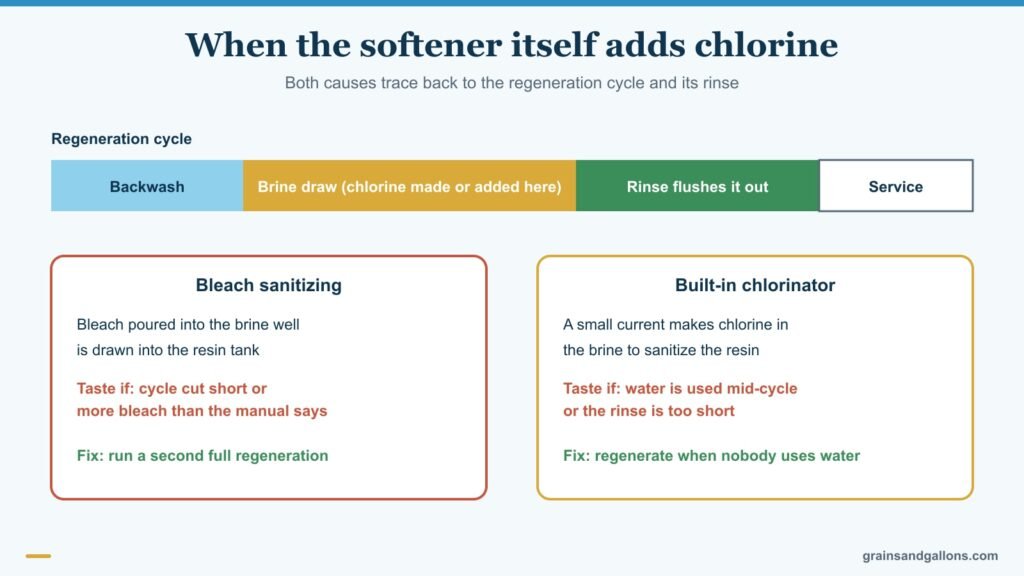
3. You sanitized the softener with bleach and it's still rinsing out
Sanitizing is normal maintenance, and many manuals tell you to pour unscented household bleach into the brine well and run a regeneration. If the regeneration didn't complete, or you used more bleach than the manual calls for, chlorinated water can sit in the resin tank and come out at the taps.
Fix: start a second manual regeneration and let it finish, then run cold water at a tub spout (no aerator to clog) until the smell is gone. Next time, follow the dose in your manual exactly. Our softener sanitizing guide walks through the process and safety steps. Never mix bleach with any other cleaner, especially resin cleaners containing acid.
4. Your softener makes its own chlorine during regeneration
Some softeners include a chlorine generator that passes a small current through the brine during regeneration to sanitize the resin. It's designed to be rinsed out before the tank goes back into service. If someone uses water mid-regeneration (an early shower, say) or the rinse is cut short, you can catch some of it.
How to check: look in your owner's manual for a "chlorinator," "chlorine generator" or similar feature, then check whether the regeneration time overlaps anyone's water use. We go deeper in chlorine smell during regeneration.
Fix: move regeneration to a time nobody's using water and let the full cycle run. If the smell persists after complete cycles, call the manufacturer; the rinse settings or the chlorinator may need service.
Match the timing to the cause
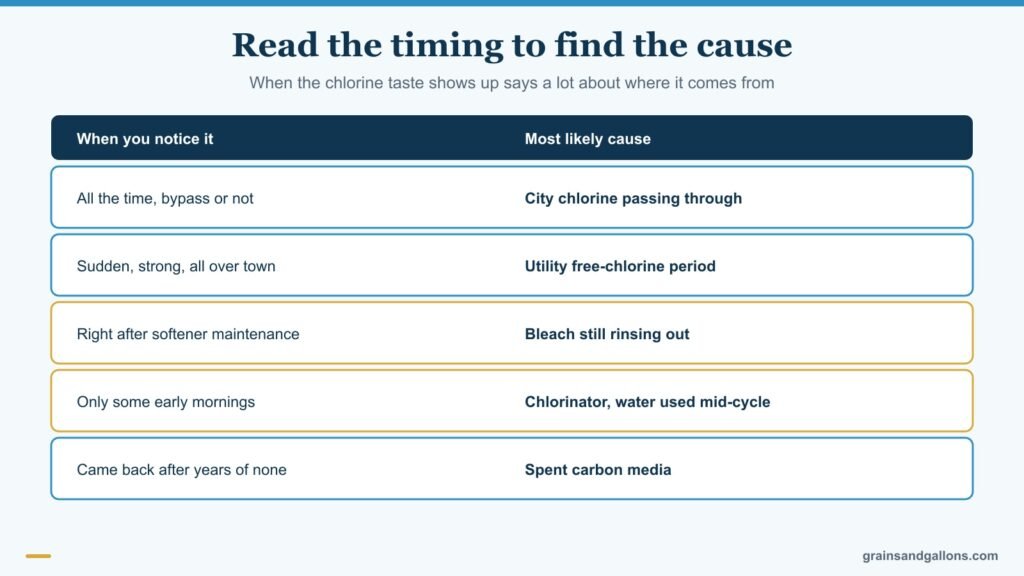
| What you notice | Most likely reason | What to do |
|---|---|---|
| Chlorine in bypass and in service | City water; softener doesn't remove it | Add carbon (whole-house or point-of-use) |
| Sudden, strong, pool-like smell citywide | Utility free-chlorine period | Check the utility notice; it's temporary |
| Started right after maintenance | Bleach still rinsing out | Run another full regeneration, flush |
| Only some mornings | Built-in chlorinator, water used mid-cycle | Change the regeneration time |
| Came back after years | Spent carbon | Replace the carbon media |
Quick ways to cut the taste today

While you sort out a permanent fix:
- Chill it in a jug. Free chlorine dissipates from water left standing, and cold water tastes less of it. This does little for chloramine, which is far more persistent.
- Use a pitcher or faucet carbon filter for drinking and cooking water. It's the cheapest stopgap and works on both chlorine and, with the right media, chloramine.
- Flush after maintenance. If you just sanitized the softener, run cold water at a tub spout until the smell clears before anyone drinks from the kitchen tap.
When it isn't chlorine at all
People describe several smells as "chlorine." A sharp smell only from the hot water, a sweet chemical odor, or a smell at a single faucet can point elsewhere. Rubber hoses and seals in appliances and fittings can react with the small amount of chlorine in tap water and create a medicinal, disinfectant-like taste at that one tap. If the bypass test doesn't explain it, see tap water that smells like bleach or why your water taste changed suddenly. A fuel or solvent smell on a well is different: stop drinking the water and get a lab test.
FAQ
Does a water softener remove chlorine?
No. A standard ion exchange softener removes hardness minerals, not chlorine or chloramine. Only softeners with a built-in carbon stage reduce chlorine taste, and that carbon eventually wears out.
Why does my water taste like chlorine after installing a softener?
Usually the chlorine was always there and now stands out without the mineral taste of hard water. Less often, bleach from sanitizing or a built-in chlorinator is still rinsing out. The bypass test tells you which.
How long does chlorine taste last after sanitizing a softener?
It should clear after a complete regeneration and a good cold-water flush. If it lingers past that, run a second full regeneration.
Will a carbon filter fix chlorine taste from a softener?
Yes, when the chlorine comes from city water. Put a whole-house carbon tank ahead of the softener, or a point-of-use carbon filter at the kitchen sink. Use catalytic carbon if your utility uses chloramine.
Is chlorine taste in softened water safe?
Usually. EPA allows disinfectant residuals up to 4.0 mg/L, and a strong taste doesn't mean that limit is exceeded. Test free and total chlorine if you want a number.
Bypass first, then add carbon
A chlorine taste after water softener installation almost always traces back to chlorine that the softener was never designed to remove, and the bypass test proves it in two minutes. If the taste is there in bypass, add carbon or wait out a utility chlorine burn. If it's only there through the softener, finish the regeneration, flush, and reschedule the cycle.