

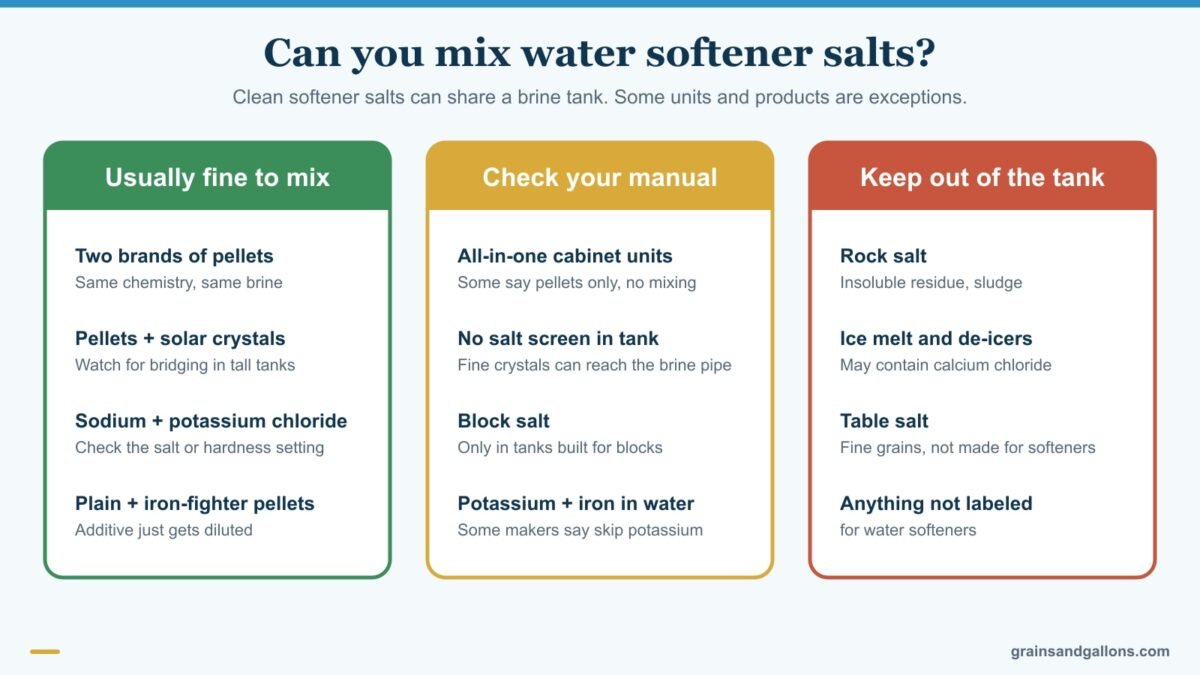
Quick Answer: Can you mix water softener salts? In most two-tank softeners, yes. Pellets, solar crystals, different brands and even potassium chloride can share a brine tank without harming the resin. The exceptions: some all-in-one cabinet units say not to mix pellets with solar salt, rock salt and ice melt don't belong in any softener, and potassium chloride needs a setting change.
The store was out of your usual bag, or there's a sale on a different type. So can you mix water softener salts? For most softeners it's a non-issue, as long as both products are made for softeners and your manual doesn't say otherwise.
In this guide
- Why the resin can't tell pellets from crystals
- Can you mix water softener salts of any type?
- When your softener's manual says don't mix
- Mixing sodium chloride and potassium chloride
- Where mixing actually causes problems
- How to change salt types without a hiccup
- FAQ
- Mix clean softener salts, keep everything else out
Why the resin can't tell pellets from crystals

The softener never uses the salt pile directly. It draws brine: water that has sat on the salt long enough to dissolve as much as it can. Sodium chloride brine made from pellets is the same liquid as brine made from solar crystals, so the resin beads get recharged the same way.
What differs is behavior in the tank. Pellets dissolve steadily; crystals dissolve faster and pack differently. Mixing two clean softener salts averages those habits without creating a chemical problem.
Can you mix water softener salts of any type?
| Mix | OK? | What to watch |
|---|---|---|
| Two brands of evaporated pellets | Yes | Nothing special |
| Pellets + solar crystals | Usually | Some cabinet units say no |
| Plain pellets + iron-fighter pellets | Yes | The additive is diluted, so it works less well |
| Sodium chloride + potassium chloride | Generally yes | Setting changes; see below |
| Any softener salt + rock salt | Usually no | Sludge, clogged brine parts |
| Any softener salt + ice melt or table salt | No | Additives and other chlorides don't belong in a softener |
| Pellets + block salt | Only if the tank is built for blocks | Most aren't; check the manual |
If you're choosing a single type going forward, our comparison of salt pellets vs crystals vs solar salt covers purity, residue and cost.
When your softener's manual says don't mix
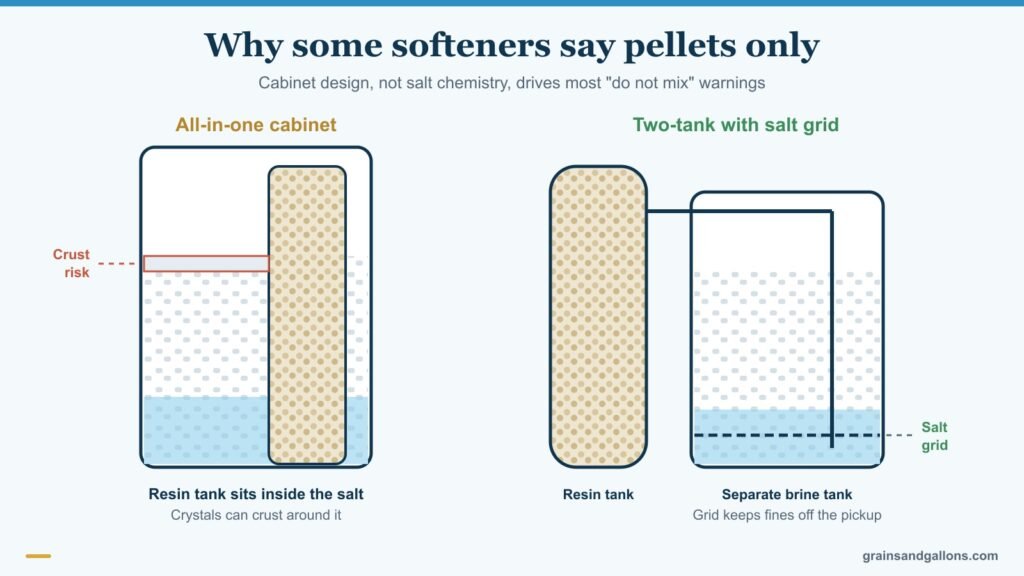
All-in-one cabinet softeners. The resin tank sits inside the salt cabinet, and crystals can crust around it instead of sliding down to the water, so makers often specify pellets. The WaterBoss 700/900/950 owner's manual, for example, accepts pellet, cube-style or solar salt but says plainly not to mix pellet with solar salt.
Tanks without a salt screen. If the brine tank has no grid or screen at the bottom, fine crystals can drift toward the brine pickup. Pellets or cubes are the safer choice there.
Block salt. Blocks are designed for tanks shaped to hold them. In a standard tank they may not sit in the water correctly.
If your manual is silent and you have a separate brine tank with a grid, mixing clean softener salts is fine.
Mixing sodium chloride and potassium chloride
The chemistry is fine: potassium ions recharge the resin the same basic way sodium ions do, so a tank holding some of each still regenerates.
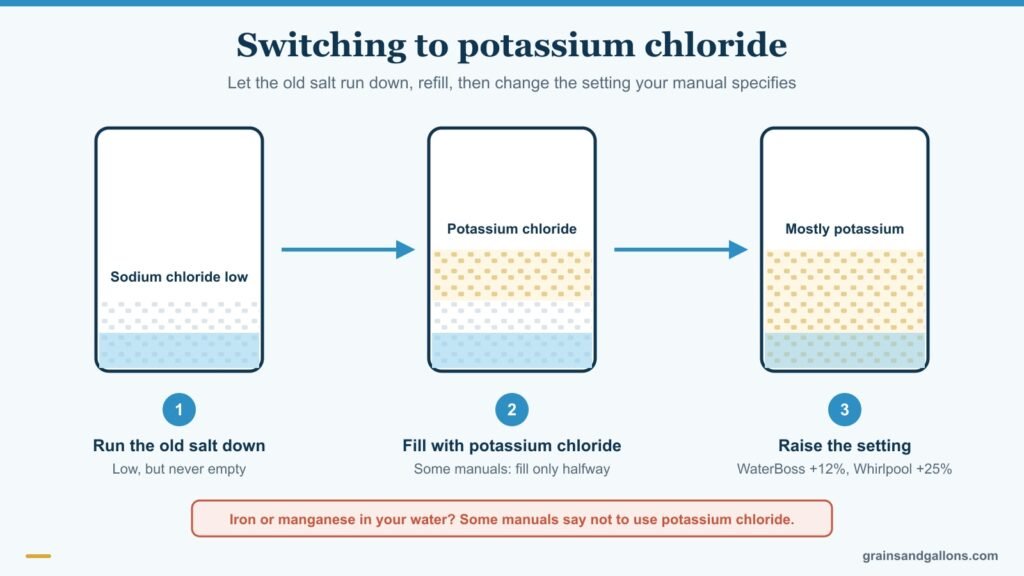
The catch is efficiency. Potassium chloride regenerates less resin per pound, so manufacturers tell you to raise a setting, and the amount varies by brand. The WaterBoss manual says to raise the hardness setting by 12%. The Whirlpool WHES softener manual says 25%, and adds that a tank of potassium chloride shouldn't be filled more than halfway. WaterBoss also warns against potassium chloride if your water contains iron or manganese. Our guide to setting the salt dose on a water softener shows where these settings live.
So which setting do you use for a mixed tank?
- Switching for good: let the sodium chloride run low (not empty), fill with potassium chloride, and change the setting once the old salt is mostly gone.
- Topping off once: leave the setting alone; a partial bag won't matter for a few weeks.
- Mixing indefinitely: use the potassium setting. It wastes a little salt but avoids hard water.
If you want potassium to cut sodium in drinking water, mixing undoes part of that. Our guide to the best potassium chloride softener salt covers what to look for in a bag.
Where mixing actually causes problems

Rock salt and ice melt
Rock salt carries more insoluble material such as clay, which settles as sludge and can clog the brine line and injector. The Whirlpool manual lists rock, block, granulated, table and ice-melting salts as not recommended. Ice melt can contain calcium chloride, the opposite of what a softener needs. If a bag went in, see what to do after putting rock salt in a softener.
Layers that crust over
Fine crystals over pellets, or fresh salt dumped on damp, caked salt, make a hollow crust more likely: a salt bridge, where the tank looks full but the water isn't touching salt. In humid areas the Whirlpool manual suggests a lower salt level and more frequent refills. Our guide to the water softener salt bridge shows how to break one up.
How to change salt types without a hiccup
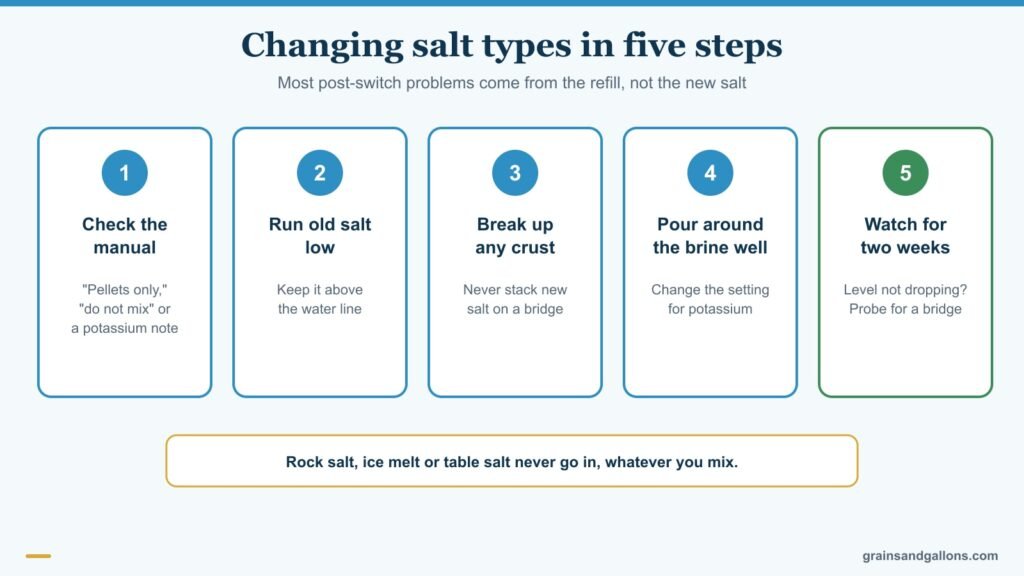
- Check the manual for "pellets only," "do not mix" or a potassium chloride note.
- Let the old salt run low, but keep it above the water line.
- Break up any crust so you aren't stacking fresh salt on a bridge.
- Pour around the brine well, not into it, and change the setting if potassium chloride is going in.
- Watch the level for two weeks. If it never drops, probe for a bridge with a broom handle.
FAQ
Can I mix salt pellets and crystals in a water softener?
Yes, in most two-tank softeners with a salt grid, since both make the same brine. The exception is a manual that says pellets only or not to mix, common with all-in-one cabinet units.
Can I put potassium chloride on top of sodium chloride softener salt?
Yes. Both regenerate the resin. If potassium will be most of the tank, raise the setting by the amount your manual gives.
Do I need to empty the brine tank before switching salt brands?
No. Let the tank run low, break up any crust and refill. Empty and clean it only if it holds sludge or mush.
Is it bad to mix rock salt with pellets?
Usually, yes. Its insoluble material still settles out when mixed with cleaner salt, and many manuals say not to use rock salt at all.
Why does my softener make hard water after I mixed salts?
The mix itself rarely causes it. Check for a salt bridge, a crust that collapsed into the brine well, or a potassium chloride refill without the setting change. Problems after switching to a different salt walks through each one.
Mix clean softener salts, keep everything else out
So can you mix water softener salts? Yes, if they're clean and softener-labeled and your manual doesn't say pellets only. Keep rock salt, ice melt and table salt out entirely, change the setting for potassium chloride, and watch the salt level after any switch.