

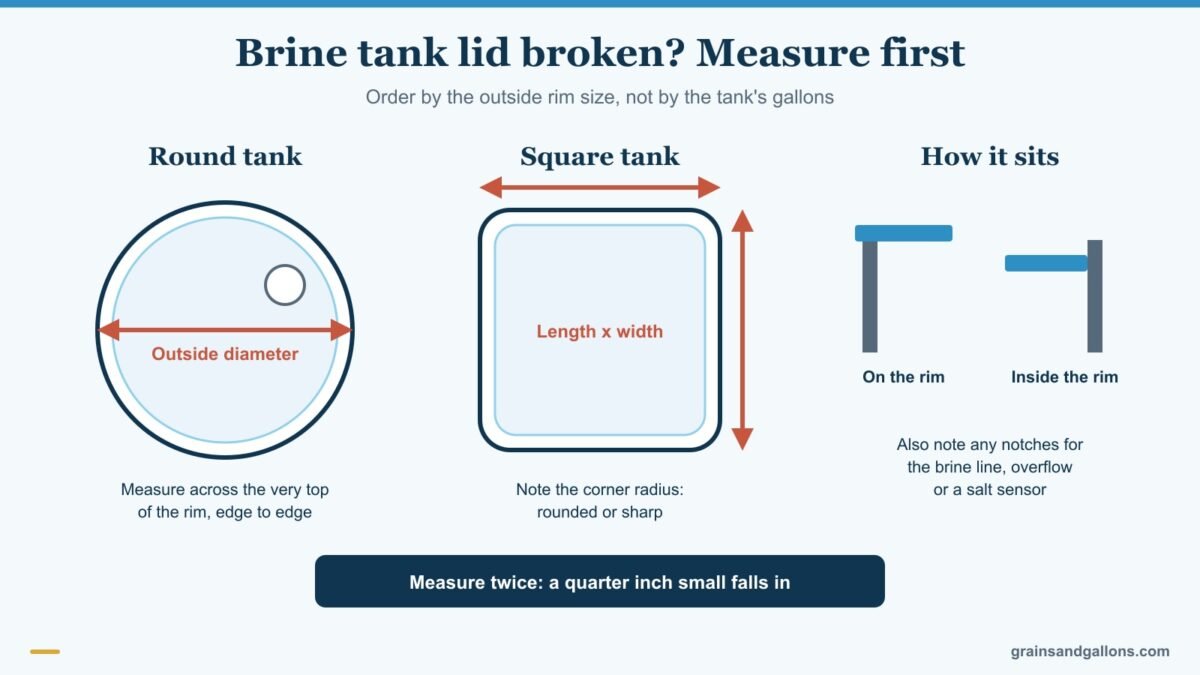
Quick Answer: Brine tank lid broken or missing? Note the brand and model from the softener's control valve label, then measure the outside of the tank's top rim (diameter for round tanks, length and width for square ones). Order the exact lid by model number if you can, or a universal lid in the same rim size if you can't. Until it arrives, lay a rigid board larger than the opening across the top so nothing can fall in.
A broken brine tank lid looks like the least important problem a water softener can have. The lid doesn't touch the water or the resin, and the system softens just as well without it for a while. It still deserves a quick fix, because an open salt tank collects dirt, invites pests and is a real hazard for small children and pets. The good news: lids are cheap, and most are easy to match once you know which type you have and how to measure.
In this guide
Why an open salt tank causes trouble

- It keeps stuff out. Dust, leaves, insects, mouse droppings, garage grime and the occasional dropped tool. All of it ends up in the brine, and some ends up as sludge in the bottom or jammed in the float. If you've already found bugs, see our guide on insects or ants in the brine tank.
- It keeps people and pets out. A brine tank holds water and salt deep enough to matter for a toddler or a curious dog. A lid that sits firmly is a safety feature, not a cosmetic one.
- It holds humidity in. An open tank releases moist, salty air. Over months that can corrode nearby metal like water heater jackets, tool chests and furnace parts, and damp air reaching the salt can help form a crust or salt bridge.
- It keeps rain and sun out on outdoor installs. Rainwater overfills the tank and weakens the brine, and UV breaks down exposed plastic.
Identify which lid you're replacing
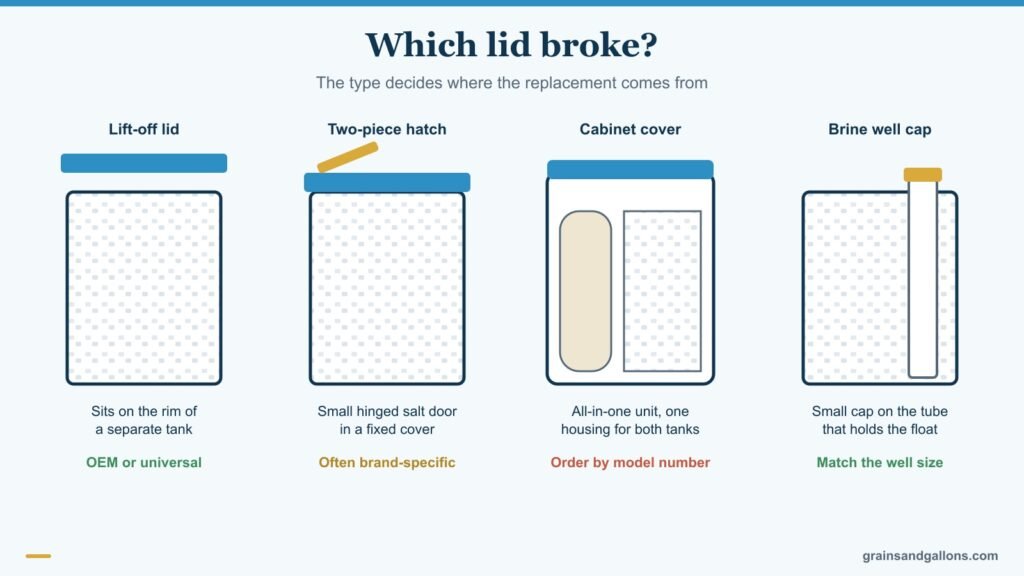
"Brine tank lid" can mean four different parts, and each comes from a different place.
- Full lift-off lid that rests on the rim of a separate, freestanding tank. Easiest to replace, either from the original brand or as a universal part.
- Two-piece lid with a small hinged salt hatch in a larger fixed cover. If only the hinge or hatch broke, ask for the hatch alone; some brands sell it separately.
- Cabinet cover on an all-in-one unit, where the brine tank and resin tank share one housing. These covers are shaped to the cabinet and almost always brand-specific, so order by model number.
- Brine well cap, the small cap on top of the tube that houses the float. It's friction-fit on many systems and pries straight up. A cracked one lets salt and debris fall onto the float, which is a common cause of a stuck brine tank float. Match the outside diameter of the brine well when you replace it.
Tank makers usually sell tanks and covers as a matched pair. Clack, for example, makes its brine tanks in blow-molded, injection-molded and rotationally molded designs, and Pentair's square brine tank spec sheet lists each size as a "brine tank & cover" part, with molded covers also sold as separate accessories. That's why the tank's dimensions, not its gallon rating, are what you need.
Measure for a replacement brine tank lid
1. Write down the brand and model. Look at the label on the control valve or the side of the resin tank. Brand dealers (Culligan, Kinetico, EcoWater, Hague and others) and big-box brands (Whirlpool, GE, Morton and similar) often list lids as service parts by model number.
2. Measure the rim.
| Tank shape | Measure | Also note |
|---|---|---|
| Round | Outside diameter of the rim, at the very top | Whether the lid sits on the rim or inside it |
| Square/rectangular | Outside length and width of the rim | Corner radius (rounded vs. sharp) |
| Either | Any notches for the brine line or overflow | Where the brine well sits, if the lid has a cutout |
Measure twice. A lid that's a quarter inch too small falls in; one that's too big slides around and lets dust in at the edges.
3. Note anything mounted on the old lid. Some smart salt sensors and level indicators mount on or through the lid. Your new lid needs a matching spot, and if you never had one, our roundup of the best smart salt level sensors for brine tanks shows how each type mounts.
Where to get the new lid, best option first
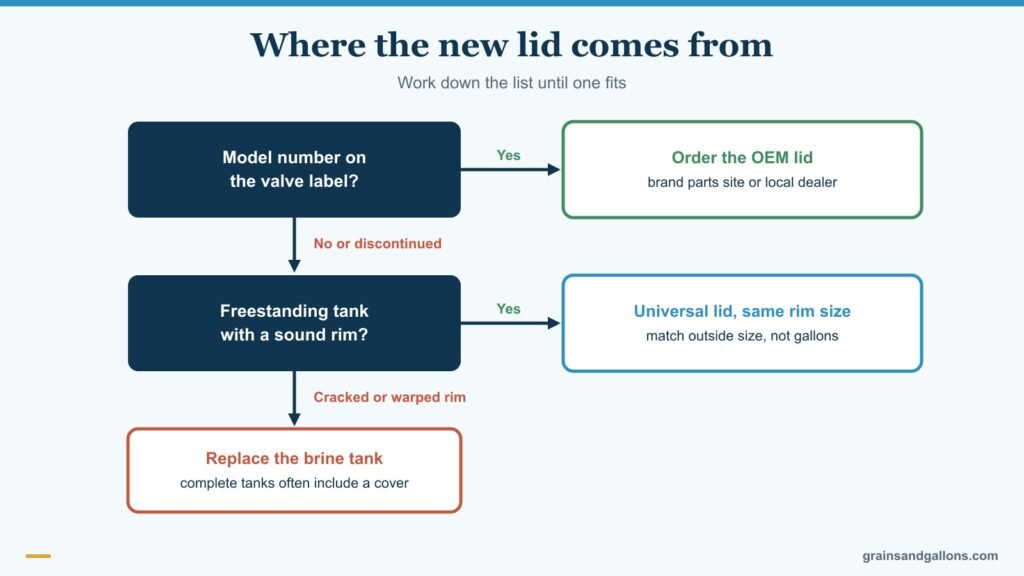
OEM lid by model number. The cleanest fit. Search the brand's parts site or call a local dealer for that brand with the model number from the valve label.
A universal lid in the same size. Freestanding brine tanks come in a handful of common round and square sizes, and parts suppliers sell lids to match. Compare your measurements to the listed outside rim size, not the tank's capacity, and check whether the lid is drilled for a sensor or brine line.
A replacement tank with a lid. If the rim is cracked or warped and no lid will sit right, replacing the whole brine tank may be simpler. Complete replacement tanks often ship with a new brine well, float and cover. See our guide on a cracked brine tank for how to swap one.
A safe stopgap until the lid arrives

You want something that blocks debris, can't fall in, and doesn't trap moisture against the salt.
- A rigid board (plywood, a plastic cutting board, a scrap of melamine shelf) larger than the opening. Weigh it down lightly if pets are curious.
- A plastic bin lid or storage tote lid that overhangs on all sides.
Avoid:
- Plastic sheeting or trash bags tied over the top. They sag into the salt and collect condensation.
- Anything metal. Brine corrodes it, and rust ends up in the tank.
- Taping it shut. The tank isn't pressurized and doesn't need a seal, and you'll be back in it to add salt.
Check the tank while the lid's off
Since the tank's been open, take two minutes:
- Look for debris on the salt and down the brine well. Scoop out anything that doesn't belong.
- Check the salt for a crust or bridge by probing with a broom handle.
- If anything got in that shouldn't, like rainwater, leaves or droppings, clean the tank. Our brine tank cleaning guide shows how.
Stop the next lid from breaking
Most lids break the same few ways: they crack when someone sets a full salt bag on them, the hinge snaps when the hatch is flipped all the way back, or the plastic turns brittle in the sun. Lift the lid off and set it aside before you pour salt, and don't use the tank as a shelf.
If the lid broke because it sat in the sun, a new one will fail the same way. A cover or enclosure for the whole system shades the plastic and keeps rain out; see our picks for outdoor water softener covers and enclosures and our outdoor installation guide for the bigger picture. And if you're buying a lid anyway, it's the easiest moment to add a salt level sensor that tells your phone when salt runs low.
FAQ
Does a water softener brine tank need a lid?
The softener will keep working without one, but the lid keeps debris, insects, rain and curious kids or pets out of the salt and brine, and it holds damp, salty air inside. Replace a broken or missing lid soon rather than running uncovered for months.
Are brine tank lids universal?
Partly. Freestanding round and square tanks come in common sizes, so a universal lid that matches the outside rim measurement often fits. Two-piece hatches and cabinet covers on all-in-one softeners are usually brand-specific and need the model number.
Brine tank lid broken at the hinge: can I fix it?
Sometimes. If the hatch is fine and only a plastic hinge pin snapped, the hatch may still sit in place as a loose lid. Glue rarely holds on polyethylene, so ask the brand for the hatch or hinge part, or replace the full lid.
What can I use as a temporary brine tank cover?
A rigid board, cutting board or storage tote lid that overhangs the opening on every side. Avoid plastic bags or sheeting that sag into the salt, and avoid metal, which rusts in brine.
Can a missing brine well cap cause problems?
Yes. Without the cap, salt and debris can drop into the brine well and jam the float or clog the brine line inlet. Replace it with a cap that matches the well's diameter.
Fix the lid now; it costs less than what gets in
Leaving a brine tank lid broken for months costs more than fixing it. It's a small, cheap repair that prevents bigger ones: contaminated brine, a jammed float, rusted neighbors and a safety risk for kids and pets. Identify the lid type, measure the outside rim, order by model number if you can, and keep a rigid board on the tank until the new one arrives.
More brine tank help: Insects or ants in the brine tank · Cracked brine tank · How to clean a water softener brine tank · Best water softener enclosures