


Quick Answer: Does a water softener change pH? No, not in any way that matters. A standard salt-based softener swaps calcium and magnesium for sodium (or potassium). It adds no acid or base and leaves the bicarbonate that sets your pH alone, so pH before and after the softener normally lands within a few tenths. If your readings differ by more, suspect the test method or another piece of equipment. Test both taps the same way, same day, with a kit like the Hach HA-62A hardness, iron and pH kit.
Disclosure: As an Amazon Associate, Grains & Gallons earns from qualifying purchases.
People usually ask "does a water softener change pH" because a dealer promised it would "fix" acidic well water, or because two taps tested differently. If your well water is already known to be acidic, the fix is separate equipment; see our picks for the best acid neutralizer filters.
In this guide
- Does a water softener change pH? Why the meter barely moves
- What softening does to alkalinity and buffering
- Same pH, different behavior: softened water is less scale-forming
- When your before-and-after readings don't match
- Low-pH well water needs its own fix, before the softener
- The exception: weak-acid resin units do lower pH
- FAQ
- Treat pH and hardness as two separate jobs
Does a water softener change pH? Why the meter barely moves
pH measures hydrogen ions. In most tap and well water it's set by the carbonate system: the balance of dissolved carbon dioxide, bicarbonate and carbonate.
A softener's resin bed doesn't touch that system. As water flows through, the resin grabs positively charged calcium and magnesium and releases sodium in their place, charge for charge. The negatively charged ions, bicarbonate included, pass straight through. No acid gets added and no CO2 gets removed, so the thing that sets pH leaves the tank the same as it went in.
For how the two numbers interact on a test report, see our guide on interpreting pH and hardness together.
What softening does to alkalinity and buffering

Alkalinity is the amount of bicarbonate and carbonate in the water, reported as ppm of calcium carbonate. It's what keeps pH from dropping when something acidic is added. Because the softener leaves bicarbonate in place, alkalinity stays essentially where it was, even though hardness falls to near zero.
A FloraLife research test by Smithers Oasis shows this clearly. Softening took a sample from 325 ppm hardness down to 17 ppm, yet pH didn't change and alkalinity didn't go down (it read slightly higher). The researchers also measured conductivity jumping about six-fold, to 4.06 mS/cm, in water drawn during the regeneration cycle.
What that means at home:
- Aquariums, ponds and plants care about buffering and salt, not just pH, so test KH and GH rather than pH alone.
- Don't fill tanks or water plants during regeneration. That's when the salty rinse can reach the line, as our guide to how water softener regeneration works explains.
Same pH, different behavior: softened water is less scale-forming
The pH doesn't change, but the water acts differently. Hard water drops calcium carbonate scale, and a thin layer of it shields metal pipes a little. Softening removes that tendency.
Water chemists measure this with the Langelier Saturation Index (LSI), which combines pH, calcium, alkalinity, dissolved solids and temperature. Penn State Extension's guide to corrosive water problems notes that negative LSI values indicate corrosive water and that soft, acidic water tends to be more corrosive. Softening lowers the calcium term, so the index drops: less scale, somewhat more aggressive water, at the same pH.
Water that was already borderline corrosive won't improve after softening, and plumbers often say water heater anode rods wear faster on softened water, so check yours on the manual's schedule. None of this makes softened water acidic; it just means a softener isn't a corrosion-control device.
When your before-and-after readings don't match

If you see a gap of half a point or more, rule these out roughly in order:
- Different test methods. Strips and cheap pens are commonly off by a few tenths. Use the same kit on both samples.
- Sample time. As a well water sample sits, dissolved CO2 escapes and pH creeps up. Test both samples right away.
- The "before" tap isn't really before. Outdoor spigots are usually unsoftened, but not always. Use the softener's bypass to pull a true raw sample.
- Something else is in the line. A neutralizer upstream raises pH. RO downstream usually lowers it, because the membrane strips bicarbonate but passes dissolved CO2.
- An uncalibrated meter. Calibrate with buffer solution before you trust a decimal.
Our step-by-step on how to test water pH at home covers calibration and sampling.
Low-pH well water needs its own fix, before the softener
The EPA's secondary (non-enforceable, aesthetic) guideline for pH is 6.5 to 8.5. Below that range, water tends to taste metallic or bitter and to eat at copper plumbing. The classic warning sign is blue-green staining under faucets; our guide to blue-green stains in sinks explains it.
A softener won't raise that pH. The usual fixes:
- Calcite neutralizer: a tank of crushed calcium carbonate, sometimes blended with magnesium oxide for very low pH. Water dissolves a little media and pH rises. Penn State notes this adds hardness, which is part of how it controls corrosion.
- Soda ash injection: a chemical feed pump adds sodium carbonate. Penn State notes it raises pH without adding hardness, at the cost of a pump and solution tank to maintain.
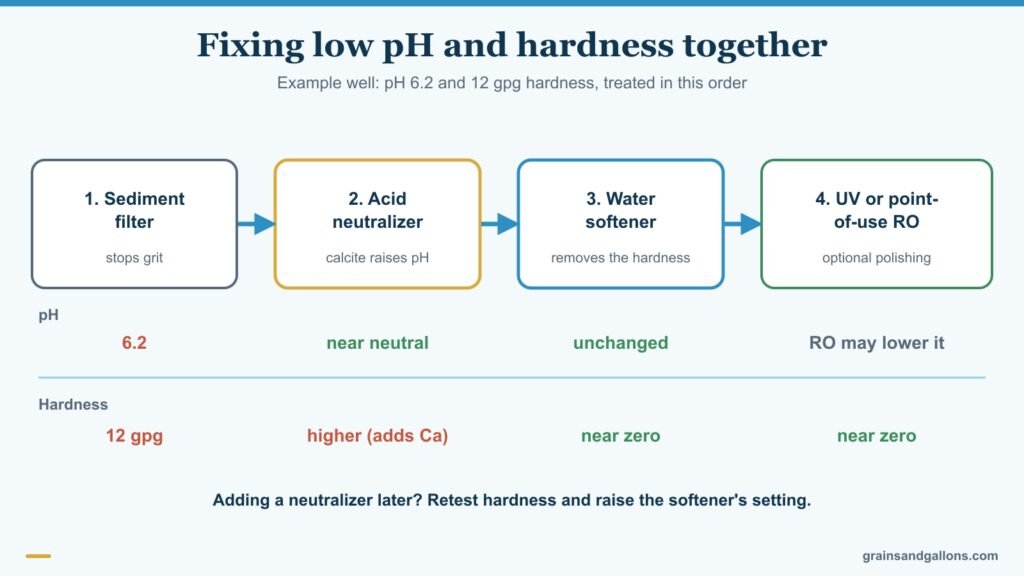
Because calcite makes the water harder, the order is sediment filter, neutralizer, softener, then any UV or point-of-use RO, as the diagram shows. If you add a neutralizer to a house that already has a softener, retest hardness and raise the softener's hardness setting. More on sequencing is in our well water treatment train order guide.
Worked example: pH 6.2 and 12 gpg hardness
- Softener only: soft water at roughly pH 6.2. Scale stops, but blue-green stains and pinhole-leak risk in copper don't.
- Neutralizer only: pH climbs toward neutral and hardness rises by however much calcite dissolves. Corrosion slows, scale gets worse.
- Neutralizer, then softener: pH near neutral, hardness near zero. This combination solves both problems.
Results depend on your water, so retest after installation.
The exception: weak-acid resin units do lower pH

Everything above applies to the common salt-based softener with strong-acid cation resin. Some cartridges, mostly for espresso and commercial coffee machines, use weak-acid cation resin, which trades hardness for hydrogen ions. That hydrogen converts bicarbonate to CO2, so these units lower alkalinity and pH on purpose. If your "softener" is a cartridge that never uses salt, check its spec sheet for the resin type.
FAQ
Is softened water acidic?
No. A sodium-exchange softener leaves pH where the source water had it. Acidic source water stays acidic, but the softener didn't cause it.
Will a potassium chloride softener change pH differently than sodium?
No. It swaps potassium for hardness instead of sodium. The carbonate chemistry that sets pH is untouched either way.
Can a water softener raise pH?
Not on its own. If pH went up after installation, look for a neutralizer stage or a combination unit with calcite in it.
Does low pH damage a water softener?
Acidic water mainly attacks plumbing, but the iron and copper it dissolves can foul resin. Treating pH ahead of the softener protects both.
My softened water tastes "flat." Is that a pH change?
Usually not. The taste change comes from swapping calcium and magnesium for sodium. Our guide on whether softened water is safe to drink covers the sodium side.
Treat pH and hardness as two separate jobs
So, does a water softener change pH? Not meaningfully. It removes hardness, leaves alkalinity and pH essentially intact, and makes the water a little less scale-forming. If your pH is below 6.5, add an acid neutralizer or soda ash feed ahead of the softener, then retest. Start with a full test of pH, hardness, iron and manganese; our best well water test kits cover lab and home options.