


Quick Answer: Here's how to test water pH at home: fill a clean cup straight from a cold tap and read it within a minute, before dissolved carbon dioxide escapes and shifts the result. Strips or color drops tell you roughly whether water is acidic, neutral or alkaline. For a number precise enough to choose or check an acid neutralizer, use a pocket meter like the Apera PH20, calibrated with pH 7 and pH 4 buffer first. The EPA's guideline range is 6.5 to 8.5.
Disclosure: As an Amazon Associate, Grains & Gallons earns from qualifying purchases.
Blue-green stains under the faucet, a pinhole leak in a young copper line, a metallic taste in the morning: those classic signs of acidic water are why most people look up how to test water pH at home. pH is easy to check yourself. The catch is one timing detail that trips up many well owners.
In this guide
What pH measures and the range to aim for
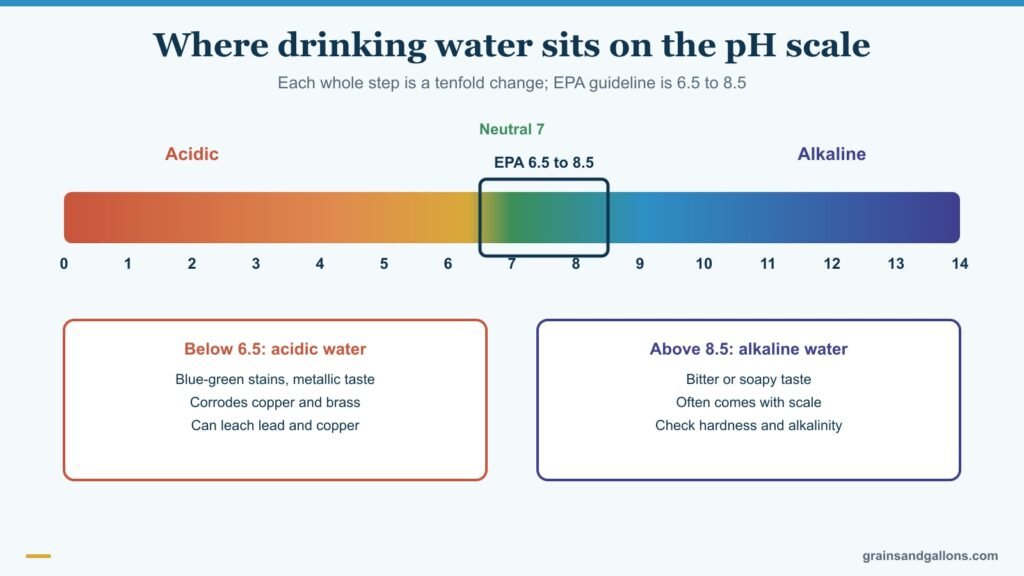
pH runs from 0 to 14. Seven is neutral, lower is acidic and higher is alkaline. Each whole number is a tenfold change, so pH 6 is ten times more acidic than pH 7. That's why a half-unit difference matters.
The EPA's secondary standard for drinking water is 6.5 to 8.5. It's about corrosion, taste and staining rather than a direct health limit. Private wells aren't covered by it, so testing is up to you.
Read a well sample within a minute

Well water often carries dissolved carbon dioxide from underground. CO2 in water forms a weak acid that pulls pH down. Once that water sits in an open cup, the gas escapes and the pH climbs. A sample that reads 6.3 straight from the tap can read 6.9 an hour later. The first reading is the one your pipes experience.
So run the tap until the water is cold and fresh, fill the cup gently without splashing, and test within a minute. Sample before any treatment if you want the raw number.
Strips, drops or a meter: picking a pH test

Test strips are fine for "is my water acidic at all?" The color steps are usually a half to a full pH unit apart, and pool strips cover a narrow range that may not go low enough for an acidic well. Dip times vary by brand, so read the label, and match colors in daylight against white.
Liquid color drops in a test vial give a more even color than a strip pad. They're still a color match, good to about half a unit. Many multi-parameter home kits include them.
A digital meter reads to a tenth of a unit or better. That matters when you're choosing between a calcite filter and a stronger blend, or checking whether a neutralizer still works.
Very low-mineral water, such as RO water or some very soft wells, is hard to measure by any method, and readings wander. That's the water, not a broken meter.
How to test water pH at home with a meter

- Calibrate before each session with fresh buffers, usually pH 7.0 first, then pH 4.0 (or 10.0 if your water runs alkaline). Follow your model's button steps.
- Rinse the probe in a little of your sample.
- Collect fresh water as described above and test right away.
- Stir gently and wait for the number to settle. Slow drift is normal on low-mineral water.
- Write down the reading, the tap and the time since sampling.
- Store the probe in storage solution, not distilled water and not dry. A dried-out bulb gives sluggish, wrong readings.
Reading a low or high pH result
| Reading | What it usually means | Next step |
|---|---|---|
| Below about 6.5 | Acidic; can corrode copper and brass and leave blue-green stains | Confirm with a meter or lab; consider an acid neutralizer |
| 6.5 to 8.5 | Within EPA's guideline | Usually nothing for pH alone |
| Above about 8.5 | Alkaline; can taste bitter or soapy, often with scale | Check hardness and alkalinity first |
Penn State Extension notes that soft, acidic water below pH 7.0 tends to be more corrosive, with blue-green copper stains, a metallic taste in the first morning water and, in severe cases, pinhole leaks. Our guide to blue-green stains in the sink covers that symptom. Corrosive water can also pull lead and copper from plumbing, so if pH is low and your home has older pipes or brass fixtures, see how to test water for lead at home.
pH alone doesn't tell the whole story. Hardness and alkalinity change how corrosive the same pH is; see interpreting pH and hardness together. If you suspect your softener changed things, read does a water softener change pH?
Checking an acid neutralizer with home pH tests

For a low-pH well, the usual fix is an acid neutralizer: a tank of calcite (crushed calcium carbonate) that slowly dissolves and raises pH. Very low pH often calls for a blend with magnesium oxide, so check each maker's minimum pH. Our acid neutralizer filter roundup compares designs.
Test before and after the tank every month or two at first. When the treated reading drifts back down, it's usually time to add media; see replacing acid neutralizer media. Penn State notes these filters also raise hardness, since they add calcium. For pH, hardness, iron and metals on one report, our well water test kit guide covers lab panels.
FAQ
Are pH test strips accurate for drinking water?
They're accurate to about half to one pH unit, which is enough to tell acidic from neutral. For treatment decisions, use a calibrated meter or a lab.
How often should I calibrate a pH meter?
Before each testing session for the best accuracy, and always after the meter has sat unused. Use fresh buffer solution, since old or contaminated buffer throws calibration off.
Can I test water pH without a kit?
Only roughly. Red cabbage juice changes color with pH and can show acidic versus alkaline, but it can't give a number precise enough for treatment.
Why does my well water pH change after it sits?
Dissolved carbon dioxide escapes once the water is exposed to air, and losing that weak acid raises the pH. Read well samples within a minute.
Calibrate, read fast and trust the meter over the strip
The most reliable answer to how to test water pH at home is a calibrated meter on fresh, untreated water read within a minute. Strips and drops are fine for a first look. Below 6.5, confirm it, check for copper and lead, and size a neutralizer from the meter reading.