

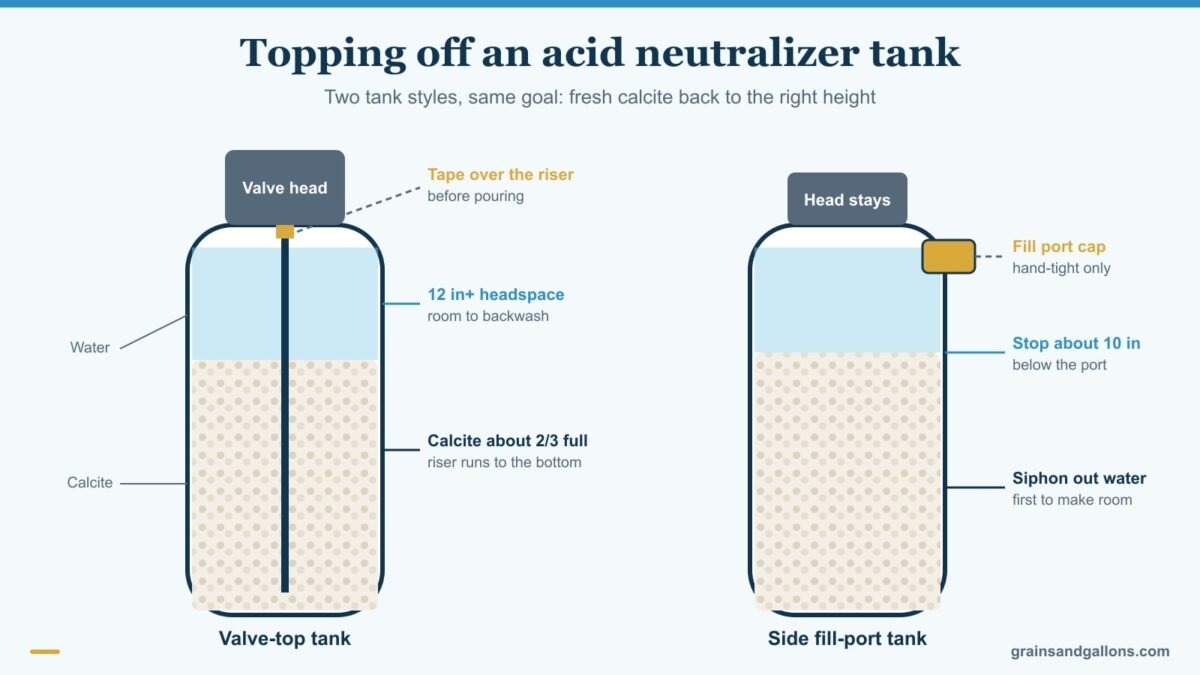
Quick Answer: How to replace acid neutralizer media in short: calcite is meant to dissolve, so most tanks need a top-off, not a full replacement. Bypass the tank, relieve pressure, open the fill port or lift off the valve head, siphon out some water, tape over the riser tube, and pour fresh calcite back to the original height (about two-thirds full, with at least 12 inches of free space above the bed). Clean the threads, refill slowly, and rinse until the water runs clear. A full clean-out is only needed if the bed has clumped, fouled with iron, or run empty.
Knowing how to replace acid neutralizer media saves you a service call once a year or so. The usual trigger: your well water pH has slipped back to around 6, or a faint blue-green streak has reappeared under the faucet. The neutralizer is still running, but the calcite has dissolved into your water, which is exactly its job, and there isn't enough of it left. This guide covers how to tell how much is missing, whether you need a top-off or a full clean-out, and how to do either without cracking the fill port or sending gravel into your plumbing.
In this guide
Calcite is supposed to disappear

Calcite is crushed calcium carbonate. Penn State Extension's guide to corrosive water problems explains that acid-neutralizing filters raise pH as water contacts the media, that "the tank must be routinely refilled with neutralizing material as it is dissolved," and that the process adds hardness. How fast the bed shrinks depends on how acidic your water is and how much you use. Lower pH and heavier use eat through it faster.
How to check the level. In a dim room, shine a bright flashlight against the back of the tank. On most translucent fiberglass tanks you'll see the shadow line where the media stops. Mark it with tape and note the date. If you can't see through the tank, measure with a dowel after you open it.
How often you'll add calcite. Most homes add media about once a year, but tank size changes that a lot. One supplier's schedule runs roughly 6–12 months for a 1.0 cubic foot tank, 18–24 months for 1.5 cu ft, 24–30 months for 2.0 cu ft and 30–36 months for 2.5 cu ft. Treat those as starting points and let your flashlight checks and pH readings set the real interval.
How much to buy. Compare the current line with the original fill height on your paperwork. A common target is about two-thirds of the tank height. Worked example: a 10-inch-wide tank whose bed has dropped 10 inches. Each inch of height in a 10-inch tank is about 0.045 cubic feet (π × 5² ÷ 1,728), so 10 inches is about 0.45 cubic feet, close to one 50-lb bag. Check the coverage printed on the bag, since densities vary.
Top off, or rebed the whole tank?

Top off if the remaining media is loose and granular, the bed has simply dropped, and backwash water isn't heavily stained.
Do a full clean-out (rebed) if:
- The bed has fused into hard clumps or a solid cake, often from too little backwashing, so water channels through cracks instead of the media.
- The media is coated orange or black from iron or manganese, which stops the calcite dissolving. If that's your water, see orange stains from well water for what belongs ahead of the neutralizer.
- The tank ran empty or had a bacteria problem.
- The media is several years old and pH stays low even after a top-off. One supplier recommends a full clean-out every 5 to 10 years.
A clean-out means removing all the old media first. A wet/dry shop vac makes that much easier, or disconnect the tank and hose it out. Rinse the empty tank, then fill it with fresh media using the steps below.
Gear and supplies to have ready

- Calcite (and any blend media your tank uses), enough to restore the original height
- The wide funnel that came with the tank, or any large funnel
- A 5-gallon bucket and about 3 feet of hose for siphoning, or a wet/dry vac
- Electrical or duct tape to cover the riser (distributor) tube
- Dust mask and safety glasses; calcite is dusty
- Towels, a flashlight, a dowel or tape measure, and channel-lock pliers
- A spare tank O-ring and silicone lubricant (not petroleum grease)
How to replace acid neutralizer media, step by step

The order is the same for both common tank styles. Valve-top tanks need the control head lifted off; tanks with a side fill port let you leave the head in place.
1. Bypass and unplug. Put the neutralizer in bypass, or close the inlet valve if there's no bypass. Unplug a backwashing control valve. On a valve-top tank, some guides suggest running a short manual backwash first to release pressure inside the valve.
2. Bleed the pressure. Open a cold faucet or outdoor hose bib downstream until the flow stops.
3. Open the tank. On a fill-port tank, unscrew the port cap; a little water may escape. On a valve-top tank, undo the union or bypass fittings, unscrew the head counterclockwise, and lift straight up so the riser tube stays seated in the bottom distributor.
4. Siphon out water. Remove enough water to make room for the new calcite, usually about one bucket. Leave a few inches over the bed to cushion the falling media.
5. Cover the riser tube. On a valve-top tank, wrap a strip of tape over the top of the center tube, leaving a tab to pull it off later. Calcite in the riser goes straight into your house plumbing. This is the step people forget.
6. Pour slowly through a funnel. Wear the mask and glasses, keep the riser centered, and pour in stages, checking the height with a dowel. Fill to about two-thirds full with at least 12 inches of free space above the bed, as this dealer's calcite guide recommends; on fill-port tanks, one supplier says to stop about 10 inches below the port and never higher. Overfilling leaves no room for the bed to lift during backwash and can push media into the valve.
7. Clean the threads and O-ring. A single grain on the threads or the O-ring can cause a slow leak. Wipe both clean, replace a flattened or nicked O-ring, and lubricate with silicone only.
8. Refill slowly. Peel off the riser tape and reinstall the valve head hand-tight, or set the port cap on loosely. Open the supply about a quarter of the way so air can escape. On a fill-port tank, tighten the cap by hand once water seeps out, then add no more than a quarter to half turn; over-tightening can crack the port.
9. Rinse or backwash until clear. New calcite releases cloudy fines. On a backwashing tank, run two full backwash and rinse cycles. On an up-flow tank with no backwash valve, run cold water slowly for about 10 minutes, then at full flow until it clears. Check every fitting for drips, plug the valve back in and return it to service.
Up-flow tanks and Corosex blends
Up-flow neutralizers have no backwash valve: water enters through the distributor tube and rises through the media. The refill is the same, minus the backwash; restore flow slowly and rinse at a cold tap instead. Because the bed is never fluffed, up-flow tanks are more prone to channeling, so check them for packed media at every refill.
Some tanks hold a blend of calcite and magnesium oxide (sold as Corosex or FloMag) for water below roughly pH 6. Magnesium oxide is stronger, dissolves faster and can push pH too high if overdosed. Top off with the same blend and ratio the installer used, or ask a dealer. Don't guess, and don't add extra just to stretch the interval.
Confirm the pH and watch the stains

Give the system a day, then test pH at a cold tap. How to test water pH at home covers which methods are accurate enough. The EPA's secondary drinking water standards suggest a pH of 6.5 to 8.5, and many neutralizer makers aim a little above 7. Write down the reading and the date so you know how fast it drops next time.
Hardness will rise a bit because the calcite adds calcium. If a softener sits after the neutralizer, that's expected and one reason equipment order matters; see well water treatment train order and interpreting pH and hardness together.
If blue-green stains were the reason you checked, give it a couple of weeks. Old stains won't fade on their own, but new ones should stop. Blue-green stains in sinks and tubs covers cleanup and when a stain points to a copper pipe problem. If you're topping off more than twice a year, the tank may be undersized for your flow or pH; our guide to the best acid neutralizer filters covers sizing and when a blend makes more sense.
FAQ
How often should you add calcite to an acid neutralizer?
Most homes add calcite about once a year. Small tanks with very acidic water may need it every 6–12 months, while larger tanks can go two to three years. Check the level with a flashlight each year and add a bag when the bed has dropped noticeably.
Do you ever fully replace calcite?
Rarely. Because calcite dissolves as it works, you normally just add more. Replace the whole bed only when it has clumped hard, fouled with iron or manganese, run empty, or had bacteria, or roughly every 5 to 10 years as part of a clean-out.
How full should an acid neutralizer tank be?
About two-thirds full, with at least 12 inches of free space above the media so it can lift during backwash. For tanks with a side fill port, one supplier says to stop about 10 inches below the port. Follow your manufacturer's figure if it gives one.
Why is my water cloudy after adding calcite?
New calcite sheds fine dust. Run one or two backwash cycles, or flush a cold tap until it clears. Cloudiness that lasts for days points to media in the riser or a valve problem.
Does adding calcite make water harder?
Yes, a little. Dissolved calcite adds calcium, which is part of how it neutralizes acidity. If you already have hard water, a softener installed after the neutralizer handles the extra hardness.
Refill to height, rinse it clear, then test
Learning how to replace acid neutralizer media is mostly about protecting a few weak points: cover the riser tube, keep grit off the threads and O-ring, stop filling at the right height, and refill slowly so trapped air and fines don't cause trouble. Top off when the flashlight line drops, save the full clean-out for a clumped or fouled bed, and confirm the result with a pH test a day later.