


Quick Answer: Can a water softener be too large? Yes, but not in the way most people fear. An oversized softener won't make water "too soft" or hurt your plumbing. The real problems are that a bigger tank needs a stronger backwash flow than some wells can deliver, it can go weeks between regenerations (bad news with iron, bacteria and salt bridging), and it costs more for capacity you never use. A unit about one size above what you need is fine. Two or three sizes above starts causing trouble.
Can a water softener be too large? Somebody at the store said "get the 64,000, you'll never regret going bigger." Then someone online said oversizing wastes salt and ruins the resin. Both are partly right, and the reason comes down to how a softener spends its capacity.
Think of the grain rating as the size of a fuel tank. Each day your household burns some of it: gallons used times hardness. When it gets low, the softener regenerates and refills the tank with salt.
A bigger tank doesn't use fuel faster. It just goes longer between refills. That's the whole story of oversizing. A little extra time between refills is good: fewer regenerations means less water and electricity, and Penn State Extension notes each regeneration uses about 50 gallons of water. Far too much time between refills is where problems start.
In this guide
Worked example: a couple on 10 gpg city water

Take a couple in a two-bath house with city water at 10 grains per gallon (gpg) of hardness. A common planning figure is around 60 to 75 gallons per person per day; use 65.
- Daily load: 2 people × 65 gallons × 10 gpg = 1,300 grains per day
Now compare two softeners. One thing first: the number on the box is usually the capacity at the maximum salt dose. Run at a more efficient, lower salt setting, the usable capacity is noticeably lower. The figures below are rough illustrations; your spec sheet gives the real numbers for each salt setting.
| 32,000-grain unit | 64,000-grain unit | |
|---|---|---|
| Resin | about 1 cubic foot | about 2 cubic feet |
| Usable capacity at an efficient salt setting (rough) | ~20,000–24,000 grains | ~40,000–48,000 grains |
| Days between regenerations at 1,300 grains/day | ~15–18 days | ~30–37 days |
The 32,000 is already regenerating about every two weeks. The 64,000 would go a month or more. That's the point where most valves' days override would step in and force a regeneration anyway, using salt on a bed that's only partly used. You haven't gained efficiency; you've paid for resin that never gets used.
For this household, a 24,000 to 32,000-grain unit is the right range, and our list of softeners for small homes and one to two bathrooms is where to look. A family of four on harder water is a different story, and a 40,000-grain softener is often the sensible step up. To run these numbers for your own house, see how to size a water softener.
Backwash flow: the problem well owners hit first

Every regeneration starts with a backwash, which pushes water up through the resin bed to loosen it and flush out sediment. A bigger tank has a wider bed, and a wider bed needs more flow to lift it properly. The drain line flow control (DLFC) sets that rate, and it gets bigger as the tank gets wider. As a rough guide, a 10-inch-wide tank is often paired with a DLFC somewhere around 2 to 2.5 gallons per minute, and a 12- to 14-inch tank needs several gallons per minute more. The Fleck 5600SXT service manual lists flow washers from 0.6 up to 7 gpm and calls for a 3/4-inch drain line once backwash flow tops 7 gpm, so the plumbing grows with the tank too. Check your valve's spec sheet for the exact figure.
On city water, that's rarely a problem. On a well with a small pump or a low-yield well, it can be. If the pump can't keep up, the bed doesn't get cleaned properly, sediment and iron build up, and the resin channels (water finds easy paths through the bed and skips the rest). The symptom is hardness or iron slipping through even though the softener seems to regenerate normally. If you're on a well, read well pump flow and backwashing before choosing a large tank.
Month-long gaps: iron, bacteria and mushy salt

Resin that sits in water for weeks without regenerating isn't damaged by the wait itself, but a few things go wrong around it:
- Iron and manganese build up. On well water with even small amounts of iron, long intervals let iron oxidize and stick to the resin. Penn State Extension warns that oxidized iron "will clog the resin." More frequent regeneration with a resin cleaner keeps it in check.
- Bacteria get time to grow. A tank of still water at room temperature suits bacteria that cause musty or rotten-egg smells, and Penn State notes bacterial mats in the resin reduce its effectiveness. Regular brine rinses discourage this. If your water already smells off, see musty water after a softener.
- The brine tank sits longer too. Salt can bridge or mush when nothing draws from the tank for weeks.
This is why many valves have a days override, a setting that forces a regeneration after a set number of days even if the meter hasn't counted enough gallons. It's a good safety net, but on a badly oversized unit it means you're regenerating a mostly unused bed. More on choosing that number in days override setting explained.
Does a bigger softener use more salt?

Not automatically. Salt use depends on the salt dose per cubic foot of resin and how often the unit regenerates, not on the box size alone. A big tank set to full salt and forced to regenerate by the days override does waste salt, because it refills capacity you didn't use. The same tank set to a lower dose and regenerating every week or two can be more salt-efficient than a small tank running flat out. The fix is in the settings: see how to set the salt dose on a water softener.
Up front, though, bigger always costs more. A larger softener takes more floor space, holds more resin to eventually replace and comes with a bigger, heavier brine tank. If you never use the extra capacity, that's money spent for nothing.
Signs your softener is oversized
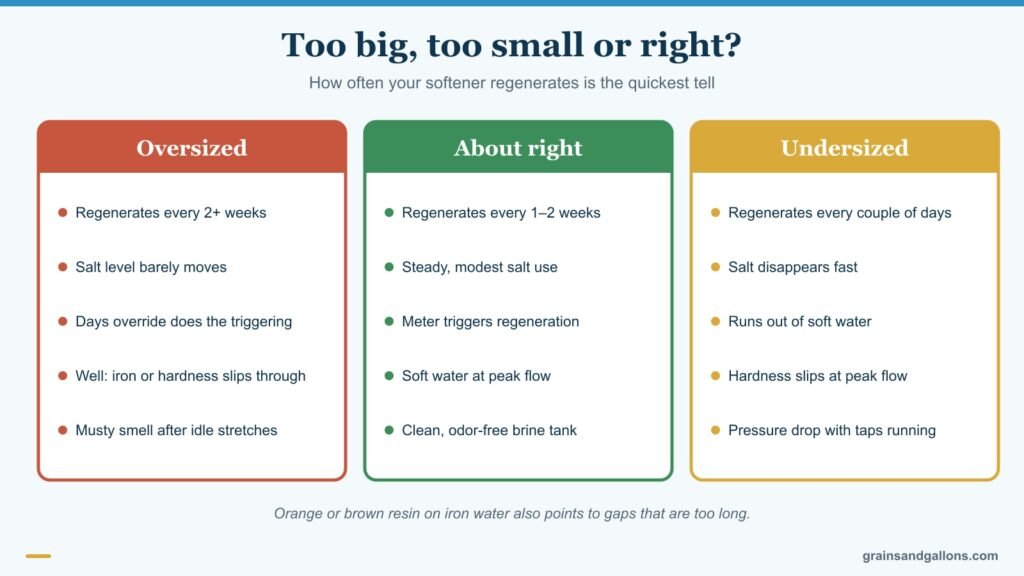
- It regenerates less than about every two weeks, or only when the days override kicks in.
- The salt level barely moves from month to month.
- Hard water or iron slips through on a well, even though regenerations look normal, which points to a weak backwash.
- Musty or sulfur smells from the softened water or the brine tank after long idle stretches.
- The resin turns orange or brown when you have iron in the water.
If your softener regenerates every couple of days instead and you're running out of soft water, you have the opposite problem; see signs a water softener is undersized.
Cases where a larger tank is the right call
Bigger isn't wrong. It's often the right call when:
- Your hardness is high. At 25 gpg, that same couple uses over 3,000 grains a day, and a 32,000 goes about a week.
- You have iron on top of hardness. Iron raises the effective hardness the softener has to handle.
- You want salt efficiency. A larger bed run at a lower salt dose can beat a small bed at full salt, as long as it still regenerates every week or two.
- Your peak flow is high. Large homes with several bathrooms running at once can push more flow than a small tank handles well. Pressure drop and hardness slipping through at peak flow mean the tank is too small, not too big.
The goal is a tank that regenerates about once every one to two weeks at a sensible salt setting and handles your peak flow. Inside that window, there's room to go a size up. For more on why the biggest number on the box isn't automatically the best, see is a higher grain rating always better?
FAQ
Is it better to oversize or undersize a water softener?
Slightly oversized is better than undersized. An undersized softener runs out of capacity and lets hard water through; one size up just regenerates a little less often. The trouble starts two or three sizes up, when regenerations stretch past two weeks.
How often should a properly sized water softener regenerate?
About once every week to two weeks at a sensible salt setting is a good target for most homes. Much more often suggests it's too small or set wrong; much less often suggests it's oversized or the salt dose is set too high for your use.
Can an oversized water softener cause low water pressure?
Not usually. Pressure drop at peak flow is more often a sign the tank or valve is too small for your flow. A larger tank does need more flow for its backwash, which matters on a weak well pump, but it doesn't reduce pressure at your taps in normal use.
Can a water softener be too large and make water too soft?
No. A softener removes hardness the same way regardless of size; a bigger one just holds more capacity between regenerations. Softened water from a 64,000-grain unit is no softer than from a 32,000-grain one.
Can a big water softener drain my well?
It can strain a low-yield well. Regeneration uses a burst of water for backwash and rinse, and a wide tank needs a higher backwash rate. If the well or pump can't supply it, you get a poor backwash rather than a dry well in most cases, but check your pump's output before choosing a large tank.
Size one step up, not three
So, can a water softener be too large? Yes, once it's big enough to stretch regenerations past two weeks or outrun your well's backwash flow. Do the grains-per-day math, pick the size that regenerates every one to two weeks at an efficient salt setting, and treat one size up as headroom rather than a reason to buy the biggest box on the shelf.
Already own an oversized unit? You don't need to rip it out. Work through these in order:
- Lower the salt dose so each regeneration matches what you actually use.
- Set the days override to something reasonable for your water, often 7 to 14 days; follow your manufacturer's recommendation.
- Use a resin cleaner if you have iron, and clean the brine tank if salt has bridged.
- Check the backwash if you're on a well: make sure the pump can supply the flow listed for your DLFC.