

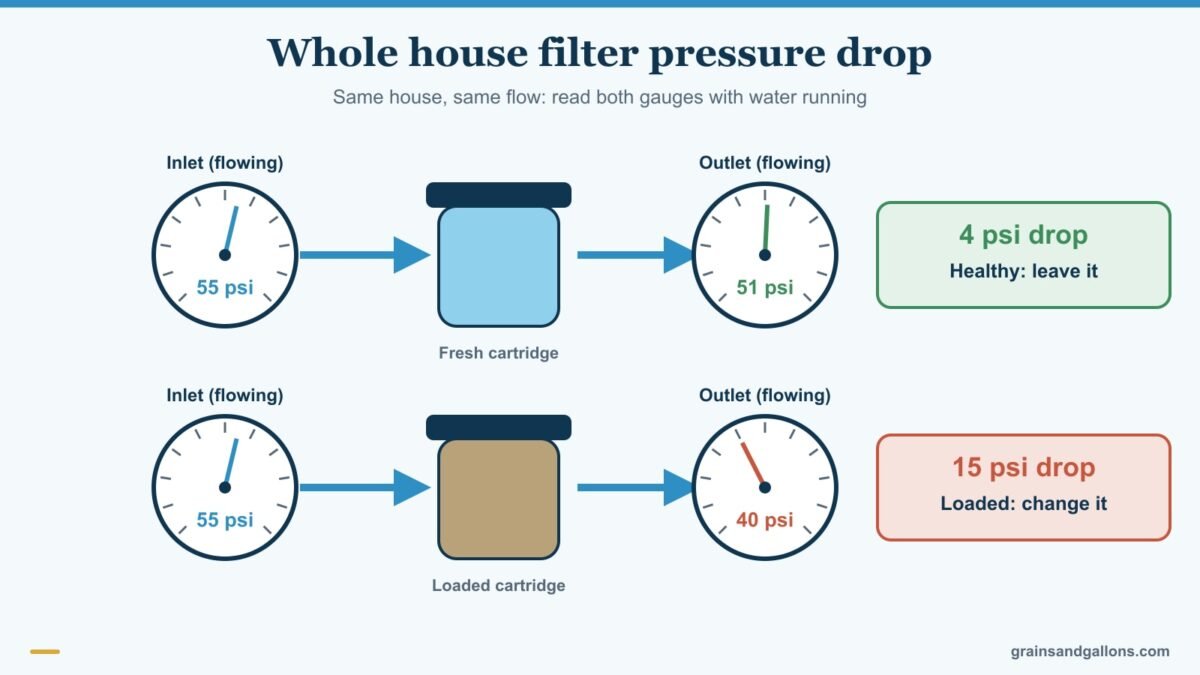
Quick Answer: Some whole house filter pressure drop is normal: a clean, correctly sized filter usually costs only a few psi with water flowing. Put the filter in bypass and run the shower. If pressure jumps back, the filter is the bottleneck. A loss that crept in over weeks means a loaded cartridge, so replace it. A big loss on day one with a fresh cartridge means the setup is too restrictive: the micron rating is too fine, the housing or ports are too small, or there are too many stages in a row.
Every whole house filter pressure drop starts with the same physics. Water has to squeeze through pleats, a carbon block or a bed of media, and that takes energy. So the real question isn't whether you lose pressure, it's whether you're losing more than the system was designed to. Below is how to measure it, what the numbers should look like, and what to change when they don't.
In this guide
- How much whole house filter pressure drop is normal?
- Take two gauge readings with water flowing
- Gradual loss or day-one loss? Sort that out first
- When a cartridge loads up faster than the box says
- A new cartridge that already chokes the flow
- Housing and port size set the floor
- Rule out the softener, PRV and well pump
- FAQ
- Keep a baseline reading and change cartridges by the gauge
How much whole house filter pressure drop is normal?
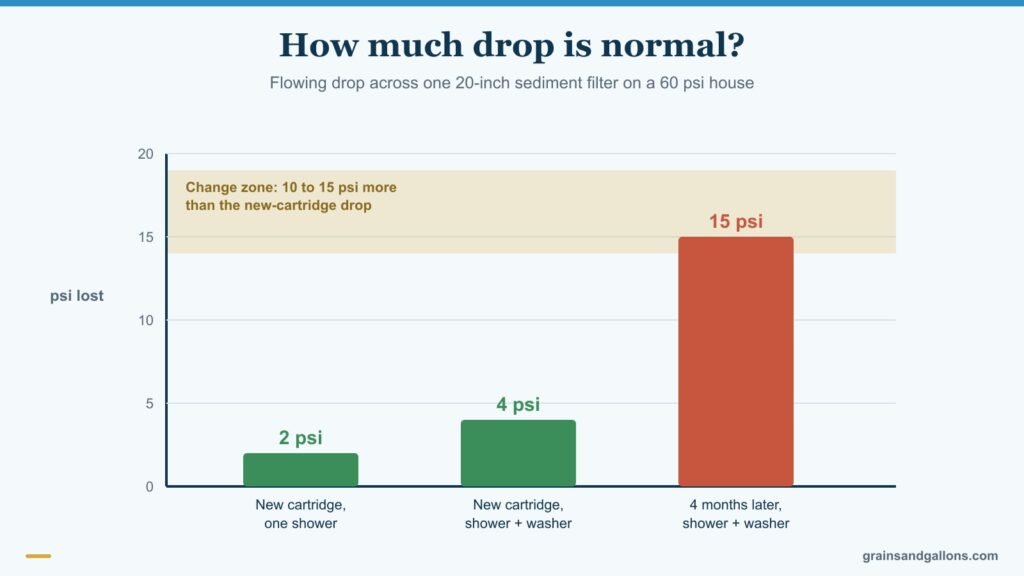
Here's a worked example for a house with 60 psi static pressure and a single 20-inch Big Blue sediment filter:
| Situation | Inlet (flowing) | Outlet (flowing) | Drop |
|---|---|---|---|
| Fresh 20-micron cartridge, one shower running | 58 psi | 56 psi | 2 psi |
| Same cartridge, shower + washer filling | 55 psi | 51 psi | 4 psi |
| Same cartridge 4 months later, shower + washer | 55 psi | 40 psi | 15 psi |
The first two rows are healthy. The third is a loaded cartridge. Two things decide where a system starts:
- The housing itself. Pentair's Big Blue housing spec sheet lists the initial drop for an empty housing at 2 psi at 15 gpm with ¾-inch ports, and 1 psi at 15 gpm with 1-inch ports. The cartridge you drop in adds its own restriction on top.
- How much water you pull at once. Pressure loss climbs with flow. One shower barely registers; a shower plus a washer filling plus a toilet refilling is where an undersized or loaded filter shows itself.
A common rule of thumb is to change cartridges when the flowing drop climbs about 10 to 15 psi above what you saw when the cartridge was new. Some manufacturers publish their own trigger, and that wins: for its AP810 5-micron sediment cartridge, 3M says to put a gauge on each side of the housing and replace the filter once the difference reaches 10 psi. Our guide on when to replace whole house filter cartridges covers the gallon and month limits too.
The baseline matters more than any absolute number. Write the fresh-cartridge reading on a piece of tape stuck to the housing. Next time you're wondering, you'll have something to compare to.
Take two gauge readings with water flowing
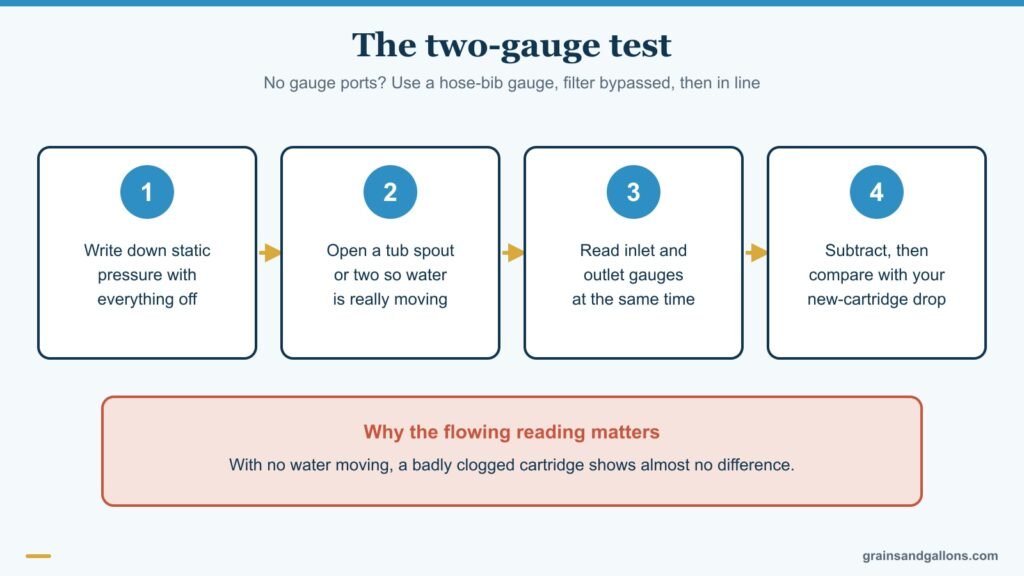
Guessing from how the shower "feels" doesn't work well. A shower that drops from 60 to 50 psi feels fine, while one that sags to 35 psi when the dishwasher kicks on feels terrible. You want gauges.
- Find your measuring points. Many housings have a ¼-inch port on the cap, and many three-stage kits ship with gauges on the inlet and outlet. If yours doesn't, a threaded hose-bib gauge on a laundry or outdoor spigot works: take a reading with the filter bypassed, then another with it back in line.
- Note static pressure first. With every fixture off, write down the number. This tells you what the house starts with.
- Get water moving. Open a tub spout or two. Static pressure shows almost no difference even with a badly clogged cartridge, because nothing is flowing through it.
- Read both sides at the same time, subtract, and compare the result with your new-cartridge number.
On a multi-stage system, a gauge between stages tells you which cartridge is doing the choking. Often it's only the first sediment stage, and the carbon behind it is fine.
Gradual loss or day-one loss? Sort that out first
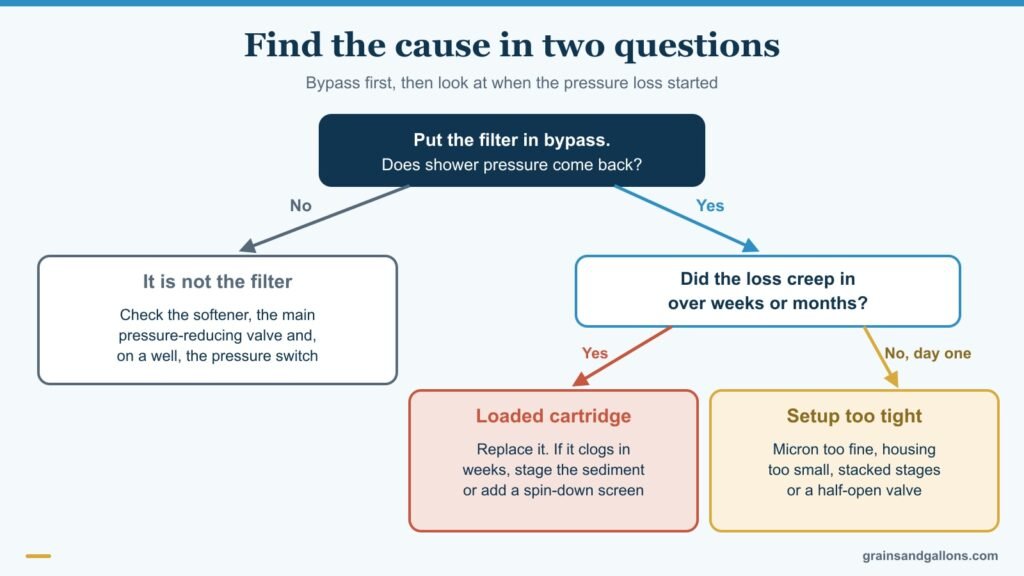
Two questions narrow the cause down fast.
Does bypassing the filter bring pressure back? If it doesn't, the filter isn't your problem. Skip ahead to the section on the softener, pressure-reducing valve and well.
When did the loss start? A drop that crept in over weeks or months is a loading problem: the cartridge is doing its job and filling up. A drop that was there from the first day with a brand-new cartridge is a design problem: something in the setup is too tight for your household's flow. The fixes are completely different, so don't buy anything until you know which one you have.
When a cartridge loads up faster than the box says
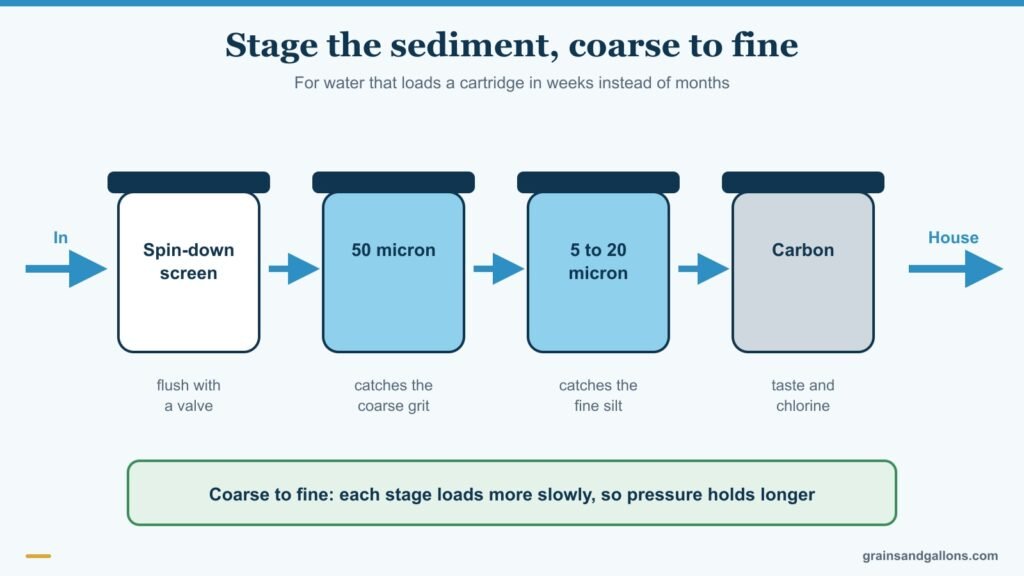
Gradual loss is the normal life cycle of a sediment or carbon cartridge. Dirt fills the pores, flow paths shrink, pressure drops. Swap it. If you're new to it, our walkthrough on how to change a whole house filter cartridge covers shutoffs, the pressure-relief button and the O-ring.
What's not normal is a cartridge that loads up in weeks when the box said months. That means your water carries more sediment than that cartridge is meant to handle. Two fixes:
- Stage the sediment. Put a coarser cartridge (say 50 micron) ahead of a finer one (5 to 20 micron) so the big stuff is caught first and each cartridge loads more slowly.
- Add a spin-down screen in front of everything. You flush it with a valve instead of buying a new cartridge each time. Our picks for the best spin-down sediment filters cover 1-inch and ¾-inch versions.
Well owners: if cartridges go orange or black fast, that's iron or manganese, not dirt, and a sediment cartridge is the wrong tool. Get a lab test before buying more cartridges. The same staging logic applies if a softener sits downstream; see our guide to a sediment prefilter before a softener.
A new cartridge that already chokes the flow

If the drop is big with a brand-new cartridge, look at these, roughly in order of how often they're the cause:
The micron rating is too fine. A 1-micron cartridge in a whole house housing chokes flow and clogs fast. For most city homes, 5 to 20 microns ahead of carbon is plenty. Save the fine stuff for a point-of-use filter at the kitchen sink.
Stages add up. A three-stage system with sediment, carbon block and a specialty cartridge stacks three separate drops. A carbon block is also more restrictive than loose granular carbon. When you shop for a 3-stage whole house water filter, look at the rated service flow at each stage, not just the headline gpm.
The bypass valve isn't fully open. After an install or a cartridge change, check that the bypass handles are all the way to "service." A half-turned ball valve is a very cheap fix.
The plumbing was necked down. Some installs reduce 1-inch pipe to ½-inch fittings at the filter. Look at the connections, not just the housing ports.
Housing and port size set the floor
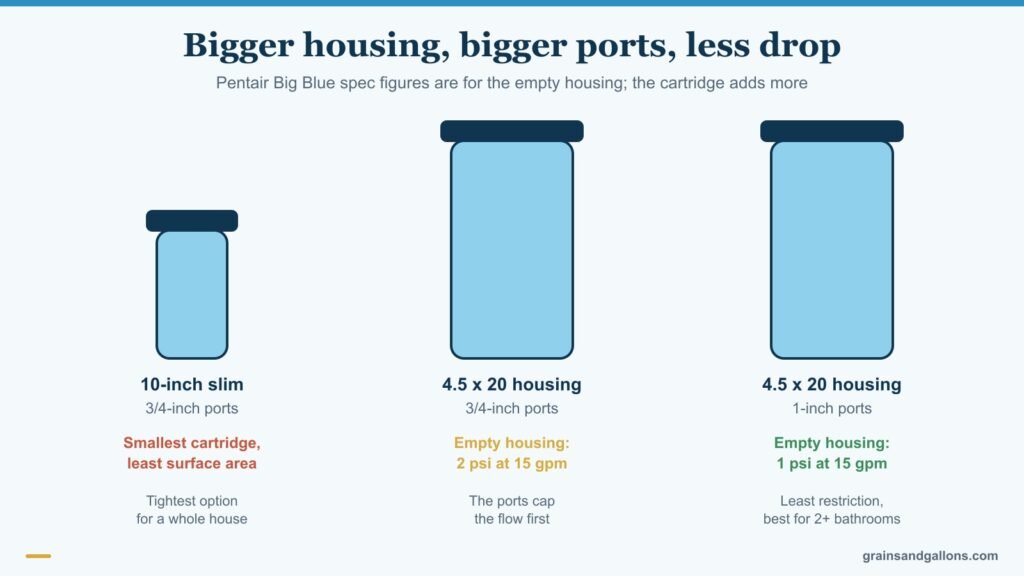
If the micron rating and valves check out, the hardware may simply be too small for your flow. A 10-inch slim housing with ¾-inch ports can't pass as much water as a 4.5 × 20-inch housing with 1-inch ports. The bigger cartridge has roughly twice the surface area of a 10-inch one, so water moves through each square inch more slowly, which means less pressure loss and a longer life between changes.
Port size matters even before the cartridge goes in. On Pentair's own spec sheet, swapping from ¾-inch to 1-inch ports halves the empty-housing drop at 15 gpm. If you have two or more bathrooms, the big housing with 1-inch ports is usually the right call. Our roundup of the best Big Blue whole house filter housings compares sizes and port options.
When you size a new system, match its rated service flow to the most water your house uses at once, not the average. A filter that is fine for one shower can fall flat when two showers and the washer overlap.
Rule out the softener, PRV and well pump
If bypassing the filter doesn't restore pressure, look elsewhere:
- A water softener downstream has its own pressure loss, and a fouled resin bed behaves much like a clogged cartridge. Our pages on water softener pressure drop and low water pressure after a water softener walk through those checks.
- The main pressure-reducing valve can drift or fail, cutting pressure to the whole house. If static pressure itself is low, the PRV is a suspect; a replacement water pressure regulator is a common fix.
- On a well, check the pressure-switch settings and the pressure tank's air charge. A filter can't create pressure the pump never delivered.
FAQ
Do whole house water filters reduce water pressure?
Yes, a little. Any filter adds some resistance. A clean, correctly sized system usually costs only a few psi with water running, which most people never notice. A noticeable loss means the cartridge is loaded or the system is too small or too fine for your flow.
How do I know if my whole house filter is clogged?
Compare inlet and outlet pressure with water flowing. If the difference has grown by roughly 10 to 15 psi since the cartridge was new, or a manufacturer's own trigger has been reached, it's loaded. A quick check without gauges: put the filter in bypass and see whether shower pressure jumps back.
Will a bigger housing fix a clogging problem?
Partly. A 20-inch cartridge has roughly twice the surface area of a 10-inch, so it lasts longer and drops less pressure. It won't fix iron or very high sediment loads by itself; those need staging, a spin-down screen or a dedicated iron filter.
Is it bad to run a filter until it's fully clogged?
Pressure gets miserable, and some carbon cartridges can start to channel or shed fines when pushed hard at the end of their life. Change on the schedule or the gauge, whichever comes first.
Why is my water pressure low right after changing the filter?
Usually a bypass or shutoff valve wasn't opened all the way, or air is still trapped in the housing. Open the valves fully, bleed the air with the pressure-relief button, and run a tap for a minute. If pressure is still low, the new cartridge may be a finer micron rating than the old one.
Keep a baseline reading and change cartridges by the gauge
A small whole house filter pressure drop is the price of clean water; a growing one is the filter asking for a new cartridge. Record the flowing drop when each cartridge is new, change it once that number climbs 10 to 15 psi, and if a fresh cartridge already chokes the flow, fix the setup rather than the cartridge: coarser micron, bigger housing, wider ports, fewer stages.