


Quick Answer: When to replace whole house filter cartridges comes down to whichever limit you hit first: rated gallons, rated months, or a pressure drop you can feel or measure. As a starting point, sediment cartridges often last 2–6 months and carbon cartridges 6–12 months. But a whole-house filter treats every gallon your home uses, including toilets and laundry, so busy households use up the rated gallons well before the "up to 12 months" on the box. Do the gallons math below once and set a reminder.
The label says "lasts up to 12 months." Eight months in, your shower feels weak and the chlorine smell is back. The label wasn't lying, exactly. It was counting on a household smaller than yours, with cleaner water than yours. Knowing when to replace whole house filter cartridges means watching three separate clocks, because whichever runs out first sets the date.
One manufacturer's change instructions put it plainly: each cartridge is good for "approximately 6 months or up to 100,000 gallons," and the real cycle depends on your water's quality, temperature and pressure, according to this whole-house system filter change sheet. Here's how to turn that into a date for your house.
In this guide
Clock one: gallons through the carbon
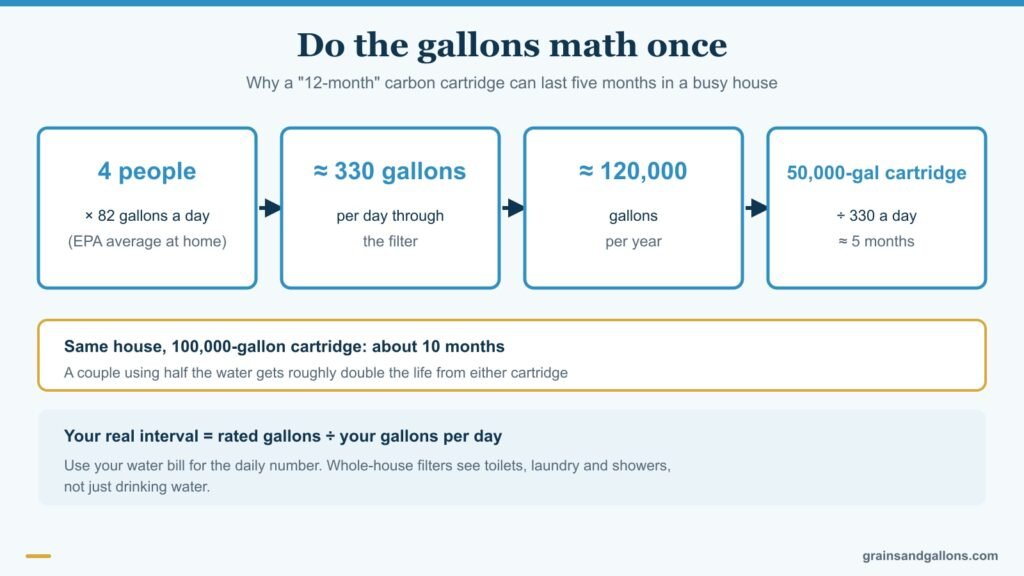
Every carbon cartridge has a rated capacity in gallons, usually printed on the spec sheet rather than the box front. That number is how much water it can treat before chlorine (or whatever it's rated for) starts getting through.
People underestimate their gallons because they think about drinking water. A whole-house filter sees all of it. The EPA's WaterSense program puts average use at about 82 gallons per person per day at home. Your own water bill is the better number if you're on city water. On a well, estimate from household size.
Worked example:
- Four people at about 82 gallons each = about 330 gallons a day
- 330 × 365 = about 120,000 gallons a year
- Carbon cartridge rated at 50,000 gallons → about 5 months of life, not 12
- Same house, cartridge rated at 100,000 gallons → about 10 months
So a cartridge can be "a 12-month filter" for a couple and a 5-month filter for a family with teenagers. Divide the cartridge's rated gallons by your daily use, and that's your real interval.
Sediment cartridges usually don't have a gallon rating, because their life depends on how much grit is in your water. They go on clock three.
Clock two: months in the housing
Even a lightly used cartridge has an age limit. Carbon slowly loses capacity, and any filter that holds damp organic material can grow bacteria, especially if the water sits still while you're away. That's why manufacturers give a time limit along with the gallon number.
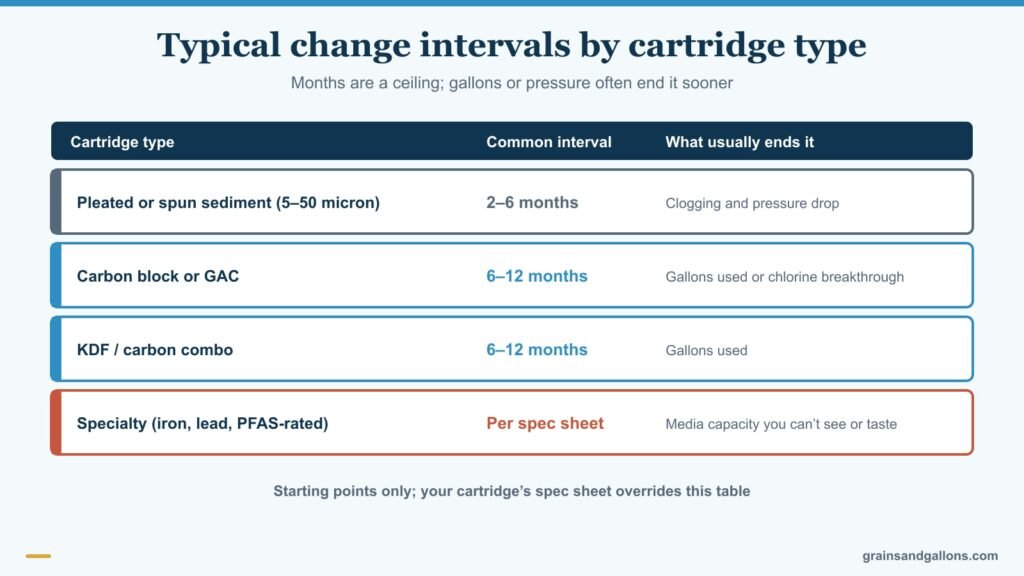
Typical starting points, which your manufacturer's sheet overrides:
| Cartridge type | Common change interval | What usually ends its life |
|---|---|---|
| Pleated or spun sediment (5–50 micron) | 2–6 months | Clogging, pressure drop |
| Carbon block or GAC | 6–12 months | Gallons used, or chlorine breakthrough |
| KDF/carbon combo | 6–12 months | Gallons used |
| Specialty (iron, lead, PFAS-rated) | Per spec sheet, often gallon-limited | Media capacity, which you can't see or taste |
If the cartridge is rated for lead, PFAS or another contaminant you can't taste, stick to the rated gallons and months strictly. When it stops working, nothing tells you.
Coming home from a long trip? Run every tap for several minutes to flush water that sat in the cartridge. If the cartridge is near the end of its months anyway, replace it rather than nurse it along.
Clock three: pressure drop across the housing

This clock is the most reliable one for sediment filters. As a sediment cartridge catches dirt, water has a harder time getting through, and pressure on the outlet side drops.
How to read it:
- With gauges: many housings and multi-stage systems have a pressure gauge before and after the filter. Note the difference with a fresh cartridge and a faucet running. The same manufacturer sheet suggests replacing once pressure has dropped 10 to 12 psi from your initial reading. Check your own cartridge's spec sheet for its number.
- Without gauges: the signs are a weaker shower when another tap is running, a washing machine that takes longer to fill, or a tankless water heater that cuts out at low flow.
If you don't have gauges, adding a pair is cheap and turns guesswork into a number you can write down.
If pressure drops sharply right after a cartridge change, that's a different problem: wrong micron rating, a kinked cartridge or a housing issue. See our guide to pressure drop after a whole house filter.
What your faucets tell you
You'll often notice an expired cartridge before you check any numbers:
- Chlorine taste or smell returning (city water): carbon is used up. Change it now. One whole-house filter manual notes that in virtually all cases the chlorine taste and odor return when the media has lost its effectiveness.
- Sediment or grit at faucet aerators again: the sediment cartridge is overloaded or channeling.
- Musty or rotten-egg smell from cold water near the filter: possible bacterial growth in an old cartridge. Replace it, and clean and sanitize the housing.
- Sudden black specks: carbon fines, usually from a new cartridge that wasn't flushed. That's not an expired filter.
- Dark brown sediment cartridge: not a reliable sign by itself. Some cartridges look dirty in weeks and still flow fine. Go by pressure.
- Drips at the housing: usually a worn or dry O-ring, not the cartridge. See whole house filter housing leaking.
Stretch cartridge life without cutting corners

Put the right filter first. If a sediment cartridge clogs every few weeks on well water with sand, add a reusable spin-down filter upstream. It catches the heavy grit and you rinse it out instead of throwing cartridges away. Our picks for spin-down sediment filters show which screen sizes suit sandy wells.
Stage the microns. A coarse cartridge (say 50 micron) followed by a finer one (5 micron) shares the load. A single 5-micron cartridge on dirty water clogs fast.
Size up. A 20-inch Big Blue cartridge holds far more media than a 10-inch standard one. That means longer intervals and less pressure drop. If you're changing cartridges every couple of months, a bigger housing, or a ready-made system like those in our 3-stage whole house filter guide, may cost less over a year.
Consider a tank instead of cartridges for carbon. For big households on chlorinated city water, a large-tank carbon system lasts years. The manual linked above, for example, rates its tank at about 300,000 gallons, or roughly three years. You rebed the media instead of swapping cartridges. See how to rebed a whole house carbon filter.
Mark the date on the housing

When you change a cartridge, write the date and the gallon target on the housing with a paint marker or a piece of tape. Then set a phone reminder based on whichever clock runs out first. Write down the fresh-cartridge pressure reading too, so you know your baseline next time.
The swap itself takes about 15 minutes. Our step-by-step on how to change a whole house filter cartridge covers shutting off the water, releasing pressure, the O-ring and the flush.
Change it at the first limit, not the label's best case
The rule for when to replace whole house filter cartridges is simple: gallons, months or pressure drop, whichever comes first. Do the gallons math once for your household, note your pressure baseline, and treat the box's "up to 12 months" as a ceiling rather than a promise. For cartridges rated for lead or PFAS, follow the spec sheet exactly, because you won't taste the failure.
FAQ
How often should I change my whole house water filter?
Most sediment cartridges need changing every 2 to 6 months and most carbon cartridges every 6 to 12 months. Busy households and wells with sand or silt land at the short end. Your cartridge's rated gallons and months, plus pressure drop, set the real interval.
What happens if I don't change my whole house filter?
A clogged sediment cartridge cuts water pressure through the whole house. An exhausted carbon cartridge lets chlorine and other contaminants pass, and an old cartridge can harbor bacteria that cause musty or sulfur smells.
How do I know when to replace whole house filter cartridges?
Watch for weaker water pressure or a 10-psi-plus drop on the gauges (sediment), and for chlorine taste or smell coming back on city water (carbon). Track gallons too, because carbon rated for contaminants you can't taste, like lead or PFAS, can stop working with no warning.
Should I change sediment and carbon cartridges at the same time?
Not necessarily. Sediment cartridges usually clog sooner and get changed by pressure drop, while carbon runs on gallons and months. Many people change sediment two or three times for every carbon change.
Can I clean and reuse a whole house filter cartridge?
Most disposable pleated, spun and carbon cartridges aren't meant to be cleaned. Rinsing can damage the media or push trapped dirt through. Reusable spin-down screens and some washable pleated cartridges are the exception, so check the label.