


Quick Answer: If your softener stopped working after new water heater install, test a cold tap and the hot tap at the same sink. Cold soft but hot hard means the softener is fine: the new tank was filled while the softener sat in bypass, or its cold inlet now tees in before the softener. Both hard means the softener itself was left in bypass, unplugged, or clogged by debris during the job.
A new water heater went in last week, and now the shower leaves your skin squeaky and the dishes come out spotted. The timing is suspicious, and it should be. Swapping a heater means shutting off water, cutting pipe and moving equipment, any of which can affect the softener. The question is whether the softener is failing or the water just isn't going through it anymore. One test answers that.
In this guide
- Softener stopped working after new water heater install? Test hot and cold
- Cold soft, hot hard: the heater isn't getting softened water
- Both taps hard: the softener was knocked offline
- Tankless heaters make a softened feed matter more
- When hot water tests soft but still acts strange
- FAQ
- Trace the heater's cold feed before you blame the softener
Softener stopped working after new water heater install? Test hot and cold

You need a hardness test; strips are fine, or see our picks for water hardness test kits. At one bathroom sink:
- Run the cold tap for a minute and test it.
- Run the hot tap until it's fully hot and test it.
Cold soft and hot hard points to the heater. Both hard points to the softener.
Cold soft, hot hard: the heater isn't getting softened water
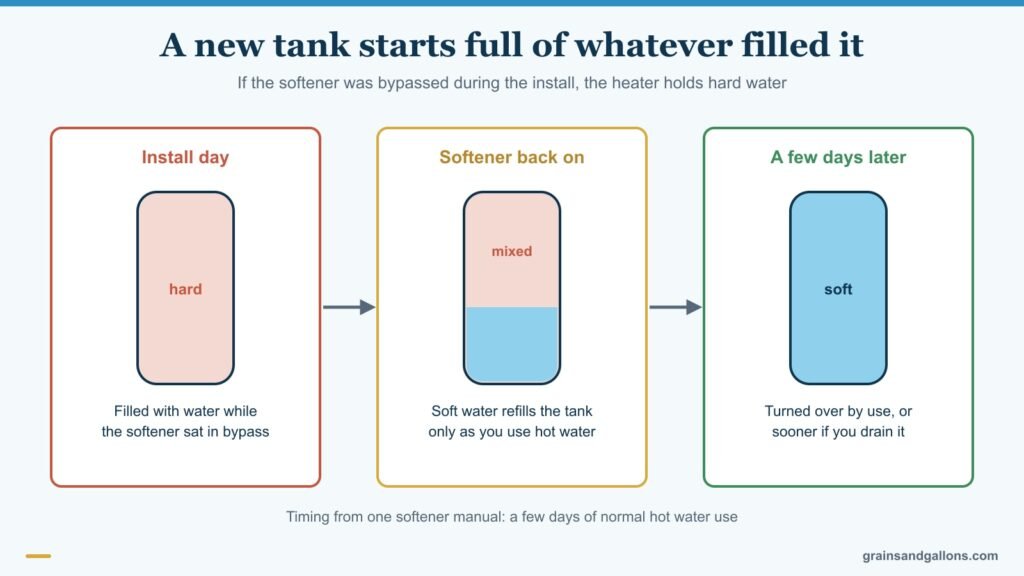
The softener is working. The water inside or entering the new heater isn't softened.
The new tank was filled while the softener was bypassed
This is the most common reason and the easiest to miss. Installers often put the softener in bypass during the job, then fill the new tank. Now a full tank of hard water sits in the heater. Whirlpool's WHES3T softener manual describes the same situation after a softener install: the heater is full of hard water, refills with conditioned water as hot water is used, and is fully conditioned in a few days. For soft hot water right away, it says to drain the water heater after the softener's recharge, following the heater's own instructions. Retest after a few days of use.
The cold inlet now tees in before the softener
In most homes the softener sits near the main and the heater's cold supply branches off after it. When the old heater came out, the installer may have connected the new one to a different pipe or a more convenient tee. If that tee sits on the raw line between the main shutoff and the softener inlet, every drop of hot water is hard, and it stays that way. The featured diagram above shows the difference.
Follow the cold inlet on top of the heater back toward the main. If it joins between the main and the softener inlet, that connection has to move downstream of the softener outlet. If the installer caused it, they should fix it.
A mixing valve or a relocated tankless feed
Some installs add a thermostatic mixing valve at the heater. If its cold port is fed from a raw line, it blends hard water into the hot supply. A tankless heater often hangs on a different wall, nearer the gas line or vent, and its new cold feed may come from a different branch. Same check, same fix.
If the strip reads soft but you see white or tan flecks in hot water, that's debris or loosened sediment, not hardness; see white particles in tap water.
Both taps hard: the softener was knocked offline
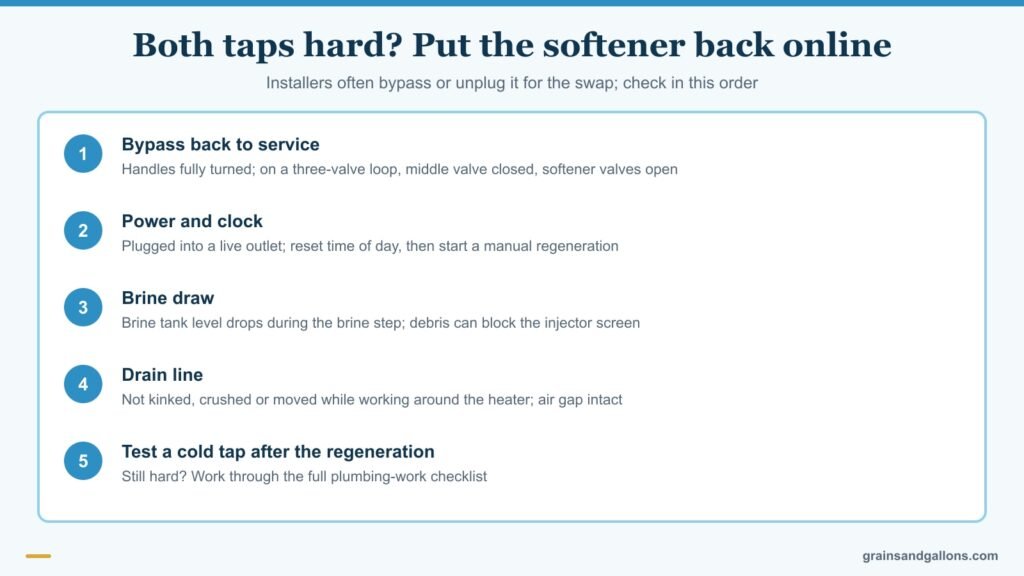
The usual reasons are the same ones that follow any plumbing job:
- Bypass left in bypass, or a shutoff near the softener partly closed so raw water mixes in.
- Unplugged to free an outlet for tools. Plug it in, reset the clock, and start a manual regeneration.
- Debris knocked loose when the main came back on, clogging the injector screen or the flow meter, so the softener doesn't draw brine or count gallons.
- Drain line moved or kinked while working around the heater, especially if both share a floor drain.
We go through each in order in softener stopped working after plumbing work. One more habit to know: using hot water while the softener regenerates can refill the heater with unsoftened water, as explained in using water during regeneration.
Tankless heaters make a softened feed matter more

Tankless heaters push water quickly through a small, very hot heat exchanger, so they're sensitive to scale. Rinnai's N Series installation manual, for example, lists a maximum total hardness of 200 mg/L (about 11.7 grains per gallon) and says replacing parts damaged by water quality isn't covered by the warranty. That makes it worth confirming the cold feed really is softened.
Don't read too much into a maintenance reminder, though. The same manual's Service Soon code is an interval the installer selects, not a hardness sensor. Test the water instead. For more on how the two systems work together, see softened water and tankless water heaters and scale in a tankless water heater. An undersized softener? See the best water softeners for tankless water heaters.
When hot water tests soft but still acts strange
A rotten-egg smell from hot taps only usually comes from a reaction at the anode rod, not hardness; see rotten egg smell only in hot water. Air spitting from hot taps can also trace back to the anode, which gives off small amounts of gas as it corrodes, and very conductive softened water can speed that up. If the strip says soft, look at the heater, not the softener settings.
FAQ
Why is my hot water hard but my cold water soft?
The water heater is getting or holding unsoftened water. Either the tank was filled while the softener was in bypass, or its cold inlet tees off the main before the softener. The first clears with a few days of use or a tank drain; the second needs a plumbing fix.
How long until hot water is soft after a new water heater?
If the tank was filled with hard water, it softens gradually as you use hot water. One softener manual puts it at a few days; draining the heater after the softener regenerates is faster.
Should a water heater be installed after the water softener?
Yes, in most homes. Install guides place the softener on the main line upstream of the water heater, so the heater gets softened water. The Minnesota Department of Health notes that softening prevents scale in water heaters, and that many people soften only the hot water.
Can a new water heater make my softener stop softening?
Not directly. The heater doesn't affect the resin. But the install can leave the softener in bypass, unplugged, or clogged with debris, which looks the same at the tap.
Do tankless water heaters need softened water?
Many tankless makers set hardness limits, such as 200 mg/L in one Rinnai manual, and won't cover scale damage under warranty. If your water is harder than your model's limit, softening or another scale control is worth it.
Trace the heater's cold feed before you blame the softener
When a softener stopped working after new water heater installation, the hot vs cold test tells you where to look. Cold soft and hot hard is a heater problem: give a hard-water fill a few days or drain the tank, and move any cold inlet that tees in before the softener. Both hard means the softener was knocked offline, so check the bypass, power, brine draw and drain line.