


Quick Answer: A water softener regenerating during daytime hours almost always has a clock problem. A power outage reset it, or someone set PM instead of AM, so the 2 a.m. cycle now runs in the afternoon. Set the correct time and check the AM/PM marker. If the clock is right, the valve is probably set to regenerate immediately when capacity runs out. Switch it to delayed. Twin-tank and some non-electric softeners regenerate any time of day by design.
The usual sign of a water softener regenerating during daytime hours is the drain running in the middle of the afternoon, or a shower that suddenly turns hard. Most home softeners regenerate in the early morning, often 2 a.m., when nobody is using water. When one runs at lunchtime, the cause is almost always simple, and you can usually find it in a few minutes at the control head.
In this guide
Check the softener clock before anything else
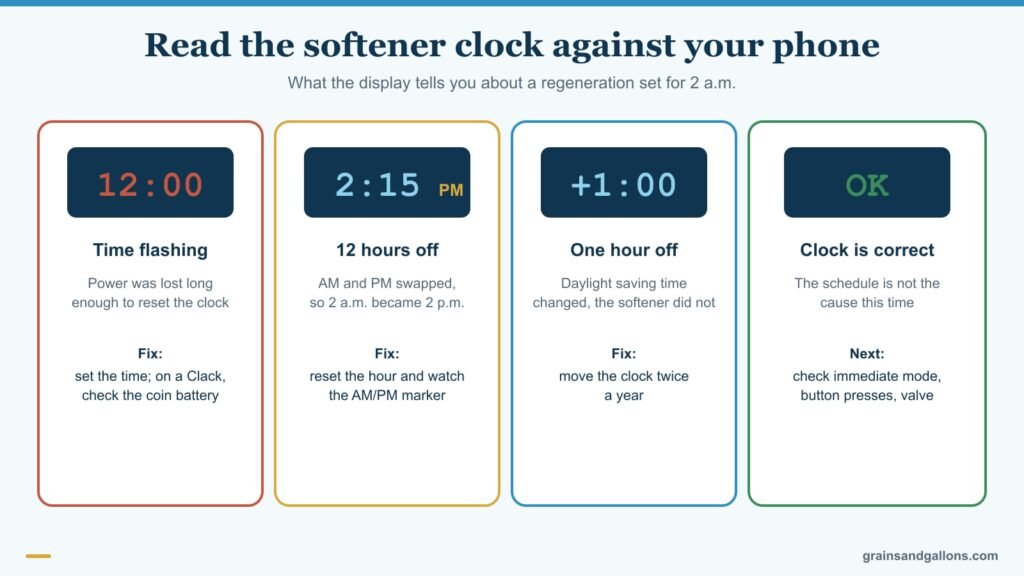
Read the display and compare it with your phone.
The time is flashing. Power was out long enough for the clock to need resetting. The Fleck 5600SXT manual says its control keeps time for at least 48 hours during an outage and flashes the time of day after a power failure. The Clack WS1 manual says the valve keeps time for up to 8 hours on its battery. After a longer outage the time flashes and must be reset. If it flashes after an outage shorter than 8 hours, replace the battery, a 3-volt 2032 coin cell. Whirlpool's cabinet softener manual warns that after a long outage, "regenerations may occur at the wrong time of day" until you reset the clock.
The time is exactly 12 hours off. Someone set PM instead of AM, so 2 a.m. became 2 p.m. This happens a lot after a first install or a reset. Look for the small AM or PM marker on the display.
The time is an hour off. That's daylight saving time, since most softener clocks don't change on their own. An hour won't usually push a regeneration into the daytime. But if your regeneration time is 5 or 6 a.m., it may overlap an early shower. Our daylight saving time guide covers the common models.
The time is off by a random amount. It could be a long outage, a dead clock battery, or an outlet on a wall switch that someone turned off. If it keeps drifting with steady power, the control may be failing.
Setting the clock on three common controls
- Fleck 5600SXT: Hold Up or Down until the programming icon replaces the service icon. Adjust the time, then press Extra Cycle.
- Clack WS1: Press SET CLOCK, set the hour with the arrows (a.m./p.m. switches after 12), press NEXT, set the minutes, then press NEXT to exit.
- Whirlpool cabinet models: Press PROGRAM until PRESENT TIME shows, set the time with UP and DOWN, and confirm AM or PM. The manual says to reset the time only if the display is flashing.
Delayed or immediate: which mode is your valve in?
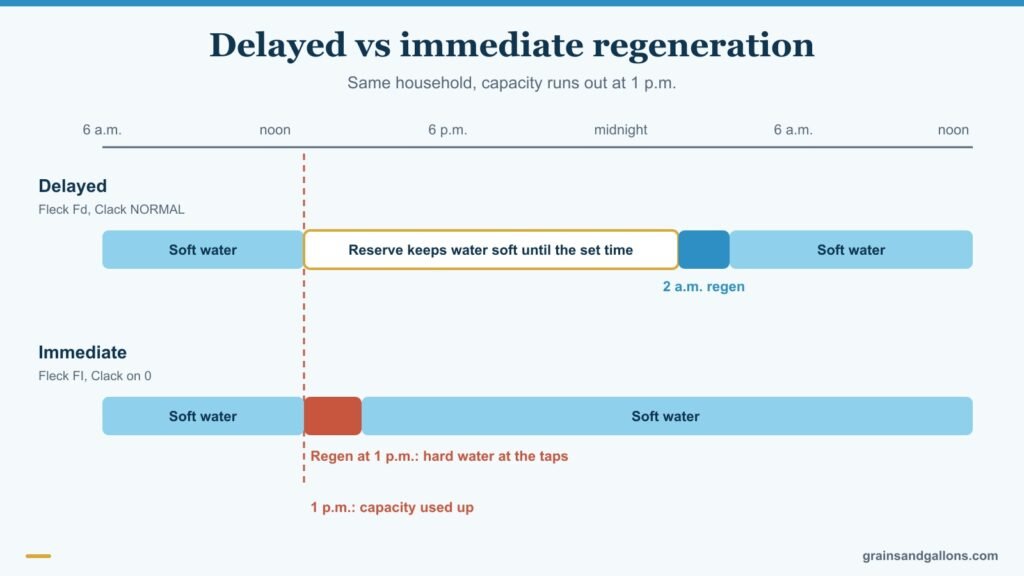
Metered valves can start a regeneration in two ways once the gallons run out:
- Delayed: waits for the set regeneration time, usually overnight. A reserve keeps the water soft until then.
- Immediate: starts right away, whatever time it is.
On a Fleck SXT this is the control type in master programming. Fd is meter delayed and FI is meter immediate. Pentair notes that meter immediate systems generally don't use a reserve. On a Clack WS1 it's the Regeneration Time Option. NORMAL regenerates at the set time, and on 0 regenerates as soon as capacity hits zero. NORMAL + on 0 regenerates at the set time once the reserve is reached, but if capacity hits zero first, it regenerates after 10 minutes with no water use. With that setting, a heavy laundry day can trigger an afternoon cycle on its own.
Immediate mode makes sense for twin-tank systems and businesses that run around the clock. In a house with one tank, it means a regeneration can start while someone is in the shower. Unless your installer chose it on purpose, switch to delayed.
Some softeners are built to regenerate any time
Twin-tank softeners switch tanks when one runs out, and the other tank keeps supplying soft water, so a daytime switch is normal. Non-electric demand units such as Kinetico work the same way. Kinetico's owner manual says the system "regenerates whenever necessary, at any time of day." Our Kinetico troubleshooting guide covers what's normal on those.
Someone, or something, started it
- A regen button press. On most controls, a short press schedules a regeneration for tonight and a long hold starts one now. Holding RECHARGE for three seconds on a Whirlpool cabinet model does it. So does holding Extra Cycle for 5 seconds on the 5600SXT. Kids, guests and helpful relatives all do this. See our guide to the immediate regeneration button.
- A catch-up after an outage. If the 5600SXT misses a regeneration because of a power failure, it runs it the next time the clock reaches the set time. If the clock was also reset, that "set time" may now fall in the daytime.
- A failing control. If the clock drifts with steady power, or regenerations start at random with correct settings, the circuit board or timer may be failing. Our roundup of the best replacement control valves covers heads that fit standard tanks.
What a water softener regenerating during daytime does to your water
It doesn't hurt the softener. It affects your water. Pentair's manual says that during a recharge, a single-tank softener lets untreated water bypass into the building. If you run water during the cycle:
- Taps and showers deliver hard water until the cycle ends.
- The water heater refills with hard water. Whirlpool's manual says to avoid using hot water during a regeneration for this reason.
- On a well, the pump has to keep up with the backwash and the house at the same time, so pressure can drop.
Our guide to using water during regeneration explains what you'll notice at the tap.
Pick a regeneration time that fits your household

The default 2 a.m. works for most homes, but not for everyone. If someone works nights, showers at 4 a.m., or runs the dishwasher on a delay timer, move the regeneration to the quietest stretch you have. A typical cycle runs well over an hour, so leave room on both sides. If you have two treatment systems that backwash, stagger their times so they don't share the drain at the same moment. Our article on what time a softener should regenerate walks through the choice.
Fix the clock first, then the mode
A water softener regenerating during daytime hours is rarely broken. Reset a flashing or wrong clock and confirm AM and PM. Next, check that the valve uses delayed rather than immediate regeneration, and ask whether anyone pressed the regen button. If none of that explains it, and the clock won't hold time with good power, the control is the likely culprit. A new head, or a metered system from our list of the best on-demand water softeners, puts regeneration back where it belongs.
FAQ
Why is my water softener running in the afternoon?
Usually the clock is wrong after a power outage or was set to PM instead of AM. If the clock is right, the valve may be set to regenerate immediately when capacity runs out, or someone held the regen button.
Can I use water while my softener regenerates during the day?
Yes, but on a single-tank softener the water is unsoftened until the cycle ends, and hot water use refills the water heater with hard water. Twin-tank systems keep supplying soft water from the other tank.
How long does a water softener regeneration take?
Most home units take well over an hour, depending on the valve and the salt setting. The display usually shows the step and the time remaining.
Is it bad if my softener regenerates during the day?
It does no harm to the softener. The downside is hard water at the taps during the cycle and lower pressure if you use a lot of water at the same time.
Do I need to reset my softener after a power outage?
If the time is flashing, set the time of day. Hardness and other settings are kept in memory on most modern controls, so you rarely need to re-enter them.