

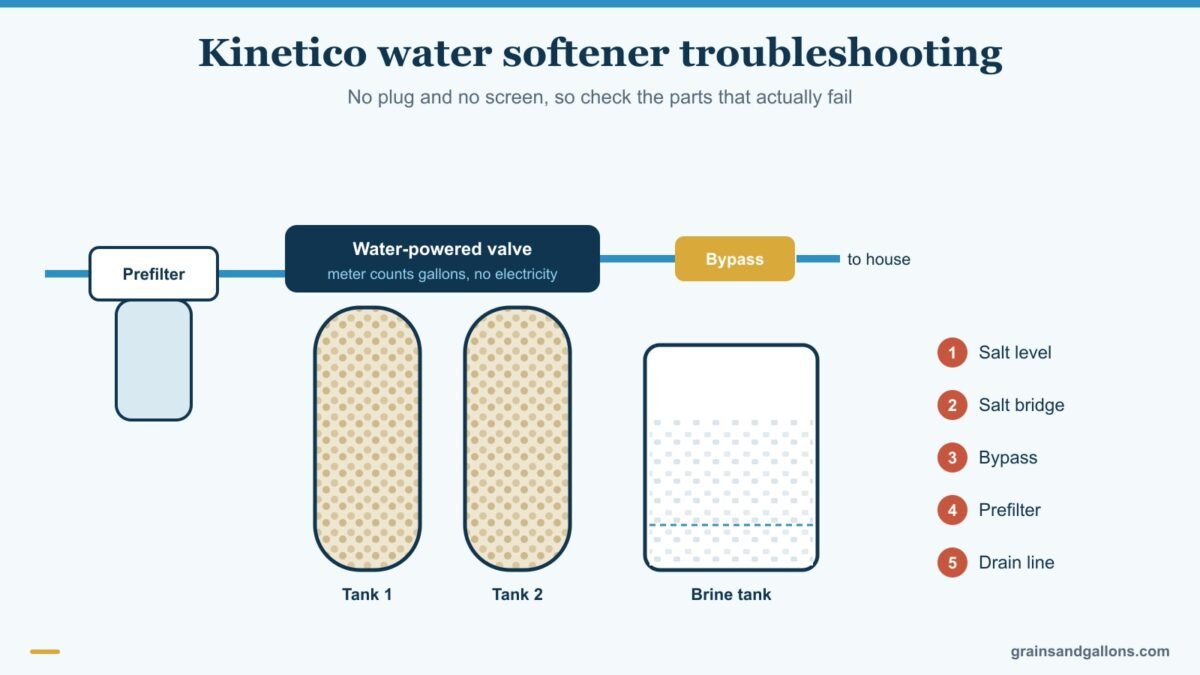
Quick Answer: Most Kinetico water softener troubleshooting ends at the brine tank. If the water is hard, lift the lid: water standing above the salt, or a hard crust with an empty space under it, is your answer. Kinetico says to keep the tank 1/2 to 3/4 full (1/2 on low-usage settings) with clean salt, never rock salt. Then check that the bypass is in service. If pressure dropped instead, replace the prefilter cartridge first.
Kinetico water softener troubleshooting is different from fixing a plug-in softener. Kinetico's whole-house units run on water pressure alone, so there's no display, no error code and no power cycle to try. The parts that fail mostly sit outside the valve.
In this guide
How a non-electric Kinetico decides when to regenerate
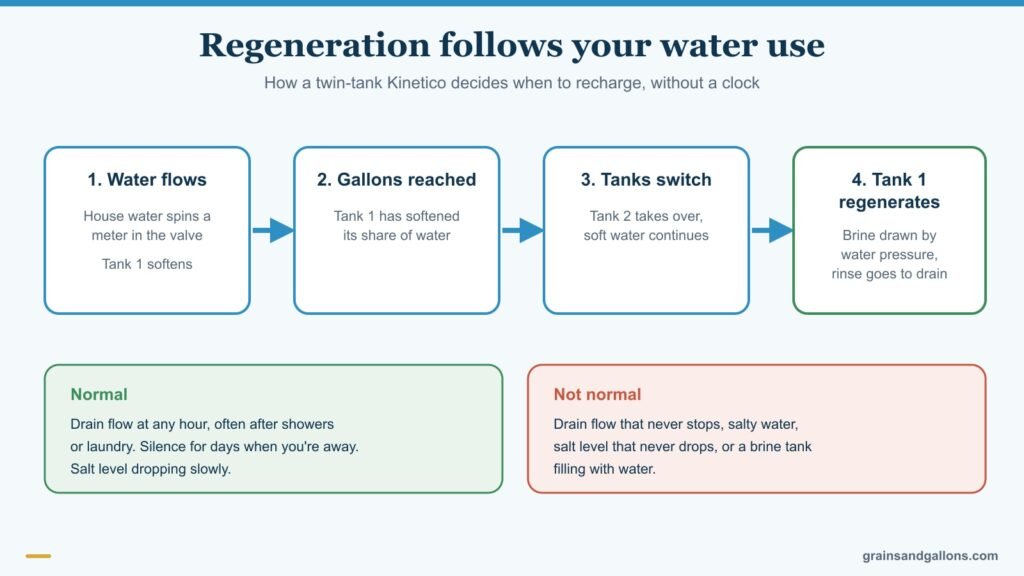
Most Kinetico non-electric models use two resin tanks. House water spins a meter in the valve, and when one tank has softened its share of gallons, the valve switches you to the other tank and regenerates the first using line pressure. It's demand-based, not on a clock.
So drain flow at 4 p.m. after a shower is normal, and so is silence for days when you're away.
Kinetico water softener troubleshooting, in order
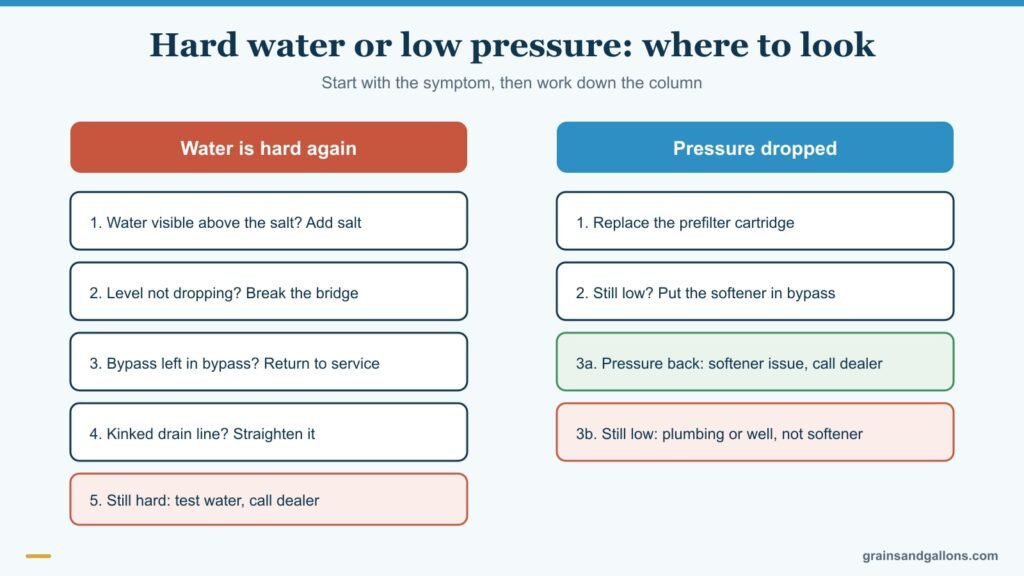
The first three take minutes and solve most calls.
- Salt level. Kinetico's FAQ says the most common cause of hard water is a lack of salt in the brine tank. If you can see water above the salt, add salt.
- Salt bridge. If the level hasn't dropped in weeks, push a broom handle down gently. A hard shelf with a gap underneath is a bridge; the water below can't reach the salt, so the resin never recharges. Break it up without stabbing the tank walls. Our salt bridge guide shows how.
- Bypass valve. After plumbing work or a vacation shutoff, the bypass often gets left in bypass. Water flows past the softener and is simply hard. If you can't find it, Kinetico says to call your dealer.
- Drain line. A kinked or pinched drain line can stop regeneration from finishing. Straighten it.
- Your water. Well hardness and iron shift with seasons, drought or a new pump. Test a softened tap and an outside spigot; how to test water hardness at home explains the numbers. If raw hardness rose, the dealer may need to change the softener's capacity, which is a mechanical adjustment on these units.
Salt problems cause most Kinetico hard water

Kinetico's salt refill guidance is specific:
- Fill 1/2 to 3/4 full on medium-to-high usage settings, 1/2 full on low usage.
- Don't fill to the top. Kinetico warns that a completely full tank can cause the salt to bridge.
- Don't use rock salt. Its dirt and debris can clog or harm the softener. If someone has been adding it, here's what rock salt does inside a softener.
- Kinetico says all its softeners accept block and tablet salt.
- Switching to potassium chloride? Ask your dealer what settings need to change first.
Pressure drop? Start at the prefilter

Many Kinetico installs put a cartridge prefilter ahead of the softener, and Kinetico's FAQ says to check it first when pressure drops throughout the house:
- Replace the prefilter cartridge and check pressure.
- If it's still low, put the softener in bypass and check again.
- If pressure comes back in bypass, the restriction is inside the softener, often fouled resin or debris. Call your dealer.
If pressure stays low in bypass, the softener isn't the cause. See low water pressure after a water softener for plumbing and well-pump causes.
Normal sounds versus real faults
| You notice | Normal? | What to do |
|---|---|---|
| Drain flow during the day | Yes | Nothing; regeneration follows water use |
| Salt level drops slowly | Yes | Keep it 1/2 to 3/4 full |
| Drain runs nonstop with no water in use | No | Bypass the softener, call the dealer |
| Brine tank filling with water | No | Bypass, call the dealer |
| Salt level never drops | No | Check for a bridge, then call |
| Salty-tasting water | No | Call the dealer |
FAQ
Why is my Kinetico softener not softening water?
Low salt is the most common cause, according to Kinetico. After that, check for a salt bridge, a bypass left in the bypass position and a kinked drain line. If all four are fine, test your raw water hardness and call your dealer.
How full should a Kinetico brine tank be?
Kinetico says 1/2 to 3/4 full on medium-to-high usage settings and about 1/2 full on low usage. Don't fill it to the top, which can cause bridging, and add salt whenever you see water above it.
Can I reset a Kinetico water softener?
There's nothing electronic to reset on non-electric models. Problems are mechanical: salt, bypass, prefilter, drain line or the valve itself. Valve service is a dealer job, since parts are model-specific.
Does a Kinetico softener use electricity?
No. Kinetico's FAQ says its whole-home systems are non-electric, so a power outage won't stop them and there's no plug to check.
Most Kinetico calls end at the brine tank
Effective Kinetico water softener troubleshooting starts with the salt: keep it half to three-quarters full with clean salt, break any bridge, and confirm the bypass is in service. For pressure loss, change the prefilter, then test in bypass. Nonstop drain flow, salty water or an overfilling brine tank go to your Kinetico dealer. If a quote pushes you toward replacement, compare Kinetico vs Hague or our picks for the best non-electric water softeners.