

Quick Answer: Water pressure fluctuating up and down is rarely caused by the softener alone. A softener adds a steady pressure drop that grows with flow; it doesn't create a rhythm. Swings usually come from a well pump cycling, a waterlogged pressure tank, a failing pressure reducing valve, thermal expansion, or the softener regenerating while you use water. Put the softener in bypass and repeat the same water use. If the swings continue, look upstream. If they stop, measure the drop with a hose-bib gauge like the Watts pressure test gauge, whose max needle catches spikes you'd miss.
Disclosure: As an Amazon Associate, Grains & Gallons earns from qualifying purchases.
Your shower goes strong, then weak, then strong again, every minute or so. Or the kitchen tap sputters at the same time every morning. When water pressure fluctuating like this starts after a softener goes in, the softener gets blamed because it's the newest thing in the basement. Sometimes that's fair. Often it isn't.
The clue is the shape of the change. A softener is basically a tank of resin beads that water has to push through, so it adds resistance. More flow means more pressure loss, the same way a longer garden hose loses push. What it doesn't do on its own is make pressure rise and fall on a rhythm. When you see a rhythm, look somewhere else first.
In this guide
- What water pressure fluctuating up and down is telling you
- Put the softener in bypass and repeat the problem
- Measure it: a worked example with a hose-bib gauge
- When the softener really is restricting flow
- Well water: the pump sets the rhythm
- Morning surges on city water: thermal expansion and the PRV
- The once-a-day dip from regeneration
- What pressure should a softener see?
- FAQ
- Bypass first, then let the gauge decide
What water pressure fluctuating up and down is telling you

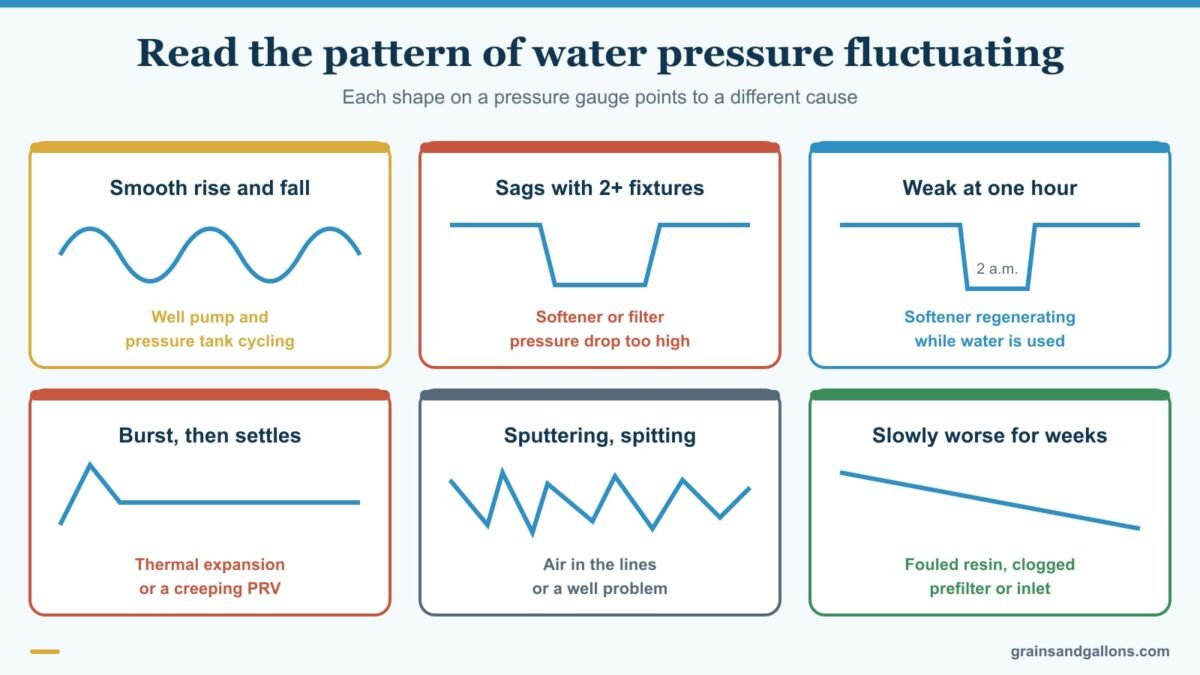
Before you touch a valve, notice when the change happens and what it feels like. Each pattern points to a different part of the system.
| What it feels like | Most likely cause |
|---|---|
| Rises and falls smoothly every 30 seconds to a few minutes, even with one tap open | Well pump and pressure tank cycling |
| Pulses every few seconds, with the pump clicking on and off | Waterlogged pressure tank (pump short-cycling) |
| Fine with one fixture, sags hard when two or three run | Softener (or a filter) adding too much pressure drop |
| Weak or odd only at one time of day, usually night or early morning | Softener regenerating while water is used |
| Strong burst when you first open a tap, then settles lower | High static pressure from thermal expansion or a creeping PRV |
| Sputtering, spitting air | Air in the lines after service, or a well problem |
| Slowly worse over weeks or months | Fouled resin, clogged prefilter or debris in the valve inlet |
Banging pipes when a valve snaps shut are a different problem; see our guide to water hammer after a water softener.
Put the softener in bypass and repeat the problem
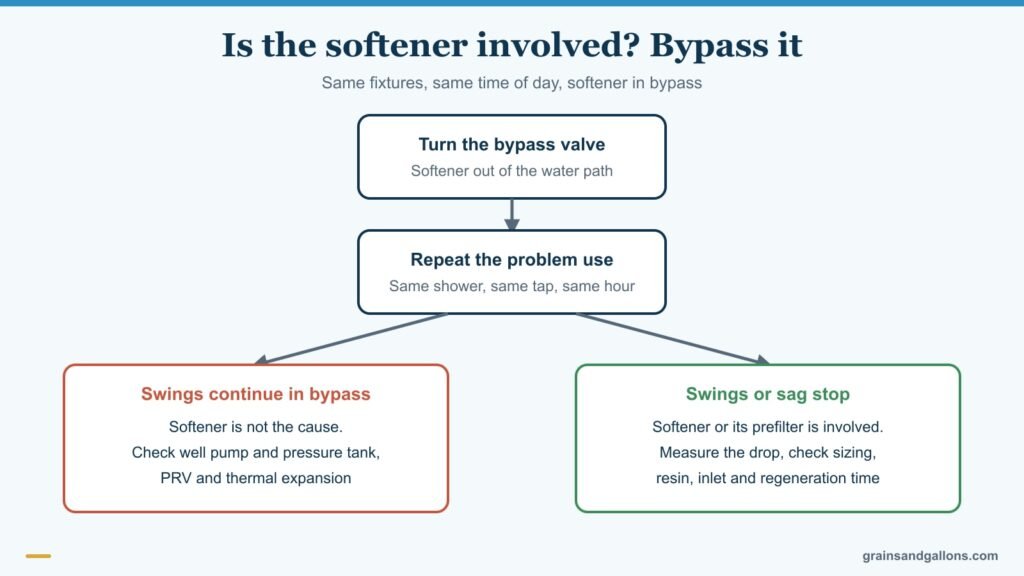
Turn the bypass valve so water skips the softener, then use water exactly as you did when you noticed the problem. Run the same shower and the same tap at the same time of day.
- Swings continue in bypass: the softener isn't the cause. Look at the well system, the PRV or thermal expansion.
- Swings stop, or the sag disappears: the softener, or something attached to it like a prefilter, is involved.
A few hours in bypass for testing is harmless. You'll just have hard water at the taps until you switch it back to service.
Measure it: a worked example with a hose-bib gauge
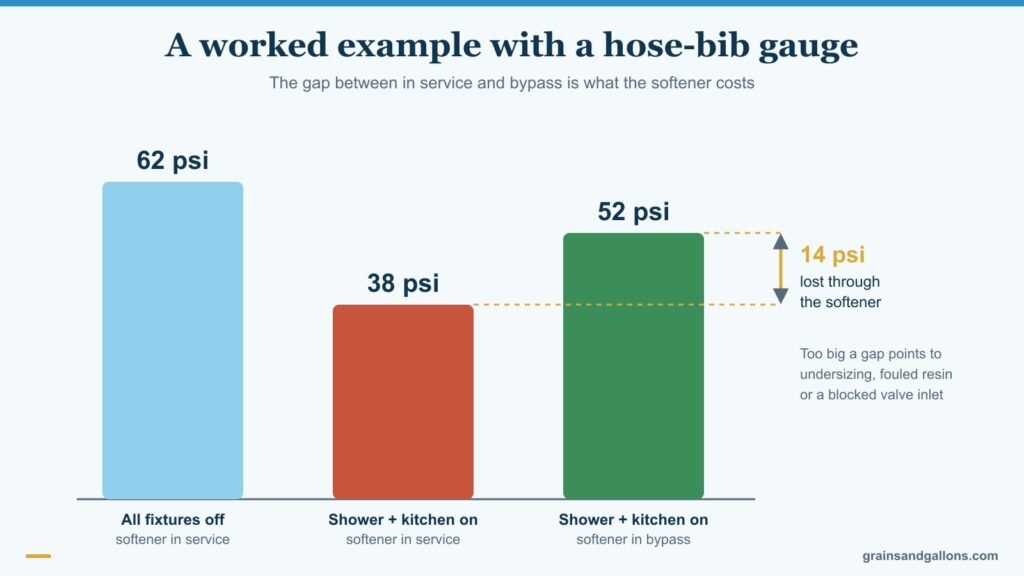
Screw a pressure gauge onto an outdoor spigot or the water heater drain valve. Say these are your readings:
- All fixtures off, softener in service: 62 psi.
- Shower and kitchen tap running, softener in service: 38 psi.
- Same fixtures running, softener in bypass: 52 psi.
The gap between steps 2 and 3, 14 psi, is roughly what the softener is costing you at that flow. A properly sized, clean softener should lose much less than that at typical household flow. Spec sheets list pressure drop at specific flow rates, so compare against yours. A gap that big means the softener is undersized for your peak flow, the resin is fouled or packed, or the valve inlet is partly blocked.
Our guide to water softener pressure drop explains how to compare readings against a spec sheet, and signs a water softener is undersized covers the other symptoms. If the numbers say the unit is too small for your household, our picks for the best water softener for a family of 4 are sized for typical peak flows.
When the softener really is restricting flow
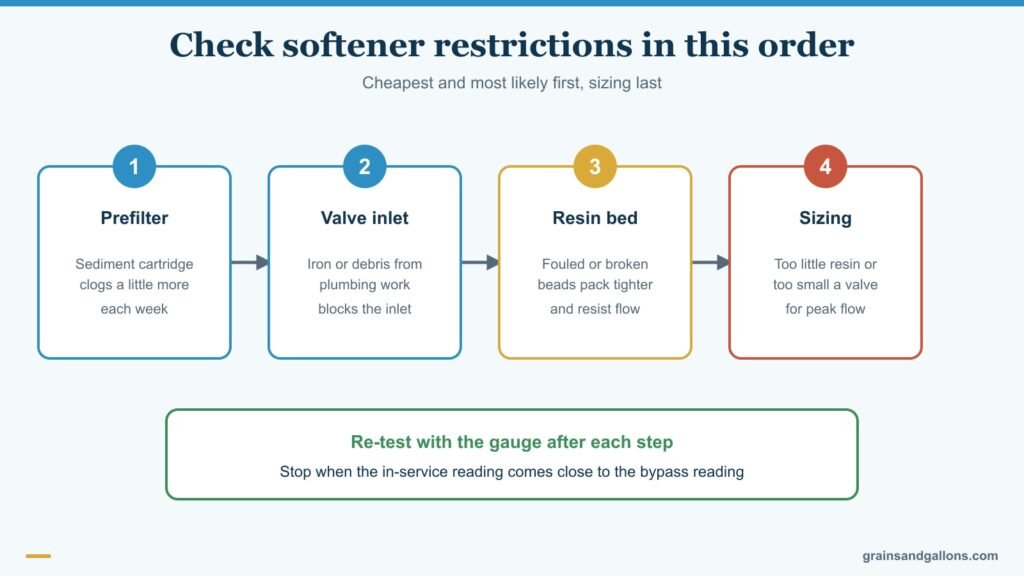
If the bypass test points at the softener, work through the restrictions from cheapest to most involved:
- Prefilter first. A sediment cartridge ahead of the softener clogs gradually, and pressure sags more each week. Swap the cartridge and re-test before anything else.
- Valve inlet debris. Pentair's Fleck 5600SXT manual lists iron buildup in the line to the softener, and debris knocked loose by plumbing work clogging the valve inlet, as causes of pressure loss. If the drop showed up right after a repair or a water main break, suspect this.
- Fouled or broken-down resin. Iron, sediment and chlorine-damaged resin pack the bed tighter, so the same flow costs more pressure. Our guide to water softener resin fouling covers cleaners and when the bed needs replacing.
- Undersizing. A unit with too little resin or too small a valve can't pass your peak flow without a big drop. No cleaning fixes that.
Salt bridges and low salt affect softening, not household pressure, so the brine tank isn't the place to look for a pressure problem.
Well water: the pump sets the rhythm
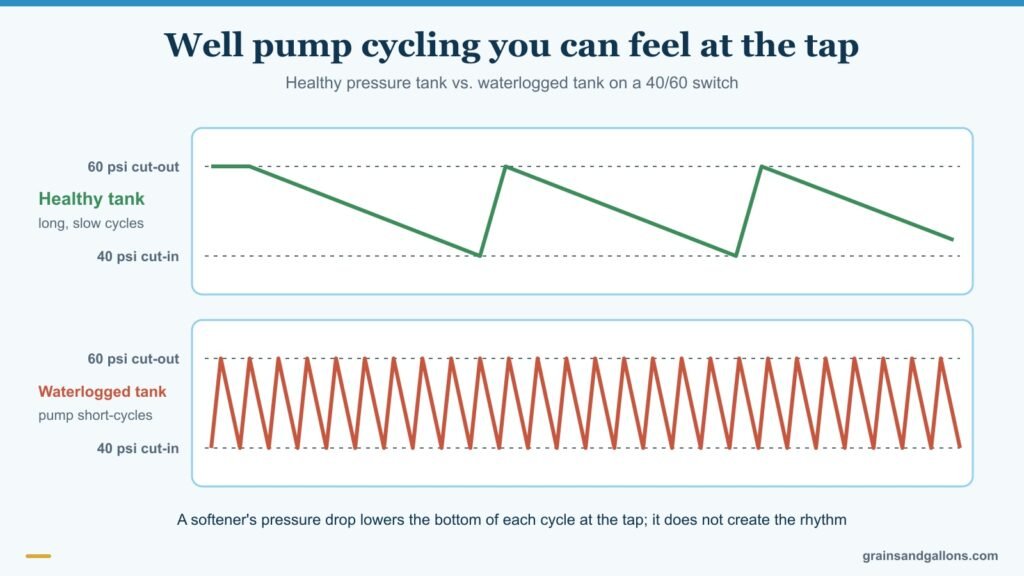
On a private well, pressure normally swings between the pump's cut-in and cut-out settings, commonly 30/50 or 40/60 psi. When pressure falls to the low number the pump starts, and it runs until it reaches the high one. With a healthy pressure tank you barely notice, because the tank stretches each cycle out. The Water Systems Council's Wellowner.org guide to well water pressure explains that the tank only holds a reserve; it can't deliver more flow than the pump produces, and a constant pressure valve can hold pressure steady at a set point.
Two things make the cycle noticeable after a softener goes in:
- The softener's pressure drop shaves the low end. At 40 psi at the tank, minus several psi through the softener, your shower may feel weak at the bottom of each cycle. It was always cycling; now the bottom is lower.
- A waterlogged pressure tank makes the pump short-cycle every few seconds, and that feels like a pulse in the water. That's a well issue, not a softener one. The tank's air charge needs checking, and the pump shouldn't be left short-cycling because it wears the motor.
Morning surges on city water: thermal expansion and the PRV
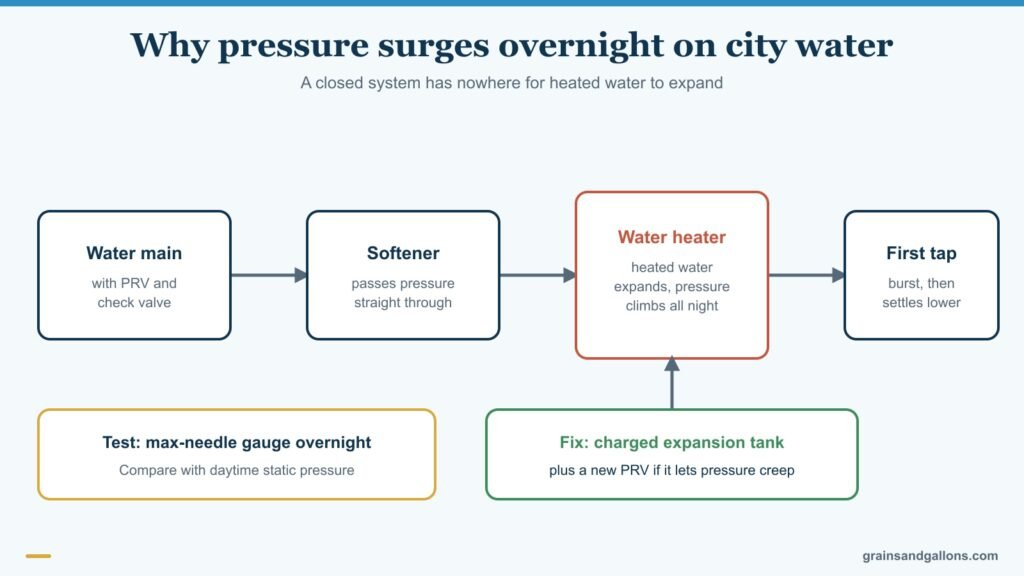
With a pressure reducing valve and a check valve or backflow preventer on the main, your plumbing is a closed system. When the water heater heats a tank of water, the water expands with nowhere to go, and pressure climbs. You get a surge when you open the first tap in the morning, then it settles.
Leave a gauge with a max (drag) needle on a spigot overnight. If the max needle reads far above your daytime static pressure, you've got thermal expansion, a PRV that's letting pressure creep, or both. Most plumbing codes cap household pressure at 80 psi. The fixes are a properly charged thermal expansion tank and, if the PRV is worn out, a new one. Our roundup of water pressure reducing valves covers models like the Watts LF25AUB-Z3 that suit homes with softeners. Replacing a PRV is a reasonable DIY job for some people, but a plumber is the safer call if you're not comfortable working on the main.
The once-a-day dip from regeneration
During regeneration, most single-tank softeners send untreated water to the house through an internal bypass while part of the flow goes to drain. On a well, regeneration also runs the pump hard for a while. Use water in that window and you may get lower pressure, hard water, or both. If your "fluctuations" happen at the same time every day, check the regeneration time on the display and move it to an hour when nobody is up. Our guide to using water during regeneration explains what happens inside the valve.
What pressure should a softener see?
Make sure the house is inside the softener's operating range before you chase anything else. Pentair lists 20 to 125 psi for the 5600SXT. Clack's WS1 service manual says incoming pressure should stay at a minimum of 25 psi. On the high side, most plumbing codes cap household pressure at 80 psi, which is also where a PRV earns its keep. Our softener pressure requirements guide covers well switch settings in more depth.
Call for help when:
- Pressure drops toward zero, or the pump runs constantly: shut it off and call a well contractor.
- Static pressure is above 80 psi and you don't have a working PRV.
- The softener inlet is plugged with debris after plumbing work and you aren't comfortable pulling the piston.
FAQ
Can a water softener cause pressure to go up and down?
Not by itself. A softener causes a steady pressure drop that gets bigger as more fixtures run. It can make an existing well pump cycle feel worse because it lowers the bottom of each cycle, and it can cause a once-a-day dip if it regenerates while you use water. A regular rise-and-fall rhythm almost always comes from the well system, the PRV or thermal expansion.
How much pressure drop is normal through a water softener?
It depends on the model and the flow rate, so check the spec sheet, which lists pressure drop at specific flows. A clean, properly sized softener loses only a few psi at typical household flow. A drop in the teens, as in our gauge example, points to undersizing, fouled resin or a blocked inlet.
Why does my water pressure drop at night or early morning?
Most softeners regenerate in the early morning hours by default. During regeneration, untreated water bypasses the resin and some flow goes to drain, so pressure can feel lower. Check the regeneration time on the display and move it to a time nobody uses water.
Is it safe to leave a softener in bypass while I troubleshoot?
Yes. Bypass sends water around the softener, so you'll just get hard water until you switch it back. A few hours to a couple of days for testing is fine, but don't leave it bypassed long-term or scale will start building in the water heater and fixtures.
How do I know if my well pressure tank is waterlogged?
The pump clicks on and off every few seconds when a tap is open, and pressure pulses in step with it. The tank's air charge has been lost, often because the bladder has failed. A well contractor can check the air pre-charge and replace the tank if needed.
Bypass first, then let the gauge decide
Water pressure fluctuating on a rhythm is almost never the softener's doing. Bypass the softener and repeat the problem. If the swings carry on, the fix is in the well system, the PRV or an expansion tank. If they stop, put a gauge on a spigot, measure the in-service and bypass readings, and work through the prefilter, the valve inlet, the resin and sizing in that order. Ten minutes with a gauge will tell you more than any amount of guessing.