

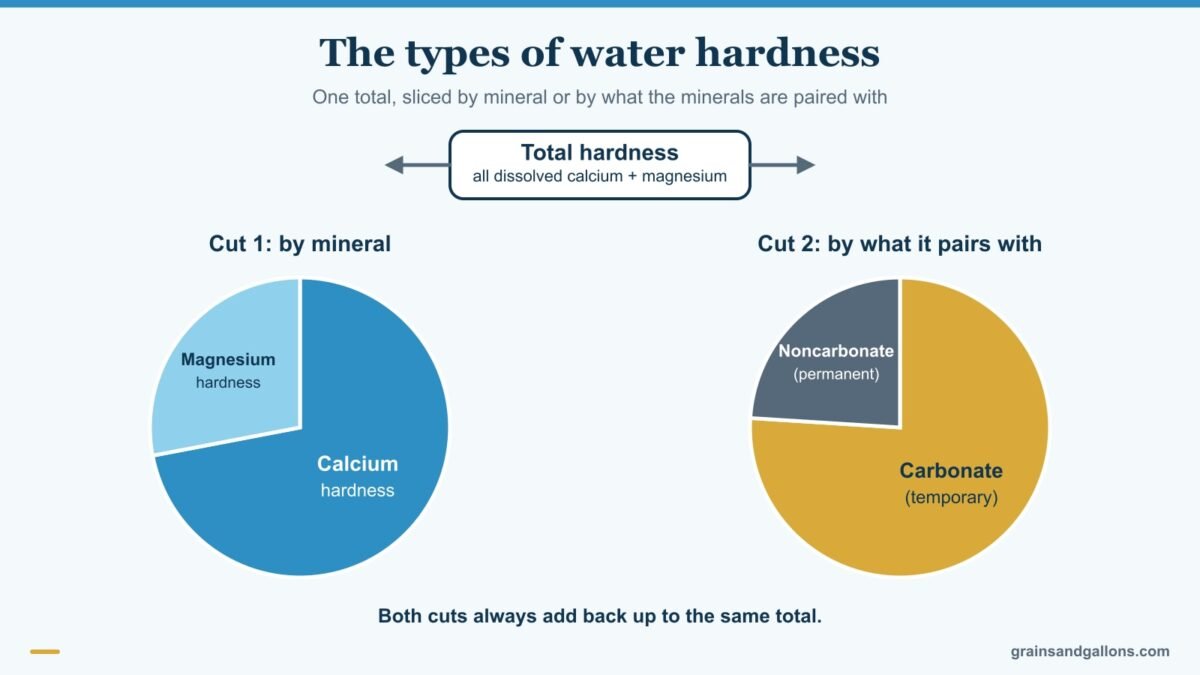
Quick Answer: The types of water hardness are all slices of one number. Total hardness is the dissolved calcium plus magnesium. Split it by mineral and you get calcium hardness and magnesium hardness. Split it by what the minerals are paired with and you get carbonate ("temporary") hardness, which drops out as scale when water is heated, and noncarbonate ("permanent") hardness, which doesn't. For sizing a softener, total hardness is the number that matters.
Your water report has three or four lines with "hardness" in them, and they don't add up the way you'd expect. That's normal. The types of water hardness aren't different amounts of different stuff; they're the same calcium and magnesium sliced in different directions.
In this guide
The types of water hardness are one total cut two ways
Total hardness is all the dissolved calcium and magnesium (plus small amounts of iron, manganese and strontium), reported in mg/L "as CaCO3" or in grains per gallon. The Water Research Center uses 1 gpg = 17.12 mg/L.
Cut 1, by mineral: calcium hardness (usually the bigger slice) and magnesium hardness. If your report lists calcium and magnesium in plain mg/L, the standard conversion is hardness ≈ 2.5 × calcium + 4.1 × magnesium.
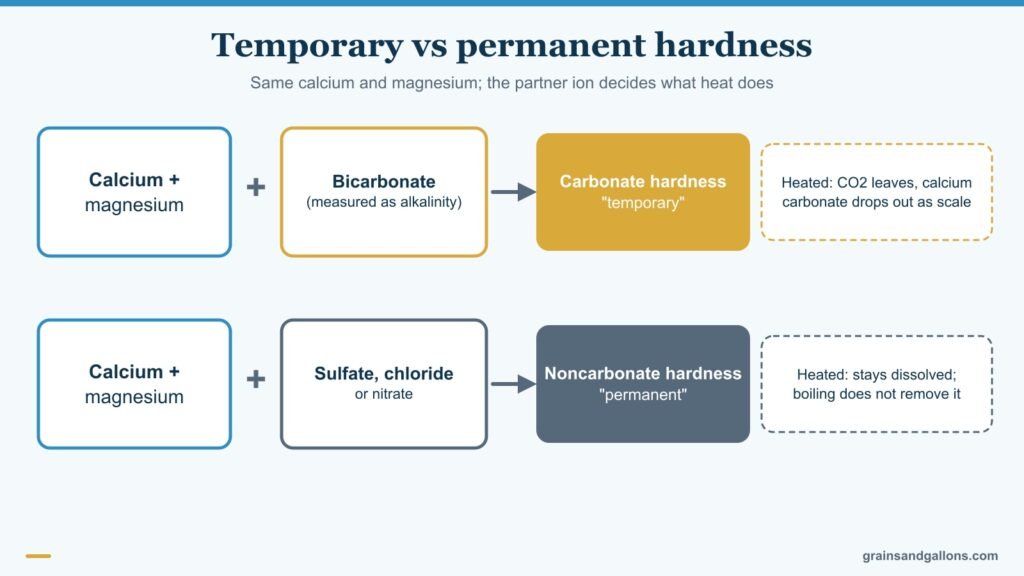
Cut 2, by partner ion:
- Carbonate (temporary) hardness: calcium and magnesium matched with bicarbonate, which a lab measures as alkalinity.
- Noncarbonate (permanent) hardness: the rest, matched with sulfate, chloride or nitrate.
Both cuts always add back up to the same total.
Why "temporary" hardness is the part that scales
The names come from what happens when you heat water. When water carrying calcium bicarbonate warms, carbon dioxide leaves and calcium carbonate drops out as a solid: the chalky crust in your kettle, the scale on a water heater element, and the reason hot water makes more scale than cold. Boil it, let the scale settle, and the hardness left is lower. Hence "temporary." That scale is usually white or gray and dissolves in vinegar.
Calcium paired with sulfate or chloride stays dissolved at kitchen temperatures, so boiling leaves it behind. Hence "permanent." It still counts: it fights soap, spots glass and loads a softener. That's why boiling or filtering only partly softens water. Lime softening removes temporary hardness at treatment plants, while permanent hardness needs soda ash, ion exchange or reverse osmosis.
A worked example from a lab report
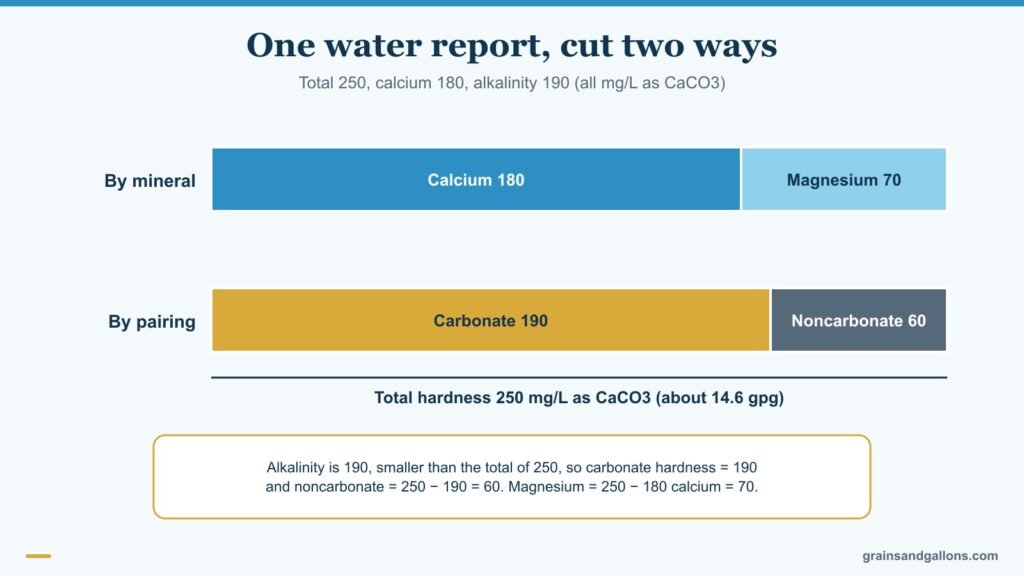
Say your report shows total hardness 250 mg/L, calcium hardness 180 mg/L and total alkalinity 190 mg/L, all as CaCO3.
- Magnesium hardness = 250 − 180 = 70 mg/L.
- Carbonate hardness equals alkalinity or total hardness, whichever is smaller. Alkalinity (190) is smaller, so carbonate = 190 mg/L.
- Noncarbonate hardness = 250 − 190 = 60 mg/L.
If alkalinity had been 300, all 250 mg/L would be carbonate and noncarbonate would be zero, which is common in limestone areas.
What it means: 250 mg/L is about 14.6 gpg. Penn State Extension classes anything above 180 mg/L (10.5 gpg) as very hard, and most of this water's hardness is the scaling kind, so expect crust in kettles, showerheads and the water heater. Our guide to water hardness units has the conversions.
Which hardness number to use for which job

- Sizing or setting a softener: total hardness, plus any allowance for iron your manufacturer specifies. Ion exchange removes calcium and magnesium whatever they're paired with.
- Salt-free conditioners: the carbonate share matters more. These systems target calcium carbonate scale; the Water Quality Association notes they don't lower calcium or magnesium or produce soft water.
- Kettles and coffee makers: carbonate hardness is the culprit. An ion-exchange filter jug can take much of it out of the water you boil; see filters that stop kettle scale.
- Pools and spas: they test calcium hardness, because calcium forms scale and protects plaster; see calcium buildup on pool tile.
- Spots on glass: both types leave spots, so total hardness predicts them best.
Magnesium counts the same as calcium for softening, but its scale is softer and less common in kettles.
Getting your own numbers
Most strips and home kits report total hardness only. A drop-count titration kit gives a clearer number than color strips; our picks for water hardness test kits cover both. For calcium, magnesium, alkalinity and iron, order a lab panel and use our guide to reading a water hardness report. "Hardness compensation" on a softener is a setting that adds extra for iron, not another type.
FAQ
What are the two main types of water hardness?
Temporary (carbonate) hardness and permanent (noncarbonate) hardness. Temporary hardness is calcium and magnesium paired with bicarbonate and drops out when heated; permanent hardness is paired with sulfate, chloride or nitrate and stays dissolved.
Does boiling remove permanent hardness?
No. Boiling removes part of the temporary hardness as scale, but sulfate and chloride hardness stays in the water. Ion exchange or reverse osmosis removes both.
Is calcium hardness the same as total hardness?
No. Calcium hardness is only the calcium share. Total hardness adds magnesium, so it is always equal to or higher than calcium hardness.
Is alkalinity the same as hardness?
No. Alkalinity is the water's ability to buffer acid, mostly from bicarbonate. It matters for hardness because it caps how much of the total is carbonate hardness.
Which type of hardness should I use to set my softener?
Total hardness in grains per gallon, adjusted for iron if your manual says so. The carbonate split doesn't change what the softener has to remove.
Total hardness decides softening; the split explains scale
All the types of water hardness come back to one total of calcium and magnesium. Use total hardness to size and set a softener, and use the carbonate split to understand why your kettle crusts up and why boiling never fully fixes hard water.