

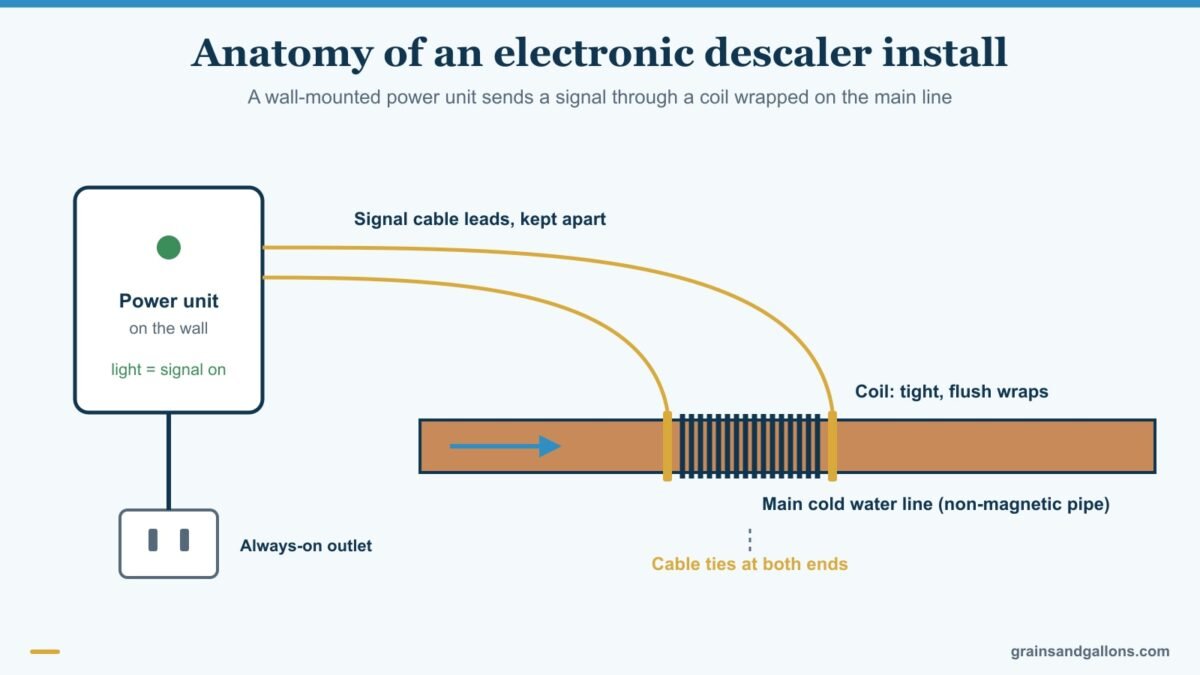
Quick Answer: To install electronic descalers, first hold a magnet to the main water line: if it sticks, the pipe is galvanized or steel and most coil units won't work through it. Pick a straight stretch of the main cold line after the shutoff and before it branches to the water heater, away from tees, elbows and valves. Mount the power unit nearby, wrap the signal cable tightly with flush, non-overlapping turns to the count in your model's chart, tie off both ends and plug it into an always-on outlet. It takes under an hour.
There's no cutting (on most pipe), no drain line and no salt. That's the appeal. You mount a small box on the wall near the main water line, wrap a cable around the pipe, and plug it in. What decides whether it does anything useful is which pipe you wrap and how carefully you wrap it.
We'll use the ScaleBlaster SB-75 installation manual as a concrete reference, since it's specific about the rules. Brands differ in cable length, wrap counts and layout, so your own manual comes first.
In this guide
Check your pipe with a magnet first
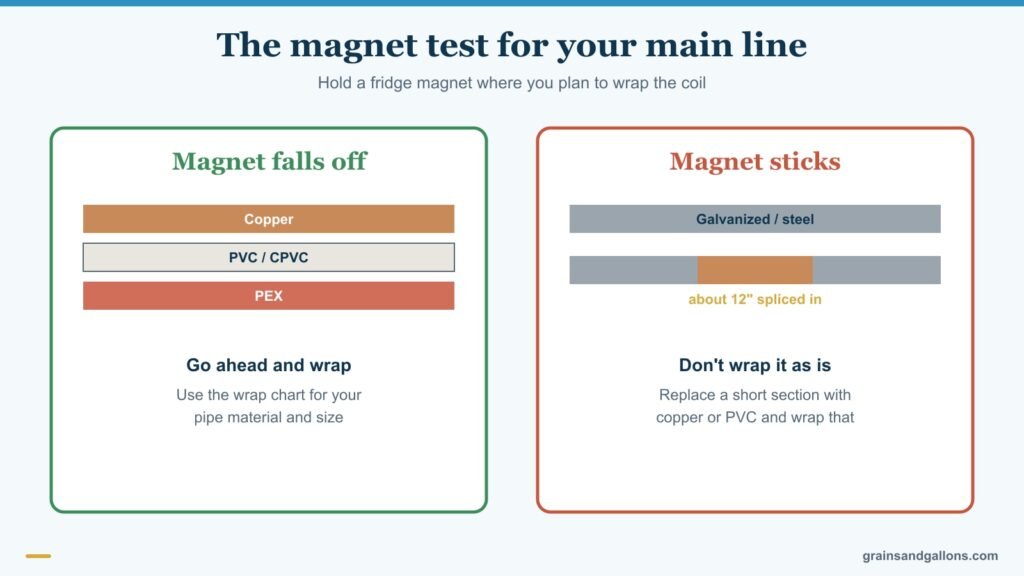
Hold any fridge magnet on the main line where you plan to install.
- Magnet falls off: copper, PVC, CPVC or PEX. The SB-75 manual lists all four as suitable and says it works equally well on each.
- Magnet sticks: galvanized or steel pipe. The manual says plainly not to install on magnetic galvanized pipe. Its fix is to cut out about 12 inches and replace it with PVC or copper, then wrap that section. The rest of the house can stay galvanized.
Stainless steel can be tricky because some grades are only weakly magnetic. If the magnet grabs at all, check your manual before going further. Splicing in a section means cutting a pressurized line, so hire a plumber if you're not comfortable with that.
Where on the main line should the coil go?
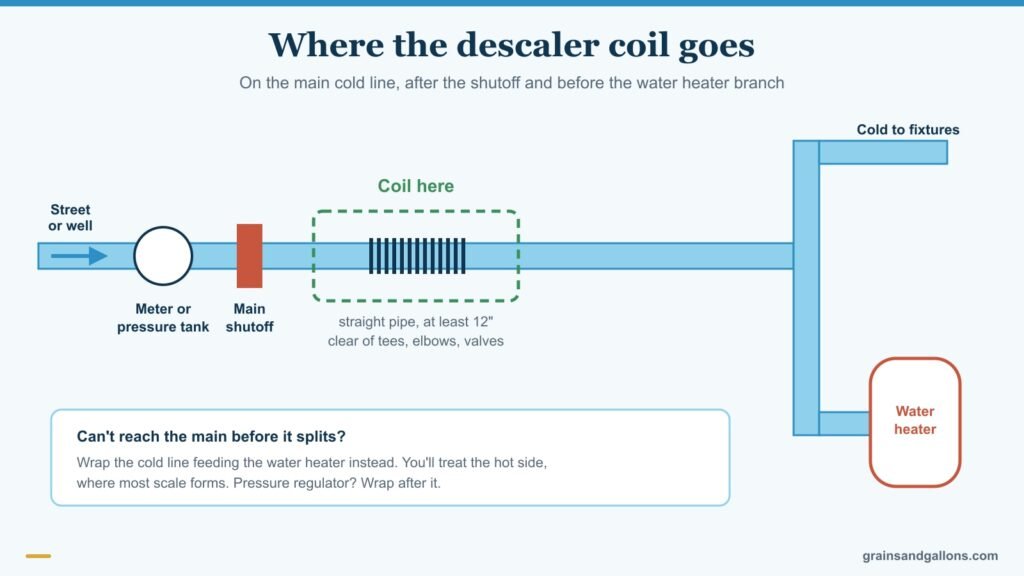
You want the descaler treating the water before it reaches the water heater, so it goes on the main cold line after the shutoff valve and before the line splits. On a private well, ScaleBlaster says the best spot is after the pressure tank. If you have a pressure regulator with almost no pipe in front of it, wrap after the regulator.
Then find a section that meets these conditions:
- Straight: at least 12 inches of straight pipe, horizontal or vertical.
- Clear of fittings: as far as practical from tees, elbows, couplings and valves, and never wrapped over a coupling or a bend, because every turn has to sit on the same diameter.
- Within cable reach: close enough to a wall and an outlet for the power unit (see the next section).
Can't reach the main before it splits, as in some slab homes? The manual's fallback is to wrap the cold line feeding the water heater. You'll treat the hot side, where most scale forms, but not every tap. A softener loop also works, though the manual prefers other spots because the kitchen tap and outdoor spigots may then go untreated.
Mount the power unit and plug it in
Screw the power unit to a wall or other solid surface. For the SB-75 that means within 5 feet of an outlet and within 10 feet of the coil location, in a ventilated spot that stays roughly between 32°F and 122°F. Keep it out of direct sun and away from dripping pipes.
Two limits trip people up:
- The 10 feet of signal cable between the box and the coil can't be extended. If the outlet is the problem, the manual says an extension cord on the power side is fine.
- The outlet must be always on. An outlet controlled by a wall switch will shut treatment off without you noticing.
Plug in after the coil is wrapped. Most units have an indicator light or small display showing the signal is running; an error light usually means the cable isn't connected properly at the terminals.
Wrap the coil exactly to the chart
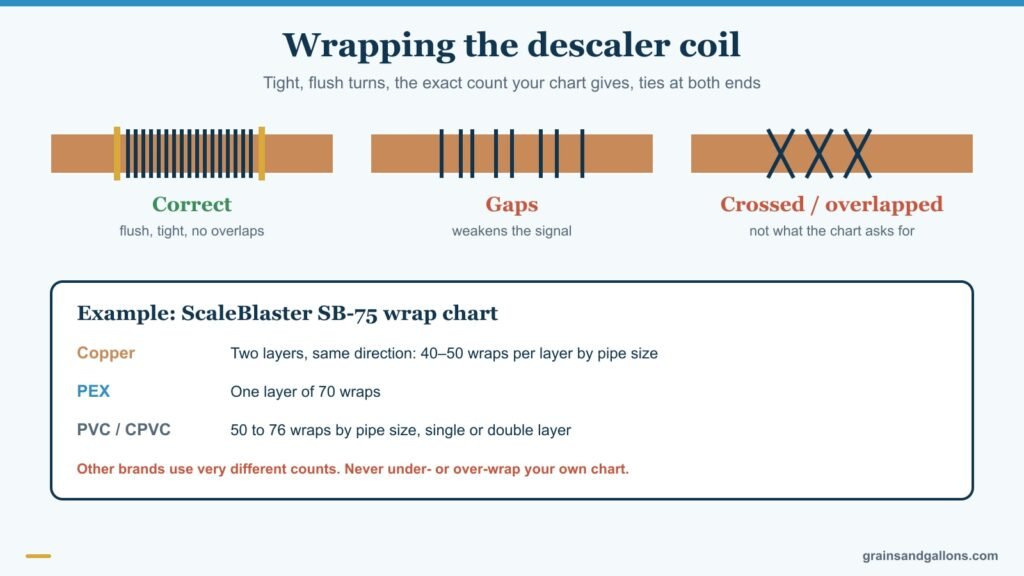
This is the step that matters most.
- Insert the stripped cable end into a terminal on the power unit, if your model uses terminals. Many units have the cable attached.
- Lay the cable along the pipe and fix the start of the wrap with a cable tie.
- Wrap the pipe tightly in one direction, each turn sitting flush against the last. No gaps, no overlaps, no crossovers.
- Use the number of turns your chart gives. The SB-75 chart calls for a single layer of 70 wraps on 3/4" PEX, and two layers of 40 to 50 wraps each on copper depending on size, with the second layer wound in the same direction as the first. Its rule is blunt: never under-wrap or over-wrap.
- Tie off the end with another cable tie and route both leads back to the box.
- Keep the two leads from touching or twisting together as much as possible.
Leftover cable is normal; manufacturers supply extra to cover different pipe sizes. Other designs, such as dual-coil units or capacitive descalers, use different layouts, so follow your own diagram rather than these numbers.
What an electronic descaler will and won't change
An electronic descaler doesn't remove calcium or magnesium. ScaleBlaster's own manual says hardness and TDS stay the same, so a hardness strip will read exactly as before. These devices are meant to change how scale forms so less of it sticks. Our explainer on how salt-free water conditioners work covers the theory behind this group of products.
Independent evidence is thin and mixed. In a Norwegian test rig, the anti-scale devices tested (magnetic units) did not prevent scale on heater elements, and one produced more scale than the untreated line. Some households report softer scale that wipes off more easily; others see no change. Our guide to evaluating salt-free and maintenance-free claims lists the questions to ask.
Judge it fairly:
- Take before photos of a shower door, faucet aerator or kettle.
- Clean those surfaces so you start from zero.
- Wait. ScaleBlaster says to allow up to a couple of months, and offers a 90-day money-back guarantee, so mark the return deadline.
- Compare. Is new scale thinner, softer, easier to wipe? Is the kettle scaling at the same rate?
Spots on glass won't disappear. Evaporating water still leaves its minerals behind.
FAQ
Can an electronic descaler go on PEX or PVC pipe?
Yes, for most coil-type units. The ScaleBlaster SB-75 manual lists copper, PVC, CPVC and PEX, and gives a separate wrap count for each. The pipe that doesn't work is magnetic galvanized or steel pipe.
Does it matter which direction you wrap the coil?
Wrap in one consistent direction. On copper, where the SB-75 calls for two layers, the second layer must go the same direction as the first, with both leads exiting the same end. Check your own manual, since some brands specify direction.
Can I install electronic descalers outdoors?
Only if the model is rated for it. The SB-75 is indoor-only, while ScaleBlaster's SB Elite is rated for indoor or outdoor use. Whatever the model, keep the power unit within its temperature range and out of direct weather.
Will an electronic descaler work with a water softener?
It can be installed alongside one, but there's little point treating water a softener has already softened. If you run both, install the descaler where it treats the water you care about, and follow the maker's guidance on placement relative to the softener.
How long before an electronic descaler shows results?
Expect weeks, not days. ScaleBlaster tells buyers to allow up to a couple of months. Judge results by new scale on cleaned surfaces, not by a hardness test, which won't change.
Wrap it right, then give it a fair trial
When you install electronic descalers, the unit only has a chance if the basics are right: non-magnetic pipe, a straight main-line spot before the water heater, an always-on outlet within reach, and tight, flush wraps to the exact count in your chart. If you've done all that and nothing changes after a couple of months, work through our checklist for an electronic descaler not working before you return it.
Still choosing a model? Our iSpring ED2000 review covers one of the most common coil-type units, and the Yarna capacitive descaler review looks at a different approach.