

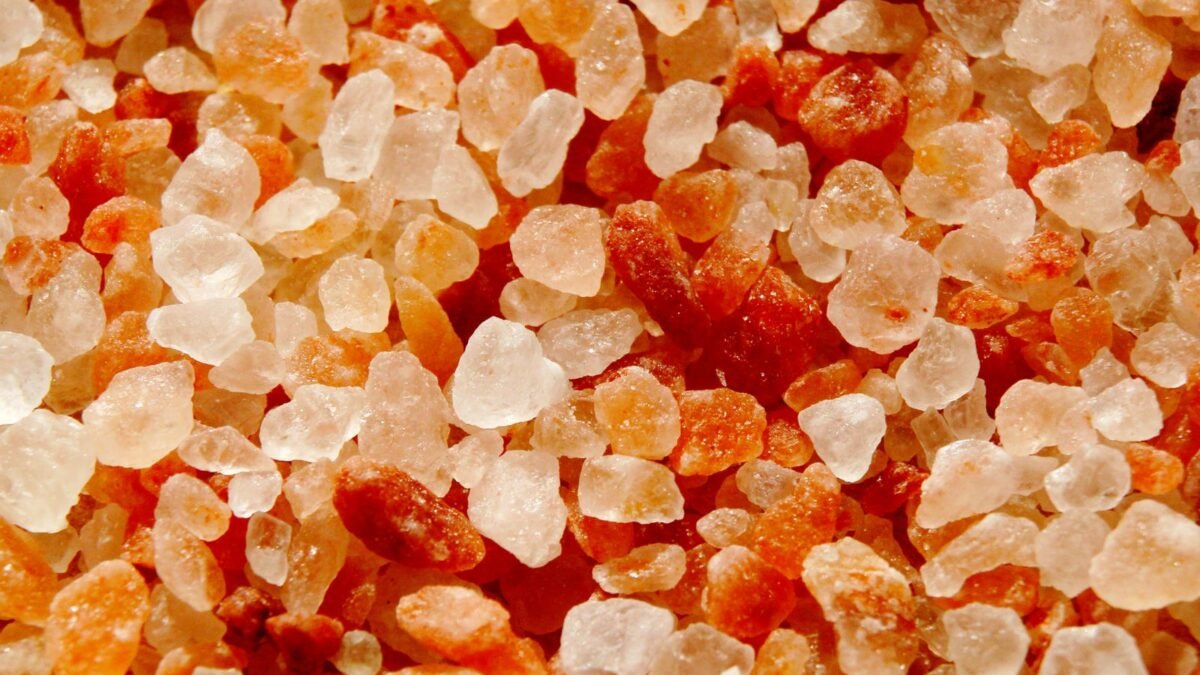
Quick Answer: If your water softener salt has red spots, the cause is almost always iron. Either iron in your water stained the salt near the waterline, or a metal object in or above the tank is rusting. Less often, the specks are natural mineral impurities in the salt itself, or the red is a slimy film from iron bacteria. Look at where the color sits: a band at the waterline points to your water, specks in salt straight from the bag point to the salt, and one rusty patch points to metal.
Disclosure: As an Amazon Associate, Grains & Gallons earns from qualifying purchases.
You lift the lid and the white pellets have rusty freckles, an orange ring or a pinkish tint at the bottom. When water softener salt has red spots it looks like contamination, and sometimes it is. Usually, though, the salt is just showing you something about your water, and the fix depends on which of four sources you're looking at.
In this guide
Where the color sits on the salt
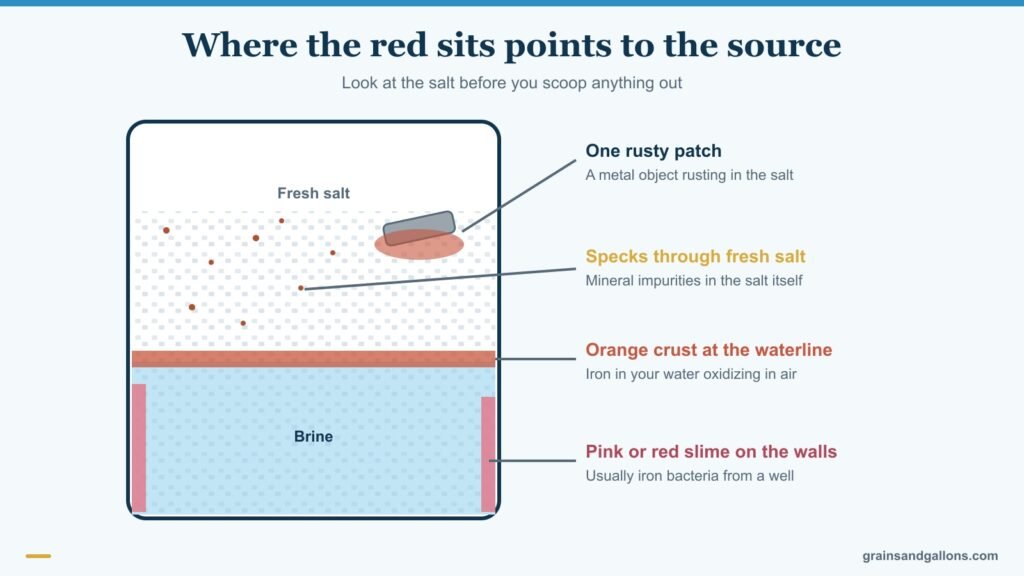
Before you scoop anything out, look carefully. The location of the color narrows things down faster than anything else.
Color only near the waterline, or on salt that's been sitting in brine. That's water-side. Iron in the refill water oxidizes when it meets air in the tank and leaves orange-red deposits on whatever it touches. Pellets that sit in the brine longest get the darkest.
Specks in salt straight out of the bag. That's salt-side. Pour some into a white bowl. If you see tiny reddish or tan grains before the salt ever touched your water, they came from the salt itself.
One concentrated rusty patch. Something metal is rusting: a dropped scoop, a screwdriver, a bolt, or a corroding fitting dripping from above.
A pink or red film on the tank walls that feels slimy. That points toward something biological, usually iron bacteria from a well. It's covered in its own section below.
Why water softener salt has red spots at the waterline

If you're on a private well, iron is the first suspect. Even on city water, older iron mains can add some. Penn State Extension explains that dissolved iron comes out of the well clear and turns orange-brown once it's exposed to air. A brine tank is exactly that kind of place: water sits in an open tank with an air gap above it, and the salt pellets at the waterline catch the oxidized iron like a filter. Over months, you get an orange crust.
Depending on your control valve, the tank refills with either softened or raw water. Either way, any iron left in that refill water will stain the salt.
Does it matter? The stain on the salt itself is mostly cosmetic. What matters is what it tells you:
- Iron is reaching your softener. Conventional softeners can remove some dissolved (ferrous) iron. Penn State Extension notes they're generally recommended only when dissolved iron is below 5 mg/L, hardness is 3 to 20 grains per gallon and pH is above 6.7.
- Oxidized iron fouls resin. The same extension guide warns that oxidized iron and manganese will foul softener resin. Fouled resin removes hardness less well, so you may notice soft water slipping before the salt runs out.
- Iron may be getting past the softener. If the water coming out still carries iron, you'll see orange stains on sinks, toilets and laundry too.
Test the raw water before you treat anything

Guessing gets expensive. Test the raw water (before the softener) for iron, and the softened water if you can, so you know how much is getting through. A home kit gives you a working number; our roundup of the best iron test kits for water covers kits that read low enough to be useful. For a private well, a certified lab test is worth it because it also reports hardness, pH and manganese, which all affect what treatment will work.
Then compare the result with what your softener can handle. Our explainer on whether a water softener can remove iron covers how much is realistic and when you need a dedicated iron filter ahead of the softener.
Reddish grains straight out of the bag
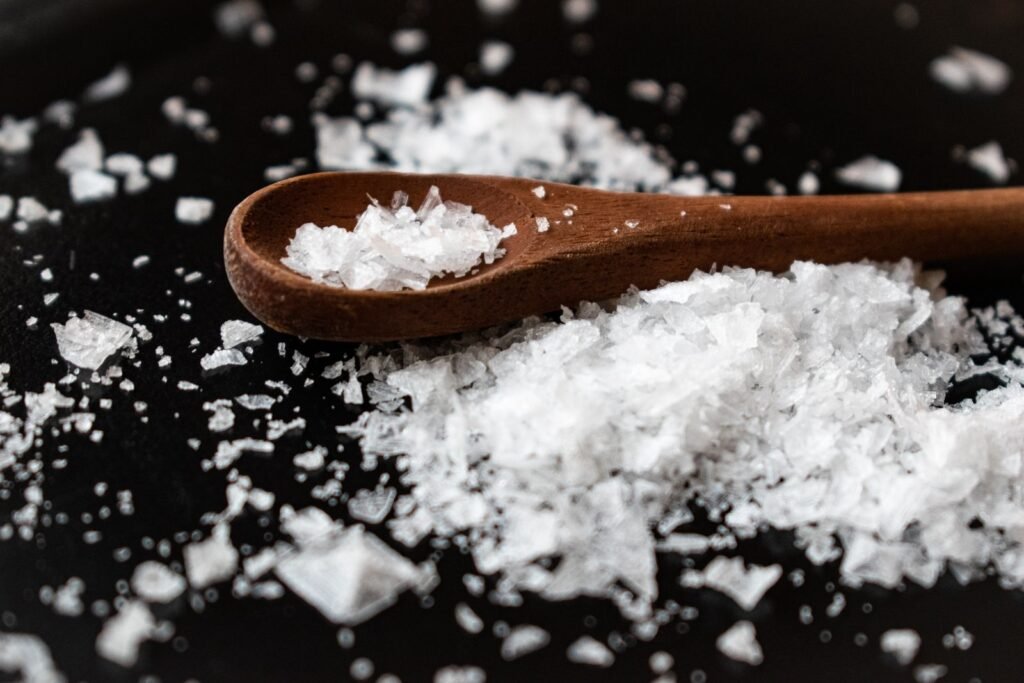
Salt isn't always pure white all the way through.
- Rock salt and some solar salt carry insoluble minerals and grit, which can show as tan, gray or reddish bits. Those insolubles don't dissolve, so they build up as sludge at the bottom of the tank. Our page on rock salt in a water softener covers why it leaves more residue.
- Potassium chloride is mined from deposits that are often naturally reddish. Softener-grade pellets are refined and look white, but a stray pinkish speck now and then isn't unusual.
None of that is dangerous in a softener, but sludge is a nuisance and grit can foul the brine pickup and injector. If your bags regularly look speckled, switch to a high-purity evaporated pellet. Our guide to the best water softener salt leans toward the cleanest options. For salt that looks gray or muddy rather than red, see softener salt that looks brown or dirty.
A rusting object in or above the tank
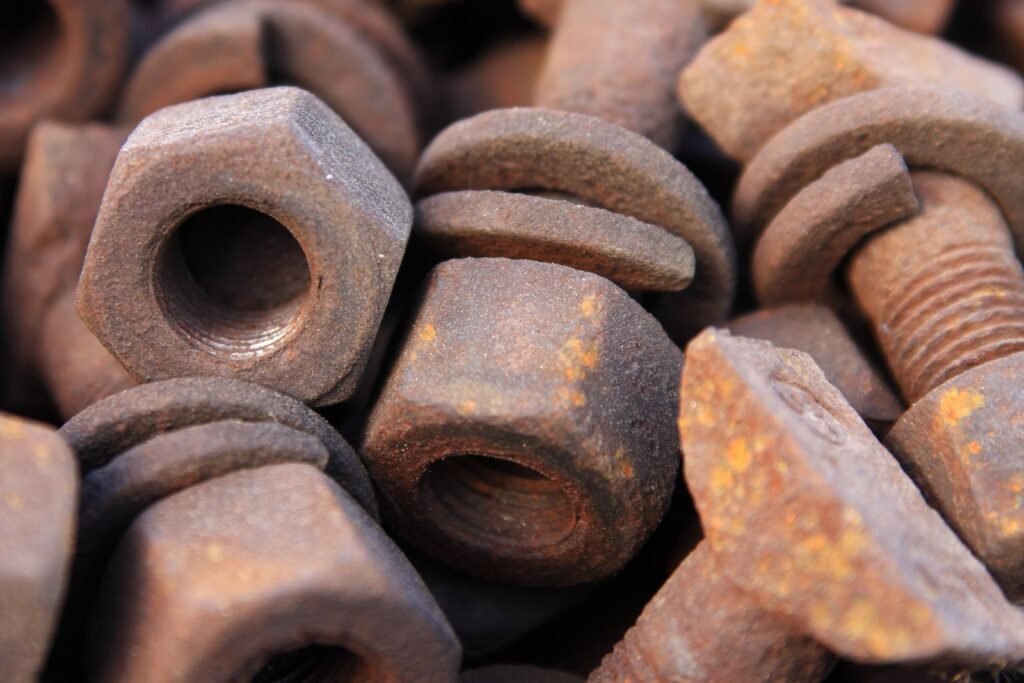
This is the easiest fix. Concentrated brine is hard on steel, so even a small piece of metal will bleed rust into the salt around it. Look for:
- A metal scoop, tool, nut or bolt buried in the salt
- A rusting shelf, pipe hanger or water heater drip directly above the tank
- A corroded overflow or brine line fitting (most are plastic, but some older setups used metal)
- Rusty lid hinges or screws on certain tank designs
Pull the object out, remove the stained salt around it, and the spots stop. Keep anything metal out of the tank from then on, including a steel scoop.
Pink or red slime on the tank walls

Saturated brine is hostile to most microbes, which is why brine tanks rarely grow much. Slime usually forms where the water is less salty, such as near the waterline on a tank that's run low, or on the walls above the salt.
On well water, red or orange slime is most often iron bacteria. The Minnesota Department of Health describes them as causing yellow, orange, red or brown stains and sticky, rusty deposits, sometimes with a swampy or oily smell or a rainbow sheen. They aren't known to cause disease, but they can create conditions where other organisms grow, and the department recommends testing for coliform bacteria and nitrate as a precaution.
What to do:
- Clean and sanitize the brine tank (steps below).
- Have the well water tested by a laboratory to confirm iron bacteria and check for coliform.
- Treat the source. Shock chlorination of the well and plumbing is the usual approach, and it may need repeating. Our guide to iron bacteria in well water walks through confirmation and treatment.
If anyone in the house is immunocompromised, talk with a doctor and get the well tested properly rather than guessing.
Cleaning the stains and stopping them coming back

Whatever the source, a single clean shows you whether the problem is ongoing.
- Let the salt run low. You'll throw away less stained salt. Don't let it run completely empty if your water is very hard.
- Scoop out the stained pellets, the crust at the waterline and any sludge on the bottom.
- Scrub and rinse the walls, the brine well and the salt grid if your tank has one. Our brine tank cleaning guide covers draining, sanitizing and reassembly.
- Refill with high-purity salt, filling only to the usual level.
- Clean the resin if iron is involved. A cleaner such as Rust Out goes into the brine well, followed by a manual regeneration. Its product sheet gives the first dose as 1 cup dissolved in a half gallon of cold water, then 1/4 cup for every 40 pounds of salt as maintenance. Your softener manual gets the final say, though: GE's softener manual says to mix the cleaner with water, pour it into the brine well and regenerate right away, and warns against leaving cleaner sitting in the salt because of the corrosive gases it forms. Our Iron Out vs Res Care comparison covers the main alternatives.
Iron cleaners like this have a sulfur odor, so wear gloves, keep the area ventilated, and never mix them with bleach or other chemicals. Check the label before using any of them with a septic system.
If the salt stays white for months, it was a one-time stain or the rusty object you removed. If the orange comes back within weeks, iron is still coming in, and the answer is upstream: confirm the iron level and consider an iron filter ahead of the softener rather than relying on resin cleaner forever.
FAQ
Is red or orange softener salt safe to use?
Yes, in most cases. Iron-stained salt still makes brine, and the stain is cosmetic. The concern is the iron reaching your resin, not the salt itself. Remove heavily crusted salt so it doesn't break down into sludge, and scoop out any salt that sits in slime.
Why does my water softener salt have red spots only at the bottom?
The bottom layer sits in brine all the time, so it collects the most oxidized iron from the refill water. That pattern points to iron in your water rather than a salt problem.
Can potassium chloride be pink or red?
Yes. Potassium chloride is mined from deposits that are often naturally reddish. Refined softener pellets look white, but an occasional pinkish speck is normal and harmless.
Will an iron filter stop the red spots?
If the spots come from iron in your water, yes. An iron filter ahead of the softener removes the iron before it reaches the brine tank and resin. Penn State Extension lists oxidizing filters for higher iron levels than a softener should handle.
How often should I add resin cleaner on iron water?
Follow your softener manual first, then the product label. Rust Out's sheet calls for 1/4 cup with every 40 pounds of salt as maintenance, but GE's manual says not to leave cleaner in the salt and instead to pour a mixed dose into the brine well before a regeneration, at least every six months on iron water or more often if iron shows up in the soft water.
Red spots are iron talking, not bad salt
In most homes, when water softener salt has red spots, the salt is fine and the iron is the story. Find where the color sits, test the raw water, remove any metal from the tank, and clean once. If the orange returns quickly, deal with the iron before it reaches the softener instead of scrubbing the tank every month.