

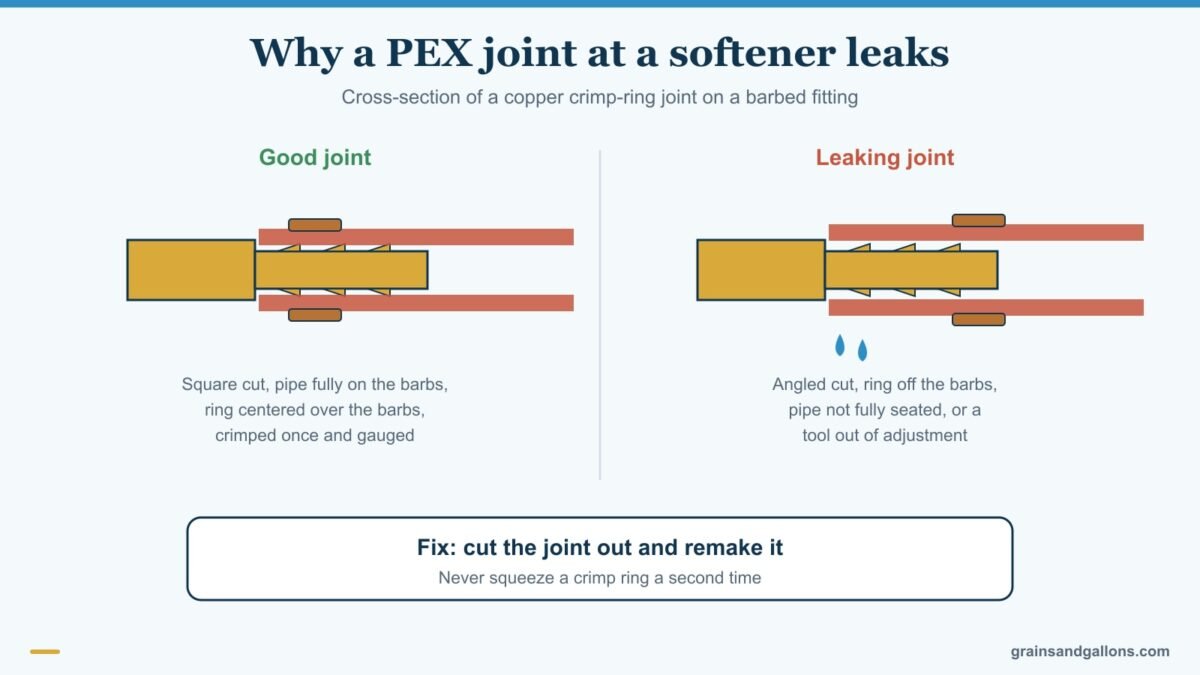
Quick Answer: For a water softener PEX connection leak, put the softener in bypass and dry every joint so you can see exactly where the drip starts. Many "PEX leaks" are really the threaded adapter or the bypass O-rings above the PEX joint. If it is the PEX joint, don't squeeze the ring again. Shut off the main, cut the fitting out with a square cut, and make a fresh joint with the right ring and a calibrated tool.
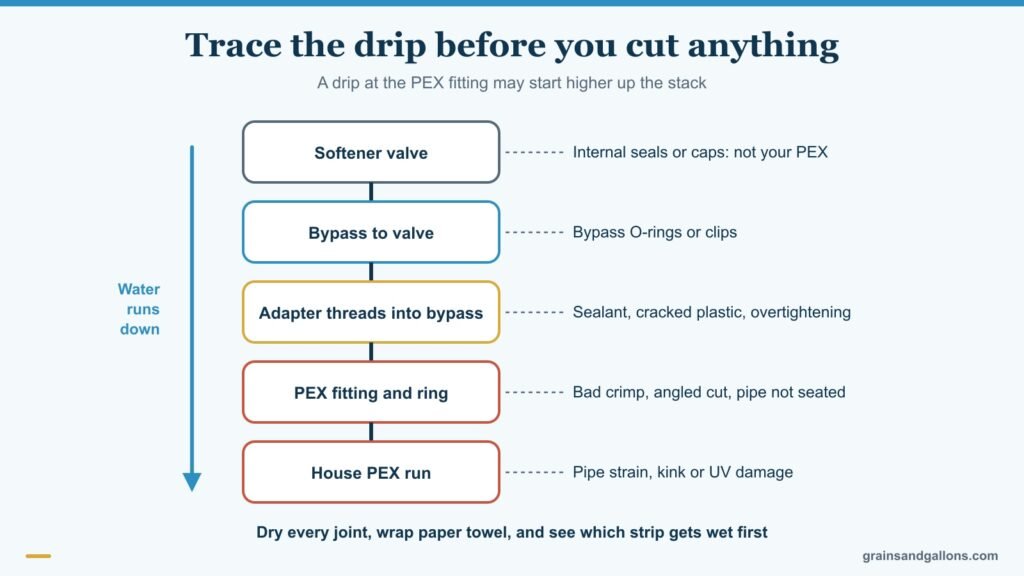
A water softener PEX connection leak usually shows up as a drip at the bottom of a fitting and a damp spot on the floor. But water runs downhill along the pipe, so that drip may have started at a threaded joint or a bypass O-ring higher up.
In this guide
Trace the drip before you cut anything
- Bypass the softener if the drip is steady. If it's only a slow weep, watch it under pressure first.
- Dry every joint between the house pipe and the valve: the PEX fitting, the adapter, the bypass and the valve body.
- Wrap a dry paper towel around each joint and wait. The strip that wets first marks the leak.
- Notice when it drips. All the time means a pressure-side joint. Only during regeneration usually points to the drain or a valve seal, not your PEX.
| Where the water first shows | Most likely cause |
|---|---|
| Between the PEX and the ring or sleeve | Wrong tool, ring out of spec, angled cut, or pipe not fully seated |
| Where the adapter threads into the bypass | Sealant problem, cracked plastic threads, or overtightening |
| Where the bypass meets the valve | Bypass O-rings or clips; see our softener O-ring leak guide |
| Push-fit fitting at the pipe end | Pipe not inserted to depth, scored pipe, missing stiffener, or a burr |
| Only during regeneration | Drain line or valve internals, not the supply plumbing |
Which PEX joint do you have?
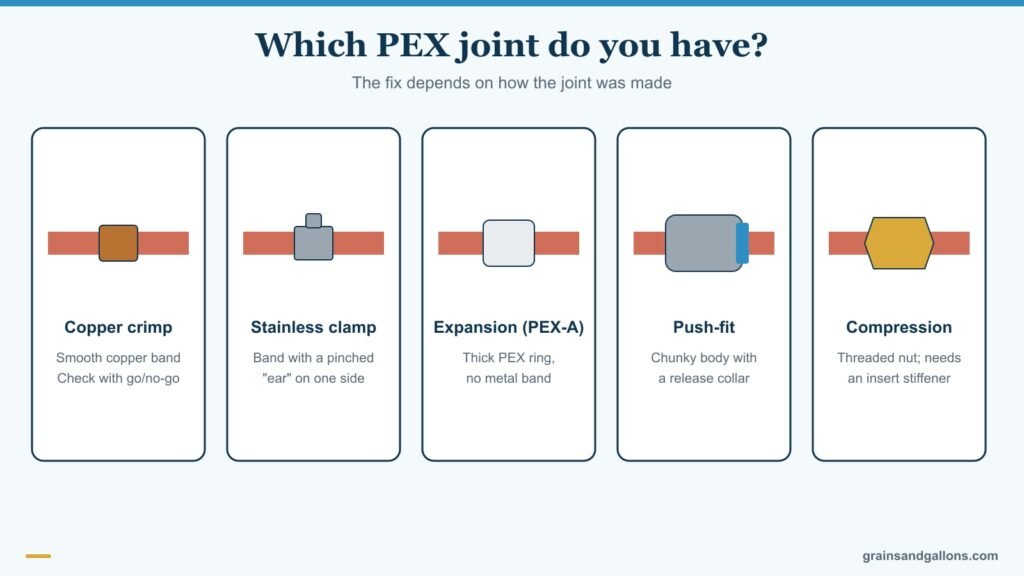
The fix depends on how the joint was made, so look closely at the ring or fitting:
- Copper crimp ring: a smooth copper band squeezed over a barbed fitting, made with a crimp tool and checked with a go/no-go gauge.
- Stainless clamp (cinch) ring: a stainless band with a small pinched "ear" on one side.
- Expansion fitting: a thick plastic or PEX ring with no metal band. This is the PEX-A system, and it only works with PEX-A pipe.
- Push-fit: a chunky fitting with a release collar. No tools needed to make it.
- Compression: a nut threaded onto the fitting body, with an insert (stiffener) inside the pipe.
Sioux Chief also notes that PEX and PB (polybutylene) fittings and crimp rings aren't interchangeable, so don't mix rings and fittings from the two systems.
Water softener PEX connection leak fixes by joint type
Crimp or clamp ring leaking
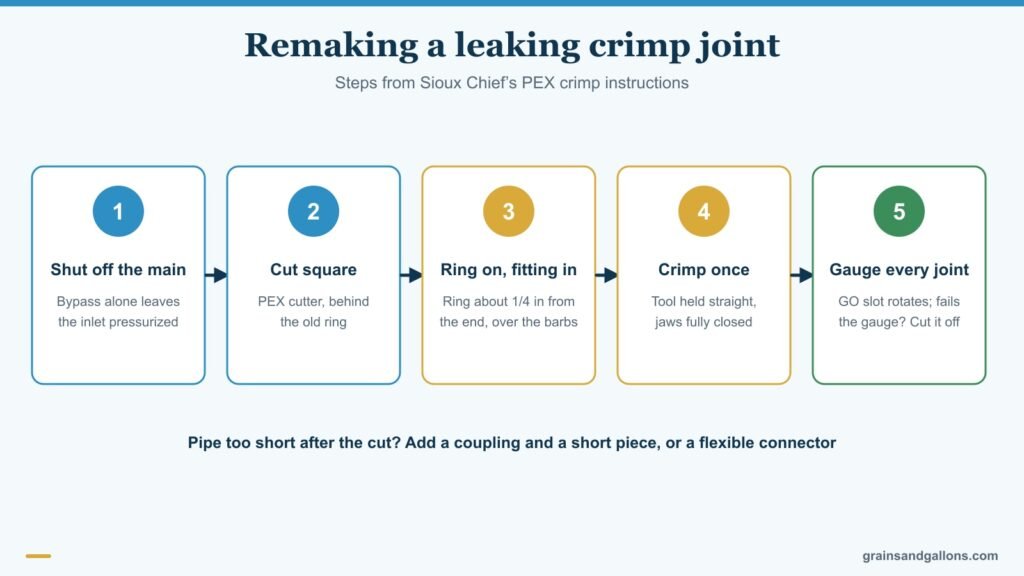
Don't re-crimp or squeeze the ring again. Sioux Chief's PEX installation guide says to crimp one time only: if you don't get a proper crimp the first time, cut the fitting off and start again.
- Shut off the main and relieve pressure at a low faucet. Bypass alone doesn't take pressure off the inlet side.
- Cut the PEX square (90°) just behind the old ring with a PEX tube cutter.
- Slide on a new ring, leaving about ¼ inch of tube showing, push the fitting fully into the pipe, and make sure the ring is centered over the barbs.
- Hold the tool straight and close the jaws completely.
- Check every joint with the go/no-go gauge. If the GO slot fits over the ring and rotates, the crimp is good. If the ring fits the NO-GO slot or won't fit the GO slot, cut it off and redo it.
A tool that has drifted out of adjustment is the classic cause of a leaky crimp, which is why the gauge check matters. If cutting leaves the pipe too short, add a coupling and a short piece of PEX, or switch to a flexible connector for the last stretch.
Expansion fitting leaking
Usually the ring wasn't expanded enough to seat fully against the fitting shoulder, or the pipe isn't PEX-A. Check the print on the pipe. Cut it out and redo it with the right pipe and expander head, and give the joint time to shrink back before you pressurize it, especially in a cold basement.
Push-fit fitting leaking
These usually leak because of how the pipe was prepared: a cut that isn't square or has a burr, pipe not pushed to the depth mark, a missing stiffener insert where the brand calls for one, or a scratch where the O-ring seals. Release it with the collar tool, cut off the end, mark the depth and reinsert. If the O-ring looks nicked, replace the fitting. Our article on SharkBite fittings on a softener covers where push-fit makes sense.
Threaded adapter leaking
This is the most common one: the PEX joint is fine, but the threaded end going into the bypass weeps.
- Plastic threads crack easily. Pentair's softener manual says plastic connections should be hand-tightened, without pliers or pipe wrenches. If you've been tightening harder to stop a drip, look for a hairline crack in the female threads. A crack means a new bypass or adapter, not more torque.
- Use tape, not dope, on plastic. Clack's WS1 manual says not to use pipe dope or other sealants on threads, and to use Teflon tape on the threaded inlet, outlet and drain fittings.
- Don't tape O-ring connectors. Clack notes that tape isn't needed on its nut connections because they seal with O-rings, and that tightening a leaking installation-fitting nut won't stop the leak; take it apart and check the O-ring instead.
If you're replacing adapters, our roundup of water softener installation kits covers yokes and adapters for common valves.
Why softener PEX joints leak more than most
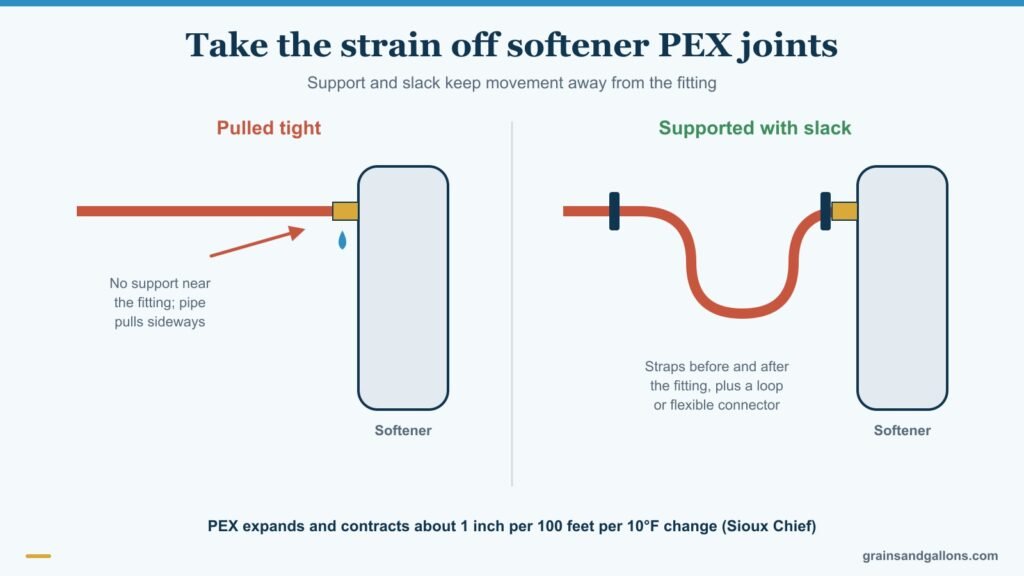
- Strain on the joint. Sioux Chief says PEX expands and contracts about 1 inch per 100 feet for every 10°F change, and says to support the tube before and after every fitting. Clack adds that its valve and fittings aren't designed to support the weight of the system or the plumbing. Leave a gentle loop or use flexible connectors so the joint isn't carrying the softener's movement.
- Vibration and water hammer when the valve changes cycles or an appliance valve snaps shut. See water hammer after a water softener.
- Sunlight. Sioux Chief says to keep PEX out of direct sunlight. In a garage with a window, sleeve or cover it.
- Tight bends. Its minimum bend radius is six times the tube size (3 inches for ½-inch tube). Kinking the pipe to reach the bypass stresses the joint.
Our walkthrough on installing a softener with PEX shows how to lay out the loop.
When it's not a slow drip
If a joint has blown apart or the pipe has split, shut off the main and follow our emergency steps for a burst softener hose, then come back for the repair. Call a plumber if the leak is inside a wall or ceiling, or if you don't have the right crimp or expansion tool.
Remake the joint instead of squeezing it twice
A water softener PEX connection leak is rarely fixed by tightening. Trace the drip to the right joint first, because the threaded adapter and bypass O-rings often get blamed on PEX. If the PEX joint really is leaking, cut it out square, remake it with the right ring and a calibrated tool, check it with the gauge, then support the pipe so the softener isn't pulling on it.
FAQ
Can I just tighten a leaking PEX crimp ring?
No. Crimp rings are a one-time connection, and Sioux Chief's instructions say to crimp once only. Squeezing again can distort the pipe without reseating it. Cut the joint out and make a new one with a fresh ring.
Should I use Teflon tape or pipe dope on softener fittings?
Use tape on threaded connections into plastic softener parts. Clack's manual says not to use pipe dope or other sealants on threads and to use Teflon tape on threaded inlet, outlet and drain fittings. Nut connections that seal with an O-ring don't need tape at all.
Why does my PEX fitting leak only when the softener regenerates?
It probably isn't the PEX. Leaks that appear only during regeneration usually come from the drain line, a valve seal or a bypass O-ring that sees different pressure in that cycle. Trace it with paper towel during a regeneration before cutting anything.
Can movement or sunlight make a PEX connection leak?
Yes. Sioux Chief says PEX expands and contracts about 1 inch per 100 feet for every 10°F change, and says to support the tube before and after every fitting and keep it out of direct sunlight. Clack adds that its valve and fittings aren't designed to carry the weight of the plumbing. A joint that is pulled, bent tighter than six times the tube size or baked by a garage window can start to weep even when the crimp was good. Add a gentle loop or a flexible connector, and cover the tube where it sees sun.