

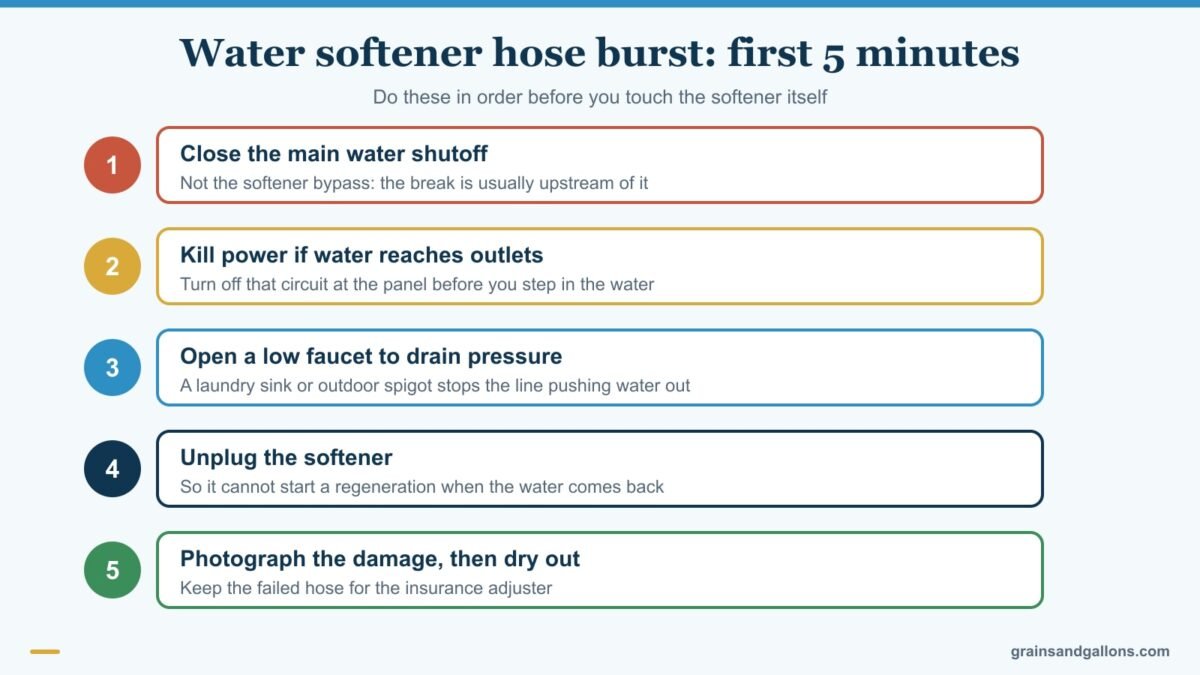
Quick Answer: After a water softener hose burst, shut off the house's main water valve first. Don't count on the softener's bypass, because a burst inlet connector usually sits upstream of it. If water is near outlets or the softener's plug, turn off that circuit at the breaker before you step in it. Open a low faucet to drain pressure, unplug the softener, then replace the failed connector before the water goes back on.
A water softener hose burst is one of the fastest ways to flood a basement or utility room, because the supply connectors carry full house pressure all day. If water is spraying right now, do the first section and come back for the rest.
In this guide
Shut off the main, not the bypass
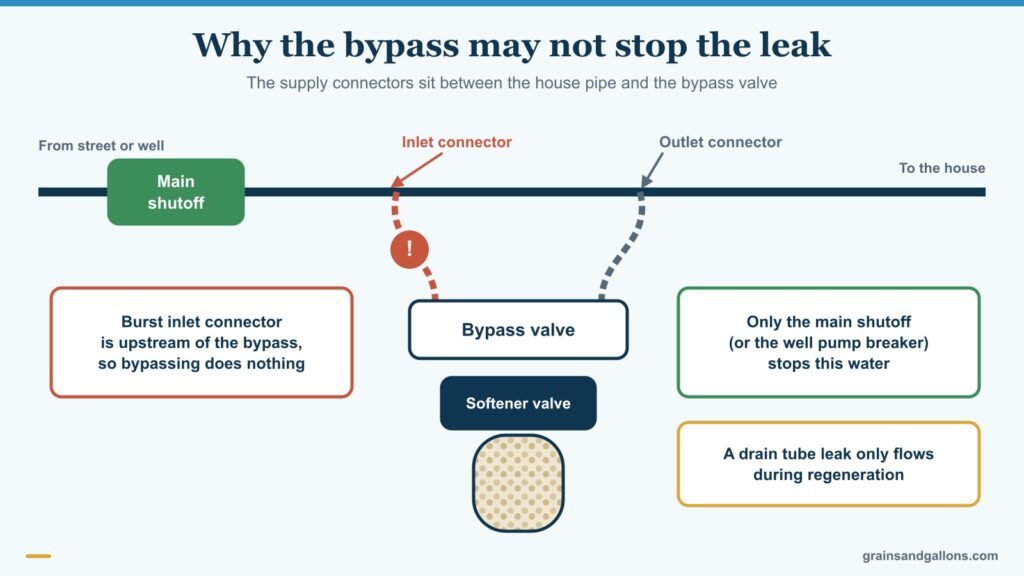
1. Close the main water shutoff. It's usually where the water line enters the house: a basement wall, utility room, garage, or near the water heater on a slab home. On a private well, switching off the well pump at its breaker stops the flow too. A valve that hasn't moved in years can be stiff, so turn it firmly but don't hang off it.
Why not the bypass? The flexible connectors normally run from the house pipe to the bypass valve. If the inlet connector burst, the bypass is downstream of the break and can't stop it. The bypass only helps when the leak is on the softener side of it, such as the valve body or the resin tank.
2. Watch for electricity. Softeners sit next to outlets, water heaters and sometimes sump pumps. If water has reached an outlet, a power strip or the softener's plug-in transformer, turn off that circuit at the panel before you walk through the water. If you can't reach the panel without standing in water, call an electrician or your utility.
3. Relieve the pressure. Open a cold faucet on the lowest floor (a laundry sink or outdoor spigot works) so the line stops pushing water out of the break.
4. Unplug the softener once it's safe to do so. You don't want it starting a regeneration when the water comes back on.
5. Document, then dry out. Take photos of the damage and the failed hose before cleanup, and keep the hose. Then wet-vac, towel and run fans, and get anything sitting on the floor up and out of the wet area.
Find out which part actually failed
With the water off, look closely. "The hose burst" can mean several different failures, and the fix depends on which one it was.
| What you find | What it means | The fix |
|---|---|---|
| Braided connector split, bulged, or the braid is rusty or frayed | The connector wore out, often from corrosion or age | Replace both connectors, not just the one that failed. |
| Connector intact, but popped off a barb, push-fit or compression fitting | The joint let go, not the hose | Rebuild the joint properly. Don't just push it back on. |
| Plastic nut cracked where the hose meets the bypass | Over-tightened, or stressed by a hose pulled too tight | New connector, with enough slack that it isn't pulling sideways. |
| Bypass valve body cracked | Freeze damage, impact or overtightening | Replace the bypass. Our list of replacement bypass valves covers common Fleck, Clack and big-box models. |
| Thin drain tubing popped off or split | That's the drain line, not a supply hose | It only flows during regeneration. Reattach and clamp it. |
If the water came from the drain tube rather than a supply connector, you didn't need the main off for long. Put the softener in bypass, turn the main back on, and use our guide to a softener leaking from the drain line to fix it at your own pace.
If the failure was at a PEX joint near the softener rather than at a braided hose, see our guide to a PEX connection leak at the softener.
What makes softener connectors burst
Supply connectors are under pressure every hour of the day, not just when water is running. A few things shorten their lives:
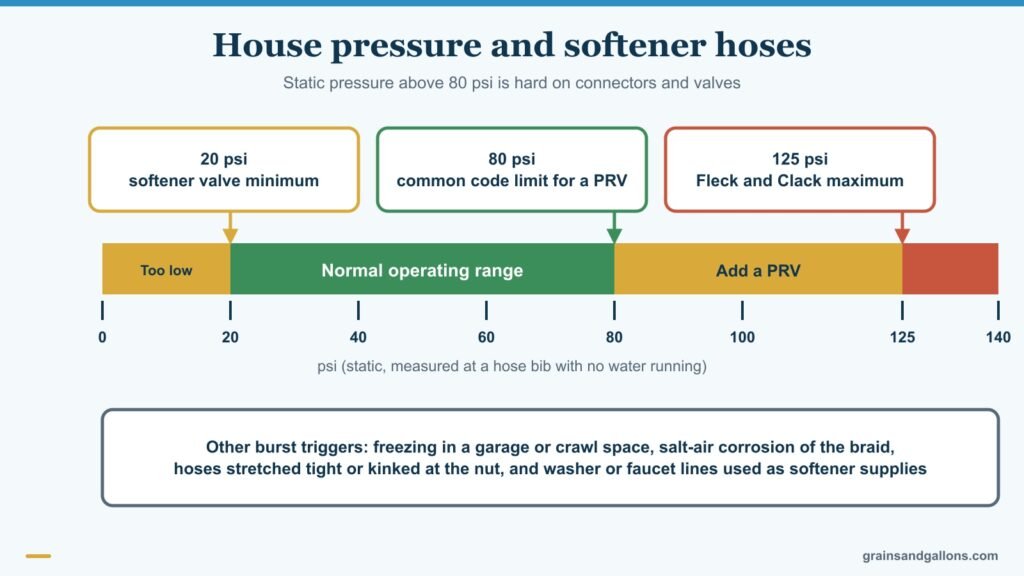
- High static pressure or pressure spikes. The Fleck 5600SXT manual says water pressure must not exceed 125 psi and the unit must not be exposed to freezing. Many plumbing codes call for a pressure-reducing valve when static pressure is over 80 psi. A cheap hose-thread gauge on an outdoor spigot tells you where you stand in seconds. If it reads high, our picks for the best water pressure regulators cover sizes that suit homes with softeners, and our page on softener pressure requirements explains the low end of the range.
- Age and corrosion. Stainless braid over a rubber core is common. Salty air from spilled salt or a brine tank without its lid isn't kind to the braid or the crimp ferrules.
- Freezing. A softener in an unheated garage or crawl space can split a connector or the bypass in one cold night. Our guide to softener placement covers protecting a unit in those spots.
- Tight, kinked or twisted runs. A hose stretched to reach, or bent hard right at the nut, fails at that bend.
- The wrong part. Washing-machine hoses and faucet supply lines aren't made to be a softener's main supply.
Braided connectors can also fail without warning, with no dripping beforehand, so age alone is a reason to replace them. If yours are original to an older install and you can't remember when they went in, replace them on your schedule rather than waiting for a flood.
Replace the connector and restart slowly
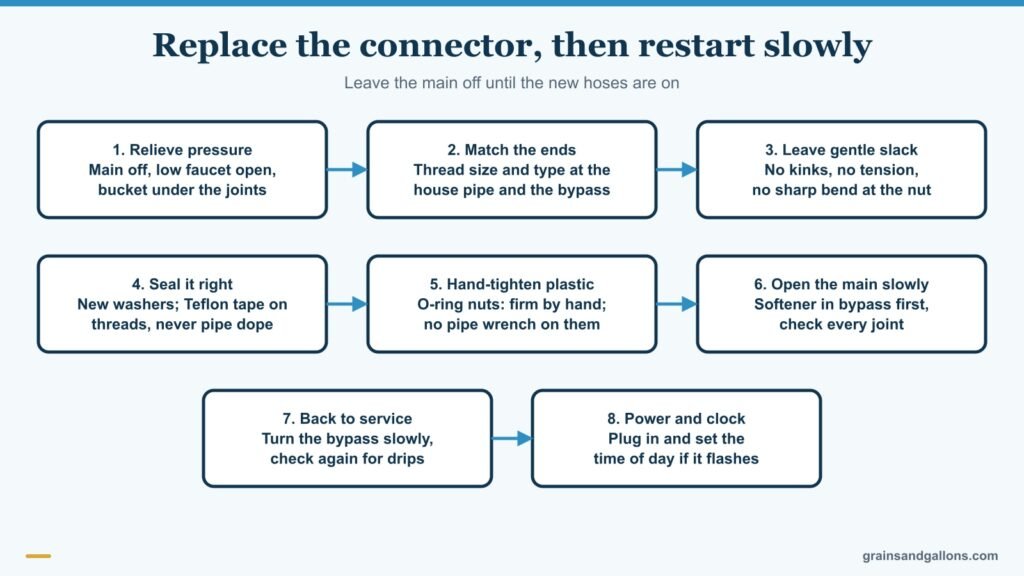
If the softener connects with threaded flexible connectors, this is usually a straightforward job.
- Leave the main off and confirm the pressure is relieved.
- Set a bucket under the joints and disconnect both old connectors. Some water will drain out of the softener and pipes.
- Match the ends. Check the thread size and type at the house pipe and at the bypass (often 3/4" or 1", male or female, sometimes with valve-specific adapters). Bring the old connector to the store if you're unsure.
- Pick a length with gentle slack. No kinks, no tension, no sharp bend at the nut.
- Seal it the way the valve maker says. Use new washers in washer-sealed nuts. The Clack WS1 service manual calls for Teflon tape on threaded inlet, outlet and drain fittings and says never to use pipe dope or other sealants on its threads.
- Hand-tighten the plastic nuts. Clack's manual says the nut connections between the valve, bypass and installation fittings are hand-tighten only, with no pipe wrench, and that if one of those o-ring joints leaks, tightening the nut won't stop it. Take it apart and check the o-ring instead.
- Turn the main back on slowly with the softener in bypass, and check every joint for drips. Then move the bypass to service slowly and check again.
- Plug the softener back in and set the time of day if the display is flashing.
Our roundup of the best flexible connectors for water softeners compares braided and corrugated stainless options and the end types that fit common valves. If the bypass won't turn when you test it, read our guide to a stuck bypass valve before forcing it.
Two things people miss when replacing hoses
Grounding. In older homes, the cold water pipe can be part of the electrical grounding path. Flexible connectors and plastic softener valves break that path, which is why many installs include a bonding jumper across the softener. If yours had one and it was disturbed, put it back. Our explainer on softener bonding and grounding shows what it should look like. Call an electrician if you're unsure.
Push-fit fittings. If the joint that failed was a push-to-connect fitting, check whether the pipe was cut square, deburred and fully inserted to the depth mark. Our article on SharkBite fittings on a softener covers when they're fine and when they're a risk.
After the cleanup: the softener, the claim and a plumber
Once the floor is dry, check the softener itself before you walk away:
- Look at the controller and transformer. If either got wet, let them dry fully before plugging back in, and replace a transformer that sat in water.
- Check the brine tank. Floodwater that got into the salt tank contaminates the salt. Empty and clean the tank if that happened.
- Watch the next regeneration. Make sure water reaches the drain and the brine tank refills, so you know the restart didn't leave anything disconnected.
Insurance. A sudden burst is the kind of event many homeowners policies are written to cover, minus the deductible, while the failed part itself often isn't. Policy details vary a lot. Our guide to homeowners insurance and softener leaks explains how these claims usually go and what to document.
Call a plumber when:
- You can't find or close the main shutoff.
- The failure is in soldered copper, PEX crimp rings or the house pipe itself, not the connector.
- Water got into the ceiling below, walls or electrical, or the floor stayed wet for a long time.
- You don't know the fitting sizes and don't want a second flood.
FAQ
Should I use the bypass or the main shutoff after a water softener hose burst?
Use the main shutoff. The supply connectors usually run from the house pipe to the bypass, so a burst inlet connector is upstream of the bypass and keeps leaking even with the bypass closed. The bypass only isolates leaks on the softener side.
Can I keep using water after a softener hose bursts?
Not until the failed connector is replaced, unless the leak was only the drain tube. If the leak is in the valve or tank rather than a connector, putting the softener in bypass may let you restore water while you wait for parts.
How often should water softener supply hoses be replaced?
There's no single rule, but braided connectors can fail suddenly with no drip beforehand. Inspect them yearly for rust, bulges or kinks, and replace any that are old, corroded or of unknown age.
Does high water pressure cause softener hoses to burst?
It shortens their life. Fleck and Clack valves are rated to a 125 psi maximum, and many codes call for a pressure-reducing valve above 80 psi. If your static pressure reads high, a regulator protects the softener and every other fixture.
Do I need to reprogram the softener after a hose burst?
Usually you only need to set the time of day after it's been unplugged. Most digital valves keep their programming. If the display shows an error or the settings look wrong, check your manual before running a regeneration.
Close the main first, then fix the cause
A water softener hose burst is scary, but the first move is always the same: close the main, because the bypass may sit downstream of the break. Once the water is off, find out whether it was the hose, the joint, the bypass or just the drain tube. Then fix the reason it failed (high pressure, freezing, corrosion or a hose pulled too tight) so the new connector doesn't go the same way.