

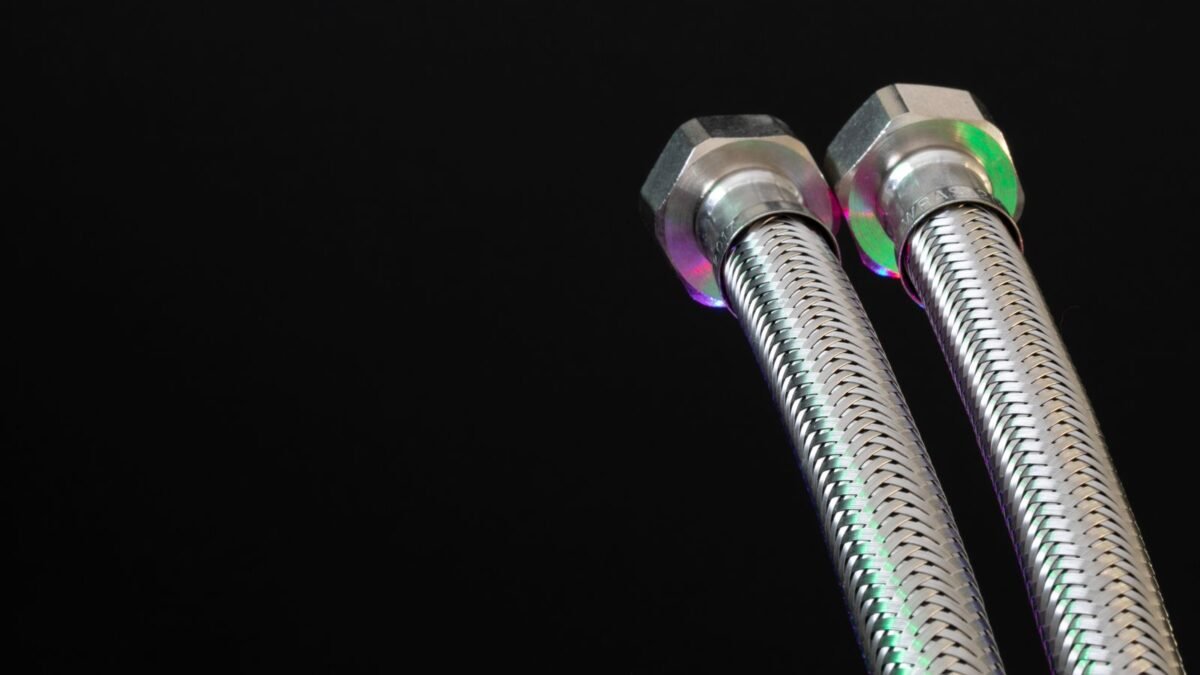
Quick Answer: If your softener has 1" female-thread fittings and you want to avoid soldering, the SharkBite Max URSS3086FX24 pushes onto 3/4" PEX, copper or CPVC and threads onto a 1" male fitting. If your softener and pipes are both 1" threaded, use a wide-bore corrugated line like the PEVEPEXE Plus 1" x 24" pair so the hose doesn't become the narrowest point in your plumbing. For 3/4" systems, the TT FLEX 18" two-pack is an easy, inexpensive pair.
Disclosure: As an Amazon Associate, Grains & Gallons earns from qualifying purchases.
The two flex lines on your softener are the parts most likely to flood your basement. They're under full line pressure 24 hours a day, they get bumped every time someone adds salt, and they're usually the cheapest component in the whole install. Spend an extra ten minutes choosing them. That's a lot less trouble than a call to your homeowners insurance about a softener leak.
The good news is that this is an easy decision once you know three numbers.
In this guide
- Thread, length, and the one people miss: inside diameter
- Braided, corrugated or push-fit?
- The five, at a glance
- SharkBite Max URSS3086FX24: the DIYer's connector
- PEVEPEXE Plus 1" x 24": wide bore for 1-inch homes
- Watflow 1" x 24" corrugated: the backup pick
- TT FLEX 3/4" 18": a pair for smaller systems
- Flextron FTWC-S34-18E: sweat end for copper
- Getting a dry install the first time
- When to replace them
Thread, length, and the one people miss: inside diameter
1. The thread on each end. Most softener bypasses end in 1" male NPT threads. That includes Fleck yokes, stainless Fleck bypasses, and Clack fittings with male-thread ends. Your connector needs a 1" FIP (female) nut on that end. On the house end, match your pipe: another FIP thread, a push-fit end, or a sweat end for soldering.
2. Length. Measure the gap from the bypass outlet to the pipe, then add a few inches so the hose makes a gentle curve. A hose pulled tight puts stress on the bypass. Too much slack makes kinks and tight loops. 18" and 24" cover most installs.
3. Inside diameter. This is the one that bites people. A connector labeled "1 inch" refers to its thread, not the bore. Inside, some corrugated lines are close to full size. Listings for 1" lines often quote an ID around 0.95". Others are much narrower. Braided connectors are often narrower still. If your softener is plumbed into a 1" main and the house has three bathrooms, a connector that narrows to a 1/2"-ish bore will cost you pressure at the far shower. Look for "full port" or a stated ID.
Braided, corrugated or push-fit?
- Corrugated stainless is a solid metal tube with ridges so it can bend. It's usually the widest bore you can buy for the size, and there's no rubber liner to break down. The downside is that it doesn't like being bent back and forth repeatedly, so shape it once and leave it.
- Braided stainless has a flexible inner hose under a stainless mesh jacket. It's easy to route and forgiving of tight spaces, but the bore is often narrower, and the inner hose is what ages.
- Push-fit ends (like SharkBite) skip the threading or soldering on the house side. They're quick, but they cost more and take up a little more room.
There's no wrong answer among these as long as the thread, length and bore are right. On a 1" main with a big household, we'd lean corrugated. In a cramped closet with 3/4" PEX, a push-fit line is easier to work with.
The five, at a glance
| Connector | Ends | Length | Type | Sold as |
|---|---|---|---|---|
| SharkBite Max URSS3086FX24 | 3/4" push-fit × 1" FIP | 24" | Corrugated | Single |
| PEVEPEXE Plus | 1" FIP × 1" FIP | 24" | Corrugated, 0.95" ID | 2-pack |
| Watflow 1" corrugated | 1" FIP × 1" FIP | 24" | Corrugated | 2-pack |
| TT FLEX | 3/4" FIP × 3/4" FIP | 18" | Corrugated | 2-pack |
| Flextron FTWC-S34-18E | 3/4" FIP × 3/4" sweat | 18" | Corrugated | Single |
Remember that single connectors come one per box, and you need two, one for the inlet and one for the outlet.
SharkBite Max URSS3086FX24: the DIYer's connector
SharkBite sells this one specifically as a water softener connector. One end is a SharkBite Max push-to-connect fitting that takes 3/4" PEX, copper, CPVC, PE-RT or SDR-9 HDPE, and the other is a 1" female thread for the softener. The line is 24" of corrugated stainless, the brass is lead-free DZR, and SharkBite rates it to 200°F and 250 psi. The Max fitting doesn't need a PEX tube liner on copper or CPVC, which SharkBite says avoids that flow restriction. You cut the pipe square, deburr it, push the end on, and you're done. No torch, no PEX crimper.
Pick it if your house has 3/4" pipe and your softener has 1" male threads. That describes a lot of homes.
Skip it if you have a 1" main and care about every bit of flow. The 3/4" push end makes this the narrowest point in a 1" system, and a 1" × 1" corrugated line will do better there.
PEVEPEXE Plus 1" x 24": wide bore for 1-inch homes
This is the one to choose when you have 1" pipe and a 1" softener and want the connector to stay out of the way. It's 304 stainless corrugated line with 1" FIP on both ends, and the "Plus" version lists an inside diameter of 0.95", close to full size (the brand's standard version is 0.7", so check which one you're ordering). It's rated to 250 psi, the listing cites NSF-61, cUPC and AB-1953 lead-free compliance, and it comes as a pair, so one box covers the inlet and outlet. Thread a 1" male adapter onto your pipe, and the hose links it to your softener's male threads.
Watch out for the washers. Corrugated connectors seal with a washer inside the nut, not with thread tape. Make sure the washer is seated before you tighten, and don't overtighten. The nut should be snug, then a quarter turn more.
Watflow 1" x 24" corrugated: the backup pick
This pair is very similar to the PEVEPEXE: 1" FIP on both ends, 24" of 304 stainless corrugated line, rated to 250 psi, with nickel-plated copper nuts and lead-free construction. Watflow lists water softeners alongside water heaters and tankless heaters as intended uses. We're including it mainly as a dependable alternative when the PEVEPEXE is out of stock. Both fit the same installs.
The listing doesn't state an inside diameter or name a specific certification, which is the main reason it isn't higher. On a 1" main where every bit of flow matters, we'd rather know the bore, so treat this as the backup.
TT FLEX 3/4" 18": a pair for smaller systems
Plenty of compact softeners and cabinet units use 3/4" connections, and plenty of houses have 3/4" pipe. This is a two-pack of 18" corrugated stainless lines with 3/4" FIP on both ends, which covers the inlet and outlet in a single box.
Good for: 3/4" threaded installs with a short gap, especially in tight utility closets where a 24" line would just make a loop.
Not for: 1" softener fittings. Don't adapt a 1" softener down to these unless your plumbing is 3/4" anyway.
Flextron FTWC-S34-18E: sweat end for copper
This is an unusual one. It's 18" of corrugated stainless with a 3/4" FIP nut on one end and a 3/4" sweat end on the other, so you solder it straight onto copper pipe. That means one less threaded joint, which is one less spot to leak.
Rule for soldering near a softener: solder the sweat end to the pipe before you connect the FIP end to the softener, and keep the flame well away from the plastic bypass or yoke. Let it cool, then thread it on.
Getting a dry install the first time
- No tape on washer-sealed nuts. PTFE tape goes on male pipe threads that seal on the threads. Corrugated and braided connectors seal on their internal washer.
- Support the weight. The softener shouldn't hang from its hoses, and the hoses shouldn't carry the weight of the pipes. Strap the pipes to the wall.
- Leave bends gentle. A corrugated line folded into a sharp bend can crack over time.
- Fill slowly. Open the supply gradually with the softener in bypass, check every joint, then switch to service. If you open the valves and nothing comes out, go through our checklist for no water after installing a softener. It's usually the bypass, not the hoses.
- Bond across it. A softener with plastic parts breaks the electrical path through metal pipe, and swapping in metal flex lines doesn't change that. Add a jumper as described in our bonding and grounding guide.
When to replace them
Braided lines with a rubber core age, and they're cheap compared with water damage. Many plumbers replace them every several years, or whenever the softener is serviced. Replace any connector right away if the braid has a broken strand, the line has a bulge or rust stain, or you can see dampness at a nut. If you're dealing with a leak at a push-fit joint now, see our guide to a PEX connection leaking at the softener. If a line has already let go, these emergency steps come first.