


Quick Answer: A water softener motor running constantly is normal on many mechanical timer valves, because the small timer motor is the clock and turns all day. On digital valves the drive motor should only run for seconds to minutes while moving between cycle positions. If a digital valve's motor never stops, the control can't sense the piston's position: think cam switch, optical sensor, wiring or a jammed piston. Unplug it, bypass the softener, and check for an error code.
You're in the utility room in the middle of the afternoon and there's a faint whir coming from the softener head. Or a grinding noise started last night and hasn't quit. Before you assume the worst, figure out what you're hearing. A softener can have one motor or two, and only one of them is supposed to rest. That's the whole difference between a water softener motor running constantly by design and one that's stuck.
In this guide
Clock motor or drive motor: which one is running?

| Valve type | What "normal" looks like | What should worry you |
|---|---|---|
| Mechanical timer (Fleck 5600/2510 mechanical, older Autotrol and similar) | A small timer motor runs all the time to turn the 24-hour clock dial. | The piston drive keeps cycling after regeneration should have ended, or the time drifts badly |
| Digital valve with a drive motor (Fleck SXT, Clack WS1, most brand-name units) | The motor runs briefly at each step change, then stops. Long silent stretches in between. | The motor runs for many minutes without stopping, grinds or clicks, or restarts over and over |
| Any valve | Some hum from the transformer itself | A hot transformer, burning smell, or water running to drain nonstop |
If you have a mechanical timer and the only thing moving is the clock, nothing's wrong. Set the time of day if it's off and walk away. If the clock keeps losing time or the timer is worn, a modern digital head from our replacement control valve picks is often a cleaner fix than a new timer.
A digital valve motor that won't stop has lost the piston

Digital controls don't time the piston's moves. They run the motor until a sensor says the piston has arrived. A Fleck SXT uses a cam and switches. A Clack WS1 counts pulses from an optical sensor that looks at one of the reduction drive gears, and its motor reverses to move the piston the other way, per the Clack WS1 service manual.
So when that motor runs and runs, one of these is happening:
- The sensor isn't reporting. A cam switch that's bent, misadjusted, shorted or unplugged. Pentair's 5600SXT troubleshooting chart lists "control cycles continuously" with the cause "misadjusted, broken, or shorted switch," and the fix is to find out whether the switch or the timer is faulty and replace it, or replace the complete powerhead.
- The piston can't reach the spot. Debris or swollen seals make the piston drag, so it never gets to the position the sensor is waiting for.
- The gear spins but the piston doesn't. A stripped gear, a broken pin between the motor shaft and the gears, or a broken piston rod lets the motor turn freely.
- Power dropped mid-cycle. The Fleck SXT saves the valve position if power fails during regeneration and resumes from that point when power returns, so a long run right after an outage can be the valve finishing its cycle. Give it a few minutes.
Most digital controls give up and throw a code instead of running forever. On the Fleck 5600SXT, Err 0 means the drive took longer than 6 minutes to reach the next position, according to Pentair's 5600SXT downflow service manual. On a Clack WS1, 103 means the motor ran too long trying to find the next position and 104 means it timed out looking for home. Either code means the long run was the valve searching and failing.
Stop a water softener motor running constantly, then find why
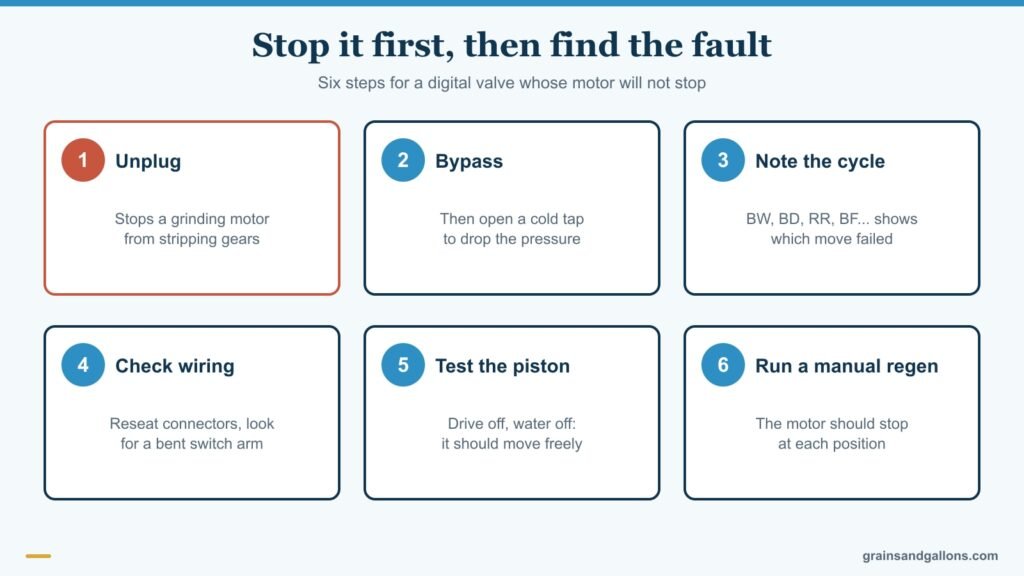
- Unplug the transformer. A motor grinding against a stuck piston can strip its own gears.
- Put the softener in bypass and open a cold tap until the pressure drops.
- Note where it stopped. Many digital displays show the cycle name (BW, BD, RR, BF and so on), which tells you which move failed. Our guide to a softener stuck on one cycle position explains what each stuck position points to.
- Look for the obvious. A connector backed out, a pinched wire, a bent cam switch arm. Push connectors home.
- Check whether the piston moves freely. With the drive removed and the water off, the piston (or main gear) should move without a fight. If it binds, it needs cleaning or a new piston and seal kit.
- Plug it back in and run a manual regeneration. If the motor stops at each position, you're likely fixed.
If the opposite happens and the motor won't start at all, see our guide to a softener motor not turning. For how the piston, seals and drive fit together, see how a softener control valve works.
Hearing water instead of a motor?
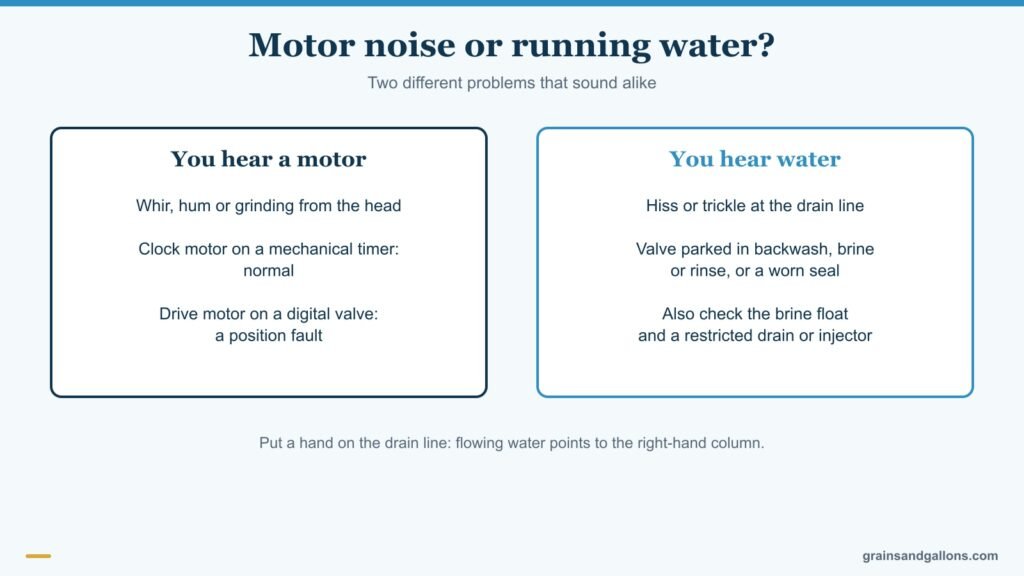
Plenty of people searching for this actually hear water, not a motor. If there's a steady trickle or hiss to the drain long after regeneration should be over, the valve is probably parked in a backwash, brine or rinse position, or a worn seal is letting water through internally. Pentair's chart lists "drain flows continuously" separately and points to a powerhead that isn't completing the regeneration cycle.
Put your hand on the drain line. If it's flowing, start with our guide to brine or water draining constantly. A brine tank that keeps filling or overflowing points to the float instead; see brine tank float stuck.
Timer, powerhead or a new head?
On a mechanical valve where the timer itself is failing (it loses time, cycles at random, or keeps advancing), the fix is a new timer. On a digital valve, Pentair's own answer for a switch fault is the switch, the timer or the complete powerhead. Whole timer assemblies aren't cheap, and on a valve that's 15 or 20 years old, a modern digital head may make more sense. Our list of the best replacement control valves covers heads that fit standard tank threads. If you're replacing the whole unit, our Aquasure Harmony vs Fleck 5600SXT comparison lays out the trade-offs.
Electrical caution: if the transformer is hot to the touch, smells burnt, or the outlet is discolored, leave it unplugged and have the outlet checked by an electrician before you power the softener again.
FAQ
Is it normal for a water softener motor to run all the time?
On a mechanical timer, yes. The small timer motor turns the 24-hour clock continuously. On a digital valve, no: the drive motor should run only briefly at each cycle change.
How long should a softener motor run during regeneration?
On digital valves, each move between positions takes seconds to a few minutes. Fleck's 5600SXT flags Err 0 if the drive takes longer than 6 minutes to reach the next position, so anything near that is a fault.
Can a bad cam switch make the motor run nonstop?
Yes. Pentair lists a misadjusted, broken or shorted switch as the cause of "control cycles continuously" on the 5600SXT. Check the switch and its wiring before replacing the motor.
Should I unplug a softener whose motor won't stop?
Yes. Unplug it to protect the gears, then put the softener in bypass so you still have water while you troubleshoot.
Why does my softener keep running water to the drain?
That's usually a valve stuck in a regeneration position or a worn internal seal, not a motor problem. Check the cycle shown on the display and feel the drain line.
A motor that never rests is lost, not broken
A water softener motor running constantly is fine if it's the clock motor on a mechanical timer. On a digital valve it means the control can't find the piston, so check the position switch or sensor, the wiring and the piston before you buy a motor. Most of those checks cost nothing but a few minutes with the unit unplugged.