

Quick Answer: A water softener bypass valve leaking is almost always a dried-out or flattened O-ring, either on the handle stem or where the bypass plugs into the softener valve. Shut off the water at the main, relieve pressure at a faucet, pull the bypass, and replace the O-rings with a light coat of silicone grease such as Molykote 111. Never use petroleum jelly. If the bypass body itself is cracked, replace the whole valve.
Disclosure: As an Amazon Associate, Grains & Gallons earns from qualifying purchases.
A water softener bypass valve leaking usually announces itself as a wet spot under the softener, a drip hanging off the bypass, or some white crust where water has been evaporating for weeks. The good news: there are only four places it can come from, and each has a different, mostly cheap fix. Find the right one first and you won't replace parts you didn't need to.
In this guide
Find the drip with the paper towel test

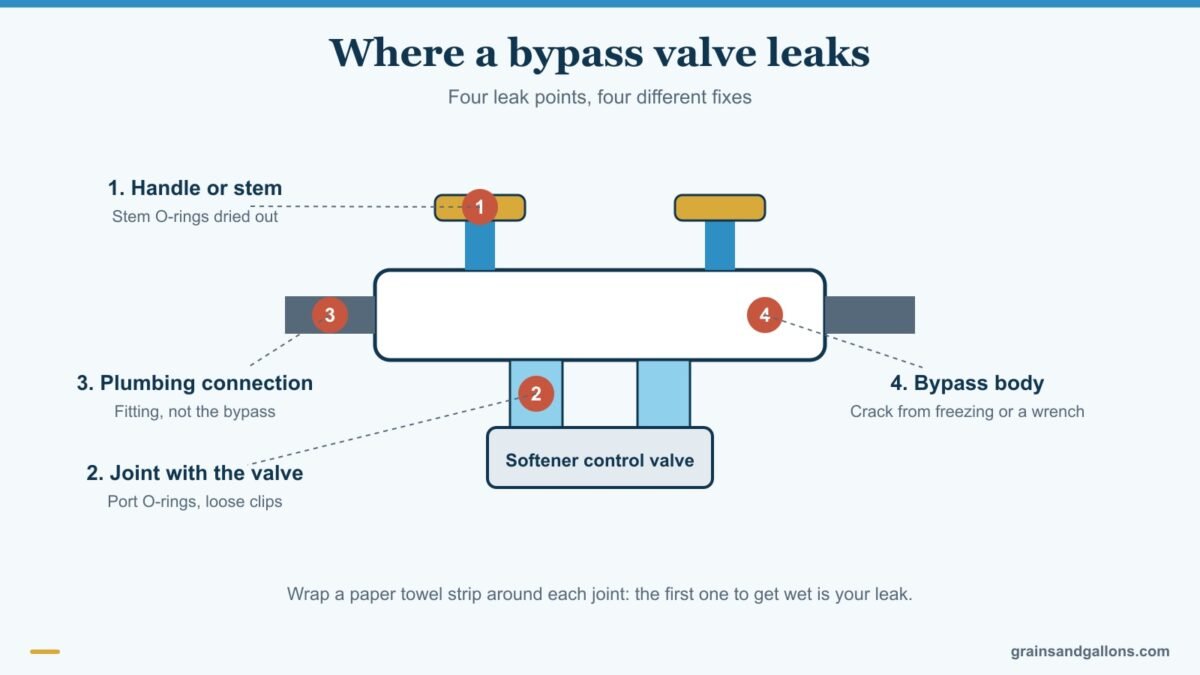
Before you take anything apart, dry the whole area with a towel. Wrap a strip of paper towel around each joint: the handle or knob, the seam where the bypass meets the control valve, and both plumbing connections. Wait 10 to 20 minutes. The strip that gets wet first tells you which leak point you're dealing with.
Two tips make the test more reliable:
- Check the area above, too. Water runs downhill. A drip at the bypass can start higher up, at the control valve or a fitting on the pipe above it. If the strip on top of the bypass gets wet, look higher; our guide to a softener leaking from the top covers the valve itself.
- Turn the handle once. Some stem leaks only show up right after the bypass has been moved. Switch to bypass and back to service, then watch.
Four places a bypass valve leaks
1. Around the handle or knob
What you'll see: water beading where the handle or push-button stem enters the bypass body, often worse right after someone turns it.
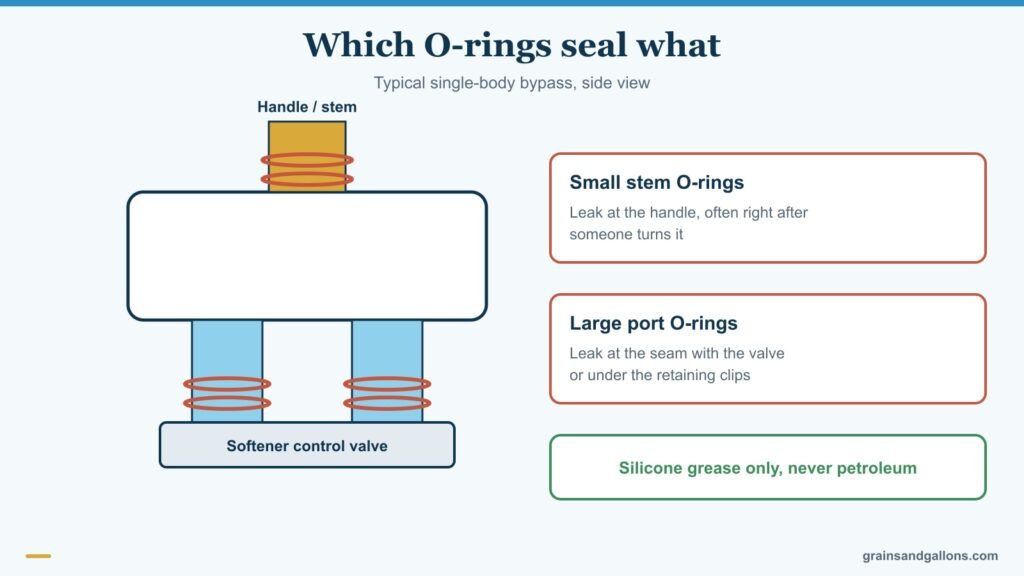
Why: the stem is sealed by one or two small O-rings. They dry out, especially on a bypass nobody has turned in years, and turning it suddenly scrapes the hardened rubber.
Fix: on most single-body plastic bypasses (Whirlpool, GE, Kenmore, Morton and similar), the stem and its O-rings come out after you remove a retaining clip or cap. On Fleck and Clack bypasses, the rotor or stem assembly comes out of the body the same way; Clack's WS1 parts list, for example, shows each rotor with its own O-rings and seal retainer. Replace the O-rings with exact-size matches from the manufacturer's parts list, coat them lightly with silicone grease and reassemble. Whirlpool's own manual tells installers to put a light coating of silicone grease on the bypass O-rings, which is a good hint that dry rubber is a known failure (Whirlpool softener manual).
2. Where the bypass joins the softener valve
What you'll see: water at the seam between the bypass and the control valve body, or seeping from under the retaining clips.
Why: the bypass ports slide into the valve with large O-rings and are held by clips or a clamp. If the clips weren't fully seated, or the plumbing is pulling the bypass sideways, the O-rings lose their seal. Hard plumbing that's slightly out of line is the classic cause.
Fix: replace the large port O-rings, push the bypass fully home and seat the clips completely. Whirlpool's instructions say to push the bypass in as far as it will go and snap both holding clips in from the top down. Then look at what's holding the bypass in place, which the "keeps coming back" section below covers.
3. At the plumbing connections
What you'll see: the drip starts at the threaded or push-fit fitting where your house pipes connect to the bypass, not at the bypass itself.
Why: loose compression nuts, a push-fit fitting not fully inserted, worn washers in a flexible connector, or threads sealed with too little (or the wrong) sealant.
Fix: this is a plumbing fitting problem, not a bypass problem. Tighten or redo the connection. Don't overtighten plastic threads; they crack. Clack's manual says not to use pipe dope or other sealants on its plastic threads and to use Teflon tape instead. If the leak is at a PEX or push-fit connection, see our guide on PEX connections leaking at the softener.
4. From the bypass body itself
What you'll see: a hairline crack, water weeping from the middle of the plastic, or a slow drip that doesn't track with any joint.
Why: freezing, overtightened fittings or a pipe wrench used on the plastic body.
Fix: you can't seal a cracked bypass reliably. Replace it. Many brands share a bypass design, so the part is usually easy to find: a bypass valve kit sold as a direct replacement for 7129871 and 7370286 (also cross-referenced to GE's WS15X10012) fits many Kenmore, GE and other Ecowater-family standard-size units and comes with new O-rings, washers and seal tape, and Fleck 5600 and 2510 valves take the Fleck 60049 plastic bypass. Confirm your model number before ordering. Our roundup of the best water softener bypass valves groups them by which control valve they fit.
The leak you can't see: hard water slipping through
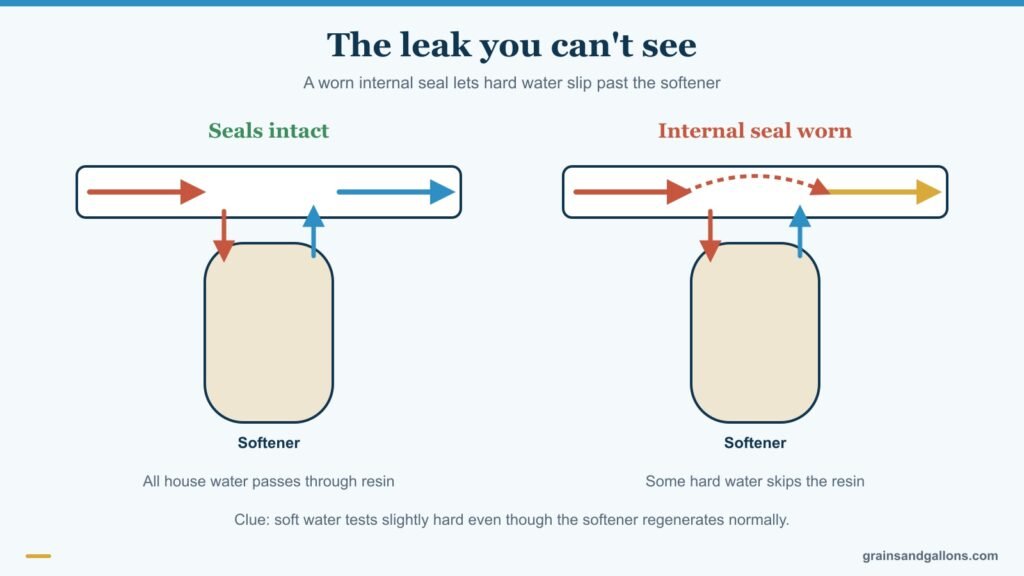
Not every bypass leak drips. The internal seals that separate the "in" and "out" sides can wear too, and then a little untreated water slips straight from inlet to outlet without passing through the resin. Nothing hits the floor, but your soft water isn't fully soft.
The clues:
- A hardness test at a tap shows a few grains even though the softener regenerates on schedule and uses salt normally.
- Spots and scale creep back slowly, not suddenly.
- The problem doesn't change after you clean the injector or check the brine tank.
To check, test your water hardness at a cold tap with the bypass in service, then compare with raw water from an outside spigot that's plumbed before the softener. If the "soft" result isn't near zero and the softener itself checks out, rebuild or replace the bypass. Cycling it between bypass and service a few times sometimes reseats a sticky seal, but it won't fix a worn one.
Replacing bypass O-rings, step by step
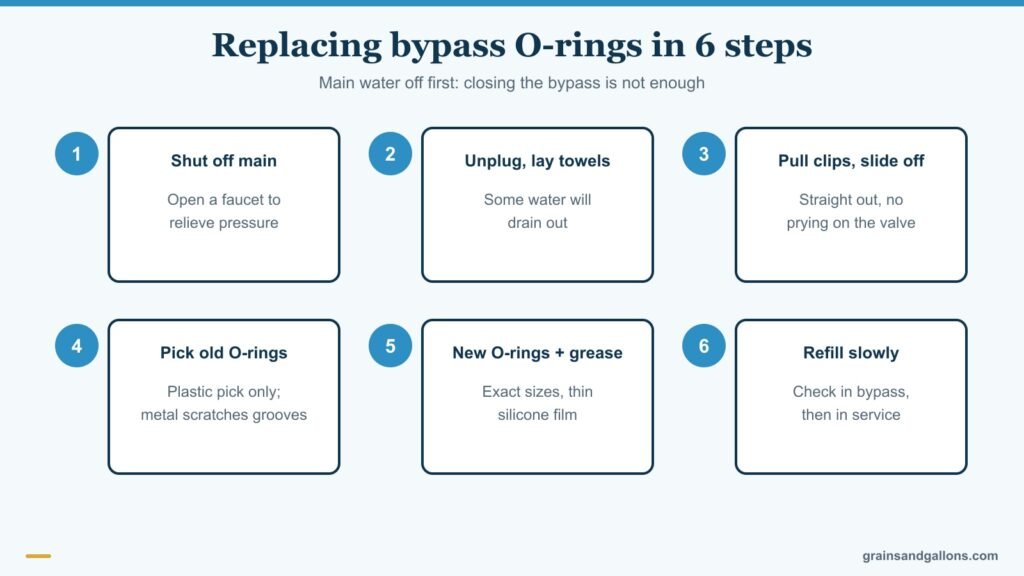
- Shut off the main water supply and open a faucet downstream to relieve pressure. Closing the bypass alone isn't enough, since the bypass is the part you're opening.
- Unplug the softener if you'll be removing the bypass from the control valve.
- Put a towel and a shallow pan down. Some water will drain out.
- Remove the clips or clamp and pull the bypass straight off. Wiggle gently; don't pry against the valve body.
- Pick out the old O-rings with a plastic pick or a toothpick. A metal screwdriver can scratch the groove and create a new leak path.
- Wipe the grooves and ports clean and look for scratches, cracks or crusted minerals.
- Fit new O-rings with a thin film of silicone grease. Clack's service manual is blunt about it: use only silicone-based lubricants, because hydrocarbons such as petroleum jelly or WD-40 damage O-rings and plastic and can cause leaks or breakage (Clack WS1 service manual). Check the product label for drinking-water suitability.
- Push the bypass back on squarely and seat every clip.
- Turn the water back on slowly with the bypass in bypass position first, check for drips, then switch to service and check again.
Bring the old O-rings to the store or match them against the parts list. On the Clack WS1 bypass alone, the connection O-ring and the two rotor O-rings are three different sizes.
Why a bypass leak keeps coming back
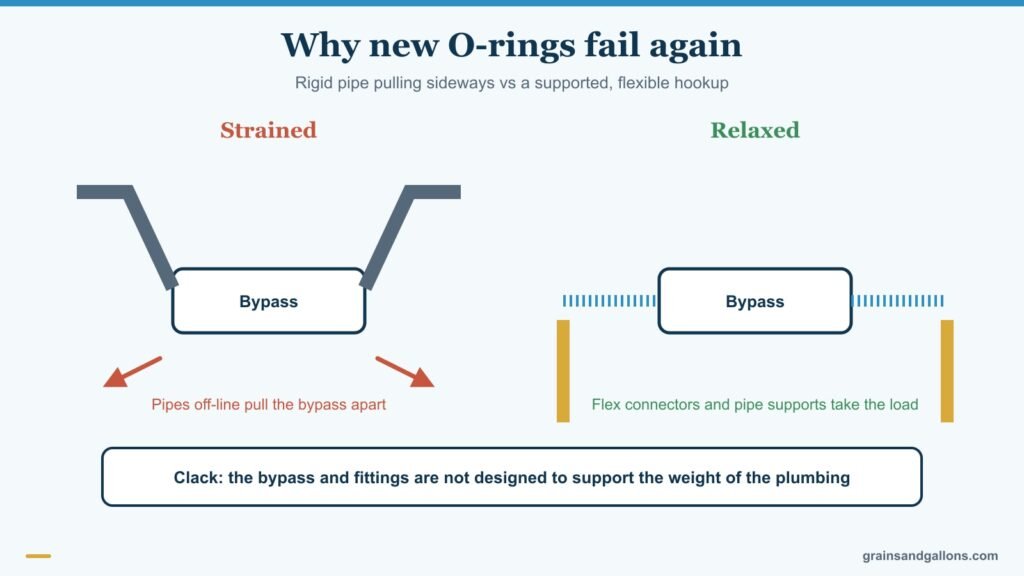
- Pipe strain. Clack states that its control valve, fittings and bypass can take minor misalignment but aren't designed to support the weight of the system or the plumbing. If rigid pipe is forcing the bypass at an angle, new O-rings will fail again. Support the pipes and add flex connectors; our picks for flexible connectors for water softeners cover the common sizes.
- Pressure spikes. High static pressure, or spikes at night when demand is low, push on every seal. Whirlpool's manual notes that if daytime pressure is above 80 psi, nighttime pressure may exceed the 125 psi maximum. A pressure regulator helps if your gauge reads high.
- The wrong O-rings. "Close enough" sizes from a variety kit often seal for a week and then seep. Get the exact part numbers from your valve's parts list.
- The wrong lubricant. Petroleum jelly swells many rubber compounds. A seal that leaked again a month after a repair may have been greased with the wrong product.
- A bypass that's never turned. Turning a bypass a couple of times a year keeps the seals from setting. If yours won't move at all, see what to do when a bypass valve is stuck before forcing it.
Rebuild the bypass or buy a new one?
O-rings and clips are the cheapest fix and solve most leaks. Replace the whole bypass instead when:
- The body is cracked or a port is chipped.
- The clip slots are broken, so the clips won't hold.
- The handle or rotor is worn enough that it wobbles or won't hold a position.
- The internal seals are leaking and your bypass design doesn't sell them separately.
- You've replaced the O-rings twice and it still leaks with the plumbing properly supported.
While it's apart, consider whether the plumbing around it is right. Our walkthrough on installing a water softener bypass valve covers orientation, support and the in/out direction. For leaks at other seals on the control valve, our guide to water softener O-ring leaks shows which O-ring sits where.
If water is spraying rather than dripping, or the leak is near anything electrical, shut off the main first and call a plumber if you can't stop it quickly.
FAQ
Can I use Vaseline on water softener O-rings?
No. Petroleum jelly and other hydrocarbon lubricants damage the O-rings and plastic used in softener valves. Clack's manual specifically warns against Vaseline and WD-40. Use a silicone grease meant for plumbing O-rings.
Is it safe to run a softener with a leaking bypass?
A slow drip isn't an emergency, but it won't fix itself and can damage flooring or the cabinet underneath. Put a pan under it and repair it soon. If it's spraying or getting worse, shut off the main.
Why does my bypass leak only when I turn it?
Turning the handle moves the stem against its O-rings. If they're dry or hardened, they scrape and lose their seal as the stem moves. New stem O-rings with a thin film of silicone grease usually cure it.
Do I need to turn off the main water to fix a bypass leak?
Yes. Putting the softener in bypass doesn't isolate the bypass itself, because water still fills its body. Shut off the main and open a faucet to relieve pressure before removing anything.
Can a leaking bypass make my water hard?
Yes, if the leak is internal. A worn seal between the inlet and outlet sides lets some untreated water skip the resin. Compare a hardness test at a tap with raw water to confirm.
A water softener bypass valve leaking is usually a $5 fix
Most cases of a water softener bypass valve leaking come down to an O-ring at the handle or at the joint with the control valve. Find the drip with the paper towel test, shut off the main, fit exact-size O-rings with silicone grease, and seat the clips fully. If the plumbing is straining the bypass, fix that too or the leak returns. Replace the whole bypass only when the body is cracked, the clip slots are broken or the internal seals are letting hard water through.