

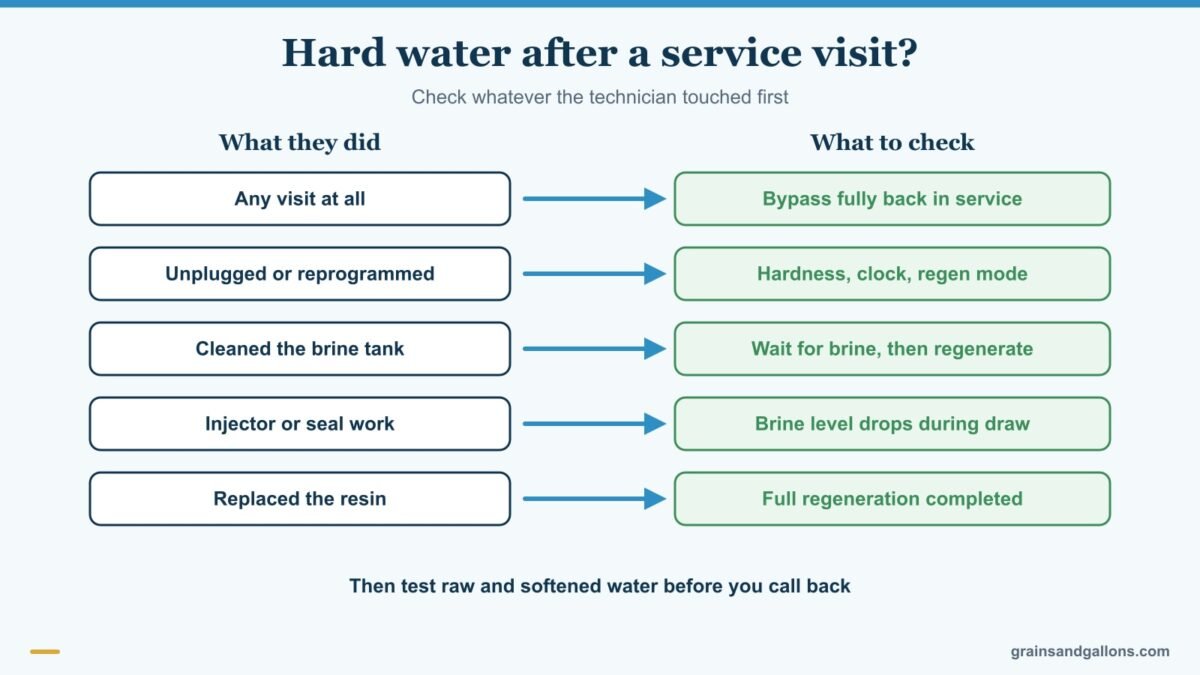
Quick Answer: Water hard after softener service almost always traces back to something touched during the visit. Check the bypass valve first, since it's often left in bypass or only partly turned back. Then confirm the settings weren't reset, give a freshly cleaned brine tank a few hours to make brine, and run a manual regeneration. Confirm with a strip test such as Varify hardness strips.
Disclosure: As an Amazon Associate, Grains & Gallons earns from qualifying purchases.
Finding your water hard after softener service is frustrating. The van left this morning, and by dinner the shower feels squeaky and the kettle has spots again. There's an upside, though: a fresh problem right after a visit almost always comes from something that was handled during it. You don't need to diagnose the whole softener, only the parts the technician had their hands on.
Find the service ticket or ask what was done, then match it below. If your softener is brand new rather than freshly serviced, see water still hard after installing a softener instead.
In this guide
- Water hard after softener service? Start at the bypass
- Settings that vanish when the valve loses power
- A freshly cleaned brine tank needs time to make brine
- Injector, seals and other small parts inside the valve
- Your water heater still holds the hard water
- Test raw and softened water before you call back
- FAQ
- Retrace the visit, then make the callback count
Water hard after softener service? Start at the bypass
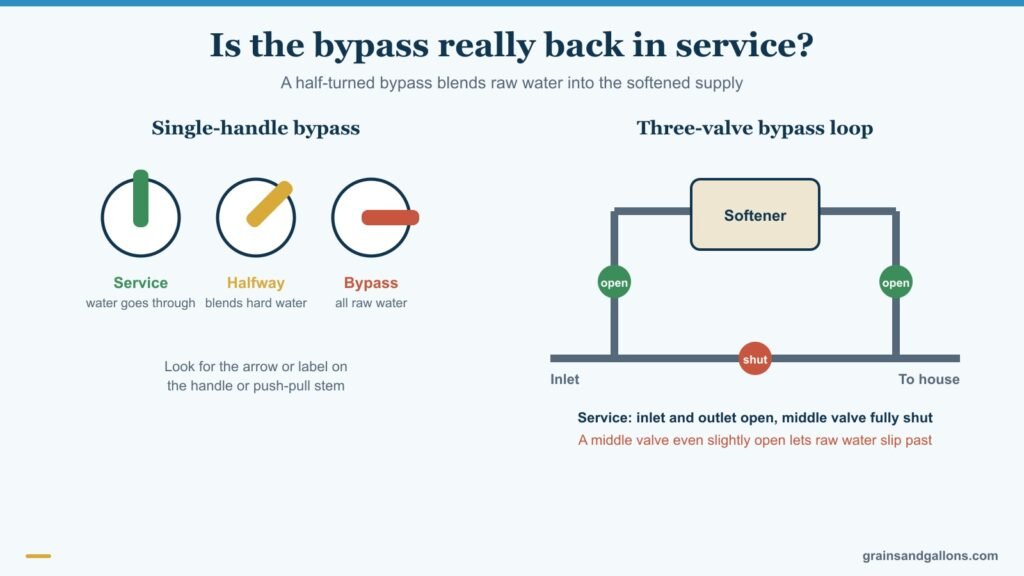
Nearly every service starts by putting the softener in bypass so the house keeps water while the valve is open. The last step is putting it back. When that step gets missed, or the handle stops partway, hard water flows around the softener. The Fleck 5600SXT service manual lists an open bypass valve as the first cause in its "hard water" troubleshooting row.
How to check:
- Single-handle or knob bypass: Find it on the back of the control valve or on the pipes beside it. There's usually an arrow or a "service" and "bypass" label. Make sure it's fully in service, not halfway. A partly open bypass blends hard water with soft, so the water is "kind of hard," which is easy to miss.
- Push-pull bypass: The stem or button should be pushed fully to the service side.
- Three-valve loop: In service, the inlet and outlet valves are open and the middle valve between them is fully closed. If the middle one is even slightly open, raw water slips past.
A bypass handle that's stiff or won't seat fully is worth replacing. Our roundup of water softener bypass valves covers the common styles.
Settings that vanish when the valve loses power
Settings disappear for a few reasons: the valve was unplugged long enough to drain its backup, a circuit board was swapped, or someone stepped through the menu and changed a value. Scroll through the menu (your manual shows how) and check:
- Hardness setting. If it's set lower than your real hardness, the softener thinks it has more capacity than it does and runs out between regenerations. See how to set hardness on a water softener.
- Time of day. A wrong clock means regenerations at midday instead of 2 a.m., which puts raw water in the lines while people are using it. Fleck's manual lists a power failure, with the fix "reset time of day," among the causes of a softener that fails to regenerate.
- Regeneration mode. Metered, timed, or a day override that's now blank.
- Salt dose or capacity, if your valve lets you set them.
If you can't find your settings, ask the service company to read back what they entered. A lot of callbacks get settled on the phone this way.
A freshly cleaned brine tank needs time to make brine

A clean brine tank is a good thing, but it resets the brine. Penn State Extension's overview of water softening notes that the brine solution must be mixed and stored in the brine tank before regeneration can push the hardness off the resin. Fresh salt in fresh water takes time to dissolve. If the softener regenerates an hour after the tank was refilled, it draws weak brine and the resin barely recharges: soft water for a day, then hard.
The fix:
- Make sure water covers the bottom few inches of salt.
- Wait a few hours, overnight if you can.
- Run a manual regeneration. Our guide to manually regenerating a softener covers the button sequences for common valves.
While you're at the tank, confirm the brine line got reattached at the brine well and at the valve; lines get knocked loose when tanks are lifted and scrubbed. And if salt was topped up instead of cleaned out, push a broom handle down through it. A hard crust with a hollow underneath is a salt bridge: the salt never touches the water, so no brine forms. Fleck's manual lists "no salt in brine tank" and "insufficient water flowing into brine tank" as hard-water causes too.
Injector, seals and other small parts inside the valve
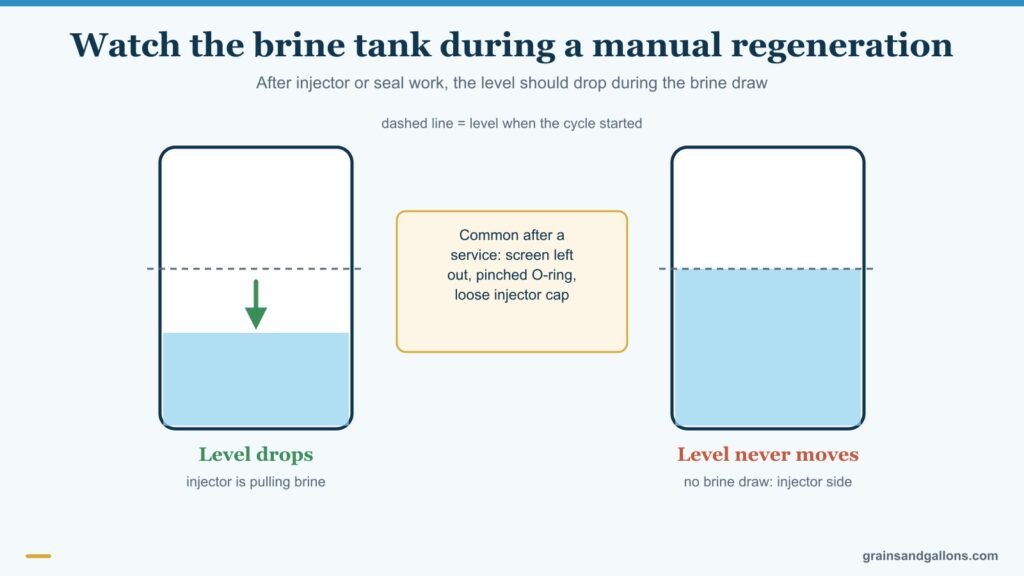
Injector and seal work involves small parts, and it's easy to:
- Leave out the injector screen or reinstall it the wrong way.
- Pinch an O-ring so the valve leaks internally, letting hard water past.
- Seat the injector cap loosely, so the injector sucks air instead of brine.
The usual symptom is a regeneration that runs but uses no brine. Start a manual regeneration and watch the brine tank. During the brine draw, the water level should drop. If it doesn't move at all, the injector side is the suspect; a plugged injector screen is on Fleck's hard-water list as well. Our guide to cleaning a softener injector shows how to check it. If the technician just worked on it, though, this is their callback to handle.
New resin and a softener that lost prime
New resin needs to be rinsed, backwashed and fully regenerated before it softens properly, and some resin ships in a form that won't soften until it has seen brine. Our guide to hard water after replacing resin explains what should happen in those first cycles. If pressure dropped, faucets spit air or the brine tank isn't refilling, the system may have lost prime after being drained and refilled; see softener lost prime after maintenance.
Your water heater still holds the hard water

Here's the one most guides miss. If the softener sat in bypass or ran out of capacity for a day or two, your water heater filled up with hard water. Fix the softener and the cold taps go soft right away, but the hot taps keep delivering that stored hard water until the tank turns over. Fleck's manual lists "hot water tank hardness" as a hard-water cause, with repeated flushing of the hot water tank as the fix.
So test a cold tap first. If cold reads soft and hot still reads hard, give it a day of normal use, or flush the water heater following its manual. It's not a sign the service failed.
Test raw and softened water before you call back
Spots on glasses and soap that won't rinse are clues, but numbers settle it. A water hardness test kit takes a minute. Test:
- A cold tap after the softener, after running it for five minutes.
- Raw water, from an outside spigot or a tap before the softener (on many homes the outdoor hose bibs bypass the softener).
Well-softened water reads close to zero, and many dealers aim for 0–2 grains per gallon. How to read the two results:
- Both the same: nothing is being softened. Suspect the bypass, a failed brine draw, or resin that hasn't been regenerated.
- Softened tap lower but still hard: partial bypass, weak brine, a hardness setting that's too low, or an internal leak past a seal.
- Cold soft, hot hard: the water heater is still flushing out.
Write down the numbers and when you tested. "It was 0 grains before your visit and 14 grains the next day" is a much easier conversation than "it feels hard."
FAQ
How long after service should my water be soft again?
Cold water should be soft as soon as the softener is back in service and has completed a regeneration with proper brine. If the brine tank was cleaned, allow a few hours for brine to form plus one regeneration. Hot taps can take longer while the water heater turns over.
Why is my softener using salt but the water is still hard?
Check the bypass and the hardness setting first. If both are right, the brine may be reaching the resin weakly, or an internal seal leak may be letting raw water past. A hardness test of raw versus softened water narrows it down.
Can a technician reset my softener settings by accident?
Yes. Unplugging the valve for a long time, swapping a board, or stepping through the programming menu can change the clock, hardness or regeneration mode. Scroll through the settings and compare them with your water test.
Should I run a manual regeneration after service?
It's a good idea once the brine tank has had a few hours to make brine. It recharges the resin and gives you a chance to watch the brine draw.
When should I call the service company back?
Call when the bypass and settings are right, the brine has had time to form, a manual regeneration still doesn't help, and your test shows hard water at a cold tap. Also call about any new leak, new noise, or a brine level that never drops after injector work.
Retrace the visit, then make the callback count
Water hard after softener service is usually one of five things: a bypass left open, lost settings, weak brine after a cleaning, an injector or seal problem, or resin that hasn't been fully regenerated. Check them in that order, give hot taps time to clear, and test both raw and softened water. If everything checks out and a cold tap still reads hard, call the dealer with your numbers. Most reputable dealers stand behind their work, and asking them to show you what they replaced (and keeping the old parts) helps if you ever need a second opinion.