

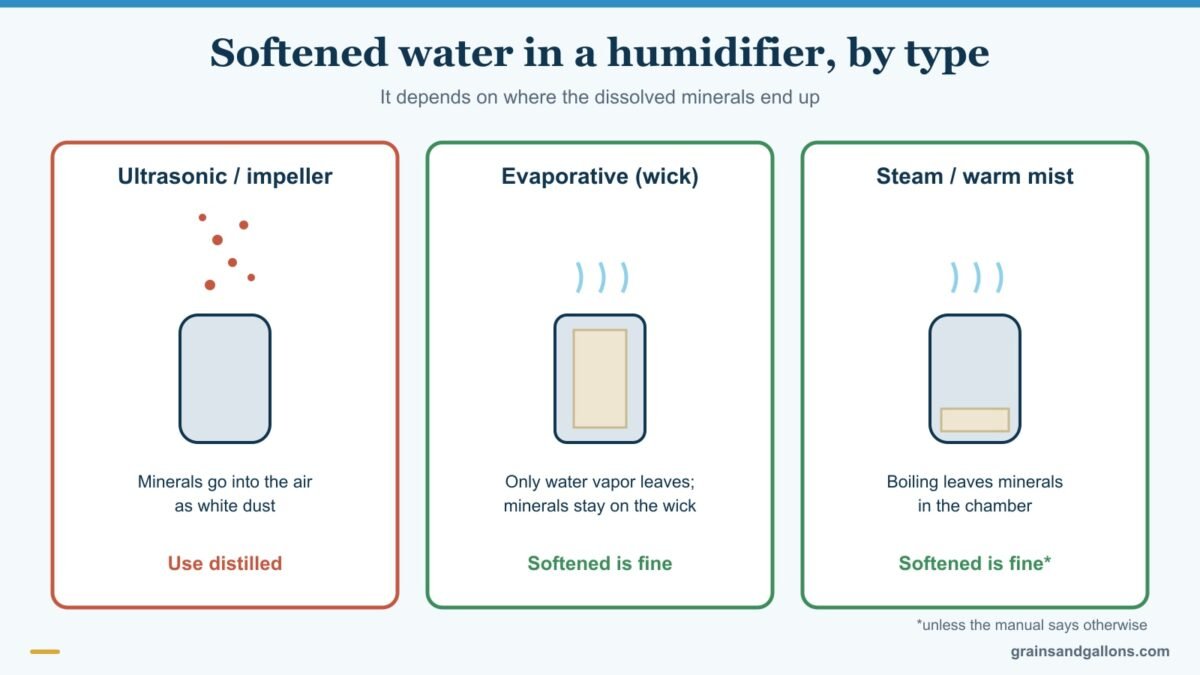
Quick Answer: Should a humidifier use softened water? Not an ultrasonic or impeller (cool mist) humidifier. A softener swaps calcium and magnesium for sodium but doesn't remove the minerals, so an ultrasonic unit still throws white dust. Use distilled water there, as the EPA recommends. In evaporative and steam humidifiers, softened water is generally fine and means less crusty scale. Check your manual, since some models specify the water to use.
The softener's been in for a month, the kettle's finally clean, and you figure the humidifier on the nightstand will stop leaving that gray film on the dresser. A week later the film is still there. Whether a humidifier should use softened water comes down to one thing: what the machine does with the minerals dissolved in it.
In this guide
Softening swaps minerals; it doesn't take them out
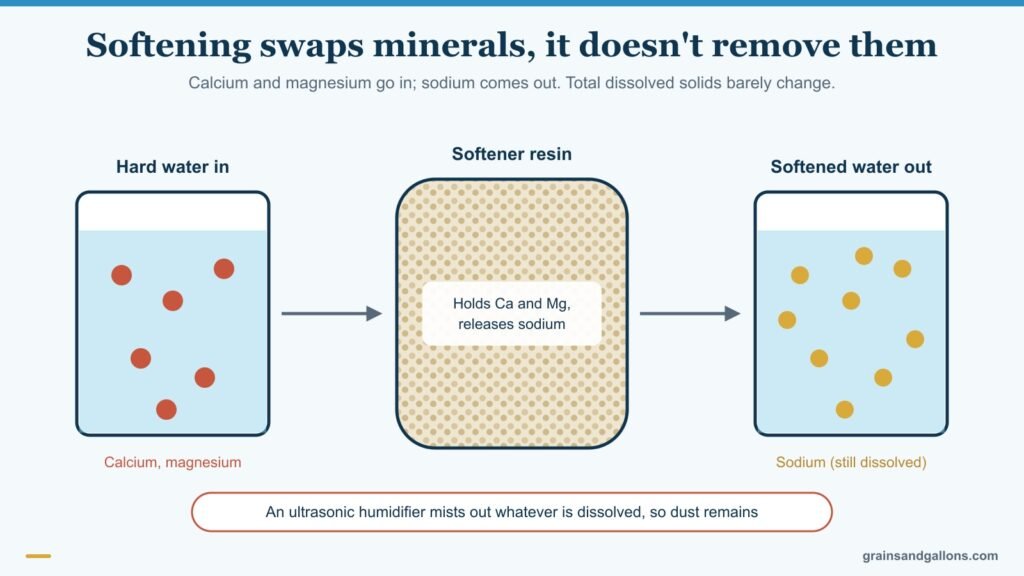
An ion-exchange softener removes hardness by trading it. Each calcium or magnesium ion that sticks to the resin is replaced with sodium (or potassium, with potassium chloride). The water comes out with roughly the same amount of dissolved material, just a different mix, which is why a TDS meter barely moves after a softener. We list everything else that passes through in what a water softener does not remove.
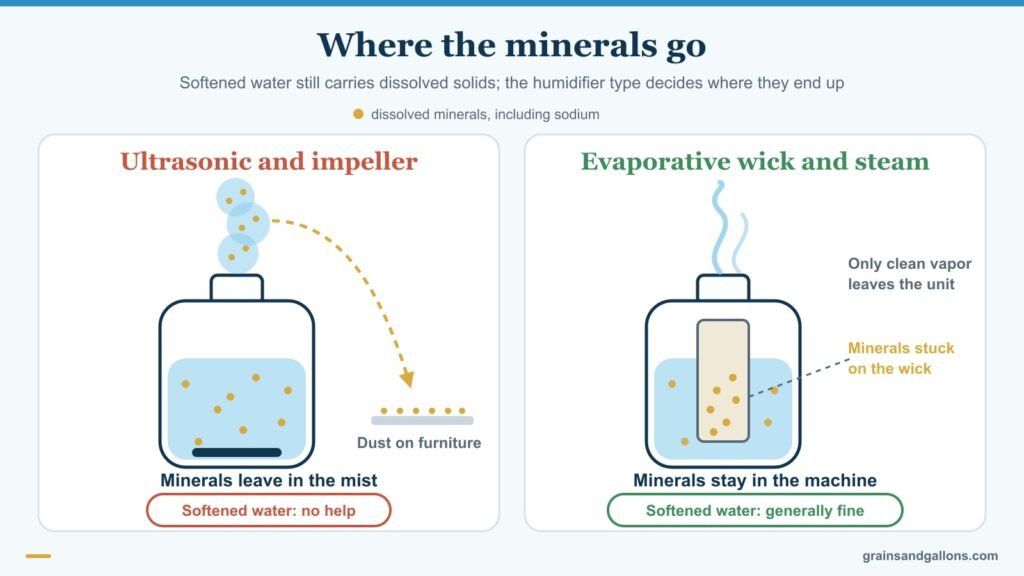
So for any humidifier, ask where the dissolved minerals go. If they stay in the machine, softened water helps by making the residue softer. If they go into the air, it doesn't.
Should a humidifier use softened water? Check the type first
| Type | Where dissolved minerals go | Softened water? |
|---|---|---|
| Ultrasonic (cool mist) | Into the air in the mist, then dry as dust | No. Still white dust. Use distilled. |
| Impeller (spinning disc) | Flung into the air like ultrasonic | No. Use distilled. |
| Evaporative (wick + fan) | Left on the wick; only vapor leaves | Generally fine; less crust on the wick |
| Steam / warm mist | Left in the boiling chamber | Generally fine; softer scale |
| Whole-house (furnace) | Depends on pad or steam design | Check the installation manual |
Ultrasonic and impeller units
These break water into tiny droplets instead of evaporating it. Each droplet carries its share of minerals, and when it dries the mineral floats as a particle. The EPA's guide to the use and care of home humidifiers says ultrasonic and impeller humidifiers are very efficient at dispersing minerals in tap water into the air, and recommends low-mineral water such as distilled. With softened water the dust is mostly sodium salts instead of calcium and magnesium carbonate, but it's still dust. Our explainer on humidifier white dust covers what it is.
Evaporative units
A fan pushes air through a wet wick; water evaporates and minerals stay behind. Hard water slowly turns the wick into a stiff, crusty slab. Softened water leaves sodium salts that tend to stay more soluble, so wicks often rinse cleaner and last longer. There's no white dust either way, because the minerals never leave the machine.
Steam and warm mist units
Boiling leaves minerals in the chamber. Hard water forms rock-hard scale; softened water tends to leave a looser residue. Some electrode-type vaporizers rely on dissolved minerals to conduct current. Softened water still carries plenty, so it behaves much like tap, but follow the manual if it gives water instructions.
Whole-house furnace humidifiers
A bypass or fan-powered pad unit handles softened water like a portable evaporative. Steam canister units may have their own water-quality rules. On commercial steam systems, softening is standard practice: a Deppmann humidification guide calls it a minimum strategy and says it can stretch maintenance from yearly to every three years. Check your unit's installation manual before tapping a softened line.
What to put in an ultrasonic tank instead
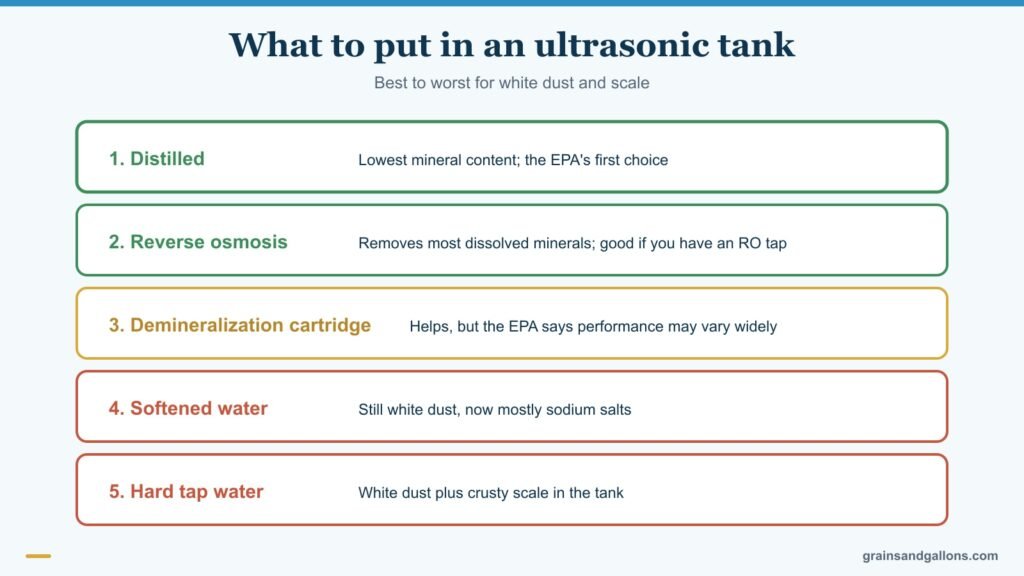
Distilled water is the EPA's first choice, and the EPA notes that in hard-water areas distilled water may cost less than demineralization cartridges.
Reverse osmosis water removes most dissolved minerals, so it's a reasonable option if you already have an RO faucet.
Demineralization cartridges help, but the EPA says their performance "may vary widely." Our list of humidifier demineralization cartridges covers common fits, and if dust returns, see demineralization cartridge not working.
Bypassing the softener doesn't help an ultrasonic unit; hard water makes the same dust problem with calcium instead of sodium, plus more scale.
Distilled for ultrasonic, softened is fine for wicks and steam
So, should a humidifier use softened water? For evaporative and steam models, yes, it's a sensible choice that cuts scale. For ultrasonic and impeller models, no; use distilled. If you're shopping and have hard or softened water, an evaporative model avoids the dust issue entirely, which is why our humidifiers for hard water lean that way.
Whatever water you use, keep the unit clean. The EPA suggests emptying, drying and refilling portable humidifiers daily and cleaning them every third day, because standing water grows microorganisms regardless of softening.
FAQ
Can I put softened water in an ultrasonic humidifier?
You can, but it won't stop white dust. The softener replaces calcium and magnesium with sodium, and the ultrasonic unit mists that sodium into the air. Distilled water is the better choice.
Is softened water better than tap water for a humidifier?
For evaporative and steam humidifiers, often yes: it leaves softer, easier-to-rinse residue. For ultrasonic units, neither is good; both leave dust.
Is the sodium dust from softened water harmful?
The sodium is tiny compared with what you eat, but adding fine particles of any kind to indoor air isn't ideal. That's the main reason to use distilled water in ultrasonic units.
Can I use RO water in a humidifier?
Yes. Reverse osmosis removes most dissolved minerals, so it greatly reduces white dust in ultrasonic units and scale in all types.