


Quick Answer: A humidifier demineralization cartridge not working is almost always a spent cartridge. It holds a fixed amount of mineral-grabbing resin, hard water fills that resin in weeks rather than months, and after that minerals pass straight through. Replace it on a schedule set by your water hardness, and if dust returns quickly every time, use distilled water or an evaporative humidifier instead.
If your humidifier demineralization cartridge is not working after a few weeks, it probably didn't break. It worked for a while, and now the white film is back. Cartridges run out, and how they run out explains every fix below.
In this guide
- Inside the cartridge: resin that fills up and never resets
- Is your humidifier demineralization cartridge not working, or just spent?
- How water hardness shortens cartridge life
- Setup mistakes that let minerals slip past
- Run the two-day distilled water test, then pick a fix
- FAQ
- Treat the cartridge as a consumable, not a cure
Inside the cartridge: resin that fills up and never resets
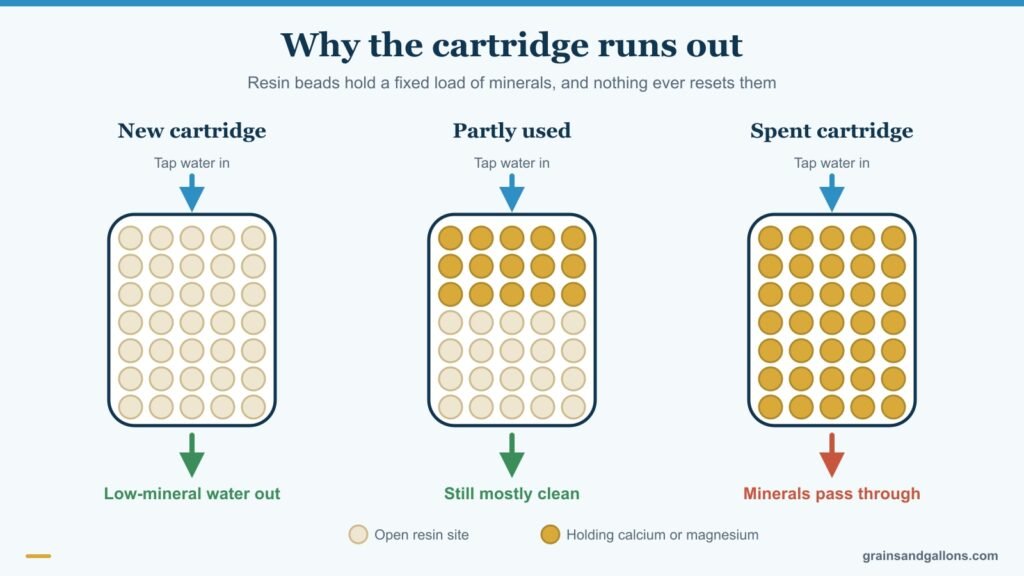
Most humidifier cartridges are filled with ion exchange resin, the same basic idea as a water softener without the salt tank. Many use a mixed-bed resin: one part grabs calcium, magnesium and other positively charged minerals and releases hydrogen ions, another swaps negatively charged ions such as chloride and sulfate for hydroxide. The hydrogen and hydroxide combine into plain water.
Once every site on the beads is occupied, the resin stops removing anything. A water softener flushes its resin with brine and starts over; a humidifier cartridge can't be regenerated at home and simply gets thrown away. How much water it treats before that point depends almost entirely on your water hardness.
Is your humidifier demineralization cartridge not working, or just spent?

- White dust is back on dark furniture, the TV screen or the floor around the unit.
- Scale in the tank or on the transducer is building faster than it did when the cartridge was new.
- The resin changed color. Some cartridges use color-indicating resin that shifts (often from dark to yellowish) when saturated. Check your packaging.
- You've passed the rated life. Crane, for example, suggests replacing its cartridge every 1 to 2 months or 30 to 40 reservoir fillings; Hunker's guide notes that dust returning before about 30 refills points to very mineral-heavy water.
How water hardness shortens cartridge life
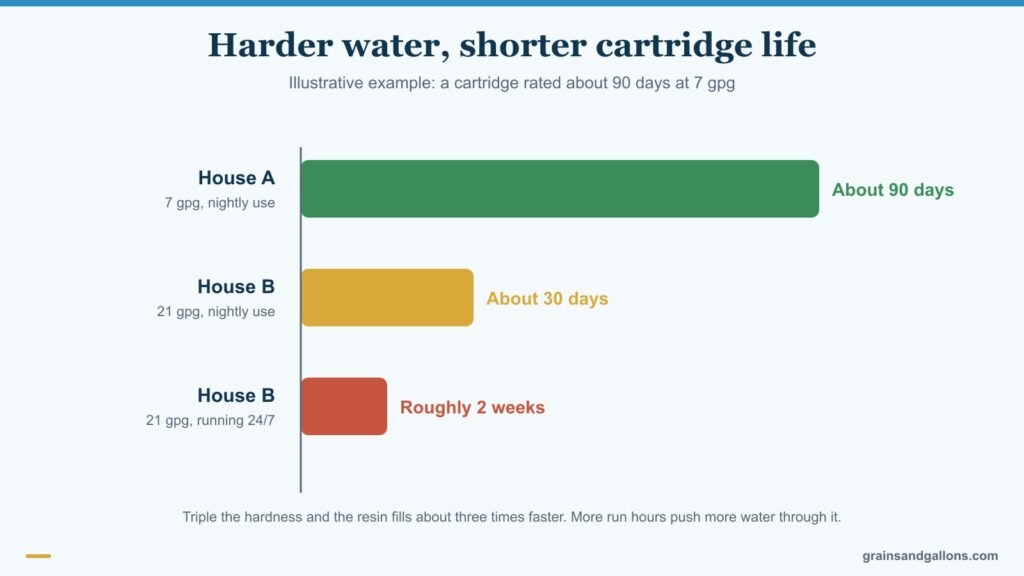
Manufacturers describe cartridge life in time ("up to 3 months") or fillings, at some assumed hardness. Say your packaging promises about 90 days at moderate hardness, roughly 7 grains per gallon (gpg). In a house with 21 gpg water, three times harder, the same cartridge lasts about 30 days. Run that humidifier around the clock instead of only at night and it's spent in roughly two weeks.
The numbers are illustrative; the logic isn't. Triple the hardness and the resin fills three times faster; double the run hours and you push twice the water through it. That's why some reviewers call cartridges unreliable once water goes much past 7 to 10 gpg. If you don't know your number, test your water hardness at home before buying more cartridges.
Setup mistakes that let minerals slip past
It wasn't soaked. Many cartridges need a soak (often about 10 minutes) before first use so the resin is fully wetted. Dry pockets let water channel around the beads.
It's out of the flow path. A cartridge floating loose in a corner, instead of in its slot near the water intake, treats very little of the water.
It's the wrong part. Match the cartridge to your exact humidifier model, not just the brand.
Your humidifier type doesn't need one. Cartridges are made for ultrasonic and impeller units, the types that throw minerals into the air. Evaporative and warm-mist models leave minerals in the wick or boiling chamber, so dust from one of those is coming from somewhere else.
You're filling it with softened water. Softening swaps hardness for sodium, which still becomes dust and still uses up resin capacity. See should a humidifier use softened water.
The dust isn't from the humidifier. An essential oil diffuser is a small ultrasonic humidifier and does the same thing; see white dust from an ultrasonic diffuser.
Run the two-day distilled water test, then pick a fix

Wipe a dark surface clean and run the humidifier on distilled water for two days. If no film comes back, tap-water minerals were the cause and your cartridge is simply too small for your water. If it still appears, look for another source. Then choose a fix, from least to most effort:
- Replace cartridges on a schedule matched to your water, not the box. At 20+ gpg, plan on every few weeks. Our picks for the best humidifier demineralization cartridges cover common models.
- Use distilled water, at least in a bedroom unit. It takes the cartridge out of the equation. If you go through a lot, a countertop water distiller makes it at home.
- Switch humidifier types. Our roundup of the best humidifiers for hard water includes evaporative options that don't put minerals in the air.
The EPA notes that ultrasonic and impeller humidifiers disperse minerals from tap water and recommends low-mineral water for them (EPA: Use and Care of Home Humidifiers). A 2020 Virginia Tech study found that most particles from an ultrasonic humidifier running on tap water were smaller than 1 micrometer, while distilled water produced very few, and recommended distilled water as a precaution (Yao et al., Water Research X). If anyone at home has asthma, that's a good reason to lean toward distilled water.
FAQ
How long does a humidifier demineralization cartridge last?
It depends on hardness and run time. Manufacturers commonly quote 1 to 3 months or 30 to 40 tank fillings, but in very hard water a cartridge can be spent in two or three weeks.
Can you reuse or recharge a demineralization cartridge?
No. A humidifier cartridge has no way to flush and regenerate its resin at home. Once it's saturated, replace it.
Why do I still get white dust with a brand-new cartridge?
Usually it wasn't soaked, isn't seated in its slot, is the wrong model, or your water is hard enough to overwhelm it quickly.
Is distilled water better than a demineralization cartridge?
For stopping white dust, yes. Distilled water has almost no minerals to release, while a cartridge only reduces them until its resin fills.
Treat the cartridge as a consumable, not a cure
A humidifier demineralization cartridge not working is usually doing exactly what it was built to do: running out. Know your hardness, replace it before the dust returns, and if that means a new cartridge every couple of weeks, distilled water or an evaporative humidifier will cost less and work better. For every other cause and fix, see our main guide to humidifier white dust.