


Quick Answer: Humidifier white dust is dissolved minerals from your tap water. An ultrasonic or impeller humidifier throws them into the air with the mist, and they settle as powder once the droplets evaporate. The fastest fix is filling the tank with distilled water. If buying jugs isn't practical, switch to an evaporative (wick) humidifier, which keeps the minerals in the wick instead of your air.
You ran the humidifier through a dry week, and now the TV stand, dresser and nightstand all wear a fine gray-white film. Wipe it off and it's back by morning. That humidifier white dust isn't mold and it isn't coming off the plastic. It's your water.
In this guide
- What humidifier white dust actually is
- Ultrasonic, evaporative or steam: where the minerals end up
- Stop the dust, ranked from most to least reliable
- Softened water, pitchers and boiling won't stop it
- Is humidifier white dust harmful, and how should you clean up?
- FAQ
- Change the water or the humidifier, not your dusting routine
What humidifier white dust actually is
Hard tap water carries dissolved calcium and magnesium, plus whatever else your supply has. When a humidifier turns that water into a fine mist, each droplet carries its share of minerals. The water evaporates in the room, and the minerals are left floating as tiny particles that drift down onto furniture, floors and screens.
A 2020 Virginia Tech study measured what an ultrasonic humidifier released when filled with tap water: most particles were smaller than 1 micrometer, essentially "dried tap water," while distilled water produced very few (Yao et al., Water Research X). The harder your water and the longer the unit runs, the more dust you'll see; very hard water can coat a room within days.
Ultrasonic, evaporative or steam: where the minerals end up
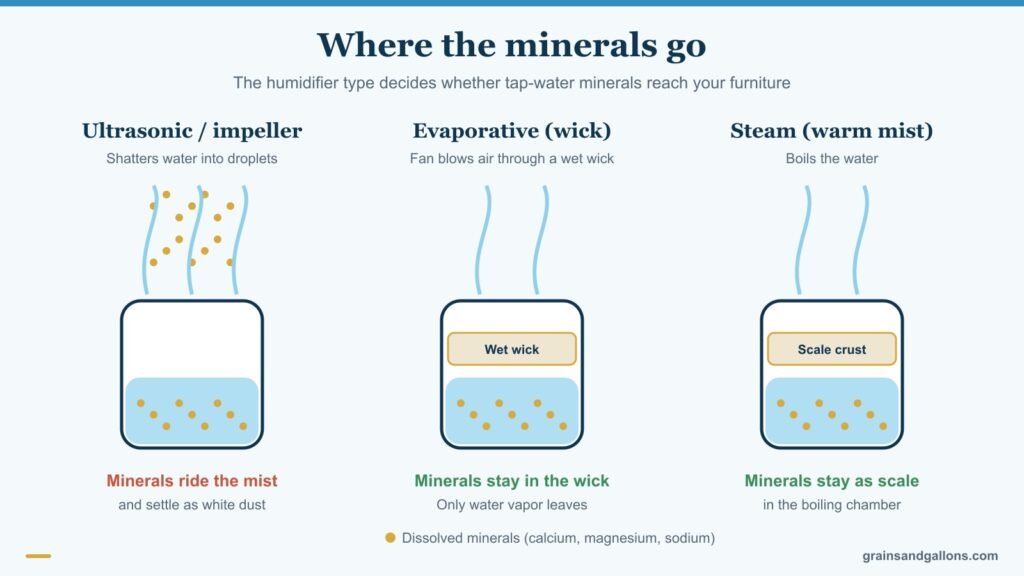
An ultrasonic humidifier uses a vibrating plate to shatter water into microscopic droplets. An impeller model flings water against a diffuser. Both send minerals out with the mist. The EPA puts it plainly: these units "are very efficient at dispersing minerals in tap water into the air" (EPA: Use and Care of Home Humidifiers). Ultrasonic whole-house units can do the same.
Evaporative humidifiers blow air through a wet wick, so only water vapor leaves. The minerals stay in the wick, which is why wicks crust over and need replacing, typically every one to three months. Steam (warm-mist) units boil the water and leave minerals as scale in the boiling chamber. Neither makes white dust in normal use, though a "warm mist" model that's really an ultrasonic with a heater can.
Stop the dust, ranked from most to least reliable
1. Use distilled water
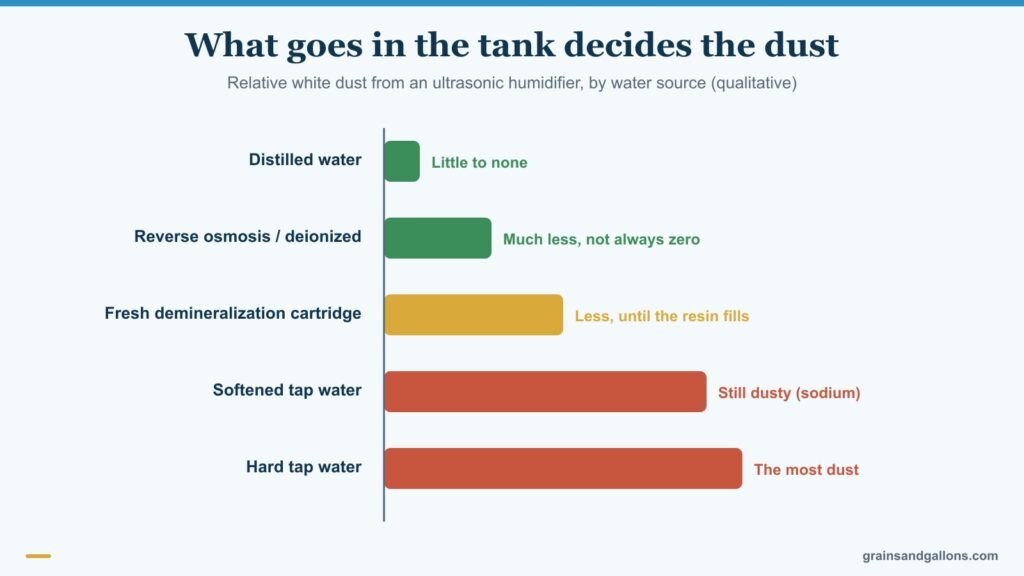
Distillation removes nearly all minerals, and the EPA calls it the most effective way to demineralize humidifier water. No minerals in the tank means no dust in the air. The downside is hauling jugs: a large unit running all night can use a gallon or more a day. If that adds up, a countertop water distiller makes it at home.
2. Switch to an evaporative humidifier
This removes the problem rather than managing it. Evaporative models run on tap water without throwing minerals into the room; the tradeoff is replacing wicks and a bit of fan noise. Our best humidifiers for hard water leans toward evaporative and other low-dust designs for that reason.
3. Fill with reverse osmosis or deionized water
If you already have an under-sink RO system, its water has most minerals removed. The EPA notes RO and deionized water are generally less thorough than distillation, so expect much less dust, not necessarily zero.
4. Add a demineralization cartridge
These sit in the tank and use ion exchange resin to grab minerals. The EPA says their effectiveness "may vary widely," and in very hard water they run out fast. Buy the cartridge made for your model (our cartridge roundup lists which fit which brands) and plan on frequent swaps. Still seeing dust with one in? Here's why a demineralization cartridge stops working.
Softened water, pitchers and boiling won't stop it
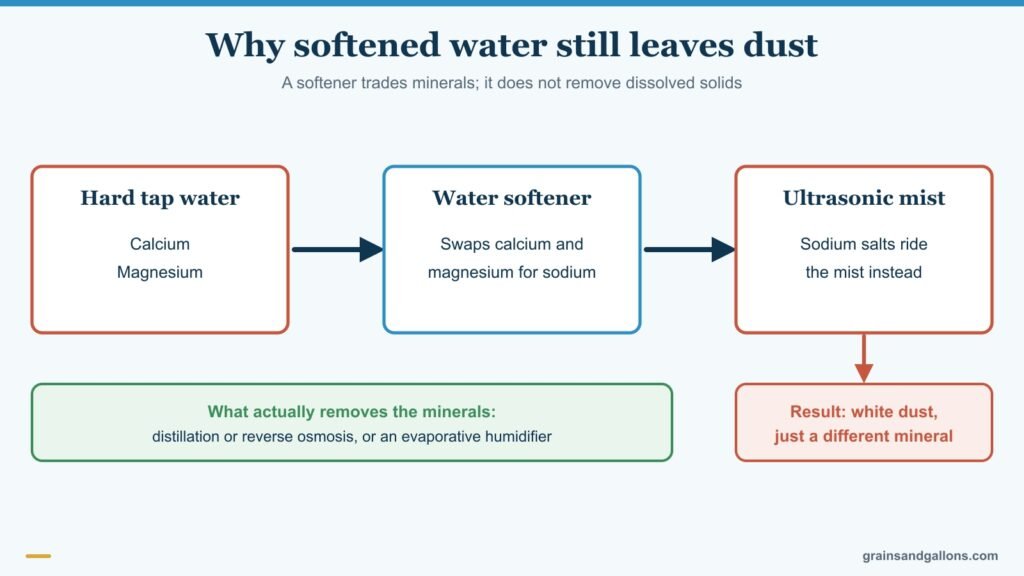
- Softened water. A softener swaps calcium and magnesium for sodium but doesn't remove dissolved solids, so an ultrasonic unit throws sodium-based dust instead. More in should a humidifier use softened water.
- Pitcher filters. Most carbon pitchers aren't built to remove hardness. A few with ion exchange media reduce it somewhat, nowhere near distilled.
- Boiled tap water. Boiling drops out some calcium carbonate, but most dissolved minerals stay put.
- Lower settings. Less mist means less dust, and also less humidity.
Is humidifier white dust harmful, and how should you clean up?
For most healthy people the main issue is the mess, and the dust wipes up like ordinary dust with a damp cloth. Research on breathing these fine particles is limited, and minerals vary by water supply. People with asthma, allergies or other lung conditions are the most likely to notice irritation, so if that's your household, stop the dust at the source with distilled water or an evaporative model, and ask a doctor if symptoms change when the humidifier runs.
The same minerals build up as scale in the tank, and the EPA notes scale can harbor microorganisms. For portable units, the EPA suggests cleaning every third day: empty the tank, remove scale as the manufacturer directs, and rinse well after any cleaner. Keep indoor humidity between about 30 and 50 percent; running a humidifier harder than that only makes more mist and more dust.
FAQ
Why does my humidifier leave white dust?
Your humidifier is almost certainly ultrasonic or impeller type, and your tap water contains dissolved minerals. The mist carries those minerals out, and they settle as powder when the water evaporates.
Does distilled water completely stop humidifier white dust?
It eliminates nearly all of it. Distilled water has almost no dissolved minerals, so there's very little left to settle once the mist evaporates.
Do evaporative humidifiers make white dust?
No. The wick traps minerals and only water vapor leaves, which is why the wick needs replacing every one to three months instead.
Can I use tap water in an ultrasonic humidifier?
You can, but expect white dust in proportion to your water hardness. The EPA recommends low-mineral water for ultrasonic and impeller units.
Do essential oil diffusers cause white dust too?
Yes. Most diffusers use the same ultrasonic plate and make the same dust, just less of it. See white dust from an ultrasonic diffuser.
Change the water or the humidifier, not your dusting routine
Humidifier white dust is a water problem, so more dusting won't fix it. Fill an ultrasonic unit with distilled water, or replace it with an evaporative model that can run on tap water without coating the room. RO water and cartridges help but don't fully stop it, and softened water doesn't help at all.