


Quick Answer: What a water softener does not remove is most of what people worry about: bacteria and viruses, nitrate, arsenic, fluoride, PFAS, chlorine and chloramine, pesticides and solvents, sediment, hydrogen sulfide, and most tastes and smells. It reliably removes only hardness (calcium and magnesium) plus small amounts of a few other positively charged metals. It's not a purifier. Pair it with the filter your water test calls for: carbon for chlorine and taste, reverse osmosis or a dedicated system for health contaminants, and UV or chlorination for bacteria.
"Once the softener's in, your water problems are over." That line gets said in a lot of driveways. It's true for scale on the shower glass and crusty faucet aerators. Knowing what a water softener does not remove matters more, because the gaps are mostly things you can't see, smell or taste.
In this guide
Why ion exchange only catches certain things
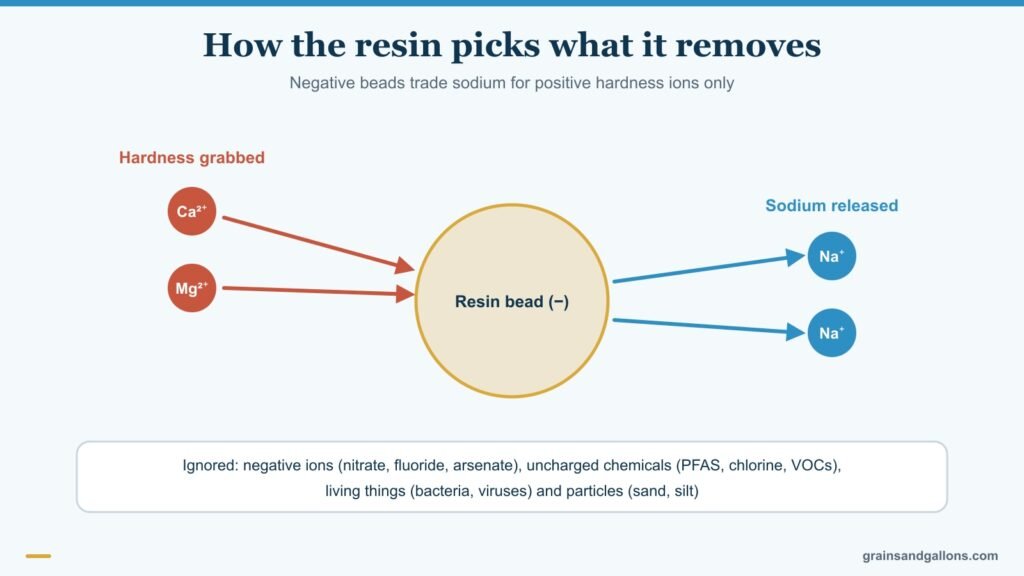
A softener is an ion exchanger. Its resin beads carry a negative charge and hold sodium ions loosely. As water flows through, the beads grab the positively charged ions they prefer, mainly calcium and magnesium, and release sodium in exchange. During regeneration, brine flushes the hardness out and reloads the beads with sodium.
That one mechanism explains the whole list below. A softener swaps dissolved positive ions (cations). It does nothing to:
- dissolved negative ions (anions) like nitrate, arsenate, fluoride and sulfate,
- uncharged dissolved compounds like most pesticides, solvents, PFAS and chlorine,
- anything alive: bacteria, viruses, parasites,
- particles: sediment, rust flakes, sand.
It also doesn't lower total dissolved solids much. It trades one ion for another, so the TDS number stays roughly the same.
What a water softener does not remove, contaminant by contaminant
| Contaminant | Does a softener remove it? | What actually handles it |
|---|---|---|
| Bacteria, viruses, parasites | No | UV disinfection or chlorination; fix the source on wells |
| Nitrate / nitrite | No | Reverse osmosis or nitrate-selective anion resin |
| Arsenic | No (not dependably) | RO at the tap, or arsenic-specific media |
| Fluoride | No | RO, activated alumina |
| PFAS ("forever chemicals") | No | Certified carbon block or RO; whole-house carbon |
| Chlorine / chloramine | No (and chlorine degrades resin over time) | Carbon or catalytic carbon |
| Pesticides, solvents (VOCs) | No | Activated carbon certified for those chemicals |
| Lead | Not reliably | Filter certified to NSF/ANSI 53 or 58 for lead |
| Hydrogen sulfide (rotten egg smell) | No | Oxidizing filter, aeration; carbon for light cases |
| Sediment, sand, silt | No (and it damages the softener) | Sediment or spin-down filter ahead of it |
| Tannins | No | Tannin/anion resin |
| Uranium | No | Anion exchange or RO |
| Total dissolved solids | No; TDS stays about the same | RO, distillation |
| Radon | No | Aeration or granular activated carbon |
A few of those deserve more than a table cell.
Bacteria, lead and chlorine get a closer look

Bacteria: the gap people assume most often
A softener is not a disinfection device. The Minnesota Department of Health goes further, warning that if water isn't disinfected first, bacteria and fungi can grow on the softener's surfaces (MDH, Home Water Softening). On a private well, the EPA recommends testing every year for total coliform bacteria, nitrates, total dissolved solids and pH (EPA, Protect Your Home's Water), none of which a softener fixes. If coliform shows up, find and fix the source, disinfect (often shock chlorination), then add UV for ongoing protection. Our guide on how to test water for bacteria covers sampling.
Lead: some reduction isn't protection
Lead is a positive ion, so resin can capture some dissolved lead in a lab. But softeners aren't designed, certified or maintained for lead, and much household lead comes from particles shed by pipes and fixtures after the softener. MDH also notes that softened water can be more corrosive to plumbing, which can contribute to higher lead and copper levels. If lead is a concern, test for lead and use a filter certified for lead at the drinking tap.
Chlorine: not removed, and it wears out resin
City water chlorine passes straight through, and over the years it slowly breaks down resin. Chloramine is harder on it. A carbon stage, either before the softener or built into a combined unit, protects both your water and the resin; see our guide to a carbon filter and water softener together and our picks for the best water softener and carbon filter combos.
What a softener does take out
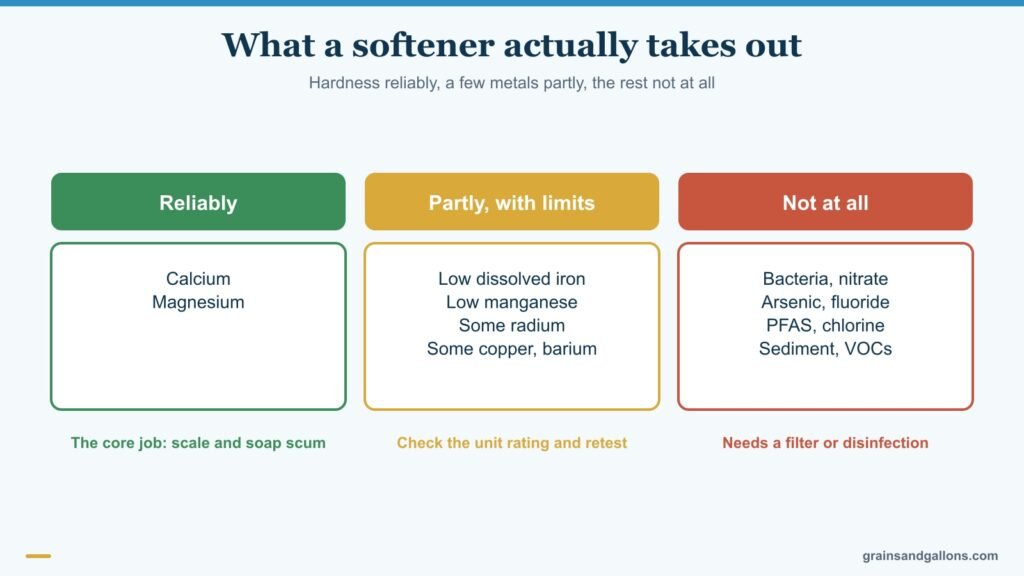
The list of what it does handle is short but useful:
- Calcium and magnesium. This is the job: no more scale on fixtures, water heaters and glass, and better soap lather.
- Low levels of dissolved iron and manganese. Penn State Extension notes softeners remove reduced (clear-water) iron, but iron already exposed to air or chlorine "will clog the resin" (Penn State Extension, Water Softening). Our guide on whether a water softener can remove iron explains when a dedicated filter is needed.
- Some radium, copper and barium. MDH says some softeners can fully or partially remove copper, iron, manganese and radium; barium, another positive ion, is also commonly reduced. Check the specific unit and retest to confirm.
What softened water adds

Removing things isn't the only change. A salt-based softener adds sodium in proportion to the hardness removed. Penn State puts it at 7.5 mg per quart for each grain per gallon removed. For most people that's small, but MDH advises anyone with high blood pressure to ask their doctor about drinking softened water, and suggests keeping an unsoftened tap for drinking and cooking or using potassium chloride instead of salt. More in is softened water safe to drink.
There's also an environmental side. Regeneration sends chloride-rich brine down the drain or into the septic system, and MDH notes it ends up in lakes and streams. That's why some areas restrict softeners and why setting the unit to your actual hardness matters.
Pair a softener with the right filter

- Test first. City water: read your annual Consumer Confidence Report. Well water: a full lab panel. Our walkthrough on reading a well water lab report shows what needs treatment.
- Use the softener for hardness and, within limits, low iron and manganese.
- Add a drinking water system for health contaminants. For nitrate, arsenic, fluoride or high TDS, an under-sink RO is the usual answer; see the best reverse osmosis systems for well water.
- Use whole-house carbon for chlorine, chloramine and some chemicals. If your utility reports PFAS, see the best whole house filters for PFAS and match certifications to your levels.
- Disinfect if bacteria shows up, then retest.
FAQ
Does a water softener remove bacteria?
No. Softeners don't filter or kill bacteria, viruses or parasites, and an unmaintained softener can even grow bacteria on its surfaces. Use UV disinfection or chlorination, and fix the source of contamination on a well.
Is a water softener the same as a water filter?
No. A softener exchanges hardness minerals for sodium or potassium. A filter physically or chemically removes contaminants: carbon for chlorine and many chemicals, RO for dissolved salts, nitrate and arsenic, sediment filters for particles. Many homes need both.
Does a water softener remove PFAS or chlorine?
No. PFAS and chlorine pass straight through the resin. Activated carbon handles chlorine, and certified carbon block or reverse osmosis handles PFAS. Chlorine also slowly damages softener resin, so a carbon stage helps the softener last.
Does a water softener remove nitrates or arsenic?
No. Nitrate and most arsenic in well water are negatively charged or uncharged, so cation resin ignores them. Reverse osmosis at the kitchen tap or a dedicated anion or arsenic system is the usual fix.
Does softened water remove lead from pipes?
Not reliably. Resin may catch a little dissolved lead, but it isn't certified for it, and lead often enters after the softener. Use a point-of-use filter certified for lead reduction.
A softener fixes scale, not safety
What a water softener does not remove is nearly every health-related contaminant: microbes, nitrate, arsenic, fluoride, PFAS, lead, chlorine and chemicals. It's an excellent tool for hard water and a poor substitute for a filter. Test your water, let the softener handle calcium and magnesium, and add carbon, reverse osmosis or UV for whatever else the results show.