

Quick Answer: To clear RV water heater scale, turn off the gas and electric element, let the tank cool, shut off the pump or city water, and relieve pressure at a hot faucet and the relief valve. Pull the drain plug (Atwood) or anode rod (Suburban) and rinse with a tank wand until no white chips come out. For hard crust, soak the tank in a 50/50 vinegar solution, then flush again. Flush at least once a year, and soften water at the hose to slow it down.
A week of boondocking in the Southwest, and now the water heater pops and crackles every time it fires. Or you pulled the anode rod for the first time and a handful of white gravel came out with it. That's RV water heater scale, and RV tanks collect it fast because you feed them whatever water the campground has. The fix is a flush, sometimes a vinegar soak, and a plan for the water you hook up to next.
In this guide
- Popping, chips and slow recovery: signs of RV water heater scale
- Suburban or Atwood? Check the tank first
- Drain and rinse the tank in six steps
- Dissolving hard crust with a vinegar soak
- Descaling an RV tankless water heater
- Stop the scale at the campground spigot
- Make RV water heater scale part of every season's checklist
- FAQ
Popping, chips and slow recovery: signs of RV water heater scale
RV tanks are small, the burner or element heats the water quickly, and hot water holds less dissolved calcium carbonate than cold water does. So every tankful drops a little more mineral on the bottom. (For the chemistry, see why hot water causes more scale.) Penn State Extension's guide to water softening notes that hard water scale "can also build up on hot water heaters and decrease their useful life," and a 6- or 10-gallon RV tank feels that sooner than a house tank.
Watch for:
- Popping, rumbling or crackling when the burner runs, as water trapped under the scale layer flashes to steam.
- White or gray chips that look like crushed eggshell when you drain the tank or pull the anode.
- Slower recovery between showers, because the scale insulates the water from the heat.
- Electric element failures, since a crusted element runs hotter.
- Bits in faucet aerators and shower heads, especially right after a flush stirs things up.
Suburban or Atwood? Check the tank first
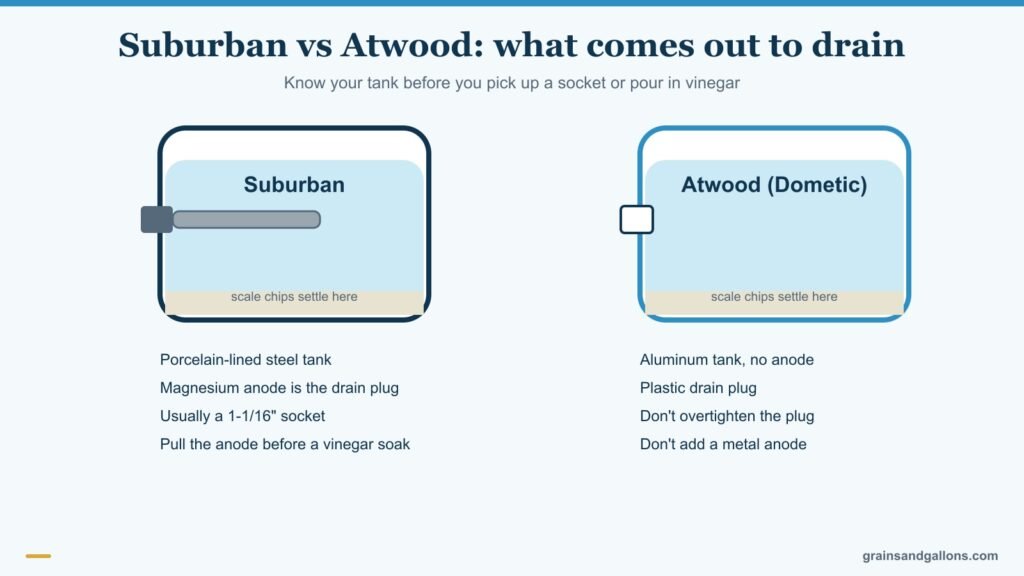
The two most common RV tank heaters are built differently, and that changes what you unscrew.
Suburban heaters use a porcelain-lined steel tank with a magnesium anode rod that doubles as the drain plug. Most take a 1-1/16" socket. The rod corrodes on purpose so the tank doesn't, which is why it looks chewed up over time.
Atwood heaters (now Dometic) use an aluminum tank with no anode and drain through a plastic plug. Don't add a metal anode to an Atwood tank unless the manufacturer says to, and don't overtighten the plastic plug.
Check the label on the heater or behind the outside access door if you're not sure. Many newer rigs have a tankless heater instead; skip to the tankless section below.
Drain and rinse the tank in six steps
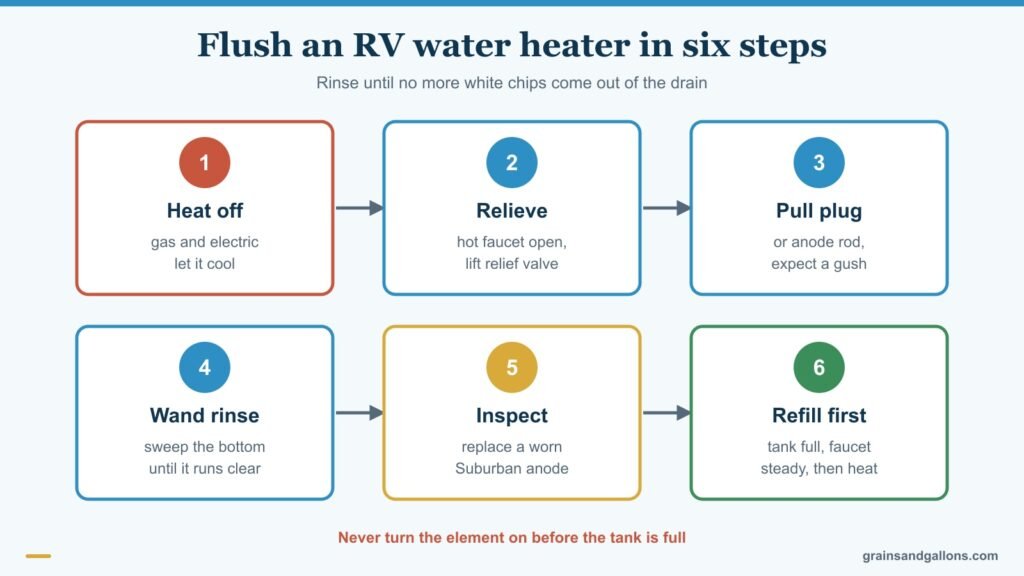
- Turn off every heat source and let it cool. Switch off the gas and the electric element. That second switch is easy to forget, and an element powered on in an empty tank can burn out fast. Wait until the tank is cool to the touch.
- Take the pressure off. Turn off the pump and disconnect city water. Open a hot faucet inside, then lift the lever on the pressure relief valve at the access door. Keep your face clear of any spray.
- Pull the plug or anode. Turn slowly and expect a gush. On a scaled tank, the first water is cloudy and full of chips.
- Rinse with a wand. A tank rinser wand screws onto a garden hose and has a bent tip that reaches through the drain hole. Sweep it across the bottom of the tank in short bursts until the water runs clear and no more chips appear.
- Inspect the anode (Suburban only). Replace it if most of the metal is gone or the core wire shows in long stretches. A rod caked in scale isn't protecting much either.
- Refill before you heat. Wrap the threads with PTFE tape (4 to 5 turns is typical), reinstall, close the relief valve, turn the water on, and run a hot faucet until it flows steadily with no sputtering. Only then turn the heat back on.
Dissolving hard crust with a vinegar soak
Flushing removes loose chips. Crust stuck to the tank wall or element needs a mild acid, and white vinegar is what most RVers use. A widely followed method from RV owners is a 50/50 vinegar-and-water mix, which works out to about 3 gallons of vinegar for a 6-gallon tank and 5 gallons for a 10-gallon tank. Let it soak, often overnight, then drain and flush with the wand until the water runs clear.
A few rules keep the soak from causing new problems:
- Suburban owners: swap the anode for a plastic plug during the soak. Vinegar attacks the magnesium rod. Put the rod (or a new one) back in when you're done.
- Read your manual first, especially on an aluminum Atwood tank, and follow any limits it sets.
- Don't heat the vinegar unless your manufacturer allows it. Some owners fire the burner to speed things up, but it's not something every maker approves.
- Wear eye protection when you drain. The solution comes out full of loosened grit, and that grit can clog faucet aerators afterward.
Descaling an RV tankless water heater
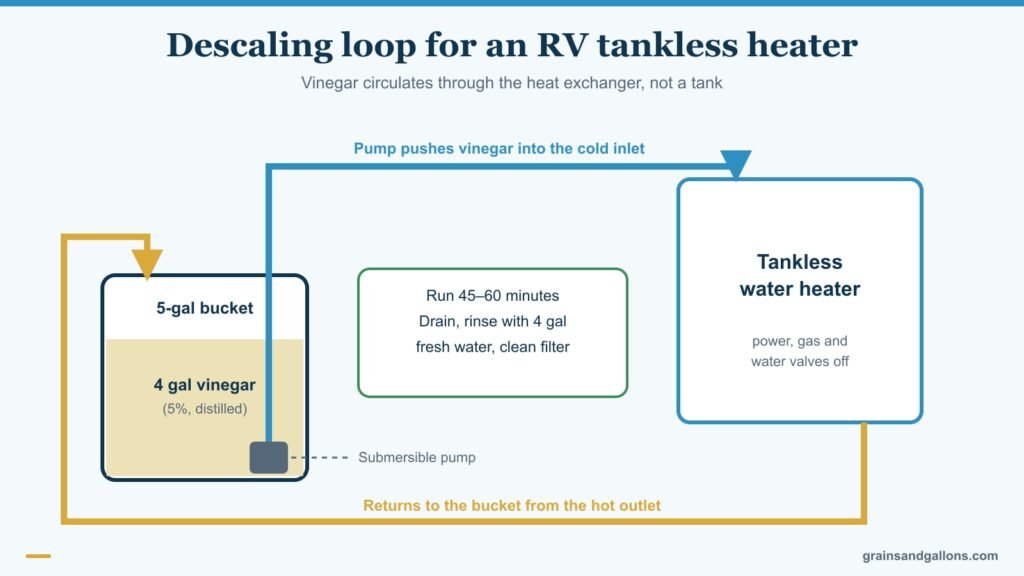
On-demand units such as Furrion and Truma have no tank to flush, so scale builds inside the heat exchanger and shows up as weak hot-water pressure. The fix is to circulate a descaling solution through it.
Lippert's guide to cleaning a Furrion tankless water heater lays out the process: turn off power, close the cold, hot and gas valves, then connect two hoses to the heater and run 4 gallons of 5% distilled white vinegar from a 5-gallon bucket through it with a submersible pump for 45 to 60 minutes. Drain the vinegar, rinse with 4 gallons of fresh water, clean the water filter, reconnect and test. Truma sells its own decalcifying product for the AquaGo, so check your model's manual. House-sized units follow the same idea; our guide to scale in a tankless water heater goes deeper.
Stop the scale at the campground spigot
You can't control what comes out of the park's water pedestal, but you can treat it before it reaches the heater.
- Soften at the hose. A portable RV softener between the spigot and your inlet is the only common option that actually removes the hardness that forms scale. It needs periodic regeneration with salt. See how to set up a portable softener in an RV.
- Don't count on a filter alone. A sediment or carbon canister catches grit and chlorine but doesn't remove calcium, so you still need to flush. Our roundup of RV water filter and softener setups covers combo systems.
- Run the heat no hotter than you need. Less heat means less scale.
- Drain before storage. Draining for storage or winterizing clears sediment before it hardens in place.
If the hot water starts to smell like sulfur after a flush, that's usually the anode reacting with sulfate and bacteria, not scale. Our article on the rotten egg smell only in hot water explains it.
Make RV water heater scale part of every season's checklist
Scale builds a little with every tankful, so treat it as maintenance, not a repair. Flush at least once a year and before long-term storage, more often if you travel through hard-water country or hear popping return. Add a vinegar soak when the wand stops bringing out loose chips but the heater still sounds crusty. And a softener at the hose will do more to protect the tank than any flush.
FAQ
How often should I flush my RV water heater?
At least once a year and before long-term storage. Full-timers in hard-water areas often flush every few months. If the popping comes back, it's time.
Why does my RV water heater make popping noises?
Scale on the bottom of the tank traps small pockets of water that flash to steam when the burner or element heats them. Flushing and descaling usually quiets it.
Can I use vinegar in a Suburban RV water heater?
Many owners do, but take the magnesium anode out first and use a plastic plug during the soak, because vinegar attacks the rod. Check your manual, then flush well before reinstalling the anode.
Does an Atwood RV water heater need an anode rod?
No. Atwood (Dometic) heaters use an aluminum tank that doesn't use an anode. Don't add one unless the manufacturer tells you to.
Will a water filter stop RV water heater scale?
Not by itself. Sediment and carbon filters don't remove calcium and magnesium. A portable water softener at the hose is what reduces scale.