

Quick Answer: With hard water and refrigerator ice makers, the usual signs are white flakes in melted ice, a crusty dispenser nozzle and, over time, slower ice production. The flakes are harmless calcium carbonate, and the fridge's carbon filter isn't designed to remove it. Wipe the dispenser with diluted white vinegar, empty and wash the ice bin, and replace the filter if it's overdue. If ice production has slowed, check the filter and water pressure before blaming the ice maker. The lasting fix is feeding the fridge softened or RO water.
Drop a few cubes in a glass, let them melt, and there it is: white specks drifting to the bottom. Or the ice maker that used to fill the bin overnight now barely covers the floor. Find your symptom below, then read the section that matches.
In this guide
- Match the symptom to the cause
- Why hard water turns into flakes in ice
- How hard water and refrigerator ice makers interact, stop by stop
- What your fridge filter can and can't do
- When ice production slows down
- Cleaning the dispenser, bin and chute
- Stop sending hard water to the fridge
- FAQ
- Fix the water and the ice maker looks after itself
Match the symptom to the cause

| What you see | Most likely cause | First thing to do |
|---|---|---|
| White flakes or grit when ice melts | Hardness minerals forced out of solution as water freezes | Normal in hard water; reduce hardness at the supply |
| Cloudy cubes | Mostly trapped air and gases; dissolved minerals add to it | Usually cosmetic |
| White crust on the dispenser nozzle or drip tray | Scale left as water evaporates | Wipe with diluted vinegar; dry the nozzle |
| Small, hollow or shattered cubes | Clogged filter, low pressure, or a scaled inlet valve screen | Replace the filter, then check pressure |
| Slow water dispenser | Same as above | Same as above |
| Cubes clumped together in the bin | Ice sitting unused and partly melting; not a hardness issue | Empty the bin regularly |
| Off taste or odor in ice | Old filter, bin absorbing food odors, mold | New filter, wash bin, discard old ice |
Why hard water turns into flakes in ice

As water freezes, ice crystals form from fairly pure water and push dissolved minerals into the liquid that hasn't frozen yet. The last bit to freeze, usually the center or bottom of a cube, ends up with the most minerals, and some calcium carbonate comes out of solution there. When the cube melts, those bits show up as white flakes.
They're harmless, the same mineral as kettle scale, but they're a reliable sign that the same minerals are coating every part of the fridge that water touches. Our guide to white flakes in melted ice cubes explains how to tell mineral flakes from other particles.
Cloudiness is a separate thing. Samsung's ice troubleshooting page describes cloudy ice as normal, caused by minerals and gases trapped during rapid freezing, and more common with hard water. Clear ice isn't realistic from a standard ice maker either way.
How hard water and refrigerator ice makers interact, stop by stop
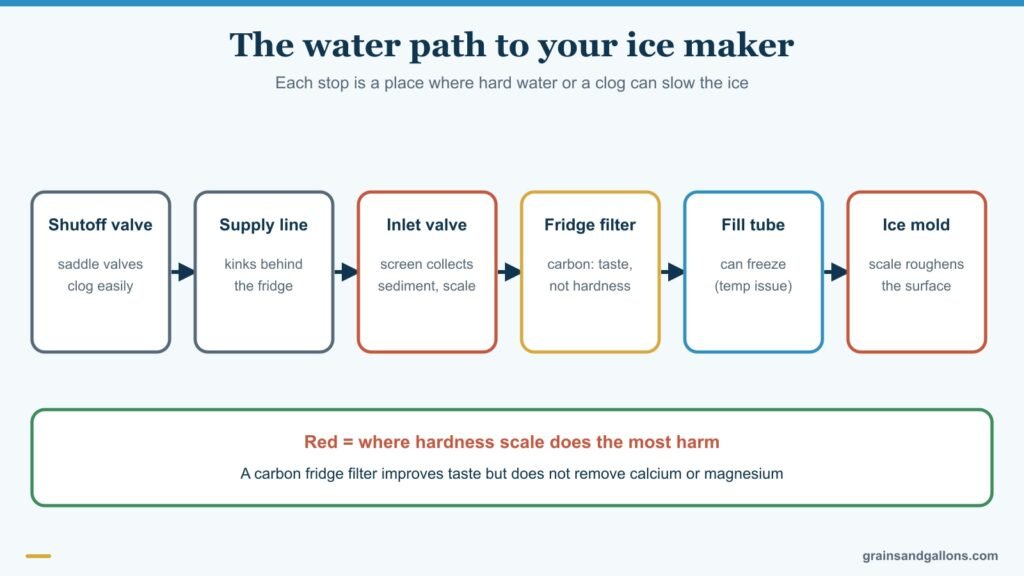
Water travels from a shutoff valve behind the fridge, through a supply line, into an electric water inlet valve, through the filter and up a fill tube into the ice mold. Hard water leaves its mark at three of those stops:
- The inlet valve screen. A small screen on the valve collects sediment and scale. A partly blocked screen means less water per fill, which means smaller cubes.
- The ice mold. Scale roughens the mold surface. Some owners report cubes sticking until the mold is cleaned, though a harvest thermostat or heater fault is a more common reason cubes won't drop.
- The dispenser nozzle. Every drip that evaporates leaves a little calcium behind, which builds into a white crust.
Saddle valves, the kind that pierce a copper pipe, also clog with mineral deposits over time; a quarter-turn valve is a worthwhile upgrade.
What your fridge filter can and can't do
Most refrigerator filters, and most inline filters added to the supply line, are built around activated carbon. They're good at chlorine taste and odor and, depending on certification, things like lead and some chemicals. Carbon doesn't remove calcium and magnesium in any useful amount.
So replace the fridge filter on schedule. A clogged one is the most common reason for slow ice production. In hard water areas, many technicians suggest changing it more often than the usual six months. After a new filter goes in, run a few gallons through the dispenser and throw out the first batch or two of ice. If your fridge has no built-in filter, our roundup of the best inline filters for fridges and ice makers explains what each one actually removes, hardness included.
When ice production slows down

Check these in order. The cheap ones come first.
- The filter. Overdue filters restrict flow. Replace it and reset the indicator.
- Water pressure. Inlet valves need a minimum pressure to fill the mold before it freezes. Samsung asks for at least 20 psi; Whirlpool's water pressure guide lists about 30 to 120 psi for ice maker operation. A quick dispenser test: 10 seconds of flow should give roughly 3/4 cup, per Samsung.
- The supply line. Look for kinks behind the fridge and make sure the shutoff valve is fully open.
- The inlet valve screen. With the fridge unplugged and water off, the screen can be inspected. Many people simply replace the valve, which is a common, inexpensive part for most models.
- The fill tube. If the tube that feeds the mold freezes, the mold won't fill. That's not a hardness problem; it points to freezer temperature or a dripping valve.
If the cause is a scaled or failed valve, don't push vinegar or descaler through the ice-making system unless your manual allows it. Many don't, and the risk isn't worth it.
Cleaning the dispenser, bin and chute

- Dispenser nozzle and paddle: lock the dispenser if your model allows it, then wipe with a cloth dampened in a 50/50 mix of white vinegar and water. Use a soft toothbrush on the nozzle tip, rinse with a clean damp cloth and dry.
- Drip tray: most pop out. Soak in warm vinegar water, then wash with dish soap.
- Ice bin: empty it, wash with warm soapy water, rinse well and dry completely before putting it back. Throw out the old ice.
- Ice chute: with the ice maker off, clear any jammed ice with warm water and check for mold around the flap.
Southern Living suggests cleaning an ice maker every nine months at minimum and every six months with hard water, and Samsung recommends emptying the ice bucket every other week so cubes don't clump. Skip abrasive pads and strong acids on the dispenser finish.
Stop sending hard water to the fridge

Feed the fridge softened water. If you have a whole-house softener, the fridge line probably already gets soft water, and the flakes and crust should stop. Softened water carries a modest amount of extra sodium; if anyone in the house watches sodium closely, read whether a kitchen tap should bypass the softener, since the fridge line is often tied into the same decision.
Run an RO line to the fridge. Reverse osmosis removes most hardness and most of the sodium a softener adds, and it produces the cleanest-tasting ice. The catch is pressure. Whirlpool says the supply into an RO system should be at least 40 to 60 psi, and a low RO tank leads to small cubes or slow ice; letting the tank refill or changing a clogged RO prefilter often fixes it. Our picks for the best under-sink water filters for hard water include RO systems that can feed a fridge, and our guide to RO and a water softener together explains why the pair is common.
FAQ
Is it safe to eat ice with white flakes in it?
Yes. Calcium carbonate is harmless. If flakes are dark, colored or slimy, that's something else; clean the bin and check the filter.
Will a new fridge filter make my ice clear?
Not if the issue is hardness or trapped air. A new filter helps taste and flow, not mineral content.
Can hard water ruin a refrigerator ice maker?
It rarely kills one outright, but scale on the inlet valve and mold can cut ice output and make cubes stick. Replacing a scaled inlet valve is usually a cheap repair.
How often should I change the fridge filter with hard water?
Follow your manual, which is usually around six months. In hard water, change it sooner if flow drops or ice slows down, since sediment and scale clog it faster.
Can I run vinegar through my ice maker?
Only if the manual says so. Clean the parts you can reach, like the bin, nozzle and drip tray, with diluted vinegar, but don't pour it into the water system or mold unless the manufacturer allows it.
Fix the water and the ice maker looks after itself
The trouble between hard water and refrigerator ice makers comes down to minerals that a carbon filter can't catch. Keep the filter fresh, clean the dispenser and bin twice a year, and check pressure before replacing parts. If flakes and crust keep coming back, the lasting answer is softened or RO water to the fridge line, which stops the scale before it starts.