

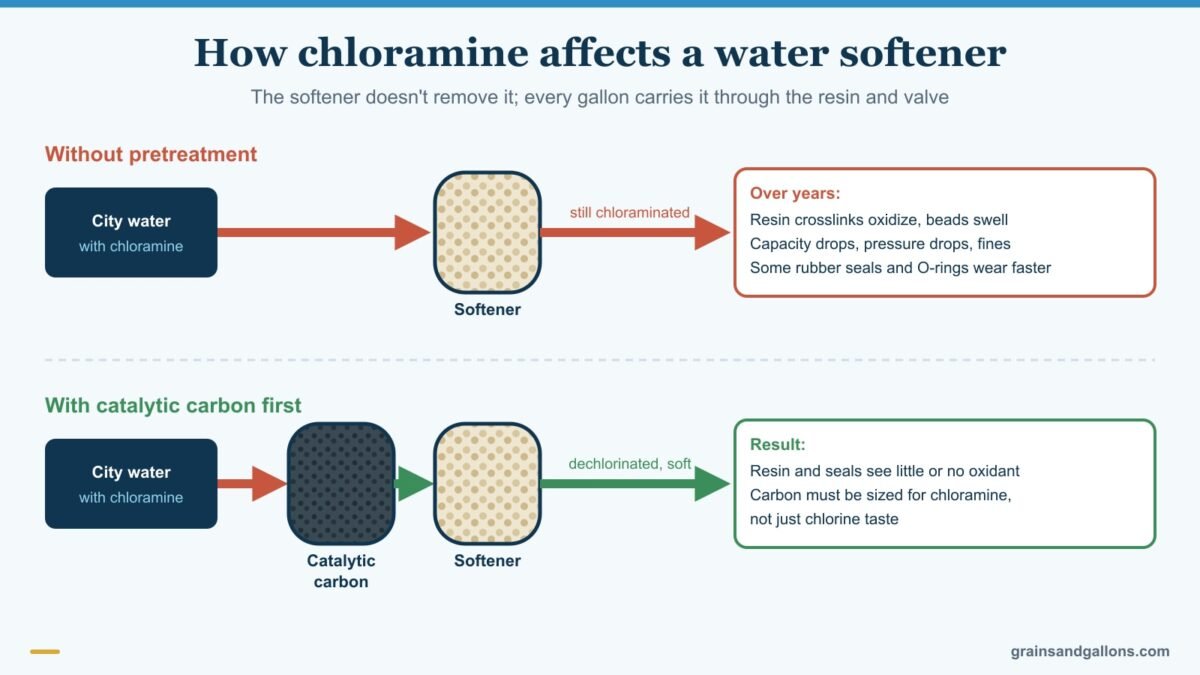
Quick Answer: Here's how chloramine affects a water softener: it doesn't stop the softener from working on day one, and the softener doesn't remove it. It passes through the resin and slowly oxidizes it, so the beads swell and lose capacity over years, and it can wear some rubber seals and O-rings in the valve. The fix is a catalytic carbon filter sized for chloramine in front of the softener; ordinary carbon that handles chlorine taste won't keep up.
Maybe your water bill mentioned it, or you found it in your city's water quality report: the utility uses chloramine, not chlorine. Then you read that it "damages softeners" and wondered whether the system you just bought is on a countdown. Understanding how chloramine affects a water softener takes the drama out of it. It isn't a sudden failure, but it does change how long resin lasts and what kind of pre-filter makes sense.
In this guide
- Chloramine versus chlorine: what reaches your softener
- How chloramine affects a water softener's resin bed
- Rubber seals, O-rings and fixtures on chloraminated water
- Signs of chloramine damage, and how to confirm it
- How to protect a softener on chloraminated water
- FAQ
- Catalytic carbon first keeps chloramine from shortening resin life
Chloramine versus chlorine: what reaches your softener
Chloramine is chlorine combined with ammonia. Utilities use it because it lasts longer in the pipes than free chlorine, and some switched to it to meet disinfection byproduct rules. According to the EPA's chloramines page, more than one in five Americans uses drinking water treated with chloramines. The EPA's drinking water regulations cap the chloramine residual at 4 mg/L (as chlorine), and most systems run well below that.
That same stability is why it behaves differently in your softener:
| Free chlorine | Chloramine | |
|---|---|---|
| How reactive | Fast, strong oxidizer | Slower, weaker oxidizer |
| How long it lasts in water | Fades fairly quickly | Persists much longer |
| Removed by standard carbon? | Yes, easily | Poorly; needs catalytic carbon and more contact time |
| Removed by softener resin? | No | No |
| Smell | Classic pool smell | Milder, often barely noticeable |
| Effect on rubber parts | Some | Generally considered harder on certain rubbers |
Not sure which one you have? Your utility's annual report will say, or you can test for chlorine vs chloramine at home with a free-and-total chlorine kit. If total chlorine is well above free chlorine, you have chloramine.
One wrinkle: many chloramine utilities switch to free chlorine for a few weeks a year (often called a chlorine burn or conversion) to clean their distribution lines. During those weeks your softener sees full-strength free chlorine.
How chloramine affects a water softener's resin bed

Softener resin is polystyrene beads held together by a crosslinking agent, divinylbenzene (DVB). Oxidizers attack those crosslinks. As they break, the beads absorb more water, swell, soften and eventually turn to mush. Swollen resin takes up more space, packs together, increases pressure drop and lets water channel through part of the bed, so effective capacity falls. The process is the same as with chlorine; we walk through it in how chlorine damages softener resin.
Here's where chloramine differs. Per part per million, it's a weaker oxidizer than free chlorine, so it's generally thought to be gentler on resin in the short run. But it doesn't fade. Water arrives at your softener with essentially the same residual it left the plant with, every gallon, for years. Slow damage with no breaks still adds up, and nothing a regeneration does can rebuild broken crosslinks.
How fast it happens depends on the chloramine level, how much water you use, the resin's crosslink percentage and water temperature. Vendor pages quote resin lifespans under chloramine, but we haven't found independent data behind those numbers, so treat any specific year count with caution.
Rubber seals, O-rings and fixtures on chloraminated water

Chloramine has a reputation in the plumbing world for degrading certain rubber compounds, especially some natural rubber and older elastomer formulations. Utilities that switched to chloramine have reported more toilet flapper and fixture washer failures afterward.
In a softener, the rubber parts are the piston seals, O-rings, the brine valve and the injector seals. Wear shows up as water running to the drain, leaks at the valve, or hardness slipping through during service. Many valve makers now use chloramine-resistant materials, so check with the manufacturer if this matters to you. When seals do go, a rebuild kit is the usual fix; see servicing a water softener control valve.
The softener isn't the only rubber in the system. The brine tank float assembly, the bypass valve O-rings and the supply connectors all sit in the same water. If you're replacing parts on a chloraminated supply, ask for EPDM or other chloramine-resistant elastomers where the manufacturer offers them, and inspect the bypass and connector washers at the same time. A carbon filter ahead of the softener protects everything downstream of it, including the valve seals, but not the parts upstream of the carbon, such as its own bypass and connectors, so those deserve a look at every media change.
Signs of chloramine damage, and how to confirm it

Chloramine damage is slow. There's no sudden failure. Typical signs, usually over several years:
- Capacity creeping down: the softener goes hard before regeneration more often, with no change in water use or settings.
- Lower water pressure through the softener as resin swells and packs.
- Fine resin particles at faucet aerators or in the drain line during backwash.
- Leaks or constant drain flow from worn seals.
Other problems cause the same symptoms, so confirm before you spend money:
- Test raw water for total chlorine. If there's no residual reaching the softener, chloramine isn't your culprit.
- Check the settings first. A capacity or hardness setting that's off causes early hard water too.
- Compare pressure in bypass and in service. A noticeably bigger drop in service points to a packed bed.
- Look at the resin. Pull a sample from the top of the tank. Healthy beads are firm, round and roughly uniform; damaged beads squash between your fingers, look swollen, or have broken into fines. Our guide to mushy resin shows what to look for.
Replace the resin or just protect it?
If the resin is already mushy, regeneration and resin cleaners won't bring it back; rebedding is the fix, and our guide to resin life and replacement covers the job. If capacity is only slightly down and the beads are still firm, adding catalytic carbon now is usually the cheaper move, because it protects the resin you have and any resin you buy later. Either way, install the carbon before or at the same time as new resin, or the new bed starts the same slow decline.
How to protect a softener on chloraminated water

1. Put a catalytic carbon filter ahead of it. This is the real fix. Catalytic carbon is processed to break down chloramine far better than standard activated carbon, but it still needs adequate contact time, so tanks are sized larger or flow is lower than for chlorine. A small cartridge housing sized for chlorine taste usually won't keep up at whole-house flow. Our guide to the best whole house filters for chloramine focuses on systems built for this.
2. Or buy a combo system. Some softeners ship with a carbon tank or carbon layer already plumbed in. Check that the carbon is catalytic and the volume is meant for chloramine, not just chlorine taste. Our picks for softener and carbon filter combos note which ones are chloramine-ready.
3. Choose 10% crosslink resin when buying new or rebedding. Higher crosslinking resists oxidation better than standard 8% resin, at the cost of a little capacity per cubic foot. See replacement softener resin for options.
4. Get the order right and verify it. Carbon goes before the softener, so the resin and seals see dechlorinated water. More on that in using a carbon filter and softener together. Once a year, test total chlorine on water after the carbon; if it's climbing, the media is near the end of its life.
A side effect worth knowing: when carbon breaks down chloramine, it releases a small amount of ammonia. In a typical home this is minor, and softener resin can capture some ammonium as it would other positive ions. If you keep fish, chloramine and ammonia both matter for aquariums, so treat aquarium water with a product designed for it.
FAQ
Does a water softener remove chloramine?
No. Softener resin exchanges ions like calcium and magnesium for sodium. It doesn't break down disinfectants, so chloramine passes straight through to your taps.
Will a regular carbon filter protect my softener from chloramine?
Not reliably. Standard activated carbon removes free chlorine easily but chloramine only slowly. You need catalytic carbon with enough media volume and contact time for your peak flow.
Is chloramine worse for a softener than chlorine?
It's a weaker oxidizer, so it attacks resin more slowly per ppm, but it persists all the way to your house and is often considered harder on some rubber seals. Over years, the steady exposure adds up either way, which is why the same catalytic carbon fix makes sense on any treated city supply, whether the utility uses chlorine, chloramine, or switches between them.
Will boiling or a pitcher remove chloramine?
Boiling removes chloramine slowly and poorly. Some pitchers and countertop filters are certified for chloramine reduction; check the certification listing, not just the box.
Is chloraminated water safe to drink?
The EPA says water that contains chloramines and meets its standards is safe for drinking, cooking, bathing and other household uses. People on kidney dialysis and aquarium owners need to remove it.
Catalytic carbon first keeps chloramine from shortening resin life
Knowing how chloramine affects a water softener comes down to one idea: the softener can't remove it, so every gallon slowly oxidizes the resin and wears some rubber parts. Confirm the residual with a total chlorine test, fix settings problems first, and put a catalytic carbon filter sized for chloramine in front of the softener. Choose 10% crosslink resin when you rebed, and the slow decline becomes a non-issue.