

Quick Answer: Are hard water stains in toilet bowl black? Plain calcium scale isn't; it turns gray or black when it traps dirt, when manganese or iron in the water is the real cause, or when mold grows on it. Wipe the ring first. If it smears off, it's mold or bacteria: use a bleach toilet cleaner. If it's hard and you're on well water, suspect manganese and try a reducing remover like Super Iron Out. If it's a gray crust, dissolve it with acid and finish with a wet pumice stone. Never mix these products.
Disclosure: As an Amazon Associate, Grains & Gallons earns from qualifying purchases.
When hard water stains in toilet bowl black instead of white, the cleaner you've been using probably doesn't match the stain. Maybe you've poured bleach in twice and the dark band is still at the waterline, or it's back within a week. Black and gray rings come from four quite different things, and each needs its own fix.
In this guide
Four causes behind a dark ring, and how they look
| Cause | Typical look | Where it shows up |
|---|---|---|
| Mold, mildew or bacteria | Black or green-black, slimy, may smell musty | Waterline and under the rim, worst in rarely used toilets |
| Manganese (often with iron) | Brown-black, flat, won't wipe off | Bowl, tank and rim jets; sinks and laundry too |
| Calcium scale that trapped dirt | Gray, rough, crusty | Exactly at the waterline |
| Metal marks | Thin gray streaks like pencil lines | Sides and near the drain, above the water |
Manganese is the one people miss. It's common in groundwater, and Penn State Extension notes that it causes black-brown staining of fixtures and laundry even at low levels. The EPA sets a secondary (cosmetic) guideline of 0.05 mg/L for manganese in its secondary drinking water standards, because above that, staining and taste problems are common.
Run four checks before you clean
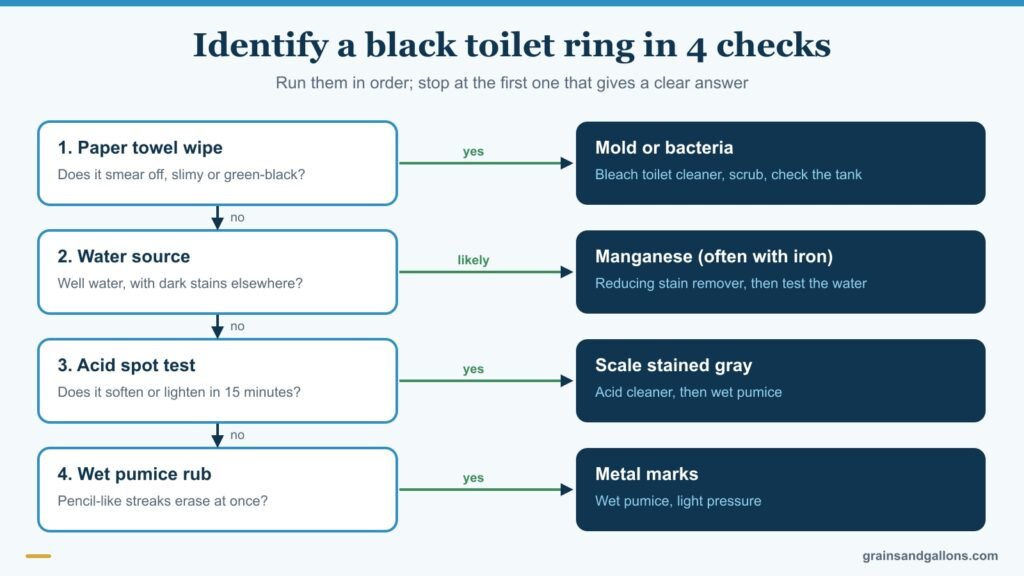
- Paper towel wipe (10 seconds). Wear a glove and rub the ring firmly. If it smears off black or green, or feels slimy, it's biological. If nothing comes off and it feels rough, it's mineral. If it feels smooth, as if under the glaze, go to check 4.
- Water source. On a private well, especially with dark stains in sinks, the tub or the dishwasher too, manganese is the prime suspect; our article on black stains from manganese in well water explains why. On city water, a gray ring is more often stained scale.
- Acid spot test. Lower the water, put an acid toilet cleaner on one section and wait 15 minutes. If it softens or lightens, calcium scale was the base. Little change points to manganese or iron, which respond poorly to the acids in most toilet cleaners. Flush the acid away fully before trying anything else.
- Wet pumice rub. Pencil-like streaks that vanish with a few light strokes were metal marks from a plunger, auger or something dropped in the bowl.
Removing each type of black stain
Mold or bacteria
Apply a bleach toilet cleaner around the ring and under the rim, wait about 10 minutes, scrub and flush. It returns if conditions stay the same, so if dark growth is also in the tank, deal with the black slime in the toilet tank as well.
Manganese or iron
Shut off the supply and flush to lower the water. Apply a reducing stain remover made for rust and iron; products like Iron Out convert oxidized metal deposits so they dissolve, and they often lift manganese too. Follow the label for toilet bowls, scrub, then restore the water and flush.
Gray scale
Lower the water, apply an acid toilet cleaner, wait 15–30 minutes and scrub. Our best toilet bowl cleaners for hard water covers thick gels that stay on the ring. Finish with a wet pumice stone and light pressure. For the white version of this problem, see the hard water ring in toilet guide.
Metal marks
Wet pumice, light pressure, done. A mild cleanser on a damp sponge handles lighter marks.
Never combine bleach, acid and stain removers
Trying one product after another is where accidents happen.
- Bleach plus any acid releases chlorine gas. Toilet bowl cleaners often contain acid; McGill University's Office for Science and Society explains why bleach and acids must never meet. Don't pair bleach with a reducing stain remover either; read both labels.
- Flush several times between products, and remove any in-tank bleach tablet first.
- Ventilate and wear gloves for every method here.
- Keep pumice to vitreous china. Not colored or plastic fixtures, or chrome.
- If nothing touches a mark under the glaze, the glaze is damaged. That's cosmetic, and only a new bowl fixes it.
Prevention depends on the cause
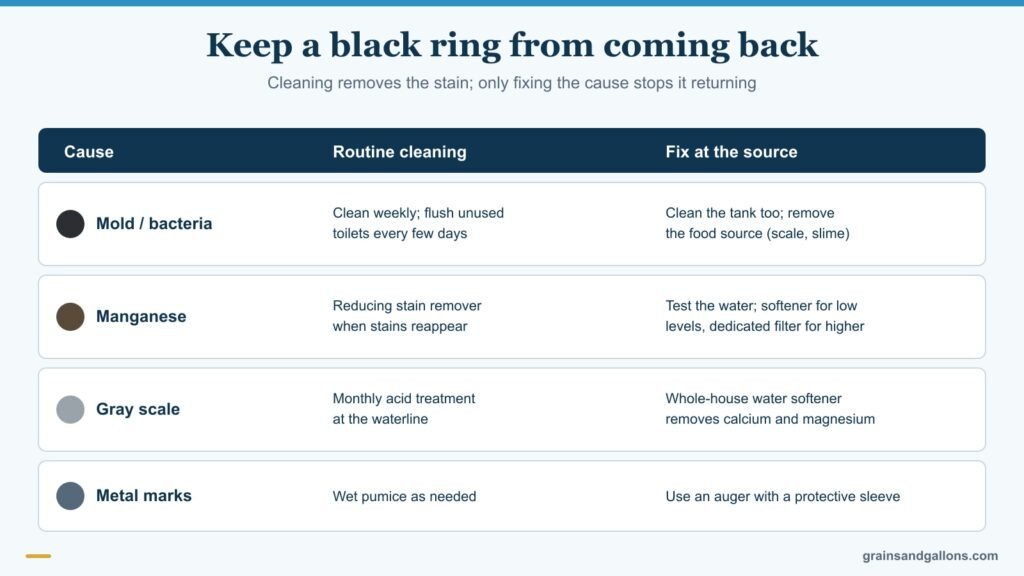
Cleaning removes the stain, not the cause.
- Mold and bacteria: clean weekly, flush unused toilets every few days, and clean the tank.
- Gray scale: a monthly acid treatment stops buildup; a whole-house softener prevents it.
- Manganese: test the water first; our guide on how to test water for manganese explains the options. A softener removes small amounts of dissolved manganese (see whether a water softener can remove manganese), while higher levels need one of the best manganese filters for well water.
If dark stains return within days, or the rim jets are crusted and the bowl fills weakly, the deposits are likely inside the rim and tank too, and they'll keep reseeding the bowl until those are cleaned.
FAQ
Are hard water stains in toilet bowl black on their own?
Not usually. Calcium and magnesium scale is white to tan. It turns gray or black when it traps dirt, grows mold, or when manganese or iron is present.
Is a black ring in the toilet dangerous?
Mold and bacteria are mostly a hygiene and cleaning issue, and manganese staining is cosmetic at typical levels. If your well has high manganese, test it, since drinking water quality matters more than the toilet.
Why does bleach not remove the black ring?
Bleach kills mold and bacteria but doesn't dissolve minerals. If bleach leaves the ring in place, it's manganese, iron or stained scale.
What causes black specks in the toilet bowl?
Loose black specks are often bits of deteriorating flapper or tank rubber, or manganese sediment shed from the tank. Check the tank parts and look for dark deposits inside the tank.
Will a water softener stop black toilet stains?
It stops gray scale and can remove low levels of dissolved manganese and iron. It won't prevent mold, and higher manganese levels need dedicated filtration.
Match the cleaner to the stain and the black ring stays gone
Most hard water stains in toilet bowl black rings are really mold, manganese or dirty scale. Identify which with the wipe, water source, acid and pumice checks, clean with the matching product, then fix the source so it doesn't return.