

Quick Answer: The simplest way to learn how to test water for manganese is a two-step approach: screen raw well water (drawn before any softener or filter) with a dedicated strip such as the ITS SenSafe Manganese kit, then confirm with a state-certified lab before you buy a filter or if a baby drinks the water. Manganese stains at 0.05 mg/L, which is at the bottom of what color-match kits can read.
Disclosure: As an Amazon Associate, Grains & Gallons earns from qualifying purchases.
Knowing how to test water for manganese matters most on private wells, where nobody tests for you. Manganese gives itself away in odd places: a black ring under the toilet rim, sooty flecks in the toilet tank, a brown-black film on dishwasher parts, gray laundry that bleach makes worse. If you're seeing those, you already suspect the answer. Testing tells you how much, whether it matters beyond stains, and which treatment will actually work.
In this guide
- Black stains and other signs that point to manganese
- Why manganese is harder to measure than iron
- How to test water for manganese with a home kit
- Sending a manganese sample to a certified lab
- Sampling mistakes that skew a manganese result
- What a manganese result means for treatment
- Babies, formula and the 0.1 mg/L guideline
- FAQ
- Get a lab number before you buy a manganese filter
Black stains and other signs that point to manganese

Iron leaves orange and rust. Manganese leaves black, brown-black or purple-gray. Common signs:
- Black or dark brown stains in toilets, tubs and sinks, often worst where water drips or sits.
- Gray or dingy laundry, made worse when you add chlorine bleach, which oxidizes the manganese onto the fabric.
- Water that comes out clear and turns dark as it sits. Penn State Extension notes this points to dissolved manganese, which is most common in groundwater with a pH below 7.0.
- A bitter, metallic taste in coffee and tea.
- Black slime or flecks in the toilet tank, sometimes from manganese bacteria.
None of these tells you the level, and you can have a health-relevant amount with only faint staining. For cleanup, see our guide to black manganese stains from well water.
Why manganese is harder to measure than iron

The numbers that matter for manganese are tiny:
- 0.05 mg/L: the EPA's secondary standard, set for staining and taste. Iron's is 0.3 mg/L, so manganese stains at one-sixth the concentration.
- 0.1 mg/L: the Minnesota Department of Health's guidance value for infants who drink tap water or formula made with it.
- 0.3 mg/L: the EPA's lifetime health advisory, and Minnesota's guidance for everyone over one year old.
So the useful range runs from 0.05 to a few tenths of a mg/L. A kit whose lowest color block is 0.1 or 0.2 mg/L will show "zero" while your toilet bowl turns black. Read the range on the box and pick one that reads down to about 0.05 mg/L.
Iron complicates things. Wells high in iron often carry manganese too, and heavy iron or colored water can throw off home tests. That's why manganese and iron belong on the same lab panel; our guide on how to test well water for iron covers the iron side.
How to test water for manganese with a home kit
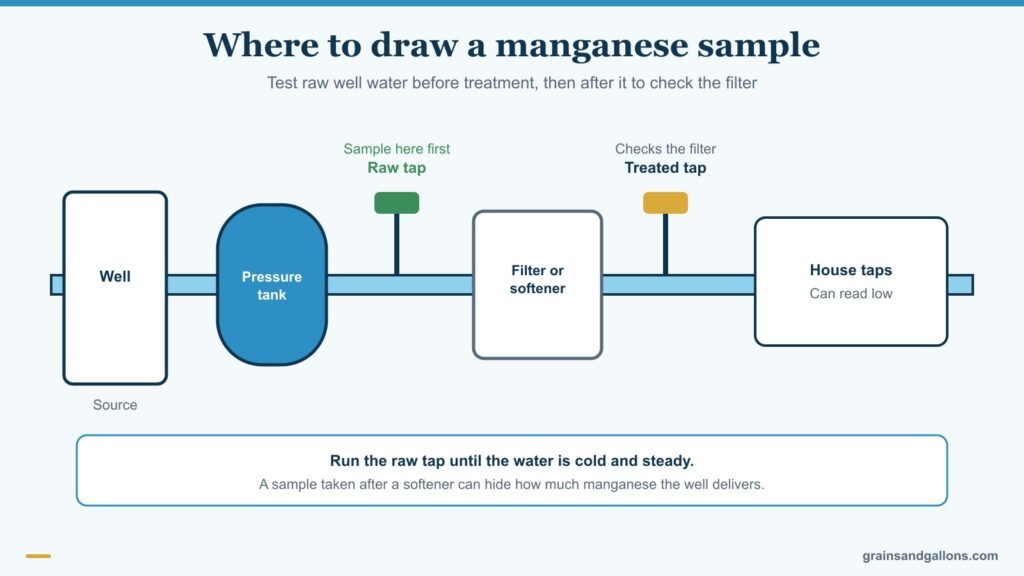
A home screen takes about ten minutes and is good for a first look, or for checking whether an existing filter still works.
- Draw raw water. Use a tap before the softener or filter, usually a valve near the pressure tank. Run it until it's cold and steady.
- Follow the kit's timing exactly. Manganese strips rely on a color reaction, and reading early or late shifts the result.
- Read in daylight, against white. Kitchen lighting makes faint pinks and browns hard to judge.
- Test after treatment too. A before-and-after pair tells you more than either alone.
If the strip reads clearly above zero, you have more than enough to stain, and a lab test is the next step. If it reads zero but you have black stains, don't trust the zero. That's the low-range blind spot.
Sending a manganese sample to a certified lab
A lab result is the one to use before buying a filter or deciding about drinking water.
- Find a lab certified by your state for drinking water. State environmental or health departments list them, and some county health departments run their own well panels.
- Order a metals or "homeowner well" panel with manganese, iron, pH, hardness and total dissolved solids. You rarely need to order manganese by name, since metals panels report iron and manganese together. Our guide to well water test kits compares mail-in panels.
- Use the bottle they send. Metals bottles often contain a little acid preservative. Don't rinse it, don't touch the inside of the cap, and keep the acid off your skin.
- Sample and ship as instructed, usually cold and within a day or two.
Results come in mg/L or µg/L: 1 mg/L equals 1,000 µg/L, so 50 µg/L is 0.05 mg/L. Our walkthrough on reading a well water lab report explains reporting limits and flags.
Sampling mistakes that skew a manganese result
- Sampling after the softener. A softener can remove some manganese, so a treated tap can read low and hide what the well delivers. Minnesota's health department points out that home units may lower manganese below what the source contains.
- Ignoring the lab's flush instructions. Water that sat in the pipes can read differently from fresh well water. Do what the lab asks, whether that's a first draw or a flushed sample.
- Rinsing a preserved bottle or swapping in your own container.
- Testing only once. Manganese can shift with season and water table. Retest yearly, as our guide on how often to test well water recommends for wells with a known issue.
What a manganese result means for treatment

| Manganese result | What it usually means | Next step |
|---|---|---|
| Below 0.05 mg/L | Unlikely to stain | Retest yearly or if stains appear |
| 0.05 to 0.1 mg/L | Black staining, metallic taste | Treat for staining; use other water for infant formula if near 0.1 |
| 0.1 to 0.3 mg/L | Staining; above infant guidance | Treat; give babies other water |
| Above 0.3 mg/L | Above EPA's lifetime health advisory | Treat drinking water; talk to your doctor |
Treatment depends on the whole panel, not just manganese. Penn State Extension says a softener is generally only recommended for manganese when pH is above 6.7, hardness is 3 to 20 grains per gallon and dissolved iron is under 5 mg/L. Birm needs a pH of at least 7.5 for manganese, and greensand suits combined iron and manganese of 3 to 10 mg/L. Above 10 mg/L combined, chlorination with filtration is typical. Our explainer on whether a water softener can remove manganese covers the softener limits, and our best manganese filter picks compare oxidizing systems.
Babies, formula and the 0.1 mg/L guideline

If anyone in the house is pregnant, or you mix formula with well water, test for manganese even without stains. The Minnesota Department of Health sets a lower guidance value, 0.1 mg/L (100 µg/L), for infants who drink tap water or formula made with it, because babies are more sensitive than adults. If your result is near or above that, use another water source for formula, ask your pediatrician, and retest after treatment before switching back.
FAQ
Can you test for manganese at home?
Yes, with a dedicated manganese strip or color kit. Pick one that reads down to about 0.05 mg/L, test raw water before any treatment, and confirm any positive or important decision with a certified lab.
How much does a manganese water test cost?
A home strip kit is inexpensive. A lab metals panel costs more but includes iron, pH and hardness, which you need to choose treatment. Some county health departments offer low-cost well panels, so check there first.
Is it safe to shower in water with manganese?
Manganese is mainly a concern in drinking water, because the body takes it in by swallowing. Showering is generally not the issue, though high levels will stain fixtures and laundry.
Does boiling water remove manganese?
No. Boiling doesn't remove metals, and evaporation slightly concentrates them. Use treatment certified for manganese reduction or another drinking water source.
How often should I test well water for manganese?
Test once to get a baseline, then yearly if manganese is present or you have treatment, and again whenever stains, taste or color change.
Get a lab number before you buy a manganese filter
The short version of how to test water for manganese: use a strip to confirm the black stains are manganese, then get a certified lab panel with iron, pH and hardness before you spend money on treatment. The 0.05, 0.1 and 0.3 mg/L marks tell you whether you're fixing stains or protecting a baby's drinking water.